

 Français
 Accounting Journal Examples: 6 Practical Cases for 2025
Discover 6 accounting journal examples to master your financial management in 2025. A practical, comprehensive guide to optimize your bookkeeping starting now!

Understanding Accounting Journals: An Asset for Your Business
Mastering accounting journals is crucial to the financial health of your business. This practical guide presents 6 accounting journal examples (purchases, sales, miscellaneous transactions, bank, cash and trial balance) to help you efficiently manage your transactions, simplify your tax filings and make informed decisions. Discover how each accounting journal example applies to your business and optimize your bookkeeping starting today.
1. Purchases journal (Journal of entries)
The purchases journal is an essential accounting register for any business, whether small or large. It tracks, in chronological order, all acquisitions of goods and services needed for the business. This journal records purchase invoices for goods intended for resale, raw materials for production, supplies and services. By centralizing this information, it provides a clear, precise view of the company’s expenses. Keeping it rigorously up to date is essential for sound financial management and to meet legal accounting obligations. It earns its place on this list because it forms the basis of expense tracking and enables calculation of deductible VAT, a crucial element for the company’s cash flow.

How it works and its features:
The purchases journal works on the principle of chronological recording. Each purchase is recorded with mandatory information, such as the invoice date, its number, the accounts debited and credited, a description specifying the nature of the purchase, the amount before tax (excl. VAT), the VAT amount and the total amount including VAT. It allows different types of purchases (goods, raw materials, services) to be distinguished for a finer analysis of expenses. In addition, some accounting software offers automatic calculation of deductible VAT, greatly simplifying the management of this aspect.
Advantages and disadvantages:
Advantages:
- Expense tracking by category: Lets you analyze expenses by type of purchase (goods, raw materials, etc.) and identify major expense items.
- Deductible VAT calculation: Makes it easier to determine the amount of VAT recoverable from the tax authorities.
- Helps with inventory management: For businesses that manage stock, the purchases journal helps track incoming goods.
- Simplifies tax filings: Provides the information needed to prepare VAT returns and other tax obligations.
Disadvantages:
- Requires regular updating: Needs regular, rigorous data entry.
- Risk of entry errors: Data-entry errors can affect the reliability of accounting data.
- Complexity for businesses with many suppliers: Managing the purchases journal can become complex for companies with a high volume of transactions.
Concrete examples:
- Date: 01/05/2023, Invoice No.: F2023-001, Debited account: 601 (Purchases of goods), Credited account: 401 (Suppliers), Description: Purchase of goods from Supplier X, Amount excl. VAT: €1,000, VAT: €200, Amount incl. VAT: €1,200
- Date: 01/10/2023, Invoice No.: F2023-002, Debited account: 606 (Purchases of materials and supplies), Credited account: 401 (Suppliers), Description: Purchase of office supplies from Supplier Y, Amount excl. VAT: €50, VAT: €10, Amount incl. VAT: €60
Practical tips:
- Number your accounting documents chronologically to make them easier to file and find.
- Use a coding system for your suppliers to simplify transaction recording.
- Carry out periodic reconciliations with supplier accounts to ensure data consistency.
- Use accounting software (Sage, Cegid, etc.) to automate data entry and reduce the risk of errors. This is particularly relevant for sole traders, freelancers, and small businesses looking to optimize their bookkeeping.
When and why should you use this approach?
The purchases journal is essential for all businesses, regardless of size or industry. It is particularly important for VAT-registered businesses, since it helps justify deductible VAT. Its use is recommended from the very start of activity to establish good bookkeeping practices from day one. For new entrepreneurs, it offers a structured method for tracking expenses and getting familiar with accounting principles. For more experienced businesses, it allows for a finer analysis of costs and optimization of financial management. The examples mentioned above, along with popular software such as Sage Comptabilité and Cegid, illustrate its practical application and its importance in French accounting practice, in line with the French General Chart of Accounts (Plan Comptable Général, PCG).
2. Sales journal
The sales journal is a key element of any accounting journal example. It is a chronological register that records all sales transactions carried out by a business. It is a cornerstone for tracking commercial activity, as it allows you to record invoices issued to customers, calculate revenue and VAT collected, and analyze the company’s performance. Keeping it rigorously up to date is essential for sound financial management and to meet legal obligations.

In practice, each sale is recorded with mandatory information: the date, invoice number, the accounts debited and credited, the description of the transaction, the amount before tax (excl. VAT), the VAT amount and the total amount including VAT. The sales journal can be sorted by type of sale (goods, services, etc.) to make data analysis easier. In addition, most accounting software allows automatic calculation of collected VAT, greatly simplifying this task.
Examples of entries in a sales journal:
- Date: 01/10/2023, Invoice No.: V2023-042, Debited account: 411 (Customers), Credited account: 707 (Sales of goods), Description: Sale of products to Customer Y, Amount excl. VAT: €2,500, VAT: €500, Amount incl. VAT: €3,000
- Date: 01/15/2023, Invoice No.: V2023-043, Debited account: 411 (Customers), Credited account: 706 (Services provided), Description: Consulting services for Customer X, Amount excl. VAT: €1,000, VAT: €200, Amount incl. VAT: €1,200
Advantages of the sales journal:
- Tracking revenue growth: Easily visualize the progression of your sales and identify periods of high activity.
- Simplified VAT calculation: Automate the calculation and collection of VAT, making it easier to file and remit to the tax authorities.
- Analysis of commercial performance: Identify your best-performing products or services and adapt your strategy accordingly.
- Tracking accounts receivable: Keep track of invoices issued and payments received, simplifying management of unpaid invoices.
Disadvantages of the sales journal:
- Requires regular updating: Needs to be updated daily to reflect the company’s actual activity.
- Managing different VAT rates: Requires special attention to correctly apply the various VAT rates in force.
- Complexity without software: Can become difficult to manage manually for a high volume of transactions.
Tips for effectively managing the sales journal:
- Clear invoice numbering: Adopt a clear, logical numbering system to make tracking and lookups easier.
- Dedicated journals: Use separate journals for different types of sales (goods, services, etc.).
- Regular reconciliation with the accounts receivable ledger: Check the consistency of data between the sales journal and the accounts receivable ledger to avoid errors.
- Alerts for unpaid invoices: Set up an alert system to track unpaid invoices and follow up with customers.
The sales journal is an indispensable tool for any entrepreneur, whether a sole trader, freelancer, or the head of a small or medium-sized business. It enables rigorous bookkeeping, precise tracking of commercial activity, and greatly facilitates tax filings. Its use, notably via software such as QuickBooks or EBP Comptabilité, is strongly recommended by the French tax authority (Direction Générale des Finances Publiques, DGFIP).
3. Miscellaneous transactions journal (OD)
The miscellaneous transactions journal (in French, “journal des opérations diverses” or OD) is a key element of an accounting journal example. It is an accounting register used to record all transactions that do not fit into the other subsidiary journals, such as the purchases journal, sales journal, bank journal, etc. It thus centralizes atypical, non-recurring or specific accounting entries. This journal is crucial for accurate, standards-compliant bookkeeping. It is used to manage transactions such as expense and revenue adjustments, depreciation allowances, provisions, closing entries, and other exceptional transactions.
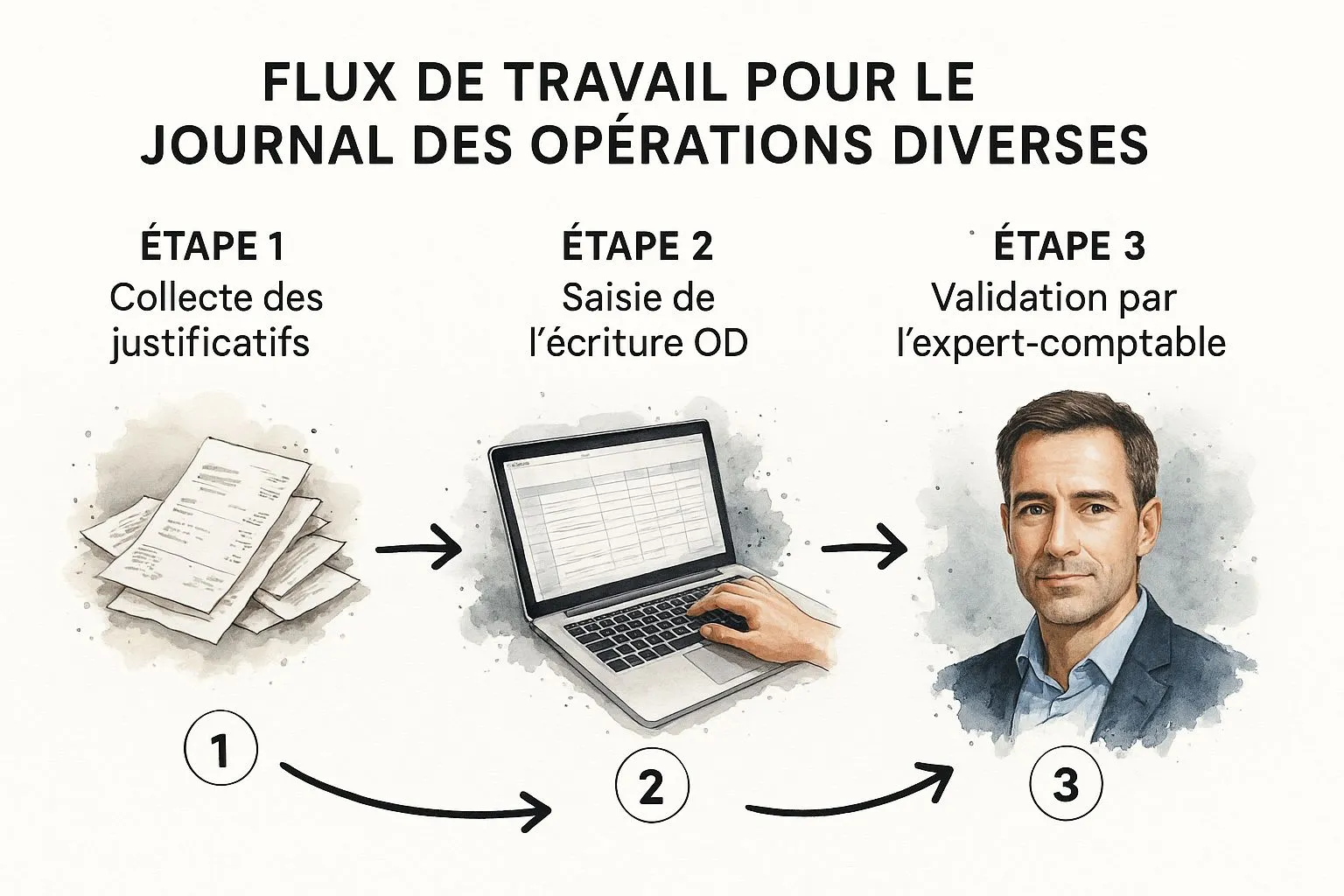
The infographic above illustrates the process for recording an entry in the OD journal. It visualizes the key steps, from identifying a transaction that doesn’t fit any other journal through to its final recording in the OD journal, including the necessary documentation and validation. The importance of this sequence lies in maintaining traceability and compliance of the entries. Each step contributes to the integrity of the accounting process.
The infographic highlights the importance of control and validation, particularly for complex transactions, in order to minimize the risk of error and ensure the reliability of accounting data.
The OD journal offers several advantages: it allows accounts to be adjusted to reflect the company’s economic reality, it makes it easier to comply with the matching principle across fiscal periods, it contributes to the accuracy of financial statements, and it centralizes atypical entries in a single journal, thereby simplifying searches and analysis.
However, using it requires a good understanding of accounting principles. It can be a source of errors for inexperienced accountants and requires detailed justification for each entry.
Examples of use:
- Date: 12/31/2023, Document No.: OD2023-124, Accounts: 6811 (Depreciation allowances) to 2815 (Accumulated depreciation), Description: Annual depreciation allowance for equipment, Amount: €4,500
When should you use the OD journal?
Use the OD journal for any transaction that cannot be recorded in another subsidiary journal. Year-end transactions, such as depreciation allowances and provisions, are typical examples. Adjustments for prepaid expenses and revenue are also handled here.
Practical tips:
- Document each OD entry precisely, with its supporting evidence.
- Create a schedule for recurring OD entries (monthly, quarterly, annual).
- Use standard entry templates for standardized transactions.
- Have complex OD entries validated by a chartered accountant.
The OD journal is popularized by institutions such as the Ordre des Experts-Comptables and the Autorité des Normes Comptables (ANC), and is built into accounting software such as Coala and ACD. It is an essential tool for sole traders, freelancers, SMEs and any business seeking rigorous, effective bookkeeping. Using it correctly is essential for producing financial statements that are reliable and compliant with accounting standards. That’s why it earns its place on this list of accounting journal examples.
The video above provides a more detailed presentation of the miscellaneous transactions journal and its practical use.
4. Bank journal
The bank journal is a key element of an effective accounting journal example. It is a chronological register that records all financial movements made through the company’s bank accounts. It is a cornerstone for cash-flow tracking, carrying out bank reconciliations, and understanding the company’s overall financial health. It allows every inflow and outflow of money to be traced, whether transfers, direct debits, cheque deposits, card payments, or any other type of transaction. By centralizing this information, the bank journal provides a clear, precise view of cash flows.

The bank journal stands out for several important features. It allows chronological tracking of transactions, making it easier to reconstruct the transaction history. It records the details of each transaction, including the date, bank statement number, the accounts debited and credited, the transaction description, and the amount. It also allows the company’s different bank accounts to be distinguished, which is particularly useful for businesses with multiple accounts. Finally, it serves as the basis for bank reconciliations, a crucial step to ensure that bank balances match accounting records.
Concrete examples of entries in a bank journal:
- Date: 01/15/2023, Statement No.: RB01-2023, Debited account: 512 (Bank), Credited account: 411 (Customers), Description: Collection of cheque from Customer Z, Amount: €5,750
- Date: 01/20/2023, Statement No.: RB02-2023, Debited account: 624 (Purchases of raw materials), Credited account: 512 (Bank), Description: Payment to Supplier X by bank transfer, Amount: €2,300
Advantages of using a bank journal:
- Precise cash-flow tracking: Visualize your company’s available cash in real time.
- Anomaly detection: Quickly identify errors or suspicious transactions.
- Deadline management: Anticipate payments and avoid delays.
- Balance justification: Facilitate audits and tax inspections.
Disadvantages:
- Requires regular updating: Needs daily entry of transactions.
- Attention to value dates: You need to account for the gap between the transaction date and the value date.
- Complexity with multiple accounts: Management can become more complex with a large number of bank accounts.
Practical tips:
- Carry out bank reconciliations at least once a month.
- Use electronic bank statements to automate data entry and save time.
- If you manage several bank accounts, create a separate bank journal for each one.
- Track your cash position daily for better financial management.
The bank journal is an essential tool for all types of businesses, from sole traders to large corporations. It enables rigorous, effective management of financial flows, simplifies bookkeeping, and contributes to better decision-making. Its place in an accounting journal example is therefore fully justified. Institutions such as the Fédération Bancaire Française, as well as software like Kyriba or the treasury modules of ERPs (SAP, Oracle), help popularize its use.
5. Cash journal
The cash journal is a key element of an accounting journal example for any business, particularly for sole traders, e-commerce freelancers, and small businesses handling cash transactions. It is a chronological register that records all movements of cash (inflows and outflows) in your business. Its main role is to control and justify the cash funds available at any given time. Keeping it rigorously up to date allows you to precisely track cash flows and simplify day-to-day cash management.
How the cash journal works:
The cash journal works on a simple principle: each cash transaction is recorded with key information. This includes the date of the transaction, the number of the supporting document (receipt, invoice, sales slip, etc.), the debited account (usually account 531 “Cash”), the credited account (for example, 707 “Sales” for a customer payment), a clear, precise description of the transaction, and finally, the amount. A cash balance is calculated after each transaction, allowing real-time tracking.
Example of an entry in a cash journal:
| Date | Document No. | Debited account | Credited account | Description | Amount |
|---|---|---|---|---|---|
| 01/08/2023 | C2023-007 | 531 (Cash) | 707 (Sales) | Cash payment from individual customer | €125 |
| 01/09/2023 | F2023-012 | 624 (Office supplies) | 531 (Cash) | Purchase of office supplies | €25 |
Advantages (Pros):
- Rigorous control of cash flows: The cash journal provides an overview of cash inflows and outflows, limiting the risk of errors and fraud.
- Justification of the cash balance: In the event of a tax audit, the cash journal serves as accounting proof and justifies the cash balance.
- Simplified cash management: Real-time tracking of the balance helps anticipate funding needs and optimize cash management.
- Limits the risk of misappropriation: Systematically recording every transaction and requiring supporting documents makes any attempted misappropriation more difficult.
Disadvantages (Cons):
- Requires strict discipline: Each transaction must be recorded meticulously and immediately to avoid errors and omissions.
- Risk of errors if not recorded immediately: Delaying entries can lead to errors and difficulty reconstructing cash movements.
- Legal constraints on cash payments: There are legal caps on cash payments, which can limit the use of cash for certain transactions.
Practical tips:
- Carry out a physical cash count daily to check it matches the recorded balance.
- Systematically issue a receipt or invoice for every cash inflow and outflow.
- Limit the number of people with access to the cash register to strengthen security.
- Set a maximum amount to keep on hand and regularly deposit any surplus at the bank.
Why does the cash journal deserve its place on this list?
In the context of an accounting journal example, the cash journal is essential, particularly for new entrepreneurs or small businesses. It provides a solid basis for tracking cash transactions, simplifies cash management, and ensures compliance with legal obligations. Solutions such as point-of-sale software (Lightspeed) or the cash modules of accounting software can automate the maintenance of the cash journal and save valuable time. Its use, even for businesses that mainly use electronic payments, remains relevant for small cash transactions and allows for complete tracking of all financial flows. It is an essential tool for transparency and the good financial health of your business.
6. Trial balance
The trial balance is a key element of an effective accounting journal example and represents a crucial step in the accounting cycle. It provides an overview of your company’s financial health at a given point in time and serves as the basis for preparing more complex financial statements such as the balance sheet and income statement. By understanding its purpose and how it works, you can better steer your business and make informed decisions.
How the trial balance works
The trial balance lists all the accounts in the general ledger with their debit and credit balances as of a given date. For each account, it shows the cumulative debit and credit movements, then calculates the final balance (debit or credit). One of the fundamental principles of double-entry bookkeeping is that total debits must always equal total credits. The trial balance automatically checks this balance, alerting you to potential errors in your accounting entries.
Concrete examples
Let’s look at a few examples to illustrate the use of the trial balance in an accounting journal example:
- Account 401 (Suppliers): Total debit: €15,000, Total credit: €22,000, Credit balance: €7,000 (meaning you owe €7,000 to your suppliers).
- Account 411 (Customers): Total debit: €35,000, Total credit: €28,000, Debit balance: €7,000 (meaning your customers owe you €7,000).
Advantages and disadvantages of the trial balance
Advantages:
- Quick check of account balance: The trial balance lets you check at a glance whether total debits equal total credits.
- Detection of accounting anomalies: An unusual balance (for example, a credit balance on a customer account) may indicate a recording error.
- Summary view of the financial position: It offers an overview of the company’s assets, liabilities, and equity.
- Basis for preparing the balance sheet: The trial balance is essential for drawing up the balance sheet and income statement.
Disadvantages:
- Error identification: If the trial balance is balanced, this does not mean there are no errors. Offsetting errors can exist. The trial balance does not specify the nature of an error.
- Interpretation complexity: For non-specialists, interpreting the trial balance can be complex and may require accounting knowledge.
Practical tips for optimal use
- Frequency: Draw up a trial balance at least monthly, or more often if needed.
- Analysis of unusual balances: Pay close attention to accounts with unusual balances and look into the causes of these anomalies.
- Checking suspense accounts: Make sure suspense accounts (for example, invoices to be received or paid) are cleared at the end of the period.
- Comparing successive trial balances: Compare successive trial balances to identify significant changes and analyze trends in your business.
Why the trial balance is essential
For sole traders, freelancers, e-merchants and small businesses, the trial balance, although it may seem technical, is a valuable tool for:
- Tracking the progress of your business and identifying strengths and weaknesses.
- Preparing your tax and social security filings.
- Obtaining financing from banks or investors.
- Making strategic decisions based on reliable financial data.
In conclusion, the trial balance is an essential component of a high-performing accounting journal example. Mastering it is a major asset for the financial management of your business and will allow you to make informed decisions to ensure its sustainability and growth.
Comparison of 6 Key Accounting Journals
| ⭐ Key Advantages | 🔄 Implementation Complexity | ⚡ Resources Required | 📊 Expected Results | 💡 Ideal Use Case |
|---|---|---|---|---|
| Purchases journal (Journal of entries) | Regular updating, complex supplier management | Accounting software recommended, chronological entry | Expense tracking, deductible VAT calculation | Purchase management, VAT tracking, stock control |
| Sales journal | Daily updating, attention to VAT rates | Suitable software essential, invoice coding | Revenue tracking, VAT collected calculation, receivables management | Commercial performance analysis, invoicing |
| Miscellaneous transactions journal (OD) | Requires accounting expertise, complex transactions | Detailed justifications, expert validation | Account adjustment, compliance with accounting periods | Atypical transactions, closings, depreciation |
| Bank journal | Very regular updating, multiple accounts possible | Electronic bank statements recommended | Precise cash tracking, anomaly detection | Bank flow management, bank reconciliations |
| Cash journal | Strict discipline, high risk of errors | Frequent checks, supporting documents | Cash control, error limitation | Cash liquidity management, till control |
| Trial balance | Sometimes complex to interpret | Automated calculations via accounting software | Account balance verification, summary view | Monthly control, anomaly analysis, balance sheet preparation |
Simplify Your Bookkeeping with Bizyness
Mastering the different accounting journals, from the purchases journal to the bank journal, via the trial balance, is essential for sound, effective financial management. This article has reviewed the key journals, notably the sales journal, the miscellaneous transactions journal (OD), and the cash journal, to give you a better understanding of their importance and how they work. Understanding how these journals fit together lets you not only track your cash flows precisely, but also confidently prepare your tax filings and analyze your company’s performance. A well-kept accounting journal example is the foundation of informed decision-making and sustainable growth.
For sole traders, freelancers, and small businesses, juggling these different journals can be time-consuming and complex. That’s where Bizyness comes in. Bizyness automates the management of your accounting journals, from recording transactions to generating reports, giving you a clear, precise accounting journal example. This frees up valuable time you can devote to growing your business.
Optimize your bookkeeping and make life easier for yourself with Bizyness. Discover how Bizyness can help you efficiently manage your accounting journals, from the simplest to the most complex accounting journal example, by visiting Bizyness today. Start your free trial and focus on what matters most: the success of your business.
