

 Français
 Mileage Allowance 2025: Calculation and Official Rate Scale
Discover the official 2025 mileage allowance scale. Calculate your actual expenses, optimize your taxes, and automate your accounting. Complete guide.

You sell online, you manage your orders, your returns, your VAT, your Stripe or PayPal payments — and your travel expenses often fall through the cracks. Yet trips to the warehouse, to a supplier, to the post office, to a client meeting or a trade show carry a real cost.
The problem isn’t just getting them reimbursed or deducted. The real issue is doing it correctly, without an approximate spreadsheet, without missing the right rate, and without wasting time on an administrative task that should be simple. For many online sellers and freelancers, the 2025 mileage allowance remains an underused lever, especially when the vehicle is electric.
Understanding the Mileage Allowance Principle
The mileage allowance comes down to a very simple idea. Your business uses your personal vehicle for professional trips. In practice, it’s a bit as if your company “rented” your own car for every business trip.
This flat-rate allowance doesn’t just reimburse fuel. It also covers vehicle wear, fuel, maintenance, insurance and, more broadly, the costs linked to professional use of a personal vehicle within the limits of the tax scale.
Two very different uses
Two situations need to be distinguished.
-
Employee or director treated as an employee The company can reimburse professional trips made with a personal vehicle, according to the applicable rate scale.
-
Sole trader or professional under the actual-expenses regime Professional mileage can be included in deductible expenses, provided a serious record of trips is kept.
In both cases, the logic stays the same. Reimbursement isn’t done “on sight.” An official rate scale is applied based on the vehicle’s fiscal power and the distance travelled.
What many entrepreneurs confuse
The classic mistake is mixing up three things:
- purely professional trips,
- home-to-work commutes,
- detailed actual vehicle expenses.
The mileage scale exists precisely to avoid recalculating each expense item — every fill-up, every oil change, every insurance invoice. It’s a flat tax allowance. That’s what makes it practical, but also strict.
Advisor’s tip. The more your business mixes client visits, local logistics and personal trips, the more you need to separate uses from the start. Correcting it at year-end always takes longer.
For a Shopify or Amazon FBA seller, the benefit is immediate. You can run a very digital business while still making very concrete trips. Stock drop-offs, product shoots, carrier meetings, sample pickups, local deliveries. All these kilometers add up.
When an entrepreneur hesitates between a company car and reimbursement at the mileage rate, the right answer often depends on frequency of use, the simplicity sought, and the level of proof available. If you want to dig into this trade-off, this comparison at https://www.bizyness.fr/blog/vehicule-de-societe-ou-indemnites-kilometriques helps you ask the right questions.
For structures that already manage several types of reimbursements, a good starting point is also to review the general rules on expense reports and travel. The guide on travel expense reimbursement provides a useful framework for avoiding confusion between flat-rate reimbursement and actual-cost reimbursement.
The Official 2025 Mileage Allowance Scale
A recurring case comes up often in practice. An online seller drops off parcels with their personal car, stops by a supplier, picks up a sample, then forgets that part of these trips qualifies for reimbursement. At year-end, the loss doesn’t come from the scale itself. It comes from misreading the brackets, and very often from forgetting the electric vehicle bonus.
The 2025 mileage allowance scale for cars remains identical to 2024, following the revaluation applied in 2023, as Onexpense points out. It applies to the 2025 tax return for 2024 income and is based on two simple criteria:
- the vehicle’s fiscal power;
- the annual professional distance travelled.
The table to use for cars
| Fiscal power (CV) | Up to 5,000 km | From 5,001 to 20,000 km | Beyond 20,000 km |
|---|---|---|---|
| 3 CV and below | d × 0.529 | (d × 0.316) + €1,065 | d × 0.370 |
| 4 CV | d × 0.606 | (d × 0.340) + €1,330 | d × 0.407 |
| 5 CV | d × 0.636 | (d × 0.357) + €1,395 | d × 0.427 |
| 6 CV | d × 0.665 | (d × 0.374) + €1,457 | d × 0.447 |
| 7 CV and above | d × 0.697 | (d × 0.394) + €1,515 | d × 0.470 |
“d” corresponds to the annual professional distance.
How to read the scale correctly
The key point is simple. The formula isn’t chosen trip by trip or month by month. It’s chosen based on the total annual professional kilometers.
This is where mistakes happen. A sole trader might think they should apply a fixed price per kilometer all year, when the scale actually works by annual bracket. You must first total the kilometers, then apply the formula for the relevant row and bracket.
Concrete example. With a 3 CV car, the formula varies according to annual distance. With a 7 CV and above car, it also changes markedly from one bracket to the next. For a freelancer alternating between client meetings, goods pickups and local deliveries, picking the wrong bracket is enough to throw off the whole calculation.
The point often forgotten for electric vehicles
For a fully electric vehicle, a 20% increase must be applied to the amount obtained with the standard scale.
Many online sellers switch to electric for short runs, hand deliveries, or regular drop-offs at carriers. Tax-wise, it’s advantageous, but only if the increase is properly included. In practice, this is one of the most frequent oversights I see among entrepreneurs who track their expenses on a spreadsheet or from memory.
Take a simple base case. For a 3 CV car up to 5,000 km, the formula d × 0.529 becomes d × 0.635 after the electric increase.
The right reflex is therefore this. First calculate the allowance using the standard car scale. Then apply the increase linked to being 100% electric.
What sole traders need to watch closely
For an online merchant, the real issue isn’t just knowing the table. You need to avoid gray areas. A trip to a pickup point, a photo studio, a supplier, a warehouse or a local client can be professional. But it still needs to be clearly tracked, with a date, a reason and a consistent distance.
Small recurring runs are the ones that most often escape tracking. Yet these are exactly the ones that add up over the year. This is even truer for hybrid e-commerce businesses — very digital on the surface, but with very real local logistics.
The most reliable method remains simple:
- check the fiscal power on the registration document;
- total only the professional kilometers;
- choose the formula matching the annual bracket;
- apply the electric increase if the vehicle is fully electric.
If you want to compare your current practice against the rules presented for the following tax year, the complete guide to the 2026 mileage allowance tax scale provides a useful benchmark, especially for standardizing your calculations and preparing a clean automation of your tracking.
Calculating Your Mileage Allowance Step by Step
An online seller might make three parcel drop-offs in a week, a round trip to a supplier on Friday, then forget to add it all up at month-end. That’s often where the loss begins. The tax calculation itself stays simple if the method is set from the start.
The most reliable method
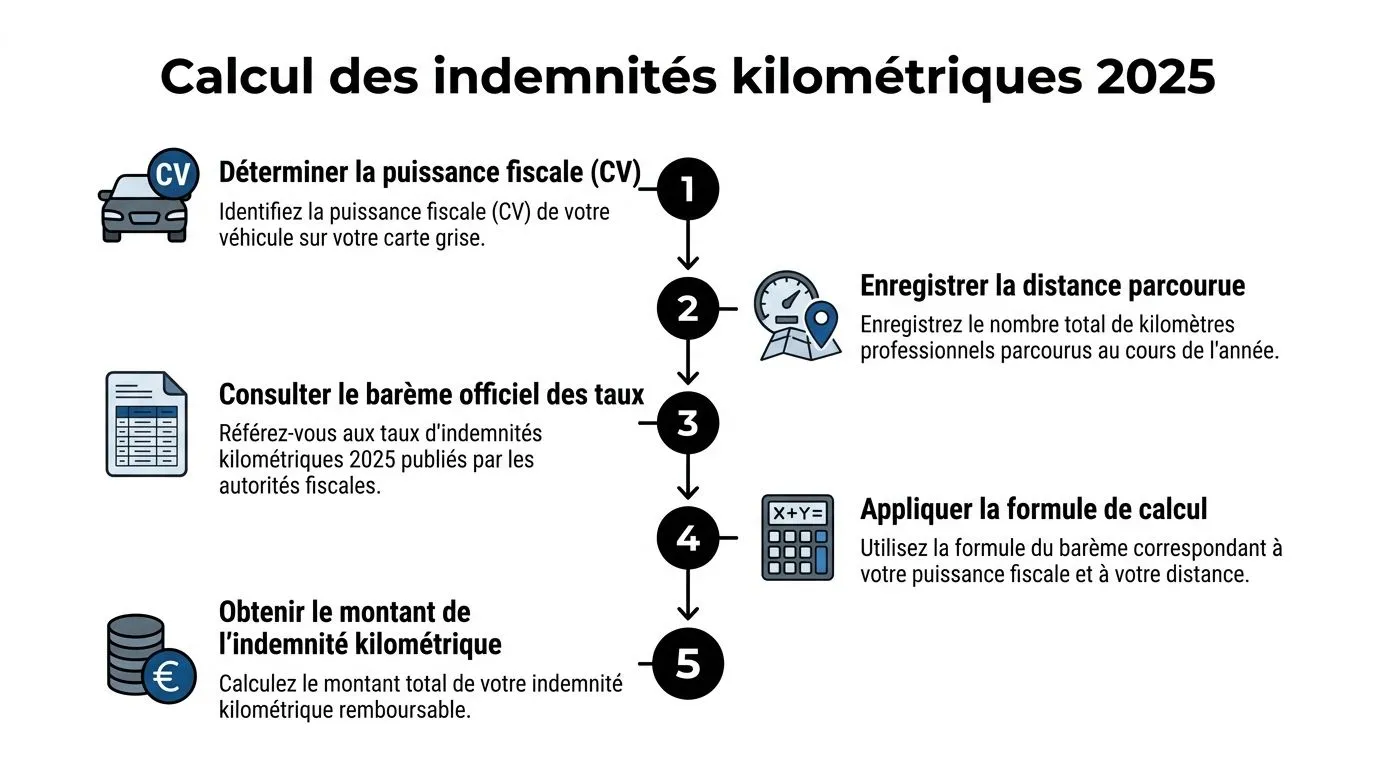
Always proceed in the same order. This avoids bracket errors, forgotten trips, and confusion between combustion and electric vehicles.
-
Note the fiscal power on the registration document. You need the number of fiscal horsepower (CV), not the engine power advertised by the manufacturer.
-
Total only the professional kilometers. Keep personal trips separate. For a sole trader, mixing the two is the most common mistake.
-
Choose the correct annual bracket in the car scale.
-
Apply the formula matching that bracket.
-
Add the electric increase if the vehicle is fully electric.
This framework works very well for freelancers and online sellers who make many small logistics trips. The real challenge isn’t the final calculation. It’s the quality of the tracking upstream.
Example 1 with a small 3 CV city car
An Etsy seller uses their personal car to drop off parcels and visit local suppliers. Over the year, they travel 4,500 km with a 3 CV car.
They fall into the up to 5,000 km bracket. The calculation is therefore:
4,500 × 0.529 = €2,380.5
The mileage allowance amount is €2,380.5.
This is a very common case in e-commerce. The trips look modest week after week, then the annual total becomes high enough to warrant careful tracking.
Example 2 with a 5 CV car
A Shopify store manager travels for trade shows, client meetings and logistics visits. They travel 15,000 km with a 5 CV vehicle.
They fall into the 5,001 to 20,000 km bracket. The applicable formula is:
(15,000 × 0.357) + 1,395 = €6,750
The resulting amount is €6,750.
The classic mistake is applying the first bracket’s coefficient to the entire annual distance. The result is then wrong, sometimes by several hundred euros.
Example 3 with a 7 CV and above vehicle
An e-commerce consultant makes numerous trips to clients, partners and service providers. They total 22,000 km with a 7 CV and above car.
They fall into the beyond 20,000 km bracket. The calculation is:
22,000 × 0.470 = €10,340
The mileage allowance thus reaches €10,340.
At this level of distance, a makeshift spreadsheet quickly shows its limits. Once trips become repetitive, the risk isn’t just calculation errors. It’s also the outright omission of professional trips that were nonetheless deductible.
The case of the electric vehicle
For a fully electric vehicle, the right reflex is to first calculate the allowance using the standard car scale, then apply the 20% increase.
The order never changes:
- calculation using the base formula;
- application of the electric increase.
For sole traders who make local deliveries with a light van or an electric car, this point is often underused. Many track kilometers but forget the increase. Others do the opposite and apply a percentage without keeping the base calculation, which complicates justification in the event of an audit.
Practitioner’s tip. Keep the detail of the calculation, not just the final amount. A date, a reason, a distance, a vehicle, then the formula applied. That’s what saves time at closing.
What wastes time and money
Three mistakes come up often in practice:
- Grouping several vehicles into a single annual calculation. Each vehicle has its own fiscal power, so its own calculation.
- Declaring estimated kilometers instead of genuinely traceable trips.
- Reconstructing the mileage allowance from fuel or charging costs. The mileage scale isn’t calculated from actual expenses.
The most cost-effective method remains the simplest one. Keep a running trip log, with the date, the reason, the starting point, the destination and the distance. For an online seller or freelancer who handles drop-offs, pickups, local deliveries and supplier meetings, this discipline prevents a quiet margin leak. Once this tracking is in place, the annual calculation becomes almost automatic.
Optimizing Mileage Allowance for E-commerce and Sole Traders
You spend the morning on Shopify, the afternoon packing parcels, then rush off to drop a restock at your storage unit before a meeting with a carrier. By month-end, these trips genuinely served the business, but they often vanish from the accounts. That’s where margin gets lost, especially for online sellers and freelancers who juggle remote work, light logistics and local deliveries.

The issue isn’t just about taxes. It’s operational. One forgotten trip here, one wrong category there, and you end up under-declaring perfectly legitimate expenses.
The trips genuinely worth tracking
In e-commerce files, the forgotten kilometers aren’t necessarily the longest ones. They’re often the most frequent ones, and therefore the ones that end up weighing the most over the year.
I regularly see these poorly tracked trips:
- Logistics drop-offs and pickups to a warehouse, pickup point, storage space or workshop.
- Supplier meetings to inspect goods, collect a sample or approve a production run.
- Content-related trips for a product shoot, a video, a collaboration or a launch setup.
- Local deliveries handled directly for a premium client, a partner store or an urgent order.
- Networking and development trips to a trade show, a pop-up, a logistics partner or a service provider.
The right reflex is to link each trip to an action that generates revenue, secures an order, or keeps logistics running.
The frequent case of electric vehicles
Among online sellers and sole traders, the electric vehicle is often used for small, repeated runs. It’s convenient in the city, cost-efficient to run, and well suited to short trips. However, tracking is often shaky.
The classic mistake doesn’t come from the calculation itself. It comes from the process. The business owner jots down kilometers somewhere, forgets to separate trips by vehicle, then tries to reconstruct everything at closing time. The result: professional trips fall through the cracks, or remain impossible to properly defend.
To avoid this loss, you need to record three pieces of information in the same flow from the start: the trip, the vehicle used, and the related business document. For an online seller making local deliveries by electric vehicle, this is the simplest way to avoid a silent under-deduction.
Two-wheelers, cars, light vans. Don’t mix anything up
A sole trader might well use a car for supplier meetings, a scooter for urban errands, and sometimes a light van for activity peaks. In accounting terms, this mix demands rigor.
The practical point is simple. Each vehicle must have its own tracking. If you merge all kilometers into a single annual total, you lose time during an audit, and you increase the risk of error.
This is also why a tracking sheet designed as a simple, generic expense report quickly shows its limits. A model structured by vehicle, trip and supporting document works better, especially if you then need to integrate this data into your expense report accounting process.
The method that holds up over time
Useful optimization relies on a light but continuous discipline.
- Create 4 to 6 fixed trip categories: logistics, supplier, client, content, event, administrative.
- Log trips as they happen rather than at the end of the quarter.
- Attach a simple proof to each trip: delivery note, order, client email, calendar appointment, supplier invoice.
- Separate usage by vehicle to avoid confusion during the annual calculation.
- Automate collection with a single tool or process, instead of scattering notes across your phone, emails and spreadsheets.
That’s the real trade-off. Either you spend ten seconds after each trip, or you lose several hours at year-end reconstructing poorly documented trips.
For a freelancer or a D2C brand making many micro-trips, automation brings more than convenience. It reduces omissions, makes the data reliable, and prevents part of the professional expenses from staying off the books. This is often the difference between tracking that’s merely tolerable on paper and a system that genuinely protects your margin.
Managing Supporting Documents and Filing Obligations
A tax audit isn’t decided on your rate scale. It’s decided on your ability to prove, trip by trip, that the expense was genuinely professional.
For an online seller or freelancer, the risk is often the same. Small trips pile up, especially with local deliveries, supplier round trips, or stock pickups. In the end, the kilometers exist, but the supporting file is incomplete. That’s where margin gets lost.
The supporting documents to keep
The right level of proof stays simple if tracking is done as you go. For each trip, keep at minimum:
- the date
- the starting point and destination
- the precise professional reason
- the distance travelled
- the vehicle used
Add a document that links the trip to actual business activity. For an online store, this could be a delivery note, an order, a client email, a supplier purchase, a pickup appointment, or a calendar slot.
With an electric vehicle used for deliveries or short logistics errands, this point is often poorly handled. The entrepreneur keeps a record of the charging session, but not of the trip that generated the professional use. Yet tax authorities primarily expect justification of the trip, not just the expense around the vehicle.
The real point of vigilance
As soon as you step outside a clear flat-rate framework, the documentation requirements rise a notch.
This is particularly sensitive if you mix several uses on the same vehicle, or if you alternate between delivery runs, client meetings and personal trips. In that case, you need to be able to reconstruct a consistent logic, without gaps, without rough estimates, and without relying on your memory three months later.
A spreadsheet may be enough at first. It rarely holds up well once the business multiplies micro-trips.
The costliest mistakes
I see the same issues come up repeatedly among sole traders and online sellers:
- a trip logged without an actionable reason
- a distance rounded “roughly”
- the same vehicle used for both business and personal trips with no clear separation
- no business document attached to the trip
- trips grouped together at month-end, or even year-end
The cost isn’t only about tax. You also lose closing time, complicate the bookkeeper’s work, and sometimes leave allowances undeclared for lack of a file clean enough to defend them.
How to keep a clean audit trail
The most effective approach is to reason as if every trip would be reviewed by a third party. A trip should be understandable without a verbal explanation. If the line reads “delivery of order 5482, warehouse to client, 18 km, electric van,” the justification is clear. If it just says “business errand,” it stays weak.
To keep a consistent method between tracking, documents and bookkeeping, it’s useful to align your mileage with your expense report accounting method. This is often what prevents discrepancies between what you actually did and what ends up in the accounts.
Where to declare these allowances
Treatment depends on your status.
-
Employee or director treated as an employee The allowances or expenses concerned are included according to the option chosen, with a complete supporting file if you opt for actual expenses.
-
Sole trader under the actual-expenses regime Tracking goes into the business’s bookkeeping, with documents kept and the calculation traceable.
The right reflex is to prepare the proof before the filing. For an entrepreneur who delivers, buys, travels often and sometimes works with an electric vehicle, this discipline saves time all year round and prevents professional expenses from being left out of the file.
Automate Your Mileage Expenses with Bizyness
Manual tracking of the 2025 mileage allowance almost always ends the same way. An entrepreneur logs a few trips at the start. Then forgets. Then tries to reconstruct the year from their calendar, emails and memory.
This system has four flaws. It takes time, creates calculation discrepancies, leaves gaps in the supporting documents, and increases stress when closing the books.
What automation actually changes
Automation doesn’t replace the tax rule. It makes it applicable without friction.
What genuinely helps day to day:
- Centralizing trips as they happen, instead of recalculating them at year-end.
- Linking a trip to a business event, such as a delivery, an appointment or a supplier purchase.
- Separating multiple vehicles without manual reprocessing.
- Making exports reliable for the accountant or the internal file.
A tool like Bizyness can fit into this logic when a business already sells across several channels and wants to reconcile expenses, sales flows and accounting documents. The platform is designed to automate e-commerce financial flows, and its integrations visible at https://www.bizyness.fr/integrations help you understand how to connect sales, payments and administrative management in a single environment.
What works, and what doesn’t
What works:
- continuous tracking;
- a clear naming convention for trip reasons;
- supporting documents attached as early as possible;
- calculations aligned with the latest applicable scale.
What doesn’t work well:
- an isolated spreadsheet nobody updates;
- a paper notebook never transferred;
- monthly entry “whenever I have time”;
- estimated trips without supporting evidence.
The point of good automation isn’t to add yet another tool. It’s to avoid re-keying data and to make the file defensible without disproportionate effort.
Frequently Asked Questions About Mileage Allowance
Can I deduct mileage allowance as a micro-entrepreneur
In practice, the micro-entrepreneur (sole trader) regime doesn’t work like a standard actual-expenses regime for detailed expense deduction. If you’re a micro-entrepreneur, check the tax framework applicable to your situation before trying to apply the mileage allowance the way an actual-expenses structure would.
How do I handle a trip that’s both personal and professional
You must isolate only the professional portion. If a trip includes a detour to visit a supplier or make a delivery, only that portion linked to the business should be counted.
Can I include tolls or parking in the mileage scale
The mileage scale already covers the main costs linked to using a personal vehicle. However, certain incidental expenses may require separate treatment if they are incurred for the professional trip and properly justified. Be careful not to confuse them with the mileage allowance itself.
What if I use several vehicles during the year
You must not merge the kilometers as if they were a single vehicle. Each car or two-wheeler must be analyzed with its own rate scale, its own fiscal power and its own tracking.
What if the registration document isn’t in my name
The issue isn’t unsolvable, but you must be able to demonstrate that you actually use this vehicle for the business and that the professional trips are properly documented. In this type of situation, it’s best to secure the file in advance with your accountant.
Does the home-to-work commute automatically count as mileage allowance
No, you should never assume this trip is automatically included without checking the framework applicable to your status and situation. This is a point where many entrepreneurs mix up reimbursement rules, actual expenses and business trips.
If your sales are already automated but your travel expenses are still handled by hand, you’re leaving complexity where there should be a clean flow. To structure your supporting documents, your accounting and your e-commerce operations in a single environment, discover Bizyness.