

 Français
 Sales Invoice: The Complete Guide for E-commerce 2026
Master the sales invoice for your online store. Our 2026 guide covers mandatory details, VAT, OSS/IOSS and automation.
You have a store that runs smoothly. Orders come in through Shopify, Amazon or WooCommerce. Stripe collects payments, PayPal joins in, a marketplace sends its own documents, and you’re left trying to answer a simple question that quickly becomes annoying: is every sale properly invoiced, with the correct VAT, to the right customer, in the right format?
That’s often where the trouble starts. Not at the moment of the sale, but afterward. When you need to find an invoice. When a business customer asks for a compliant version. When a discount isn’t clearly shown. When your accountant talks to you about the FEC, OSS, continuous numbering, or the 2026 reform, while all you wanted was to ship your orders and track your margin.
The sales invoice is not an administrative detail. For an online seller, it is the document that connects the sale, VAT, accounting, customer relationships and, tomorrow, mandatory electronic invoicing. Poorly managed, it creates friction everywhere. Well structured, it smooths out the entire financial chain.
This guide speaks to the reality of online sellers. Not a dry definition pulled from a textbook. You’ll see what a sales invoice is actually for, what it must contain, how to issue it without errors when selling across multiple channels, and why the e-invoicing and e-reporting reform planned from 2026 clearly pushes toward automation.
Introduction: The Sales Invoice at the Heart of Your E-commerce Business
Many online sellers experience the same disconnect. The front office looks modern, automated, fast. The financial back office, on the other hand, often stays cobbled together. A CSV export on one side, a spreadsheet on the other, a few invoices generated by hand, and accounting adjustments at the end of the month.
The problem is that the sales invoice sits at the center of everything. It proves the transaction, justifies the VAT, formalizes payment terms and feeds the accounting. When it’s imprecise, the whole chain becomes fragile.
For an e-commerce seller, the difficulty doesn’t just come from the rule itself. It comes from the accumulation of real-world cases:
- Multi-channel sales with different customer data depending on Shopify, Amazon or Stripe
- B2B and B2C customers with obligations that aren’t handled the same way
- International sales that complicate VAT rules
- Digital products, discounts, shipping fees, credit notes that make the invoice less simple than a “product x quantity” line
In 2022, 31% of French companies sent structured electronic invoices, with marked differences depending on company size — a sign of gradual adoption as part of the electronic invoicing reform (figures reported here). This is no longer a topic reserved for large groups.
A well-managed invoice doesn’t just help you avoid a tax problem. It saves time, secures your sales and makes your business easier to steer.
The real stake, then, is not just “being compliant.” It’s putting in place a system that supports growth instead of slowing it down.
Defining the Sales Invoice Beyond the Document
A sales invoice is not just a PDF sent after an order. For a merchant, it is the birth certificate of the transaction. It states in black and white what was sold, to whom, at what price, with what VAT, and under what conditions.
Its legal function
The invoice proves that a sale took place. In the event of a dispute over the price, the order content, the date or the payment terms, this is what gets examined.
For an e-commerce seller, this role becomes very concrete. The receipt sent by a platform or the order confirmation email doesn’t always replace a compliant invoice. If a business customer asks for a document usable in their own accounting, you need to be able to produce it correctly.
Its accounting and tax function
Every sales invoice feeds your accounting. It determines your revenue, your VAT collected, and how the transaction will be recorded in your books.
This carries even more weight in online commerce. In 2017, digital sales accounted for 21.6% of the revenue of French companies, and 30.3% for large enterprises, showing just how much invoicing control accompanies the rising volume of transactions (INSEE).
As volume increases, the invoice is no longer just a document. It becomes structuring data.
Its commercial function
A sales invoice also serves the customer relationship. It states:
- the detail of the goods or services sold;
- the amount due;
- the payment terms;
- any deadlines;
- the conditions in case of late payment.
For an online seller, this matters because a clear document reduces back-and-forth with the customer. A readable invoice reassures. A vague invoice creates unnecessary support requests.
B2B and B2C aren’t managed the same way
This is a point that creates a lot of confusion.
In B2B, the invoice occupies a central place. The customer often needs it to deduct their VAT and justify their expense.
In B2C, many merchants think the receipt, payment confirmation or order email is always enough. In practice, you need to distinguish commercial uses, the obligations tied to the type of sale, and the new requirements for transmitting tax data. For a site selling to individuals in France and abroad, the management logic is therefore not the same as for a store that only invoices French businesses.
Why this document deserves more attention
A well-designed sales invoice does three things at once:
| Role | What it secures | Impact for the e-commerce seller |
|---|---|---|
| Legal | Proof of the sale | Fewer disputes and challenges |
| Accounting | Journal entries and VAT | Cleaner accounting |
| Commercial | Payment and clarity | Smoother customer relationship |
If you sell across multiple channels, the real difficulty isn’t creating an invoice. It’s creating the right invoice, repeatably, even as flows multiply.
Mandatory Details for a Compliant Invoice in 2026
You end a day with sales on Shopify, Amazon and Stripe. Payments are collected correctly, but the real test starts afterward. For each sale, can you produce an invoice that holds up legally, fiscally and technically, including within the logic of the 2026 reform?
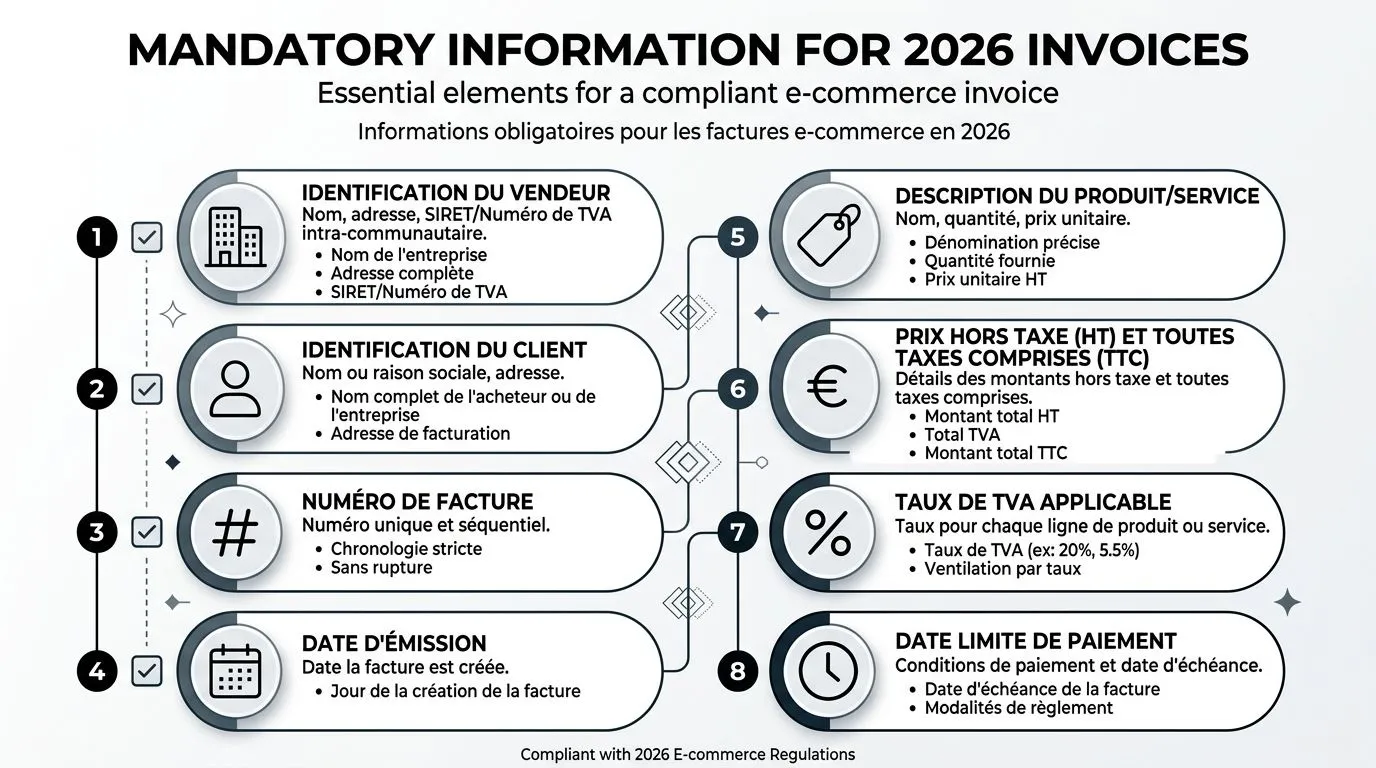
A compliant invoice works like an identity card for the transaction. It must answer several simple questions without hesitation. Who is selling. Who is buying. What was sold. On what date. For what amount. With what VAT treatment.
What must appear on the invoice
In practice, a sales invoice must display the information that secures the customer relationship, the VAT and the accounting record all at once. This typically includes the seller’s identity, the customer’s identity, the issue date, a unique sequential number, the description of the goods or services, the quantities, the unit prices excluding tax, the applicable VAT rate(s), the amounts excluding and including tax, and the payment terms.
The difficulty, for an e-commerce seller, doesn’t just come from the list. It comes from the fact that these details must stay accurate regardless of the sales channel, the customer’s country, the nature of the product and the VAT regime applied.
For a structured reminder of the fields to plan for, see this guide on mandatory details on an invoice in France.
Why 2026 changes how these details are read
By 2026, this information will no longer just serve to produce a clean PDF. It will also need to feed reliable data flows for electronic invoicing and e-reporting.
This is a significant change for online sellers.
Until now, many teams corrected an error by hand after the fact. Tomorrow, this way of working will quickly show its limits. If the company registration number is missing, if the customer address is unusable, if the VAT is misclassified, or if the numbering isn’t consistent, the problem no longer stays contained in a single document. It spreads into the accounting, the VAT return and the transmission obligations.
The points that often cause trouble in e-commerce
Customer identification
This is often the first gray area. On a D2C site, an individual customer fills in few fields. On a marketplace, some data arrives in a partial format. On a B2B sale, the absence of a correct company name or an intra-community VAT number can make the invoice hard to use.
In other words, a checkout funnel designed to convert quickly doesn’t always collect the data needed to invoice correctly.
Numbering without gaps
The invoice number must follow a logical sequence, without duplicates or unexplained gaps. Many merchants discover this issue too late, after switching tools, migrating stores, or generating invoices from the ERP, the CMS and a payment tool all at once.
Numbering works like a vehicle’s odometer. If the counter jumps for no reason, you’ll be asked to explain what happened.
Correct VAT, line by line
This is the point that gets complicated the fastest. The same store can sell a physical product in France, a digital service in another EU country, and marketplace orders already governed by specific rules. Add to that shipping fees, discounts, credit notes and OSS or IOSS cases.
A visually perfect invoice can therefore still be wrong on the substance. And when it comes to VAT, substance is what counts.
Useful summary table
| Detail | Description | Why it matters |
|---|---|---|
| Seller identification | Name or business name, address, SIRET, required tax elements | Identifies the issuer unambiguously |
| Customer identification | Name, address, and relevant identifiers where applicable | Secures the business relationship and VAT in B2B |
| Invoice number | Unique, sequential number | Prevents duplicates, gaps and control anomalies |
| Issue date | Date the invoice was created | Places the sale in the right fiscal year and VAT period |
| Description of products or services | Description, quantity, unit price excluding tax | Makes the sale clear and enforceable |
| VAT rate | Rate applied per line where needed | Determines tax accuracy |
| Amounts excluding and including tax | Subtotal, VAT, final total | Provides the basis for payment and bookkeeping |
| Payment terms | Deadline, terms, penalties | Frames collection and reduces disputes |
A compliant invoice isn’t judged by its appearance. It’s judged by its ability to pass an audit, feed clean accounting, and avoid manual rework.
The real cost of an omission
A missing detail is never just a minor administrative point. It can block a business customer, complicate VAT justification, create an anomaly in the FEC, or force your team to redo dozens of documents one by one.
For a growing merchant, the real question isn’t just “does my invoice contain the right fields?” The real question is more operational. Can my system produce compliant invoices consistently, even across several channels, several countries and several VAT regimes?
This is precisely why the 2026 reform is pushing e-commerce sellers toward automation. Not as a trend. Because past a certain volume, compliance no longer depends on an invoice template. It depends on a reliable process.
The Practical Guide to Issuing a Sales Invoice Online
A customer orders on your site. Payment goes through Stripe. The product ships from Shopify. The next day, the same item is sold on Amazon, then a digital subscription goes out to a customer in Belgium. On paper, you’ve “made sales.” In practice, you have to produce accurate, traceable and consistent invoices despite data sources, channels and VAT rules that don’t look alike.
That’s why issuing an invoice online isn’t just about generating a PDF. For a growing e-commerce seller, the real difficulty is turning scattered data into a reliable document, then into a usable flow downstream. The 2026 reform pushes in this direction. It rewards systems capable of cleanly automating this work.
Step 1: Gather clean data
The first question is simple. What is your source of truth for the sale?
Depending on whether the order comes from Shopify, Amazon, WooCommerce, Stripe or PayPal, you won’t get the same fields or the same level of detail. A marketplace may report a settled amount without providing all the information needed for a complete invoice. A payment service provider may confirm the payment without clearly describing the items sold. It’s a bit like preparing accounting from documents cut out of several different folders. If you assemble them incorrectly at the start, the error propagates all the way to the invoice.
Check at minimum:
- The customer, with their name, address and, if needed, company information
- The transaction, with the date, currency, payment method and sales channel
- The content, with the products, quantities, discounts, shipping fees and taxes
Many errors are born here. Not at the moment of editing the document.
Step 2: Choose the right treatment based on the type of sale
Two orders of the same amount don’t necessarily get invoiced the same way. This is one of the classic pitfalls of e-commerce.
Direct sale on your own site
You have better control over the data, but you still need to check whether the order remains a simple B2C sale or shifts to a business customer with different invoicing expectations. This point is often overlooked at checkout.
Sale via a marketplace
Confusion is common here. The marketplace may send a receipt, a statement or a transaction summary. That doesn’t automatically replace your own sales invoice. You therefore need to distinguish between the commercial document visible to the customer and the accounting and tax document expected on the seller’s side.
International sale
As soon as the customer is located outside France, the “same template, same logic” routine no longer holds. The customer’s country, the nature of the product, and the type of customer change the treatment to apply. For physical goods, logistics flows matter. For digital products, localization and the classification of the service quickly become more important.
Step 3: Build the invoice line by line
A reliable invoice is built like a properly recalculated cart, not like a fixed block.
The safest work order looks like this:
- Describe each product or service with a clear label
- Report quantities and unit prices excluding tax
- Apply discounts exactly where they affect the amount
- Add ancillary fees, such as shipping or packaging
- Calculate VAT according to the rule that applies to the sale
- Check the total including tax before issuing
This detail matters especially if you mix physical goods, services and digital products. A SaaS subscription, an ebook and a shipped item don’t follow the same operational logic, even if they all appear in your back office as “orders.”
Step 4: Handle the cases that create the most discrepancies
Anomalies don’t only come from rare cases. They often come from frequent cases handled poorly.
Discounts and promo codes
A discount shown at checkout must appear consistently on the invoice. Otherwise, you end up with an invoiced amount that’s hard to reconcile with the payment actually collected. This is often the first sign of a process that’s too manual.
B2C sales abroad
With the e-reporting planned under the reform, B2C sales and certain international transactions will need to be transmitted in a format usable by the tax authorities. Teams selling across multiple countries won’t be able to keep up that pace with manually corrected exports. This concerns a very large number of businesses, as explained in Compta Online’s analysis of the generalization of electronic invoicing and e-reporting.
Digital products
A digital product invoice must stay precise, even without a parcel or delivery note. “Subscription,” “license,” “platform access” or “online course” don’t all mean the same thing. The vaguer the description, the more treatment discrepancies build up later.
If you’re looking for a concrete method to structure this process, this guide on how to make an online invoice offers a useful foundation before automating.
If you’re correcting invoices by hand every week, the problem is no longer a spike in activity. The process isn’t reliable enough.
Step 5: Issue, transmit, archive
Once the invoice is ready, three actions remain to secure. Issuing, sending, and archiving.
This is often the most underestimated part. Yet a correct invoice that can’t be found a few months later creates almost the same difficulties as a poorly drafted one. For an e-commerce seller, you need to be able to start from an order, find the corresponding invoice, verify the related payment, and keep a clear history by sales channel.
A good issuing workflow includes:
- A traceable delivery to the customer
- Consistent archiving by date, number and channel
- A clear link to the original order and payment
The following video illustrates the practical challenges of online invoicing for an e-commerce business.
Why spreadsheets quickly hit their limits
At the start, a spreadsheet may be enough. Then volume rises. Currencies multiply. Credit notes appear. Business customers mix with individual customers. Sales flow through several platforms. And every exception calls for a new column, a new rule, a new manual check.
The problem isn’t the spreadsheet itself. The problem is that a spreadsheet doesn’t naturally organize a multi-channel flow with continuous numbering, consistent VAT rules, linked documents and accounting-ready data.
From that point on, the invoice is no longer a standalone document. It becomes a control point in the entire financial machinery of your e-commerce business.
From Invoice to Journal Entry: Managing VAT and the FEC
A sales invoice doesn’t stop once it’s sent to the customer. Once issued, it must live correctly within the accounting. This is where many merchants stumble, because they see the invoice as a commercial document while the accountant sees it as an entry that needs justifying.
Translating an invoice into a simple entry
Let’s take a deliberately basic example. You invoice a sale with a total including tax. In accounting, this transaction generally breaks down into three effects:
- a receivable or a payment to record;
- revenue to recognize;
- VAT collected to isolate.
In other words, your invoice doesn’t just say “the customer owes payment.” It also serves to correctly break down what the business actually earns and what it will need to remit for VAT.
Why VAT quickly complicates the picture
In e-commerce, the difficulty rises very fast. You can have different rates depending on the nature of the product, the geographic area, or the type of customer. You can also be dealing with shipping fees, partial refunds, credit notes, or international sales that change the expected logic.
The tricky part isn’t just the calculation. It’s traceability.
The thorny case of off-invoice discounts
Managing commercial discounts that don’t appear on the invoice remains a real blind spot for many stores. Yet it’s a concrete issue with marketplaces and automated promotions.
Available data indicates that 60% of marketplace sellers run into this difficulty. From an accounting standpoint, these discounts must impact revenue account 7019 and VAT account 443, without a direct reference invoice, making them a frequent source of errors and reassessments (reference compiled here).
A merchant often sees a discount as a commercial gesture. The accountant needs to be able to explain it in the entries.
The role of the FEC
The Fichier des Écritures Comptables (FEC), or Accounting Entries File, is the structured reflection of your accounting. If your invoices are poorly numbered, inconsistent or miscategorized, these problems reappear later in this file.
To understand concretely what the tax authorities expect, this guide on the accounting entries file (FEC) helps connect the dots between the invoice, the entry, and the audit.
Clean accounting doesn’t start at the accountant’s office. It starts the moment a sale is turned into a usable invoice.
When your invoices are structured from the outset, accounting becomes simpler. When they’re approximate, every month-end turns into a catch-up session.
Bizyness: Automation Serving Your Compliance and Growth
Looking at the whole picture, the real problem isn’t editing a PDF document. The real problem is seamlessly connecting the sale, the VAT, the invoice, the accounting entry and future transmission obligations.
This is why specialized tools have become so important for online sellers.

What automation actually changes
A tool built for e-commerce can take on several tasks that become risky when handled manually:
- Centralize sales from Shopify, WooCommerce, Amazon, Stripe or PayPal
- Generate compliant invoices with the correct details
- Apply VAT rules based on the destination and type of sale
- Prepare accounting data for export, reconciliation or the accounting firm
- Trace anomalies such as duplicates, discrepancies or incomplete flows
The main gain isn’t just time. It’s consistency.
Why the 2026 reform changes the decision
From September 2026, electronic invoicing through a certified platform becomes mandatory according to the elements reported in the source provided, with a fine of €15 per invoice for non-compliance. The same source adds that 65% of e-commerce SMEs will need to rely on a compliant tool to avoid penalties and blocked accounting flows (Huggii).
For an online seller, this changes the equipment logic. Before, automating invoicing could be seen as a nice-to-have. With the reform, it becomes an infrastructure topic.
The value of a tool designed for e-commerce flows
A general-purpose piece of software may be enough for a simple business. It becomes less suited once you need to reconcile orders, payments, refunds, different sales channels and varied tax obligations.
In this context, Bizyness is an option dedicated to businesses that sell online. The platform connects the main sales and payment sources, generates invoices, applies VAT rules, prepares tax data and structures accounting entries ready to be sent to the accountant. For a multi-channel merchant, this logic avoids having to manually rebuild the financial history of every order.
What to keep in mind before choosing
Don’t choose a tool just because it “makes invoices.” Check that it answers these questions well:
| Criterion | Why it’s decisive |
|---|---|
| E-commerce connections | Your data must flow in without manual reprocessing |
| VAT management | The system must follow your real cases, not just the simple ones |
| Accounting preparation | The invoice must lead to usable data |
| Reform compatibility | The tool must fit within the e-invoicing and e-reporting logic |
| Traceability | You must be able to explain every sale and every correction |
Automation doesn’t erase the rules. It applies them more consistently. That’s exactly what an e-commerce seller needs as volume increases.
Conclusion: Turn Your Invoicing Into a Performance Lever
The sales invoice isn’t a peripheral document. It connects your revenue, your VAT, your accounting and your compliance. For an e-commerce seller, it acts as the junction point between what happens in the store and what must be justifiable in the back office.
Manual methods rarely hold up for long. They cope poorly with multi-channel sales, international flows, complex discounts and the obligations tightening under the 2026 reform. As the business grows, the invoice becomes less of an administrative topic and more of a structural one.
A solid online business doesn’t just collect payments. It knows how to turn every sale into reliable data, a clean journal entry, and a compliant supporting document.
If you currently have scattered invoices, multiple exports and VAT that’s hard to track, the right move isn’t to add another spreadsheet. The right move is to put in place a system capable of absorbing complexity without slowing down the business.
Frequently Asked Questions About the Sales Invoice
Some questions come up often because they sit in the gray areas of daily e-commerce operations. Here are the most useful ones to clarify.
| Question | Answer |
|---|---|
| Do I always have to issue an invoice for a sale to an individual? | Not always in the same way as in B2B, but you shouldn’t confuse a receipt, an order confirmation and a compliant invoice. For an e-commerce seller, the right approach is to organize your system so it can produce the appropriate document depending on the sale, the customer and the channel. |
| I’m a sole trader (micro-entrepreneur). Does the sales invoice follow the same principles? | Yes, on the basic logic, since an invoice must remain clear, dated, numbered and consistent. However, VAT treatment depends on your regime. So avoid reusing standard templates without checking the details suited to your situation. |
| I made a mistake on an invoice. Can I simply edit it? | In practice, you should avoid rewriting an already-issued invoice as if it never existed. The correction usually goes through a regularization document, often a credit note, in order to preserve traceability and numbering continuity. |
| Is it enough if a marketplace sends a document to the customer? | Not automatically. It all depends on the platform’s role and the nature of the document issued. A commercial document or a transaction statement doesn’t always fulfill the same functions as a compliant sales invoice for your accounting. |
If your business is starting to outgrow administrative tinkering, Bizyness lets you centralize sales, generate compliant invoices and prepare usable accounting without manual re-entry.