

 Français
 Automate Administrative Tasks: The Complete 2025 Guide
Master the art of automating administrative tasks with proven strategies. Cut your workload by 83% with expert advice.

Why automation is transforming your daily work
Automating administrative tasks has become essential for businesses. It optimizes how work is organized and frees up precious time. Let’s look at how this transformation impacts day-to-day operations.
Saving time and boosting efficiency
Freed from repetitive tasks like data entry or invoice processing, your teams can focus on higher-value activities: business development, customer relations, innovation. Automation becomes a lever for increasing productivity and profitability. For example, automating leave management lets HR teams focus on recruitment and training.
Automating certain tasks can free up a considerable amount of time. Take expense report processing as an example. A study showed that automating this process can save up to 5 hours per month per employee. That saved time can be reinvested in more strategic projects.
Reducing errors and improving quality
Repetitive administrative tasks are often a source of errors. Automation minimizes these errors, improving data reliability and work quality. The result: better compliance, fewer disputes, and a stronger brand image. Automated processes ensure consistency in how information is handled. Imagine the gain in accuracy and reliability.
Improving employee satisfaction
Automation improves quality of life at work. Employees can focus on more stimulating missions, boosting their motivation and engagement. A calmer, more efficient work environment helps retain and attract new talent. To learn more, check out our guide: How to master the automation of administrative tasks.
Measuring return on investment
The infographic below illustrates the gains from automation. It compares the error rate, time spent on administrative tasks, and the average cost per task, before and after automation.
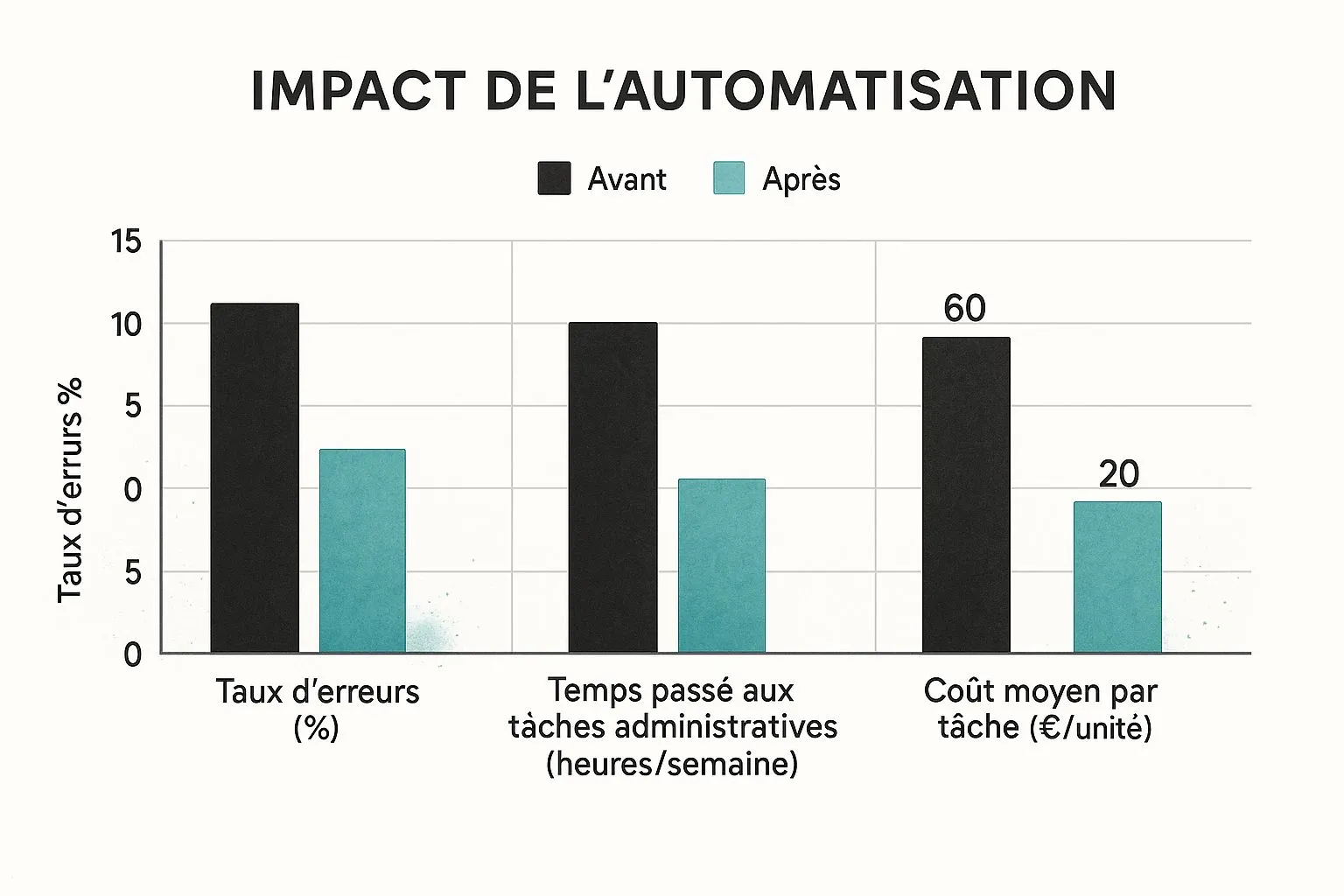
Automation reduces the error rate, frees up working hours, and lowers the cost per task. These gains translate into a fast return on investment. Automation, particularly in human resources, is expanding rapidly. Platforms like Vorecol HRMS can automate up to 83% of HR tasks, freeing teams to focus on strategic missions and cutting recruitment costs by 30%. Find out more about automation trends.
To better understand the impact of automation on productivity, here is a comparison table:
The table below details the productivity gains achieved by automating various administrative tasks.
Comparison of productivity gains by type of administrative task — a comparative table showing the percentage of time saved for each type of automated administrative task
| Task type | Manual time (hours/month) | Automated time (hours/month) | Productivity gain (%) |
|---|---|---|---|
| Data entry | 20 | 2 | 90 |
| Invoice processing | 15 | 3 | 80 |
| Email management | 10 | 2 | 80 |
| Leave management | 5 | 1 | 80 |
| Reporting | 8 | 1.6 | 80 |
This table clearly shows that automation delivers significant productivity gains, reaching up to 90% for data entry. These gains allow businesses to allocate their resources better and improve overall performance.
Automation is a genuine transformation lever for businesses. It streamlines processes, cuts costs, and improves both work quality and employee satisfaction. To dig deeper into this topic: Automating your administrative tasks.
Spotting hidden automation opportunities

Automating administrative tasks offers considerable potential for optimization, but not all tasks are equal. Some optimizations will save you precious time, while others will have only a limited impact. This chapter offers a method for identifying tasks with high automation potential. A strategic approach is essential to maximize the return on your efforts.
The 3-criteria method: repetitiveness, complexity, and impact
Assessing automation potential rests on three main criteria: repetitiveness, complexity, and business impact. Organizational consultants regularly use this method to identify productivity gains. A repetitive, low-complexity task, such as data entry, is an ideal candidate. Conversely, a complex, low-repetition task, such as negotiating a contract, is harder to automate.
Take invoice processing as an example. Entering the information from each invoice is a repetitive operation. The impact on the business is significant, since this process directly affects cash flow. While complexity can vary, it generally remains manageable by an automated system. Invoice processing therefore represents an excellent automation opportunity.
Involving your teams: a wealth of information
Your teams are at the heart of the action and know the weak points of current processes inside out. Consulting them is therefore fundamental to identifying time-consuming, error-prone tasks. Workshops, individual interviews, or questionnaires can be set up to gather their feedback and improvement suggestions. This collaborative approach lets you uncover hidden automation opportunities and drives adoption of the solutions put in place.
An anonymous questionnaire can, for example, reveal repetitive, tedious tasks unsuspected by management. The marketing team might flag the manual creation of weekly reports, a time-consuming task that is nonetheless easily automated.
Identifying the signs of a process ready for automation
Certain signs clearly indicate that an administrative process is ready to be automated. Manual, repetitive tasks, frequent errors, long processing times, or a lack of visibility into case progress are all key indicators.
If a process involves handling a large volume of data, automation can significantly reduce errors and speed up processing. Imagine the time and accuracy gains for a company processing hundreds of orders daily.
From simple workflows to complex chains: anything is possible
Automation isn’t limited to simple tasks. It can also apply to more complex chains of processes, involving several departments. The recruitment process, from receiving applications to onboarding the new employee, can be largely automated.
Automating complex workflows improves coordination between teams and smooths operations, on top of saving time. The result: better overall efficiency and lower costs. To dig deeper into administrative management, read this article: Business administrative management: the complete guide. Explore the various automation solutions and identify those that best meet your business’s needs.
AI in the service of your daily administration
Artificial intelligence (AI) is now a concrete reality for businesses. It is gradually being integrated into administrative processes, enabling companies to automate certain tasks and streamline organization. Let’s look at how AI can optimize the daily administration of French-speaking businesses. Take resume screening as an example: an AI can analyze hundreds of applications in minutes, selecting the profiles that match the defined criteria. This valuable time saving lets HR teams focus on the next steps of recruitment.
Concrete applications of AI in administration
AI offers a range of solutions to improve the efficiency of administrative tasks. Among them, automatic document recognition. Imagine an AI able to extract the key information from an invoice and feed it directly into your accounting software. Manual entry, a potential source of errors, disappears. This type of automation greatly simplifies accounting management.
AI also excels at intelligent data classification. It can sort and categorize a large volume of documents, emails, or customer data. Finding information becomes faster and data analysis more accurate. One example? AI can identify urgent emails, optimizing the management of your inbox.
Virtual assistance for recurring requests is another benefit. A chatbot can answer frequently asked questions from customers or employees, available 24/7. Your teams are thus freed from these repetitive tasks and can focus on higher-value missions. This type of AI improves responsiveness and customer satisfaction. AI adoption is growing among French-speaking businesses. In 2025, 38% of HR departments were already using AI solutions, particularly for recruitment and training. 61% of employees consider AI proficiency an asset for their career. More information on this topic. Nevertheless, concerns persist, particularly around ethics and data protection, shared by 35% of HR teams.
Protecting data: a critical issue
The use of AI raises important questions regarding data protection and compliance with GDPR. Choosing compliant solutions and putting security measures in place is essential. Anonymizing or encrypting sensitive information are examples of good practice. The goal is to automate processes while preserving security and confidentiality.
Adopting AI with confidence
Introducing AI can sometimes raise concerns. Transparent communication about the benefits of automation is essential. It’s worth remembering that AI is a decision-support tool, not a replacement for human skills. AI takes on repetitive tasks, freeing up time for more creative and strategic missions. AI and humans must work in synergy for better efficiency and business performance. To simplify your administrative management, discover Bizyness, the tool for sole traders and small businesses.
Choosing the tools that truly fit you

Choosing the right solution for automating administrative tasks can prove complex. The market is vast and it’s sometimes hard to find your way around. How do you identify the tools that are genuinely effective and suited to your business? This guide offers a concrete, proven method for making the best choice. A wise choice is an investment in the future.
The key criteria for an informed choice
A tool’s performance isn’t limited to its features. Other, often overlooked, criteria are essential. Adoption by your teams is paramount. An intuitive, ergonomic tool makes it easier to get to grips with and limits resistance. An interface and support in your language are real assets.
Integration with your existing ecosystem is also crucial. The tool must be able to communicate with your current software (CRM, ERP, etc.). For example, an invoice management solution connected to your accounting software will save you precious time. Responsive local support is essential. Reactive, competent support will help you whenever you run into difficulty.
Finally, GDPR compliance is imperative. The tool must guarantee the security and confidentiality of your data. This point is non-negotiable when it comes to protecting your information.
Objectively comparing platforms: our evaluation grid
To compare solutions effectively, an evaluation grid is essential. It lets you centralize the key information: features, pricing, and support.
Here is a comparison grid of popular automation solutions on the French market. This detailed comparison of features, pricing, and specifics will help you better understand the market.
| Solution | Key features | Price (€/month) | Local support | GDPR compliance |
|---|---|---|---|---|
| Solution A | Invoice, leave, and expense report management | 49 | Yes | Yes |
| Solution B | Email automation, integrated CRM | 99 | Yes | Yes |
| Solution C | Chatbot, task management | 29 | Yes | Yes |
| Bizyness | Invoicing, VAT, transactions, e-commerce integrations | Free - €29 | Yes | Yes |
This grid is an example — adapt it to your specific needs. Add criteria specific to your business, such as multi-currency management. Bizyness, for instance, offers an attractive free plan for sole traders.
Negotiating effectively and avoiding pitfalls
Don’t hesitate to negotiate with vendors. Compare offers and ask for demos. Be wary of excessive promises and complex contracts. A free trial is ideal for testing the tool under real conditions.
Learning from others’ mistakes
Analyze the experience of other businesses. Rushing into the first solution without prior analysis can lead to an unprofitable investment. Define your needs and compare offers. A gradual rollout, with a pilot project, is often more effective.
Testing before committing: the key to success
Before committing, test the solution with a group of users. Gather their feedback and adjust your strategy accordingly. This testing phase is essential to validate the tool’s effectiveness and ensure its adoption.
Rolling out automation without organizational chaos
Implementing an administrative task automation solution is a major project for any business. To succeed in this transformation, a methodical, gradual approach is essential. This isn’t a sprint but rather a marathon, where preparation is the key to a smooth, successful transition. This chapter details the roadmap followed by businesses that have successfully carried out their transformation.
In-depth diagnosis: the first step
Before launching into automation, an in-depth diagnosis of your current processes is necessary. This audit will help identify the most time-consuming tasks and those best suited to automation. The analysis should cover the nature of the tasks, their frequency, and their impact on the business.
Involve your teams in this analysis phase. They are best placed to identify the weak points of existing processes. For example, the accounting department might flag manual invoice data entry as a repetitive, error-prone task.
Preparing for change
Automation involves changes to how work is organized. Transparent communication about the goals and benefits of automation is essential to gain everyone’s buy-in. It’s important to reassure employees and train them on the new tools. Presentation workshops and training sessions can ease the transition.
The pilot rollout
A pilot rollout on a limited scope makes it possible to test the solution under real conditions. This real-world test will help identify the adjustments needed before a large-scale rollout. Choosing the pilot department is strategic. It must be representative of the business’s challenges and allow productivity gains to be measured quickly.
Analyzing the pilot’s results will help optimize the solution and best prepare for the full rollout.
Managing resistance
Introducing new technologies can trigger resistance. It’s important to identify the barriers to change and provide concrete answers. Listening, training, and personalized support are important levers for overcoming these obstacles. Appointing change ambassadors within teams can ease adoption of the new solution. You might also be interested in this article: How to master administrative management for your business.
Communicating effectively
Effective internal communication is essential. Clearly explain the benefits of automation for each team and for the business as a whole. Highlight the time saved, the reduction in errors, and the improvement in work quality. Showcase successes and positive testimonials from pilot teams. The goal is to turn skeptics into automation ambassadors. Organize information sessions and encourage discussion.
Avoiding common mistakes
Several mistakes can jeopardize the project. A lack of preparation, insufficient communication, poorly suited tool choices, or inadequate support for teams are risk factors. Analyzing the experience of other businesses can help you anticipate these difficulties.
Take the time to properly define your needs, choose the most suitable solution, and support your teams throughout the process. A gradual rollout and proper training are essential to guarantee success.
Measuring your success and continuously optimizing

Automating administrative tasks is an ongoing process. Once the solutions are in place, the real optimization work begins. It’s essential to measure the real impact of this automation and adapt your strategy based on the results observed. This regular monitoring is the key to continuous improvement in the efficiency of your processes. This section guides you through the various steps for measuring your success and optimizing your automation solutions for the French market.
Building relevant dashboards: an essential tool
To effectively track the impact of automation, setting up clear, precise dashboards is essential. These dashboards should display the key performance indicators (KPIs) most relevant to your business.
Examples include time saved on certain tasks, the reduction in the number of errors, or the cost per operation. These figures let you visualize concretely the benefits brought by automation. An effective dashboard should be concise and allow you to quickly understand how your performance is evolving.
Using charts and visualizations is an excellent way to make the data easier to read and interpret.
Gathering user feedback: a wealth of information
Your teams’ experience is a valuable source of information. It’s important to regularly gather their feedback on the automated tools and processes.
Meetings, interviews, or questionnaires can be organized to gather their improvement suggestions. This feedback helps identify the weak points of your solutions and optimize them accordingly.
Your teams’ buy-in is a key factor in the success of automation. Listening to their needs and difficulties will help improve the tools’ effectiveness and ease their adoption.
Identifying opportunities for improvement: a process of constant evolution
Automation is a dynamic process. It’s essential to stay alert to new opportunities for improvement. Regularly analyze your processes and identify tasks that could be automated or optimized.
For example, if an automated task keeps generating errors, it may be necessary to review the process or adjust the tool’s settings. Continuous optimization is an iterative approach that gradually improves the effectiveness of your solutions. To go further, you can read this article: How to master invoicing as a sole trader.
Communicating effectively about your results: a success factor
Communication plays a crucial role in the success of automation. Regularly present the results obtained to management, highlighting productivity gains, cost reductions, and quality improvements.
These concrete results help justify future investments and maintain the organization’s support. Clear, concise reporting, backed by hard data, is essential to demonstrate the value added by automation.
Using concrete examples can also be very useful for illustrating the benefits achieved.
Turning early wins into lasting success: the key to sustainability
By following these recommendations, you will turn your early wins into lasting success. Automating administrative tasks then becomes a genuine performance lever for your business.
A methodical approach, based on measurement, analysis, and continuous optimization, is the key to successful, sustainable automation. By adapting your strategy to the specifics of your market and the needs of your teams, you will maximize the impact of automation and contribute to your business’s growth.
Your roadmap to automation
Automating your administrative tasks isn’t just about installing software. It’s a strategic approach that requires careful planning and rigorous execution. This practical guide will help you launch your automation project and maximize your chances of success.
Identifying tasks to automate: the starting point
Identifying the administrative tasks suited to automation is essential. Focus on tasks that are repetitive, time-consuming, and of low added value. Take data entry, the creation of standardized reports, or invoice processing as examples. Involving your teams is essential. Their hands-on expertise often reveals automation opportunities that would otherwise go unnoticed.
Choosing the right tools: a crucial step
The choice of tools is decisive. Opt for solutions that are intuitive and easy for your teams to use, compatible with your current systems. Quality local support is essential. Test different solutions before making a decision. Take advantage of free trials! GDPR compliance is, of course, an essential criterion.
Rolling out gradually: the key to a smooth transition
Automation should be rolled out step by step. Start with a small-scale pilot project. This will let you test the solution, identify areas for improvement, and adjust your strategy. Once the pilot is validated, you can extend automation to other departments or processes.
Supporting change: a success factor
Automation changes how work is organized and everyday habits. Supporting this change is therefore crucial. Communicate clearly about the goals and benefits of automation. Train your teams on the new tools and make sure they’re comfortable with the new ways of working.
Measuring and continuously optimizing: an ongoing improvement process
Once automation is in place, you need to measure the results. Define relevant key performance indicators (KPIs), such as time saved, error reduction, or cost per operation. Regularly analyze these indicators and adjust your strategy. Automation is a continuous improvement process.
Anticipating changes: staying competitive in the French market
The automation market is constantly evolving. Stay informed about new trends, innovations, and regulatory changes. Anticipate your business’s future needs and adapt your automation strategy. Investing in high-performing solutions is an asset for staying competitive.
Preventive maintenance: ensuring the longevity of your solutions
Your automation solutions, like any system, require regular maintenance. Put a preventive maintenance plan in place to ensure they run smoothly and prevent service interruptions. This includes updates, performance tests, and security checks. Proactive maintenance optimizes return on investment and ensures the longevity of your solutions.
Checklist to start your automation project today:
- Identify repetitive, time-consuming tasks: List the administrative tasks that can be automated.
- Evaluate available solutions: Compare the features, pricing, and compatibility of the tools.
- Define a budget and a timeline: Plan the steps and resources needed.
- Launch a pilot project: Test the chosen solution on a limited scope.
- Train your teams: Make sure they have mastered the new tools.
- Measure results: Track KPIs and adjust your strategy.
Simplify your management with Bizyness, the tool designed for sole traders and small businesses. Automate your invoices, your VAT, and your transactions, and focus on what matters: growing your business.
