

 Français
6 Balance Sheet Examples to Master Your Finances
Discover 6 balance sheet examples to better understand your financial health. Ideal for mastering your finances in 2025.
Understanding a balance sheet can seem complex, but it is an essential exercise for any entrepreneur who wants to run their business with precision. This document is not just a simple legal obligation; it is a genuine identity card of your assets, revealing the financial structure and soundness of your company at a given point in time. For a freelancer or the manager of a small business, knowing how to interpret this financial statement is crucial.
Mastering the reading of a balance sheet lets you make informed decisions, anticipate cash flow needs, and convince your financial partners, such as banks or investors. It is the tool of choice for assessing performance and identifying areas for improvement. A well-analyzed balance sheet example can reveal unsuspected opportunities or risks to manage.
Through 6 concrete, detailed examples, we will show you how to turn this accounting tool into a powerful growth lever for your business. We will break down each type of balance sheet, from the simplified version for micro-businesses to the functional balance sheet used for financial analysis. The goal is to give you strategic insights and practical advice that you can apply today to optimize the management of your company.
1. Example 1: The Standard Balance Sheet for SMEs
The standard balance sheet is the cornerstone of corporate finance for small and medium-sized enterprises (SMEs). It offers a faithful snapshot of the company’s assets at a given point in time, generally at the close of the fiscal year. Its two-sided structure, with assets (what the company owns) and liabilities (what the company owes), lets you visualize the financial balance and understand where resources come from (liabilities) and how they are used (assets).
It is an essential document not only for meeting legal obligations, but also for steering the business, reassuring financial partners (banks, investors), and making informed strategic decisions. For any SME, mastering the reading and preparation of this document is a fundamental skill.

Strategic Analysis of the Standard Balance Sheet
This balance sheet model is universal, but its analysis varies greatly depending on the industry.
- For an artisan bakery: Fixed assets will be significant, including the oven, the kneading machine, and the shop fittings. Current assets will include large stocks of raw materials (flour, butter). On the liabilities side, you will likely find supplier debts for these raw materials and a bank loan for equipment.
- For a consulting firm: Assets look very different. Tangible fixed assets are low (computers, office furniture). Most of the current assets will consist of accounts receivable, i.e. invoices awaiting payment.
- For a transport company: Fixed assets will be dominated by the value of the vehicle fleet. Liabilities will often reflect financing (leasing, loans) tied to the acquisition of these vehicles.
Key point: The structure of this balance sheet immediately reveals the company’s business model. Heavy fixed assets suggest an industrial or service activity requiring substantial equipment, while a balance sheet dominated by receivables and short-term debts points to a trading or consulting activity.
Practical Tips and Applications
To use this balance sheet example effectively, follow these recommendations:
- Check the fundamental balance: The golden rule is that Total Assets must always equal Total Liabilities. An imbalance signals an entry or calculation error that must be corrected.
- Break down major line items: Do not lump heterogeneous elements together. If accounts receivable make up a large share of your assets, detail them in an appendix to track late payments.
- Apply the prudence principle: Never anticipate a profit, but always provision for a probable loss. For example, if a client is in financial difficulty, set up a provision for doubtful debts.
- Use the notes: The accounting notes are not optional. They are mandatory and are used to explain the accounting rules and methods used, and to give details on balance sheet items (breakdown of debts, statement of fixed assets, etc.).
2. IFRS Balance Sheet for Multinationals
On an international scale, the balance sheet is transformed to meet the requirements of global financial markets. IFRS (International Financial Reporting Standards) are the standard for large listed companies and multinationals. They favor economic substance over legal form, meaning that the valuation of assets and liabilities reflects their actual market value (fair value) rather than their historical cost.
This shift in philosophy offers a more dynamic and up-to-date view of the company’s financial health. It aims to harmonize the presentation of accounts to make them comparable from one country to another, a crucial issue for international investors and financial analysts. The complexity of this balance sheet example lies in its valuation methods and transparency requirements.
Strategic Analysis of the IFRS Balance Sheet
The IFRS approach profoundly changes the reading of the balance sheet and highlights assets that are often invisible under local standards.
- For a company like LVMH: The value of brands (Dior, Louis Vuitton) constitutes a major intangible asset, valued and recorded on the balance sheet. This valuation, impossible on a classic SME balance sheet, gives a more accurate picture of the group’s true wealth.
- For an oil group like TotalEnergies: Oil and gas reserves are periodically revalued based on global prices and new discoveries. Assets therefore fluctuate significantly, directly reflecting the sector’s economic outlook.
- For an airline like Air France-KLM: The accounting treatment of aircraft leasing contracts is complex. Under IFRS, these contracts are recorded as assets (right of use of the aircraft) and as liabilities (lease debt), which increases the size of the balance sheet and changes debt ratios.
Key point: The IFRS balance sheet does not just list what the company owns — it seeks to assess its current and future market value. It thus provides a forward-looking, economic view essential for large-scale investment decisions.
Practical Tips and Applications
Adopting IFRS standards is a major project that requires careful preparation:
- Anticipate the impact on ratios: Fair value measurement and the treatment of certain contracts can strongly influence key indicators such as the debt ratio or return on equity. Simulate these impacts so you are not caught off guard.
- Set up robust information systems: Tracking fair value requires reliable, up-to-date data. Your IT systems must be able to collect and process this complex information.
- Document valuation choices: IFRS standards sometimes leave room for interpretation. Every choice (valuation model, depreciation period) must be rigorously documented and justified in the notes.
- Train accounting and finance teams: The transition to IFRS requires a significant upskilling effort. Investing in training is essential to guarantee the reliability of the financial statements.
3. Simplified Balance Sheet for Micro-Businesses
The simplified balance sheet is a lighter version of the standard balance sheet, designed for very small businesses and micro-entrepreneurs that meet certain thresholds for revenue, headcount, and total assets. Its purpose is to reduce the administrative burden while still providing a clear, concise view of the company’s financial health. It groups certain line items together for a faster, more direct read.
This balance sheet example is particularly relevant for craftspeople, independent shopkeepers, or small service companies that do not have the financial complexity of an SME. It allows them to comply with legal obligations without having to produce a document as detailed as the standard balance sheet, making bookkeeping more accessible.

Strategic Analysis of the Simplified Balance Sheet
The condensed structure of this balance sheet offers quick insights into a company’s management and business model.
- For a family-run retail shop: Assets will be dominated by merchandise stock and accounts receivable from unpaid sales. Liabilities will mainly show supplier debts and possibly a small loan for fitting out the premises. The simplicity of the balance sheet lets the manager quickly gauge their working capital needs.
- For a sole-trader plumber: Assets will highlight tools and equipment (tangible fixed assets) as well as the utility vehicle. Current assets will consist of receivables for completed but not yet paid jobs. Liabilities will reflect debts owed to material suppliers.
- For a home-services company: Fixed assets will be very low (IT equipment). Most of the value will lie in accounts receivable and cash. This asset-light balance sheet is typical of service businesses where the main value lies in human delivery.
Key point: The simplified balance sheet highlights the essentials: cash, short-term debts, and the value of key assets. It is a day-to-day management tool, ideal for entrepreneurs who run their business in a very hands-on way.
Practical Tips and Applications
To make the most of this simplified format, here are a few recommendations:
- Check your eligibility: The thresholds for qualifying for the simplified regime change. Check every year that your company (revenue, total assets, headcount) still meets the criteria to avoid a reassessment.
- Don’t skimp on rigor: “Simplified” does not mean “approximate.” Bookkeeping and the retention of supporting documents (invoices, receipts) must be flawless. Every line of the balance sheet must be justified.
- Use it for management: Even simplified, this balance sheet lets you calculate key ratios such as working capital requirement (WCR) or the debt ratio. It is perfect for preparing a request for small bank financing.
- Anticipate moving to the standard regime: If your business grows, assess the value of switching to the standard accounting regime. This will give you a more precise view of your performance and will be essential for attracting investors. To go further, discover the specifics of the simplified balance sheet.
4. Example 4: The Consolidated Group Balance Sheet
The consolidated balance sheet offers a global economic and financial view of a group of companies (a parent company and its subsidiaries) as if it were a single entity. This document is essential for investors, analysts, and creditors, as it neutralizes transactions carried out between group companies (receivables, debts, internal profits) to show only transactions with third parties. It aggregates the assets and liabilities of each entity to give a faithful picture of the group’s real strength and financial health as a whole.
Preparing this balance sheet is a complex exercise that requires harmonizing accounting methods across all subsidiaries and specific restatements, such as eliminating reciprocal receivables and debts. For international groups such as Carrefour or Bouygues, the consolidated balance sheet is the ultimate financial communication tool, allowing an understanding of the aggregate performance of their various activities (construction, telecoms, media, retail).
The infographic below illustrates the key steps of the consolidation process.
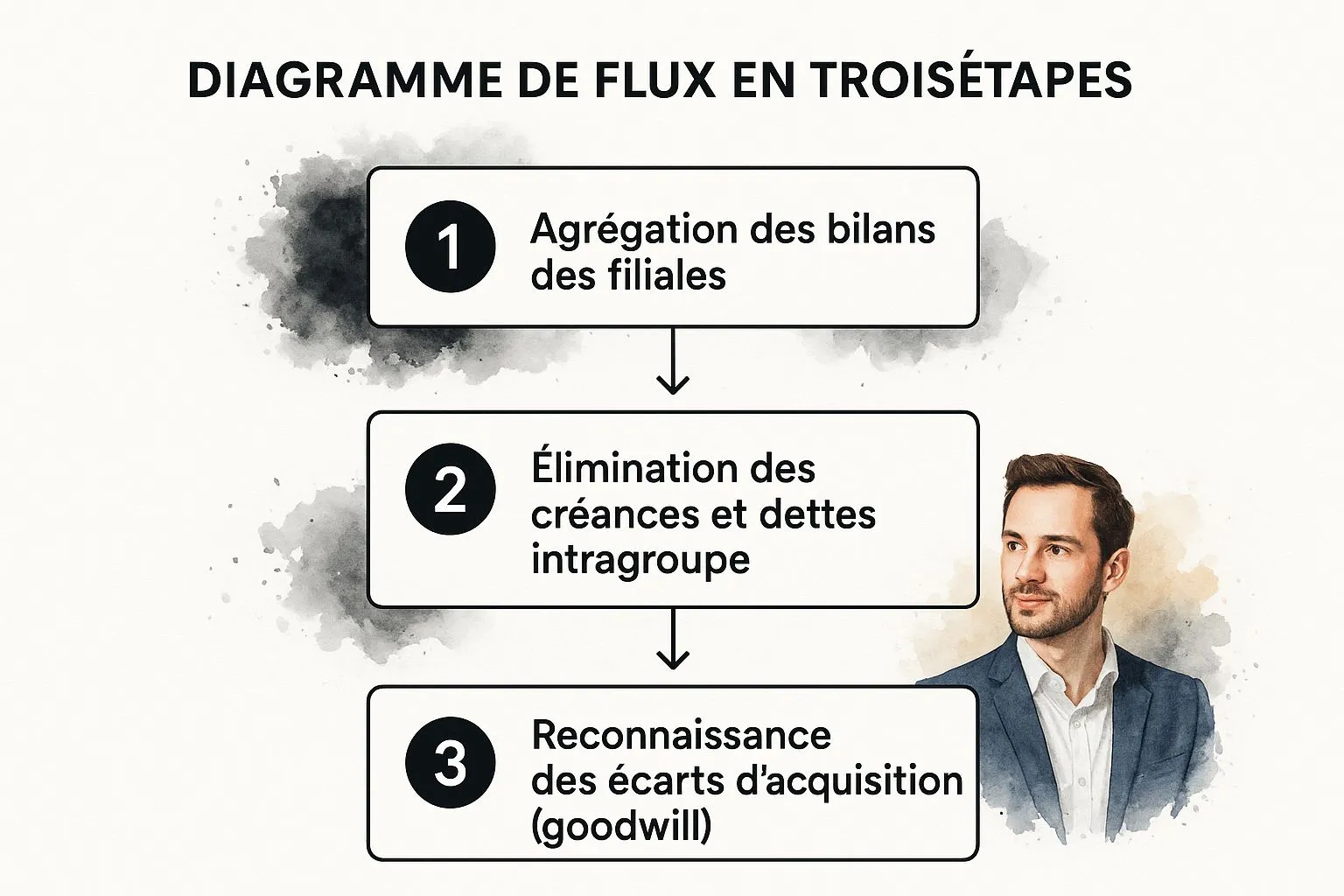
This process ensures that the final balance sheet reflects only the group’s true financial position vis-à-vis the outside world.
Strategic Analysis of the Consolidated Balance Sheet
Analyzing a consolidated balance sheet reveals a group’s overall strategy and structure.
- For an industrial group like Peugeot-Citroën (before Stellantis): Consolidated fixed assets would be colossal, representing the factories, assembly lines, and patents of all the brands. Liabilities would show significant loans to finance these assets and provisions for warranties on vehicles sold worldwide.
- For a retail group like Carrefour: Current assets would predominate, with massive stocks in the warehouses and stores of all its international subsidiaries. Liabilities would be characterized by very large supplier debts, reflecting the retail business model based on long payment terms.
- For a conglomerate like Bouygues: The balance sheet would consolidate very different activities. You would need to analyze the share of each division (construction, TF1, Bouygues Telecom) in total assets to understand the group’s strategic pillars and their respective weight.
Key point: Consolidation reveals a group’s true size and diversification. The appearance of a significant “goodwill” line item in assets indicates a strong external growth strategy, where the group paid more than the book value to acquire its subsidiaries.
Practical Tips and Applications
To tackle this complex balance sheet example, here are some essential recommendations:
- Harmonize accounting methods: First and foremost, make sure all subsidiaries use the same valuation rules (e.g. for stock or depreciation). This is an essential prerequisite for a fair consolidation.
- Document eliminations: Every intra-group transaction (a loan from one subsidiary to another, sale of goods) must be identified and eliminated. Keep a clear audit trail of all these restatements.
- Set up a strict timetable: Consolidation requires collecting information from all entities. A “consolidation schedule” with clear deadlines for each subsidiary is crucial for meeting legal deadlines.
- Use dedicated tools: For groups of a certain size, manual consolidation on a spreadsheet is risky and inefficient. Specialized consolidation software automates calculations and reduces the risk of errors.
5. Forecast Balance Sheet for a Business Plan
The forecast balance sheet is a projection exercise that anticipates the company’s financial position at a future date, generally over 1 to 5 years. Unlike the classic balance sheet, which is a snapshot of the past, this tool is purely forward-looking. It is a centerpiece of any business plan, essential for convincing investors, obtaining a bank loan, or simply validating the viability of a new venture or development project.
This document translates a vision and a strategy into figures. It demonstrates the project’s ability to generate value and maintain its financial balance in the future. For a business founder, building a solid forecast balance sheet is the best way to give substance to their project and test its soundness before even launching.
Strategic Analysis of the Forecast Balance Sheet
The credibility of this balance sheet rests entirely on the soundness of the assumptions behind it. Its analysis differs depending on the project’s context.
- For a tech startup: The forecast balance sheet for the early years will often show low tangible fixed assets but significant R&D investment (sometimes capitalized). Liabilities will be marked by capital contributions (funding rounds) and financial debt. The goal is to show a path to profitability and growing valuation.
- For an industrial expansion project: Fixed assets will grow significantly (purchase of new machinery, plant expansion). Liabilities will reflect the new bank loans taken out to finance this growth. The projections must prove that the increased production capacity will generate enough revenue to repay these debts.
- For a business acquisition: The opening balance sheet will be that of the target company, but the projections will factor in the synergies and improvements planned by the acquirer. The challenge is to demonstrate how corrective actions (cost reduction, new sales strategy) will improve the financial structure and restore profitability.
Key point: The forecast balance sheet is not a mere formality — it is the numerical expression of your strategy. It must tell a coherent story: how planned investments (assets) will be financed (liabilities) and how they will generate the expected growth.
Practical Tips and Applications
To build a convincing forecast balance sheet example, follow these steps:
- Base your assumptions on facts: Use market studies, supplier quotes, price lists, and industry data to justify your revenue, cost, and investment forecasts. An unsourced assumption is a weakness. To go further, you can consult our guide on the forecast balance sheet and its examples.
- Ensure consistency with the other statements: The forecast balance sheet is linked to the forecast income statement (which determines net income, impacting equity) and the cash flow plan (which determines the bank balance in assets).
- Prepare several scenarios: A good business plan does not settle for a single optimistic scenario. Prepare at least a realistic (base) scenario and a pessimistic scenario to show that you have anticipated risks and that your project remains viable even in the event of difficulties.
- Update regularly: The forecast is a living document. Once the business is launched, compare it regularly to reality to adjust your strategy and refine your future projections.
6. Functional Balance Sheet for Financial Analysis
The functional balance sheet is not a legal requirement, but a powerful analytical tool. It reorganizes the traditional balance sheet to highlight the company’s major functions: investment, financing, and operations. Rather than classifying items by legal nature, it groups them by cycle, offering an economic reading of the company’s financial health.
This presentation makes it possible to calculate key indicators such as Net Working Capital (NWC), the Working Capital Requirement (WCR), and Net Cash. These metrics are essential for understanding whether the company’s financial structure is sound and whether it properly finances its operating cycle. This is a restated balance sheet example, essential for any manager who wants to steer their cash flow with precision.
Strategic Analysis of the Functional Balance Sheet
Analyzing a functional balance sheet depends entirely on the company’s operating cycle.
- For a distributor with a high WCR: Its functional balance sheet will show very large stocks and accounts receivable (operating uses), partly financed by supplier debts (operating resources). The WCR will be high, indicating a substantial short-term financing need to keep the business running.
- For a capital-intensive industrial company: Most stable uses will consist of fixed assets (plants, machinery). Net Working Capital will need to be significantly positive to finance these long-term assets and cover the WCR generated by production.
- For a services company: Stable uses (fixed assets) are often low. The WCR can even be negative if customers pay in advance (resources exceeding uses), thus generating a cash surplus. This is the model for many digital businesses.
Key point: The functional balance sheet reveals cash flow tensions. Net Working Capital that is insufficient to cover the WCR (Net Working Capital < Working Capital Requirement) is a major warning sign, indicating that the company is financing its short-term activity with unsuitable resources, at the risk of default.
Practical Tips and Applications
To make the most of this analytical tool, here are a few recommendations:
- Use gross values: Unlike the standard balance sheet, functional analysis is carried out using the gross values of fixed assets to reflect the initial acquisition cost of production equipment.
- Identify the restatements: Moving from the standard balance sheet to the functional balance sheet requires precise reclassifications. For example, leasing must be reintegrated into stable assets and stable financing.
- Calculate the three indicators: The trio of Net Working Capital, WCR, and Net Cash is inseparable. Net Cash (Net Working Capital − WCR) is the ultimate judge of financial balance.
- Analyze the trend over several years: A single functional balance sheet is informative, but analyzing it over 3 to 5 years reveals underlying trends in WCR management and investment policy. To go further on this topic, discover how to analyze a balance sheet on Bizyness.fr.
Comparison of the 6 Types of Balance Sheet
| Balance Sheet Type | 🔄 Implementation Complexity | 💡 Resources Required | ⭐ Expected Results | 📊 Ideal Use Cases | ⚡ Key Benefits |
|---|---|---|---|---|---|
| Standard Balance Sheet for SMEs | Medium | Standard accounting staff | Reliable asset data | SMEs wanting to comply with local standards | Universal format, easy to read |
| IFRS Balance Sheet for Multinationals | High | Specialized training, dedicated systems | Economic fair value, transparency | Large companies, multinationals | International comparability, transparency |
| Simplified Balance Sheet for Micro-Businesses | Low | Minimal resources | Condensed financial data | Very small businesses below thresholds | Simplicity, lower accounting costs |
| Consolidated Group Balance Sheet | Very high | Sophisticated information systems | Consolidated global view | Groups of companies with multiple subsidiaries | Eliminates double counting, group-wide view |
| Forecast Balance Sheet for Business Plan | Medium to high | Financial analysis, forecast data | Reliable future financial projection | Startup, financing, planning | Strategic tool, anticipates needs |
| Functional Balance Sheet for Financial Analysis | Medium to high | Analytical accounting expertise | Structural financial analysis | In-depth financial analysis | Understanding of financial policy, key indicators |
From balance sheet to action: How to turn these examples into winning strategies?
Throughout this article, we have broken down several balance sheet examples, from the simplified model ideal for micro-businesses to the consolidated balance sheet required for complex groups. Each format, whether standard, functional, or forecast, offers a unique perspective on a company’s financial health. The goal is not to become a chartered accountant overnight, but to recognize the balance sheet for what it really is: a strategic map for your business.
The true power of these documents does not lie in the figures themselves, but in the story they tell. A well-interpreted balance sheet reveals your strengths, exposes your vulnerabilities, and guides your future decisions. It turns raw data into actionable business intelligence.
Summary of key takeaways
To turn theory into practice, let’s remember the essential points:
- Context dictates the format: A micro-business does not have the same obligations or the same analytical needs as an SME or a multinational. Choosing the right type of balance sheet (simplified, standard, etc.) is the first step to getting relevant insights.
- Balance is non-negotiable: The fundamental principle Assets = Liabilities is the guardian of the consistency of your accounts. It is the first indicator of the reliability of your balance sheet example.
- Beyond legal obligations: Even when the law does not require it, as is the case for many sole traders, preparing a simplified balance sheet is a proactive management exercise. It lets you track your business assets and calmly prepare for growth.
- The balance sheet is a dialogue tool: Whether with a banker for a loan, an investor for a funding round, or even internally to set objectives, the balance sheet provides a factual, credible basis for all your strategic discussions.
Your next concrete steps
Mastering the balance sheet is a marathon, not a sprint. Here is a simple action plan to get started today:
- Identify your need: Determine which type of balance sheet is most relevant for your structure and your current objectives. Is it a forecast balance sheet for your business plan or a simplified balance sheet to track your first year of activity?
- Gather your data: Centralize all your financial information. Make sure your invoices, bank statements, and fixed asset registers are up to date. This is the foundation of any reliable balance sheet.
- Use the right tools: Don’t drown in complex spreadsheets. Modern management software is designed to automate the creation of these documents, minimizing errors and saving you precious time.
- Analyze, don’t just accumulate: Take the time to analyze the figures. Calculate a few key ratios such as working capital or the debt ratio. Compare your current balance sheet with previous periods to identify trends.
By adopting these practices, you will stop seeing the balance sheet as a mere administrative formality. It will become a genuine dashboard, a compass guiding you toward sustainable growth and well-managed finances. Every balance sheet example covered here is a gateway to a better understanding of your own business.
Ready to move from example to practice without getting lost in complexity? Bizyness is the invoicing and management tool that automates the collection of your financial data to generate clear reports, including the elements needed for your balance sheet. Simplify your accounting and focus on what really matters: growing your business by visiting Bizyness.
