

 Français
Preparing your balance sheet made easy: an essential practical guide
Learn how to prepare your balance sheet with our complete guide. Tips and key steps to master this essential process.

Why so many entrepreneurs miss the point
Let’s be honest: your balance sheet is a goldmine of information that’s often underused. After years of advising entrepreneurs, I’ve noticed a pattern: many see the balance sheet as a legal obligation, a tedious piece of paperwork. That’s a mistake! It’s their financial GPS, gathering dust. And believe me, that neglect can be costly.
Why do some entrepreneurs get bank loans easily while others hit systematic refusals? The key often lies in understanding and using their balance sheet. A clear, precise, well-analyzed balance sheet inspires confidence in banks. It’s proof of sound financial management.
Some business owners anticipate cash flow problems months in advance. They use their balance sheet as a forecasting tool, spotting trends and potential dangers before it’s too late. And you — can you anticipate these fluctuations?
A poorly used balance sheet can also cause you to miss investment opportunities. Without a solid grasp of your financial situation, how could you seize growth opportunities? Hesitation is understandable, but it can hold you back.
Turning an obligation into an opportunity
The balance sheet is far more than a mere formality. It’s a powerful management tool, a genuine competitive advantage. It lets you make informed, strategic decisions for your business. The balance sheet is essential for assessing a company’s financial health. In France, revenue for small and mid-sized businesses grew by 1% on average in 2023, after a 6% increase in previous years. This shows how adaptable French businesses are. More information on small and mid-sized business statistics here. The balance sheet is precisely what lets you track these trends and adjust your strategy.
I remember a company I was working with. It struggled to secure financing. By analyzing its balance sheet together, we identified a weak point: inventory management. After optimization, not only did profitability improve, but its stronger balance sheet also secured the financing it had been waiting for.
Getting ahead of the curve
Analyzing your balance sheet is an investment in your company’s success. It’s the shift from reactive management to a proactive approach, anticipating difficulties and seizing opportunities. It’s also a way to build credibility with your partners.
I’ve seen entrepreneurs transform their approach through a better understanding of their balance sheet. Their financial results improved, certainly, but more importantly, they gained peace of mind and control over their business. Understand your balance sheet, and you’ll master your destiny.
The organization that changes everything: my field-tested secrets
Picture Marc, a small business owner I know well. 25 employees, boundless energy, but before every balance sheet close… it was chaos. Missing invoices, impossible bank reconciliations, repeated all-nighters. We worked together to set up a system, and now he manages his accounts with peace of mind. The balance sheet has even become almost — dare I say — pleasant!
What if I told you that you too could experience this peace of mind? I’ve supported many entrepreneurs, and believe me, I’ve seen far too much stress tied to accounting. No more year-end panic — imagine having a clear view of your finances and the time to grow your business. Interested?
Building an automated collection system
Forget the piles of paper! The key is digitization. Scan your invoices, bank statements, everything! Tools like Bizyness automate collection and centralize your data. A phenomenal time saver. Personally, I’ve seen clients cut the time spent on this task in half.
For Marc, it was a revolution. No more searching for receipts for hours — everything is accessible in a few clicks, perfectly organized. What a relief!
Anticipating missing supporting documents
The classic scenario: closing time arrives and… surprise! Some documents are missing. The solution? Regular monitoring. I recommend a monthly check, a quick review to avoid unpleasant surprises.
A simple table listing document types and their receipt dates is basic but remarkably effective. You instantly spot what’s missing and can follow up without waiting until the last minute.
Identifying risk areas specific to your industry
Every business is different. A restaurant owner doesn’t manage accounts the way a web developer does. Identify the sensitive areas of your industry and adapt your processes accordingly. For example, in the restaurant industry, inventory management is critical. Rigorous tracking is essential.
In e-commerce, it’s return and refund management that can get complex. Anticipate this by defining clear processes.
The contribution of digital tools
Accounting software is your ally. It automates tasks, centralizes data, and generates real-time reports. Explore the available solutions and choose the one that fits you. For Marc, switching to online software was a real turning point. He was finally able to focus on analyzing his results and steering his business.
Before wrapping up, here’s a quick summary table of the documents you shouldn’t forget:
Checklist of essential documents for the balance sheet
Summary table of required supporting documents by accounting category
| Document type | Collection frequency | Priority level | Usual source |
|---|---|---|---|
| Customer invoices | Monthly | High | Invoicing software |
| Supplier invoices | Monthly | High | Suppliers |
| Bank statements | Monthly | High | Bank |
| VAT returns | Quarterly | High | Tax portal |
| Payslips | Monthly | High | Payroll software |
| Purchase receipts (expense reports) | Monthly | Medium | Employees |
| Contracts | Annual | Medium | Customers/Suppliers |
| Inventory documents | Annual | High | Stock department |
This table will help you organize your document collection and make sure you have everything on hand to prepare your balance sheet.
With good organization and the right tools, preparing a balance sheet becomes simple and efficient. You save time, reduce stress, and steer your business more effectively. So, ready to change how you see accounting?
Decoding your accounts without getting lost in the details

Let’s skip the theoretical lectures and look at what your numbers are really telling you. While training business owners, I’ve noticed that many know their revenue by heart but struggle more to grasp the meaning of their accounts receivable or the state of their inventory. That’s a shame, because that’s exactly where valuable information for steering your business is hiding!
Think of your balance sheet as a snapshot of your company’s financial health. The idea isn’t to drown in technical details, but to learn to identify the key points that have a direct impact on your cash flow and your growth.
Identifying common mistakes
Believe me, certain mistakes are common. Overvaluing inventory during difficult periods, for instance. We all tend to cling to the value of our products, but is that always realistic? Another classic trap: underestimating doubtful receivables. Hoping for a payment that will never come can give you a false picture of your situation. Finally, accounting for fixed assets can sometimes be a real headache. Are you sure you’ve chosen the most appropriate depreciation method for your business?
I notably worked with a textile company that had gotten into the habit of overvaluing its inventory. By helping it make a more realistic assessment, we got a truer picture of its financial situation and were able to make better-informed decisions about production and sales.
Developing an accounting intuition
Through concrete examples drawn from my field experience, I’ll help you develop a better understanding of each item on your balance sheet. Take a restaurant, for example: its inventory is perishable, so turnover is a key indicator. For a consulting firm, on the other hand, it’s accounts receivable that deserve special attention. I worked, for instance, with an IT consultant who was accumulating unpaid receivables. An in-depth balance sheet review and tighter follow-up allowed him to improve his collections and stabilize his cash flow.
Every industry has its own particularities. You need to know how to adapt your reading of the balance sheet to your context. Let’s not forget the 2025 reform of the French General Chart of Accounts (PCG), which aims to simplify and clarify the account structure for greater transparency. With the removal of 150 accounts and the creation of 10 new ones, this reform will inevitably affect how you go about “preparing your balance sheet.”
Moving from knowledge to understanding
My goal is to give you the tools to quickly spot the weak points in your balance sheet and understand their consequences for your business. An article like this one: How to prepare a balance sheet? can give you additional information. It’s not just about knowing your numbers, but about decoding them to run your business more effectively. That expert perspective changes everything. Knowing your revenue is good, but understanding what’s behind your inventory and your receivables is even better! That’s the key to turning your balance sheet into a genuine strategic management tool.
The calculations that reveal your company’s true health
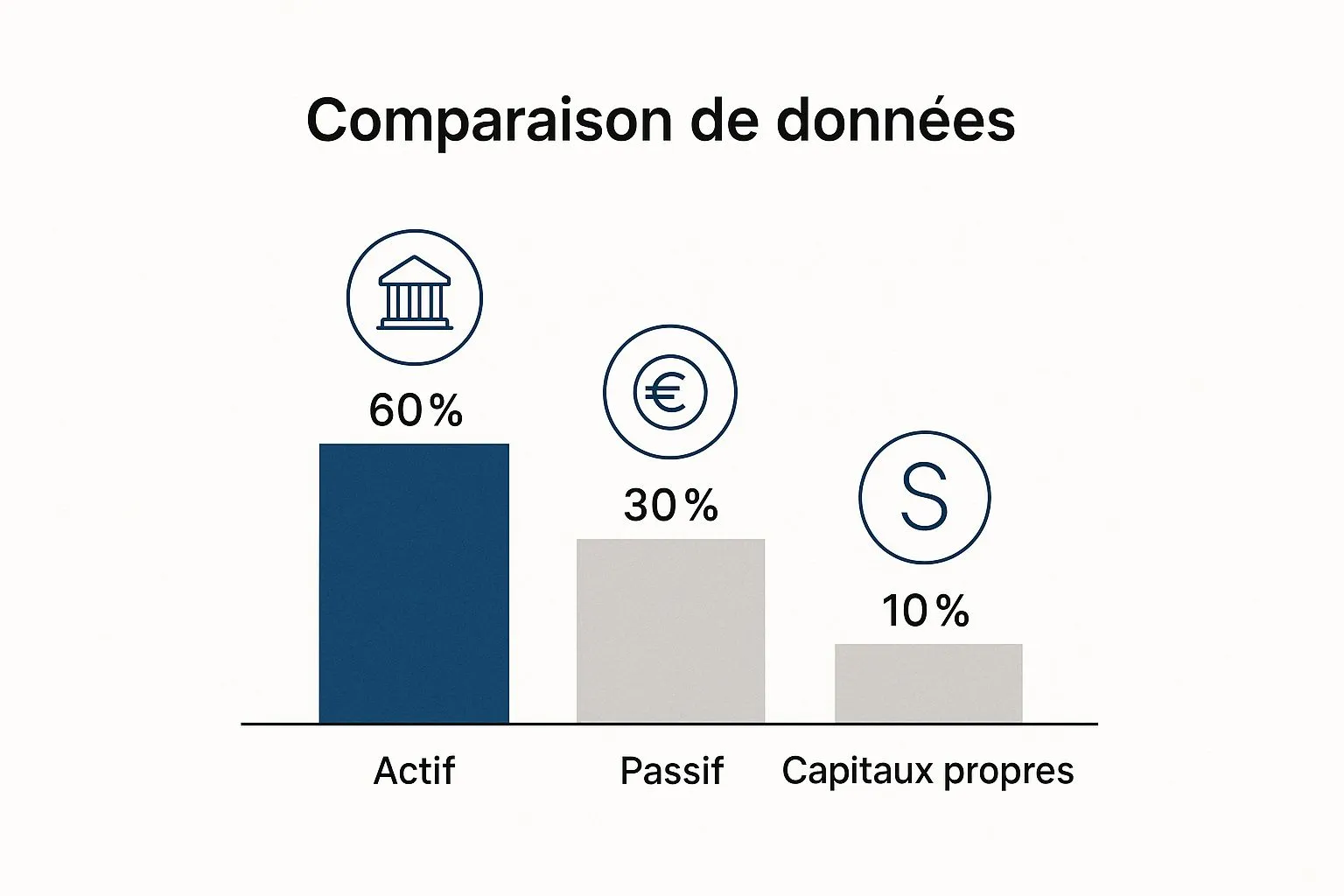
The infographic above gives us an overview of the breakdown of assets, liabilities, and equity. We can clearly see, for example, that assets make up the majority, followed by liabilities, then equity. It’s a good way to quickly visualize a company’s financial structure.
Let’s now talk about balance sheet calculations, the ones that can sometimes seem a bit complex. Rest assured, I’ll explain it all simply, the way I’d explain it to an entrepreneur friend. Because behind every calculation, there’s an economic logic. Once you understand that logic, the rest follows naturally.
Valuing your inventory: the importance of the right method
Let’s take inventory valuation. Imagine a clothing shop. The value of the clothes in stock isn’t fixed. Unsold items from a previous collection lose value, while new pieces can justify a higher price. There are several methods for valuing inventory: weighted average cost, FIFO (First In, First Out), and LIFO (Last In, First Out). The choice of method really depends on your business and your strategy.
I once helped a bookshop that used weighted average cost for all its books. By switching to FIFO for new releases and applying write-downs on older titles, they got a much more accurate picture of their inventory value, and it also optimized their tax management.
Depreciation: anticipating the wear on your assets
Another important point: calculating depreciation. Your equipment (machinery, computers, vehicles) loses value over time and with use. Depreciation accounts for this loss of value. Here too, several methods exist: straight-line depreciation, declining-balance depreciation, and units-of-production depreciation. The choice depends on the type of equipment and how it’s used.
For example, for a transport company, units-of-production depreciation, based on mileage, is more realistic than straight-line depreciation. I helped a construction company choose the depreciation method best suited to its machinery fleet, and it had a positive impact on their profitability.
Provisions: guarding against risk
Provisions are simply money set aside to cover future risks or expenses. For example, a provision for doubtful receivables lets you anticipate non-payment of certain customer invoices. A provision for litigation lets you anticipate potential legal costs. These provisions must be justified and carefully assessed.
I remember a restaurant owner who never made any provisions. By setting up a simple provision for doubtful receivables, he was able to anticipate a potential shortfall and better manage his cash flow.
Accounting restatements: refining your balance sheet
Finally, accounting restatements let you adjust raw data to get a more accurate picture of the company’s economic situation. It’s like a final polish to make everything more precise. For example, you can restate how expenses and revenues are classified.
Before moving on to the comparison table of depreciation methods, I wanted to stress that mastering these calculations not only lets you prepare your balance sheet with peace of mind, but above all lets you use it to make the right decisions for your business.
Comparison of depreciation methods
Comparative analysis of the different depreciation methods and their impact on the balance sheet
| Method | Advantages | Disadvantages | Recommended use case |
|---|---|---|---|
| Straight-line | Simple to apply | Doesn’t always reflect actual usage | Assets used consistently over time |
| Declining-balance | Tax advantage early on | Lower depreciation later on | Assets that lose value quickly |
| Units of production | Reflects actual usage | More complex to implement | Assets with variable usage |
This table summarizes the key points of each method to help you choose the one that suits you best. Preparing your balance sheet isn’t just a legal obligation — it’s a valuable tool for steering your business.
Presenting your balance sheet to impress your audience

The screenshot above, taken from the Service-Public.fr website, shows an example of a balance sheet. Classic in structure, with its assets and liabilities, it lets you visualize the company’s financial health. This official document is a reminder of how important a clear, well-organized presentation is.
There’s a secret few people will tell you: how you present your balance sheet has a direct impact on how your financial partners perceive you. I’ve personally seen solid files rejected because of a sloppy presentation, and, conversely, average balance sheets accepted thanks to careful formatting. In this section, we’ll look at how to give your numbers weight with an impeccable presentation.
Structuring information for a smooth read
First and foremost, put yourself in the shoes of the person who will read your balance sheet. A banker doesn’t have the same expectations as an investor. Be concise and logical, with clear headings and summary tables. Highlight the important elements, such as revenue growth or profitability. A chart to illustrate key trends, for example, can make all the difference.
Imagine presenting your balance sheet to a potential investor. They’ll likely be more interested in your growth potential than in the details of your depreciation. Adapt your pitch accordingly!
Highlighting your strengths
Don’t be afraid to highlight the positives! If your revenue grew by 15% compared to the previous year, showcase it clearly. If you’ve reduced your debt, emphasize that effort. The goal is to show your business at its best, while remaining fully transparent.
Writing the notes: a subtle art
The notes aren’t a dumping ground for information. They should complement and explain your balance sheet, not bury it under detail. Explain your accounting choices, justify your provisions, detail any exceptional events. Well-written notes are a sign of rigor and transparency.
Adapting the presentation to your legal structure
LLC, corporation… The presentation of the balance sheet can vary depending on your legal structure. Find out about the specifics that apply to you. For more information on preparing a balance sheet, I recommend this article: Preparing your balance sheet.
Turning your balance sheet into a communication tool
With this advice, your balance sheet will become a genuine communication tool. A well-presented balance sheet strengthens your credibility, eases negotiations, and opens doors. Believe me, at key moments, these details can make all the difference. So take care of them!
Turning your balance sheet into a strategic compass
This is where things get interesting. After preparing your balance sheet, you need to decode it to turn it into a real decision-making tool. I’ll show you how to analyze your numbers like a financial consultant, without complicated jargon or obscure formulas. The goal? Identifying the indicators that matter for your business.
Adapting the analysis to your context
There’s no magic solution! A restaurant owner doesn’t analyze their balance sheet the way a web development company does. The size of your organization also plays an important role. A small business doesn’t have the same needs as a mid-sized company. So let’s focus on the indicators suited to your situation, your industry, and your goals. For example, inventory turnover and conversion rate are crucial for an e-commerce business. For a service company, the focus is more on billed hourly rate and customer retention rate.
For instance, if you’re a craftsperson, your balance sheet will let you analyze the impact of raw material prices on your margin. If wood prices soar, your balance sheet will reflect it immediately.
Spotting early warning signs and hidden strengths
Your balance sheet can reveal weaknesses before they become major problems. A drop in gross margin rate, for example, can signal a production cost issue or tougher competition. Conversely, some financial strengths can be invisible at first glance. Good management of accounts receivable, for example, can free up funds and finance your growth. I remember a small business that, through analyzing its balance sheet, realized it could optimize its supplier payment terms and thereby improve its cash flow. A real boost for their growth!
Identifying the highest-impact areas for improvement
Analyzing your balance sheet should let you prioritize your actions. Improving your profitability is often the main goal. But how? Raise prices? Cut costs? Optimize processes? Your balance sheet guides you in identifying the most effective levers. The broader economic context also needs to be taken into account. For example, France’s public deficit reached 5.5% of GDP in 2023 and is expected to reach 6.0% in 2024 according to the government. These figures influence mandatory contributions and public spending, thereby impacting economic stability and, in turn, how balance sheets are prepared. More information here.
Benchmarking and tracking your performance
Comparing your performance to that of your competitors is essential. What are their key ratios? How are they evolving? This benchmarking gives you reference points and lets you identify best practices in the market. Don’t forget to track your own performance over time. Is your revenue growing? Is your profitability improving? This regular tracking lets you adapt your strategy and stay competitive. Imagine your conversion rate stagnating while your competitors’ keeps rising — your balance sheet will alert you to this critical point.
Turning findings into action
Analyzing your balance sheet is good. Acting on it is better! I’ll give you tips for presenting your analysis to your teams and turning your financial observations into concrete action plans. The goal is to make your balance sheet a genuine steering tool, a compass for your strategic decisions. For a simplified approach to the balance sheet, take a look at this article: Simplified balance sheet. Keep in mind that what matters isn’t enduring your numbers, but using them to build your company’s future.
To go further and simplify your accounting, discover Bizyness, the all-in-one solution for entrepreneurs. Simplify your accounting with Bizyness!
