

 Français
 bank account for sole traders: comparing the pro offers
Compare the best bank account options for sole traders and find the pro account that fits your business. Clear offers and useful advice.

When you’re starting out as a sole trader (micro-entrepreneur), choosing your bank can feel like just another box to tick on a long list. Yet it’s a far more strategic decision than it seems — a real pillar for the success of your project. A well-thought-out banking solution simplifies your daily life, protects your cash flow, and builds your credibility from day one.
Why choosing your bank is a key decision for your micro-business
Selecting the ideal banking offer is one of the first building blocks you’ll lay when setting up your micro-business. This choice goes well beyond the simple legal obligation to open a dedicated account if your revenue crosses the €10,000 threshold two years in a row. It’s really about building solid foundations for your business.
The first golden rule is to clearly separate your personal and business finances. This is essential. This discipline gives you a clear, instant view of your cash flow health, greatly simplifies your tax and social security filings, and saves you headaches in case of a URSSAF audit. Without this separation, tracking financial flows can quickly become an administrative nightmare.
The best bank isn’t necessarily the cheapest one. It’s above all the one whose services fit your reality perfectly. A freelancer who only invoices for services won’t have the same needs as a tradesperson who needs to collect payments via a card terminal.
This decision has a direct impact on your productivity. Today’s banks offer far more than a simple current account. They provide real tools to help you save time:
- Built-in invoicing tools to create and track your quotes and invoices without juggling multiple software.
- Accounting sync that automates a good chunk of data entry — a real relief.
- Simplified expense management to track your spending without pulling your hair out.
- Specialized customer support that truly understands the challenges faced by independent professionals.
The dynamism of entrepreneurship in France makes this choice even more important. Over the first eight months of the year, nearly 490,000 micro-businesses were created, representing around 65% of all new business creations. In such a competitive environment, having strong financial tools is no longer a luxury. It’s a genuine asset that lets you focus on what you do best: your craft. If you want to dig deeper into this topic, you can read the full analysis on business growth.
Ultimately, there’s no such thing as the “best bank” in absolute terms. The goal is to find the solution that fits you, adapts to your unique needs, and can evolve alongside your micro-business.
Dedicated account or business account: what does the law really say?
Untangling legal obligations can quickly become a headache, but when it comes to a sole trader’s bank account, the rule is fortunately quite simple. The 2019 PACTE law introduced welcome flexibility, especially for those just starting out.
Specifically, the obligation to open a bank account separate from your personal account isn’t automatic. It only applies to you if your annual revenue exceeds €10,000 for two consecutive years. Below that threshold, you can technically use your personal current account. That said, I’d strongly advise against it if you want a clear view of your finances.
The key nuance to grasp is the difference between a “dedicated account” and a “business account.” The law only requires a dedicated account, which is not the same as a business account, which is often paid.
A dedicated account is simply a second, standard current account that you reserve exclusively for your business. It’s the most economical solution for staying compliant and separating your finances. A business account, on the other hand, is a commercial offer from banks, with services designed for companies (small businesses, insurance, etc.), but also a higher price tag.
Which option is best for you?
The choice of your bank account for sole traders really depends on your business, your habits, and your stage of development. Today, three main types of players compete in the market, each with its own advantages.
- Traditional banks: Still relevant if you value human contact. Need face-to-face advice for a project, want to negotiate financing, or simply want reassurance from someone at a branch? This is the option to consider.
- Online banks: Perfect for independent professionals comfortable with digital tools and mindful of their budget. They offer very competitive, even free, rates for fully autonomous management via a mobile app.
- Neobanks (or online business accounts): They go a step further by integrating management tools. If you’re looking for an all-in-one solution — account, invoicing, help with filings, accounting connection — these are the ones to turn to.
The banking sector has evolved a lot and now offers solutions for every profile. You can choose between traditional current accounts, pro offers from online banks, and even free business accounts offered by players like Indy, which provides a French IBAN and Mastercard cards. To go further on this topic, feel free to explore the possibilities offered by the online business account for sole traders.
To make the right choice, ask yourself the right question: are you looking for a simple tool to collect and pay, or a true assistant to run your business? Cost is a factor, but the value the service brings you day-to-day matters just as much.
How to choose the best bank for your business? A close look at the criteria
Choosing the right pro account for your micro-business isn’t just about comparing the monthly fees displayed in big letters on websites. That’s a classic mistake that can end up costing much more than expected. To make the right choice, you need to dig a little and analyze the offer from four essential angles: overall pricing, services that simplify your life, compatibility with your accounting tools, and, of course, the quality of customer service.
Keep in mind that each criterion should be weighed against your own reality. A freelance web developer won’t have the same needs as a tradesperson selling products at markets.
Beyond the subscription price: breaking down the fee schedule
The real cost of a business account goes well beyond the monthly fee. The real work is uncovering hidden fees, often buried in the fine print, which can blow up your final bill.
To get a clear picture, here are the right questions to ask:
- Are SEPA transfers really free and unlimited? Watch out — some offers cap the number of included transfers per month (sometimes 20 or 50), and every additional transaction is billed.
- How much do transfers outside the SEPA zone cost? If you work with international clients, these fees can quickly add up to a significant budget.
- Is the physical bank card included? A virtual card is often standard, but a physical card can come at an additional cost, sometimes up to €5 per month.
- What commissions are charged on card payment terminals? This is a crucial point if you take in-person payments. These commissions, often around 1.5% to 1.75% per transaction, weigh heavily in the balance.
Overlooking these details means risking your banking fees doubling overnight.
Built-in services: when your bank becomes your right hand
A good business bank doesn’t just keep your money safe. It should help you be more efficient day-to-day. It’s the built-in services that make all the difference between a basic offer and a solution that brings real added value.
These management tools can save you a huge amount of time. Think especially of:
- The quoting and invoicing tool: Being able to create professional, legally compliant documents directly from your banking dashboard is a real plus.
- Help with URSSAF filings: Some neobanks go as far as calculating your contribution amounts for you and sending reminders before deadlines. A real relief!
- Expense management: Just take a photo of your receipt and it’s directly integrated into your accounting. Essential for any independent professional who travels often.
The idea is to centralize your administrative management as much as possible. The less you have to juggle between different software tools, the more time you have to devote to what you do best: your craft.
Thanks to these services, the cost of your account turns into an investment that automates tedious tasks and limits the risk of errors.
Accounting integration: the technical criterion not to overlook
This is a point that’s often forgotten, yet it’s absolutely fundamental. The smoothness of the connection between your bank account and your management tools can change everything. A poor sync, and all the benefits of automation go out the window.
Ideally, your bank should connect seamlessly to your accounting software so that your transactions are categorized automatically. This is what makes tracking your finances simple, fast, and reliable.
This automation is the cornerstone of healthy management. To go further on this point, I recommend reading our guide on how automatic bank reconciliation can truly transform your organization. It’s the key to saving time and having a clear view of your cash flow, effortlessly.
Customer support: your safety net when things go wrong
You only think about it when problems arise, but good customer support is the life insurance of your business. A transfer that doesn’t arrive, a lost card, blocked access… those are the moments when you’re glad to have someone competent on the other end of the line.
Quality customer service comes down to two things: responsiveness and relevance.
- Responsiveness: Do you have an easy way to reach an advisor (chat, email, phone)? How long does it take to get a response?
- Relevance: Are advisors trained to understand the specific challenges of sole traders, or do they just read from a generic script?
Poor customer support can literally paralyze your business for several days. A good reflex before signing up: go read reviews on independent platforms to get a sense of what really awaits you if a problem arises.
Comparison of the best offers for sole traders
To properly compare bank account offers for sole traders, you need to go beyond a simple list of features. The best approach is to put yourself in the user’s shoes. A freelancer just starting out doesn’t have the same needs as a growing micro-business that may already be thinking about hiring.
The market is roughly split into two categories. On one side, specialized neobanks, custom-built for independent professionals. On the other, the professional offers from major online banks. Each player has its own vision and aims to win over a specific type of sole trader.
This infographic summarizes the three pillars to base your decision on: cost, built-in services, and the quality of customer support.
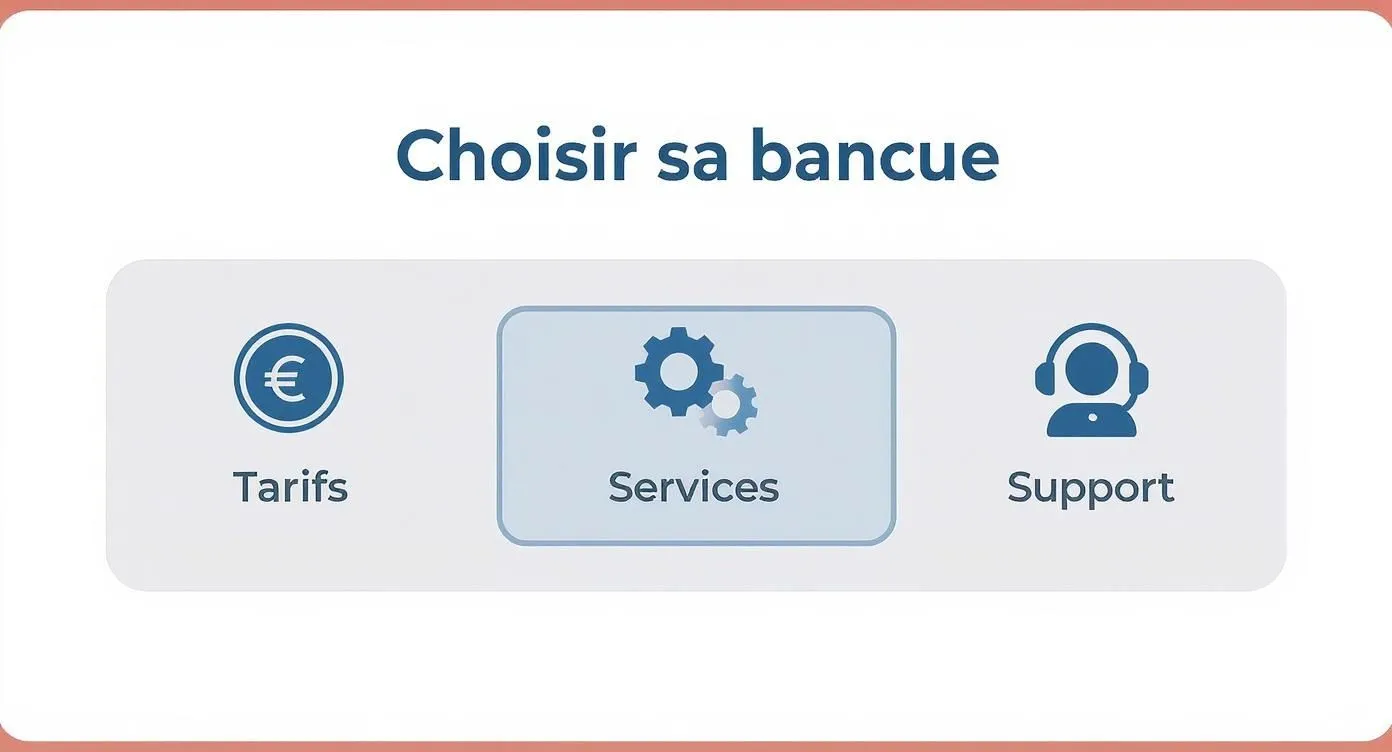
The idea is to find the right balance between a rate that doesn’t weigh on your cash flow, tools that genuinely save you time, and responsive help when you need it.
Specialized neobanks: designed for independent professionals
These new, 100% online players have really changed the game. They built their solutions with freelancers and small businesses in mind from the start. Their greatest strength? Integrating management tools that go well beyond what a traditional bank offers.
Shine: the copilot for your administrative management
A subsidiary of Société Générale, Shine presents itself as a genuine “copilot” for independent professionals. The interface is clear, intuitive, and designed to make administrative management as painless as possible.
- Ideal for: Freelancers providing services (consultants, developers, designers) who want to focus on their craft, not their paperwork.
- Standout services: Built-in invoicing tool, automatic calculation of social security contributions, and alerts for URSSAF filings. They also add practical insurance, such as accident coverage or equipment protection.
For a sole trader just starting out, Shine is incredibly reassuring. The contribution calculations and deadline reminders prevent beginner mistakes and penalties. That’s peace of mind you can’t put a price on.
Shine’s approach is genuinely centered on support and prevention, making it an excellent choice for starting your business on solid footing.
Qonto: the solution for those who think bigger
Qonto targets independent professionals and small businesses with ambition. The platform is more complete, more robust, and clearly designed to support a growing company.
- Ideal for: Sole traders considering converting to a company (SASU, EURL) or already collaborating with other freelancers.
- Standout services: The ability to create access for collaborators, unlimited virtual card creation to manage specific budgets (online ads, software subscriptions), and an advanced expense management module.
Where Qonto stands out is in its ability to structure the finances of a growing business. Everything is designed to offer more control and visibility.
Indy: the freemium model that centralizes everything
Indy shook up the market with a very aggressive value proposition: a fully free business account, backed by accounting software.
- Ideal for: Sole traders who want to minimize fixed costs at launch without sacrificing management tools.
- Standout services: The strong point is the perfect sync between the bank account and the in-house accounting tool. Indy also helps with income tax filing, manages VAT, and generates essential accounting documents.
Indy’s model is very attractive for those who want to centralize everything (banking and accounting) without paying a monthly subscription. More advanced services are available through paid options.
Online banks: solidity at a competitive price
The heavyweights of online banking haven’t sat idle. They’ve developed their own offers for professionals, leveraging their reputation and infrastructure while offering very attractive rates.
Boursorama Pro: the efficiency of a leader
Through its Boursorama Pro offer, Boursorama Banque offers a highly competitive business account for just €9 excl. VAT/month.
- Ideal for: Sole traders looking above all for a simple, reliable, and economical solution, with the security of a major bank behind it.
- Standout services: The offer sticks to the essentials and does them well. It includes an Ultim card (immediate or deferred debit), free instant transfers, comprehensive insurance, and access to a Zettle Mpos payment terminal at a negotiated rate.
This is the pragmatic choice. Perfect for those who don’t need a built-in invoicing tool but want the reliability of a big name.
Hello bank! Pro: the best of both worlds
A subsidiary of BNP Paribas, Hello bank! Pro offers a very balanced solution.
- Ideal for: Sole traders who need to be able to deposit checks or cash. This is a real advantage for tradespeople, shopkeepers, or professionals who still collect payment this way.
- Standout services: This is its trump card against neobanks. Being able to use BNP Paribas’s network of machines for deposits changes the game for many businesses.
This hybrid approach combines the agility of an online bank with the very concrete advantages of a physical branch network.
To dig deeper into your analysis, feel free to check out our comparison of business bank accounts, which offers an even broader view to help you see things clearly.
Summary of banking offers for sole traders
To help you quickly visualize the strengths of each solution, this table compares the offers on the criteria that matter most to a sole trader.
| Banking Solution | Monthly Rate (from) | Key Services Included | Ideal Profile |
|---|---|---|---|
| Shine | €7.90 excl. VAT | Invoicing tool, social contribution calculation, insurance | The freelancer providing services looking for administrative simplicity. |
| Qonto | €9 excl. VAT | Team management, unlimited virtual cards, expense management | The sole trader with growth ambitions or who collaborates with others. |
| Indy | €0 | Free business account, accounting software, help with filings | The budget-conscious sole trader who wants to centralize everything. |
| Boursorama Pro | €9 excl. VAT | Ultim card, instant transfers, comprehensive insurance | The independent professional looking for a solid, economical banking offer. |
| Hello bank! Pro | €10.90 excl. VAT | Check/cash deposits at branches, Visa card, insurance | The tradesperson, shopkeeper, or freelancer who needs a link to a physical network. |
Ultimately, the best choice really depends on you and your business. If automating paperwork is your priority, Shine and Indy are formidable options. If you’re anticipating rapid growth, Qonto’s scalable platform is made for you. And if you’re looking for unbeatable value with the security of a major bank, Boursorama Pro and Hello bank! Pro are safe bets.
Which bank to choose based on your business and income?
A technical comparison is good, but it doesn’t tell the whole story. The best bank for a sole trader is the one that fits your daily life, your reality. To make the right choice, you first need to ask yourself the right questions on three points: the nature of your business, your current revenue, and, of course, your ambitions.
There’s no miracle solution that suits everyone. The idea here is to point you toward the most logical and cost-effective choice for your situation. By recognizing yourself in one of the profiles below, you’ll immediately see things more clearly and avoid paying for unnecessary services.
Profile 1: The freelancer providing services
You’re a consultant, developer, designer, writer… In short, your transactions are fairly simple. You send invoices to a handful of clients, mostly in France, and receive SEPA transfers. On the expense side, we’re mainly talking about software subscriptions and a few travel costs.
- Your essential needs: An account with a French IBAN that doesn’t cost you an arm and a leg, a bank card that works well for your online purchases, and, if possible, a small built-in invoicing tool to save time.
- Indy: If your goal is to cut fixed costs to the bare minimum, their free offer is simply unbeatable. The real plus is the perfect sync with their accounting software.
- Shine: For a few euros a month, you move up a gear. Shine acts as a genuine administrative assistant that helps you calculate your contributions and sends you reminders. It’s a small investment that can bring you a lot of peace of mind.
For this type of profile, traditional banks don’t really offer added value. The agility and tools of neobanks are much better suited to your pace.
Profile 2: The tradesperson or shopkeeper
Whether you’re a plumber, a market vendor, or you run an online shop, your daily life is different. You need to be able to accept card payments, sometimes deposit checks or even cash, all while managing purchases of raw materials or stock.
- Your essential needs: A reliable card payment terminal with acceptable commissions, the ability to deposit cash or checks, and solid professional insurance such as professional liability coverage.
- Hello bank! Pro: This is probably the most obvious choice if physical deposits are part of your routine. Being able to use the BNP Paribas branch network to deposit your takings is a decisive advantage that neobanks simply can’t offer.
- Qonto: If you work mostly without cash, Qonto is a very serious option. They offer integrations with excellent payment terminals (like Zettle) and their platform is very robust for tracking your many expenses and payments to suppliers.
For a tradesperson, the reliability of payment collection is a matter of survival. Choosing a bank that makes it easy to access a good payment terminal and helps you manage varied cash flows is absolutely fundamental.
Profile 3: The content creator or side business
You’re launching on YouTube, running a blog, or your micro-business is something you run alongside a salaried job. Your income is still modest, sometimes irregular. Your top priority is therefore to limit fixed costs so your project doesn’t end up costing you money.
This scenario is extremely common. It’s worth knowing that most sole traders earn on average between €590 and €670 per month. Half of them even report less than €340 a month, since this status is often used as supplementary income. To go further, you can check out this analysis on sole traders’ income.
- Your essential needs: A dedicated account that’s free, or nearly so, just to be compliant with the law and clearly separate your finances. No frills.
- Indy: Hard to beat. Their free business account perfectly meets the legal requirement without costing you a single cent.
- Boursorama Pro: For a very low rate, you get the solidity of a major online bank. That can be a reassuring factor when you’re just starting out.
Keep in mind that your choice of bank isn’t set in stone. Nothing stops you from starting with a simple, economical solution. If your business takes off, your needs will change, and you can always migrate to a more complete offer.
How to make the right final choice?
Choosing the ideal bank for your micro-business isn’t that complicated. It all starts with a simple step that’s often overlooked: taking stock of your own needs.
Take a moment to ask yourself the right questions. What’s the nature of your business? If you’re a tradesperson at markets, a payment terminal is probably essential. On the other hand, if you’re a web developer, you’ll mainly need to make transfers easily. How many transactions do you expect to make per month? Is a responsive, available customer service a non-negotiable criterion for you, or would you rather manage everything in complete autonomy?
Thinking about today, but also tomorrow
Once you have a clear picture of your expectations, you’ll be able to effectively compare what banks offer. And above all, don’t forget to plan ahead. A free offer may seem perfect for a gentle start, but will it still make sense if your business takes off and your revenue doubles next year?
Think of your business account less as an administrative obligation and more as a true ally. The right bank should simplify your life and free your mind, so you can focus on what really matters: your craft.
The world of professional banking is constantly evolving. New players are arriving, offers are changing. Your choice today isn’t therefore set in stone. The key is to find the solution best suited to your current situation, one that will let you lay healthy financial foundations to support your success.
Frequently asked questions about bank accounts for sole traders
The banking world for independent professionals can quickly become a real maze. To help you see things more clearly, I’ve gathered here the questions that come up most often, with direct answers and no jargon. The idea is to give you all the keys to make a calm, well-informed choice.
Is a business account really mandatory?
No, and that’s an important nuance. The law doesn’t require you to take out a “business account,” which is above all a commercial offer, often more expensive. What is mandatory is having a dedicated account for your business, and only if your revenue exceeds €10,000 over two consecutive years.
A dedicated account can therefore simply be a standard current account in your name, used only for your business. It’s this separation that’s crucial for keeping healthy management and clear accounting, even if you’re below this threshold.
Can I keep my personal account for my business?
Technically, yes, as long as you stay under the famous €10,000 threshold for two years. But honestly, it’s a bad idea in disguise.
Mixing your business and personal expenses is the best way to lose track of your cash flow, struggle with your URSSAF filings, and pull your hair out when it’s time to file your income tax return. Imagine a tax audit: untangling that mess can quickly become a nightmare and raise suspicion with the administration.
Using your personal account for your business is a bit like trying to navigate in thick fog without a compass. A dedicated account, even the most basic one, is a small effort for enormous peace of mind.
How do I switch banks without hassle?
If your current bank no longer satisfies you, know that switching your bank account as a sole trader has become child’s play. All thanks to bank switching mobility, a service your new bank handles to automate the transfer of all your operations.
Specifically, here’s how it works:
- You open your new account with the provider of your choice.
- You sign a bank switching mandate. This is the document that gives your new bank the green light to handle everything.
- And that’s it for you! The new bank contacts the old one, migrates your recurring transfers and direct debits, and notifies the relevant organizations of your IBAN change.
The system is designed so everything runs smoothly and you experience no interruption in your operations.
Are neobanks really safe?
Completely. Neobanks and other online business accounts operating in France are subject to very strict rules to guarantee the safety of your money. The vast majority hold a payment institution or credit institution license, granted by the ACPR, the banking watchdog attached to the Banque de France.
This means your money is covered by the Deposit and Resolution Guarantee Fund (FGDR) up to €100,000. That’s exactly the same protection as at a traditional bank. So you get the same security, but with the flexibility and digital tools on top.
And if you want to go even further by centralizing invoicing and accounting in one place, Bizyness has designed a complete solution specifically for sole traders. Discover how to simplify your management today with Bizyness.
