

 Français
Break-even point calculation: a practical guide for entrepreneurs
Discover how to nail your break-even point calculation with our simple tips. Boost your financial management right now!

Demystifying the break-even point calculation
The break-even point, also called the break-even threshold, is an essential financial indicator for any business. It shows the level of activity, in revenue, at which income exactly covers expenses, with neither profit nor loss. It’s the starting point of profitability.
Understanding why the break-even point matters
Knowing your break-even point is crucial for several reasons. It lets you set realistic revenue targets and assess the viability of a project. For example, a meal-delivery business can use it to determine the minimum number of orders needed to cover its costs (salaries, rent, etc.). The break-even point also helps you anticipate financial risks and adjust your strategy if needed.
In France, this calculation is particularly important when starting or taking over a business. It helps determine the minimum revenue needed to cover fixed and variable costs. The standard formula is: Break-even point = Fixed costs / Contribution margin ratio. Take the example of an SME with €100,000 in annual fixed costs and a contribution margin ratio of 40%. Its break-even point would be €250,000 in revenue. Below that amount, the company is running at a loss. For more information, see this article on calculating the break-even point here.
The components of the calculation
Two main elements make up the break-even point calculation: fixed costs and the contribution margin ratio. Fixed costs are expenses that don’t depend on activity level, such as rent. The contribution margin ratio represents the portion of revenue left over after deducting costs tied to production or sales.
A decision-support tool
The break-even point is a valuable decision-support tool. It helps you assess the impact of different strategies, such as changing selling prices or cutting costs. For example, a shop planning a sale can use this calculation to anticipate the impact on its profitability.
Mastering the break-even point calculation is therefore essential for running a business effectively and ensuring its longevity. It allows you to make informed decisions, optimize your strategy, and maximize your chances of success.
The formula explained without accounting jargon

Let’s forget the complex terms and focus on calculating the break-even point. We’ll break the formula down to make it accessible to everyone, whatever your industry (retail, crafts, services). What matters is understanding the mechanism and applying it to your own situation.
For a clearer understanding, let’s dig into the essential elements of this calculation.
Identifying fixed and variable costs
The break-even point calculation rests on two pillars: fixed costs and variable costs.
Fixed costs stay constant regardless of your volume of activity. Rent, internet subscriptions, and salaries are examples of fixed costs.
Variable costs, on the other hand, fluctuate with your activity. The more you sell, the more they increase. For a baker, flour, sugar, and yeast are variable costs. Their quantity depends directly on the number of baguettes produced. Distinguishing between these two types of costs is fundamental to an accurate calculation.
The break-even point formula: a simple equation
The formula is as follows: Break-even point = Fixed costs / Contribution margin ratio.
The contribution margin ratio represents the share of revenue remaining after deducting variable costs. You get it by subtracting variable costs from revenue, then dividing the result by revenue.
Let’s illustrate with a concrete example: a jewelry designer has €500 in monthly fixed costs and a contribution margin ratio of 60%. Her break-even point is therefore €833.33. She needs to generate €833.33 in revenue each month to cover her costs and reach her break-even point.
Before going further, let’s take a moment to analyze the components of this essential calculation. The table below details each element:
To fully understand the break-even point calculation, it’s essential to precisely identify the elements that make it up. The following table will help with that.
| Component | Definition | How to calculate it | Example figure |
|---|---|---|---|
| Fixed costs | Constant expenses, independent of activity volume. | List all of the company’s fixed expenses. | €500 |
| Variable costs | Expenses that fluctuate with activity volume. | List all variable expenses tied to production/sales. | €400 |
| Revenue | Total sales generated. | Unit price x quantities sold | €1,000 |
| Contribution margin ratio | Percentage of revenue remaining after deducting variable costs. | (Revenue - Variable costs) / Revenue | 60% |
This table summarizes the key elements for calculating the break-even point and provides a concrete example to better visualize their application.
Applying the calculation across industries
This calculation is universal and applies to every industry. A restaurant will include the cost of ingredients and staff salaries in its variable costs. A freelance consultant, on the other hand, will mostly have fixed costs (office, work tools). The key is to correctly identify the costs specific to your activity. A tool like Bizyness can automate this tracking and give you a clearer view of your expenses.
Mastering this calculation lets you steer your business with confidence. It gives you a precise view of your profitability and helps you make informed decisions for your company’s growth.
Getting a handle on your fixed costs to lower your break-even point
Identifying and controlling your fixed costs is essential to optimizing your break-even point. These expenses, constant regardless of activity volume, need to be precisely mapped out for sound financial management. This rigorous work helps avoid calculation errors that could skew your profitability analysis.
Identifying fixed costs: an essential first step
A company’s fixed costs consist of recurring expenses such as rent, salaries and social contributions, subscriptions, and insurance. Precisely identifying these expense items is the first step toward optimizing your break-even point. For example, some French entrepreneurs have gotten a better handle on their fixed costs through a detailed review of each expense. This meticulous work has helped uncover unnecessary subscriptions or negotiable contracts, a major asset for running a business effectively.
Optimizing fixed costs: concrete solutions
Once fixed costs have been identified, optimization strategies can be considered. Renegotiating a commercial lease can be a significant lever, but its actual impact on the break-even point needs to be carefully assessed. Rethinking the organization of certain fixed items can also generate significant savings. Remote work, for example, can reduce costs tied to premises. The main goal is to optimize without compromising the quality of service provided.
In France, fixed costs represent a significant share of SME revenue, often between 35% and 50%. For a company generating €500,000 in annual revenue, that represents between €175,000 and €250,000 in fixed costs. Controlling these costs is therefore key to lowering the break-even point and gaining a competitive edge. For more information on calculating the break-even point, see this page: Break-even point.
Concrete optimization examples
French small and medium businesses have managed to cut their fixed costs by 15% to 25% without hurting, and sometimes even improving, the quality of their services. Some have chosen to pool services such as accounting or customer support. Others have bet on digitizing their processes to gain efficiency and reduce administrative costs. These examples show that it’s possible to take concrete action on fixed costs and significantly improve profitability. Using a tool like Bizyness makes it possible to precisely track fixed costs and identify optimization levers suited to each situation. This not only lowers the break-even point but also strengthens resilience against market fluctuations — a valuable asset for weathering tough periods.
Calculating your contribution margin like a pro

The contribution margin ratio is an essential financial indicator for the health of your business. It measures the profitability of your products or services after deducting the costs directly tied to their production or sale. Understanding it well and calculating it accurately are essential to ensuring your business’s long-term viability.
Determining your variable costs precisely
The preliminary step to calculating your contribution margin ratio is to rigorously identify your variable costs. These expenses fluctuate with your production or sales volume. For an e-commerce seller, for example, this means the cost of purchasing products, plus packaging and shipping fees. For a consultant, it might include travel expenses tied to assignments. An interesting article on the topic: How to master variable cost calculation.
The contribution margin formula: simple and effective
Calculating the contribution margin ratio is fairly simple once variable costs have been determined. The formula is as follows: (Revenue - Variable costs) / Revenue. Let’s take a concrete example: revenue of €10,000 and variable costs of €4,000 result in a contribution margin ratio of 60%. This percentage represents the portion of revenue that contributes to covering your fixed costs and, ideally, generating profit.
Improving your contribution margin: levers for action
Several actions can be taken to optimize your contribution margin. Analyzing your product or service range helps identify, and potentially cut, the least profitable offerings. Optimizing your purchasing, by negotiating better rates with suppliers or seeking less costly alternatives, is also an important lever. Finally, reviewing your processes for production or delivery can help reduce your costs.
Spotting warning signs
Regularly monitoring your contribution margin is essential to quickly catching any anomaly. An unexpected drop can signal an increase in variable costs, a decrease in selling prices, or a combination of both. In that case, it’s crucial to identify the source of the problem and put corrective measures in place. For example, faced with rising supply costs, renegotiating with suppliers or seeking new partners can be considered.
Mastering the calculation and optimization of your contribution margin is therefore a major asset for the profitability and viability of your business. This indicator gives you a clear view of your business’s performance and helps you anticipate difficulties and seize opportunities.
Transforming your decisions with the break-even point
The break-even point is much more than a simple accounting calculation. It’s an essential strategic tool for steering your business and making informed decisions. It helps you anticipate risks, plan investments, and optimize business development.
The break-even point: a decision-support tool
Many French entrepreneurs use the break-even point to avoid costly mistakes. Take the example of a restaurant owner looking to expand their establishment. Calculating the break-even point lets them assess the impact of this investment (higher rent, additional hires) and determine the minimum revenue needed to stay profitable. This kind of preventive analysis is essential to the long-term survival of any business.
The chart below illustrates the key elements of the break-even point calculation: total fixed costs, variable cost per unit, and selling price per unit.
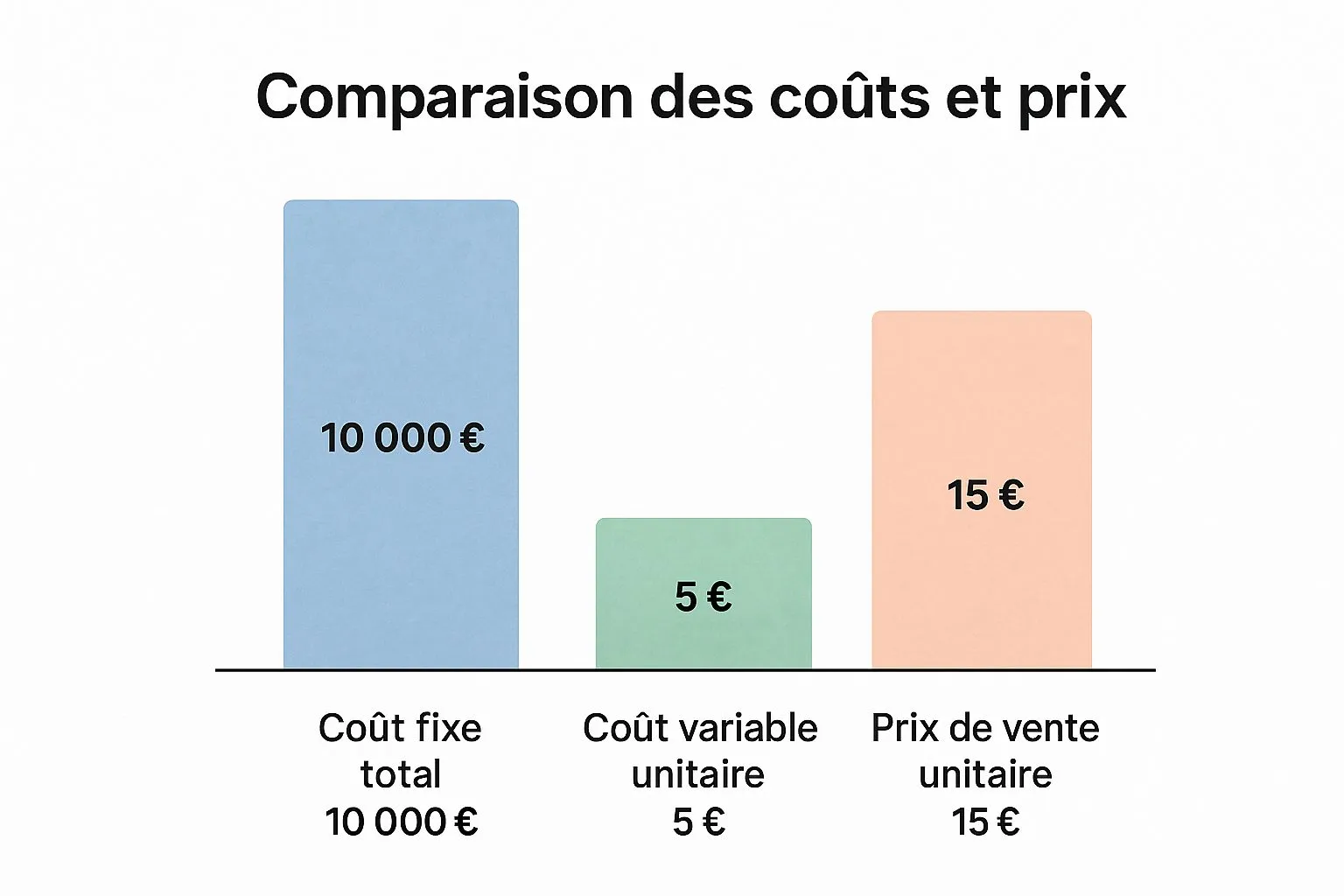
The infographic highlights the importance of the contribution margin per unit (the difference between the unit selling price and the unit variable cost). The larger this margin, the more each sale contributes to covering fixed costs, and the faster the break-even point is reached.
Simulating different scenarios to optimize your profitability
Even without being an accountant, you can run simple, effective financial simulations using tools like Bizyness. By adjusting the variables in the formula (selling price, fixed costs, variable costs), you can assess the impact of different scenarios on your profitability. Imagine, for example, the effect of a 10% increase in your selling prices, or a 5% reduction in your fixed costs.
Concrete applications for French business owners
The break-even point is a valuable tool for French business owners. It helps them optimize their strategic decisions and improve their performance.
Here are a few concrete applications:
- Determining optimal selling prices: Analyzing the impact of price on sales volume and the break-even point helps identify the ideal price to maximize profits.
- Identifying genuinely profitable products: Calculating the break-even point for each product helps distinguish flagship products from those generating losses.
- Building compelling pitches: The break-even point is a key indicator for presenting a project’s viability and potential to bankers or investors.
Additionally, anticipating the impact of an investment is crucial. An investment generating €10,000 in additional fixed costs requires a new break-even point calculation to ensure sufficient revenue. Learn more about the impact of investments on the break-even point. This kind of analysis is fundamental to validating any project in France. Using the break-even point as a steering tool helps anticipate risks and maximize the chances of success.
To illustrate the impact of strategic decisions, here’s a comparison table:
Impact of strategic decisions on your profitability
This table shows how your strategic choices concretely affect your break-even point and the time it takes to reach profitability.
| Type of decision | Impact on fixed costs | Impact on the contribution margin | Effect on the break-even point | Mitigation strategies |
|---|---|---|---|---|
| Investment in new equipment | Increase | Potentially positive (increased productivity) | Increase | Negotiating purchase prices, optimizing equipment use |
| Reduction in staffing costs | Decrease | Stable or slightly negative (impact on motivation and productivity) | Decrease | Outsourcing certain tasks, automating processes |
| Increase in selling prices | Stable | Increase | Decrease | Market research to assess acceptability of new prices, clear communication on added value |
In conclusion, this table shows that every strategic decision has a direct impact on the break-even point. Analyzing these impacts is essential to making informed decisions and optimizing your company’s performance.
Building your financial management dashboard

Once you’ve mastered the break-even point calculation, integrating it into a clear, effective management tool becomes essential. The financial dashboard meets that need. It lets you track your company’s progress toward profitability and anticipate potential obstacles. The goal is to turn this key figure into a genuine lever for action.
The key indicators to track
The break-even point is just one indicator among others. For a complete view of your performance, the margin of safety is an important element. It represents the gap between your revenue and your break-even point. A large margin reflects better resilience to market fluctuations. The operating ratio, meanwhile, measures the relationship between your operating expenses and your revenue. A low ratio indicates efficient use of your resources.
Automating creation and monitoring
Many tools simplify creating and monitoring your dashboard. Bizyness, for example, makes bookkeeping easier for small businesses and sole traders. Automating invoices, VAT, and transactions frees up your time for data analysis. Spreadsheets also offer great flexibility for customizing your dashboard. You might be interested in this article: How to master your business dashboard.
Getting your team involved
The financial dashboard isn’t reserved for the business owner. Sharing this information with your team fosters a culture of shared financial responsibility. Each team member then understands the impact of their work on overall profitability. This encourages engagement and the pursuit of daily optimizations.
Concrete examples of use
An artisan can track their weekly revenue and compare it to their break-even point to anticipate slow periods and adjust production. An e-commerce seller can track the trend of their margin of safety to quickly identify underperforming products. The dashboard becomes a decision-support tool, serving more precise management of the business.
Anticipating and optimizing
Regular monitoring and relevant analysis of indicators help identify areas for improvement. A drop in the margin of safety can signal a cost or pricing issue. A rise in the operating ratio can indicate a need to optimize certain processes. The financial dashboard lets you anticipate these difficulties and act quickly. In conclusion, it turns the break-even point calculation into a genuine management strategy. It gives you the keys to reach and exceed your goals, thanks to concrete data and real-time monitoring.
Beyond the calculation: the strategies of profitable entrepreneurs
The break-even point calculation is fundamental, but it’s only a first step. Its true value lies in how profitable entrepreneurs use it strategically to optimize their profitability. How do top-performing business owners leverage this analysis to drive growth and maximize profits?
Refining your value proposition
Break-even point analysis helps identify levers for improving profitability. Understanding the impact of each product or service on revenue and costs allows entrepreneurs to refine their value proposition.
For example, a low-margin product with high sales volume might justify a review of production costs or a slight price increase. Conversely, a high-margin product with low sales could benefit from a more dynamic marketing strategy.
Targeting profitable customers
The break-even point also helps identify the most profitable customer segments. Analyzing acquisition costs and the lifetime value of each customer allows you to focus efforts on the most profitable segments.
This targeted approach optimizes marketing spend and maximizes return on investment.
Optimizing the product/service mix
Analyzing the break-even point for each product or service helps optimize the product/service mix. Some entrepreneurs favor a handful of flagship, high-margin products, while others prefer a diversified offering for a broader audience.
The key is to find the right balance to reach and exceed the break-even point while meeting market needs. To control operating costs and build an effective financial dashboard, comparing the different pricing plans of GepettoApp can be useful.
Inspiration from entrepreneurs’ successes
Many French entrepreneurs have improved their profitability through the strategic use of the break-even point. Some have cut fixed costs by renegotiating supplier contracts or streamlining internal processes. Others have developed more profitable offerings by analyzing their costs and margins.
These examples prove that calculating the break-even point is a genuine steering tool for growth, far more than a mere accounting formality.
Overcoming business obstacles
The path to profitability is full of obstacles: competition, cost fluctuations, customer acquisition… The break-even point serves as a compass to anticipate difficulties, adjust strategy, and make informed decisions. It allows you to shift from a sales-volume mindset to a profitability-focused one. Mastering your annual accounting is also a major asset.
An action plan for profitable growth
The break-even point is a powerful tool for building a concrete action plan and achieving profitable growth. By combining this analysis with a precise business strategy, entrepreneurs optimize their performance, maximize their profits, and ensure the long-term survival of their business.
Reach your break-even point faster with Bizyness. Free trial: https://www.bizyness.fr
