

 Français
 Break-even point and profitability threshold: your complete guide
Master the break-even point and profitability threshold with our expert guide. Calculations, analysis and strategies to optimize your business's profitability.

The break-even point explained: your financial GPS

Imagine you’re at the wheel of your business, about to set off on a long journey toward success. Your revenue is your fuel, and the road is lined with expenses, small and large. How do you know if you have enough fuel to reach your destination? And more importantly, at what exact point of the trip will you stop driving at a loss and finally start making a profit?
That’s precisely what the break-even point, also called the profitability threshold, is for. Think of it as your financial GPS. It shows you the exact spot on the map where your revenue covers the entirety of your costs. It’s the zero mile marker of your profitability.
More than just a number, this indicator is a genuine steering tool. It turns the abstract question “Am I profitable?” into a concrete, measurable goal. Knowing your profitability threshold gives you a clear target: the minimum revenue you need to reach for your business to be viable. This clarity is essential for making informed decisions, whether adjusting your prices, planning a marketing campaign, or evaluating an investment.
From concept to strategy
The profitability threshold isn’t just an accounting term. It’s a barometer that measures the health of your business model. A high break-even point can indicate that your cost structure is heavy, making you more vulnerable to market fluctuations. Conversely, a low threshold is often a sign of agility and an ability to become profitable faster, even with modest sales.
In France, the profitability threshold is a key indicator for any business looking to steer its performance. It shows the sales level at which revenue covers all expenses, whether fixed (like rent) or variable (like raw materials). For a detailed approach to the calculation, the Bpifrance Création resources are an excellent starting point.
Why does it matter so much?
Mastering the break-even point concept gives you a genuine head start. It helps you:
- Anticipate: Assess whether a new product or project has a chance of being profitable before you even launch it.
- Steer: Base your decisions on concrete data rather than navigating blind.
- Convince: Present a solid, credible business plan to your partners, such as banks or investors.
In short, ignoring your break-even point is like driving blindfolded. You’re moving forward, sure, but without knowing whether the next stretch leads to success or an obstacle. Calculating it and tracking it means taking control of your financial trajectory.
Breaking down your costs: the art of classification

Before diving into calculating your break-even point or profitability threshold, a crucial step awaits: playing financial detective. Your mission, should you choose to accept it, is to comb through every expense in your business. While this may seem tedious, this analysis is the foundation of sound management. Misclassifying costs could skew all your calculations and lead you to make risky strategic decisions.
The goal is simple: split your expenses into two clearly distinct categories. This breakdown is key to truly understanding how your business model works and what drives your profitability.
Fixed costs: the foundation of your business
Think of fixed costs like the rent on your apartment. Whether you’re there every day or away on vacation for a month, the amount due stays the same. For your business, it’s exactly the same principle. These are the costs you must bear whether you make zero sales or a thousand. They represent the baseline operating cost of your business.
Among the most common:
- Rent for your offices or warehouse.
- Salaries of your permanent employees (fixed portion).
- Software subscriptions, such as your e-commerce platform or a management tool like Bizyness.
- Your professional insurance premiums.
- Your accountant’s fees.
These expenses are generally stable in the short term and determine your business’s level of operational risk.
Variable costs: the pulse of your activity
Conversely, variable costs are directly tied to your sales volume. Take the example of a restaurant owner: the more pizzas they sell, the more flour, tomato sauce and mozzarella they need to buy. These costs rise in step with your sales. And if you sell nothing, these expenses are simply zero.
Here are a few concrete examples:
- For an e-commerce seller: the cost of purchasing products, packaging boxes and shipping fees.
- For a restaurant: the cost of food ingredients and beverages.
- For a consultant: subcontracting fees for a project or commissions paid to referral partners.
The methodology for calculating the profitability threshold, often highlighted by organizations like Bpifrance, rests entirely on this distinction. Fixed costs are unavoidable expenses, while variable costs fluctuate with revenue. To dig deeper into this topic, you can consult the detailed recommendations on Bpifrance Création.
Once you’ve carefully classified all your expenses, you have the two essential ingredients to move forward: calculating your contribution margin and, finally, your precious profitability threshold.
Mastering the calculations: break-even formulas explained simply
Once your fixed and variable costs are clearly identified, it’s time to move on to the calculation. Don’t worry, you don’t need to be a math genius to determine your break-even point, also called the profitability threshold. The formulas are, above all, logical tools designed to give you a clear picture of the financial performance needed to reach equilibrium. Let’s look together at the most common methods so you can apply them without difficulty.
The basic formula: the profitability threshold in value
The first and most widespread approach is to calculate the minimum revenue (turnover) to generate. To do this, you first need to determine your contribution margin rate. This key indicator shows what proportion of each sale is actually available to pay your fixed costs.
The formula is as follows:
- Contribution margin rate = ([Revenue - Variable Costs] / Revenue)
With this rate in hand, calculating the profitability threshold becomes very straightforward:
- Profitability threshold (€) = Fixed Costs / Contribution margin rate
The result is the exact amount you need to sell so that your revenue covers all your expenses. It’s your minimum revenue target so you don’t lose money. If you’d like to explore the different methods further, feel free to check out our detailed guide on calculating the profitability threshold.
The volume formula: how many products do you need to sell?
For many entrepreneurs, especially in retail or e-commerce, thinking in terms of number of products to sell is more concrete and relatable. This method turns an abstract financial goal into a tangible sales mission.
Here’s how to calculate it:
- Profitability threshold (in quantity) = Fixed Costs / (Unit selling price - Unit variable cost)
The element (Unit selling price - Unit variable cost) is what’s known as the unit contribution margin. It’s the gross profit you make on each unit sold, before covering fixed costs.
This chart perfectly illustrates the concept: with fixed costs of €10,000 and a margin per unit of €50, the break-even point is reached when 200 units are sold.
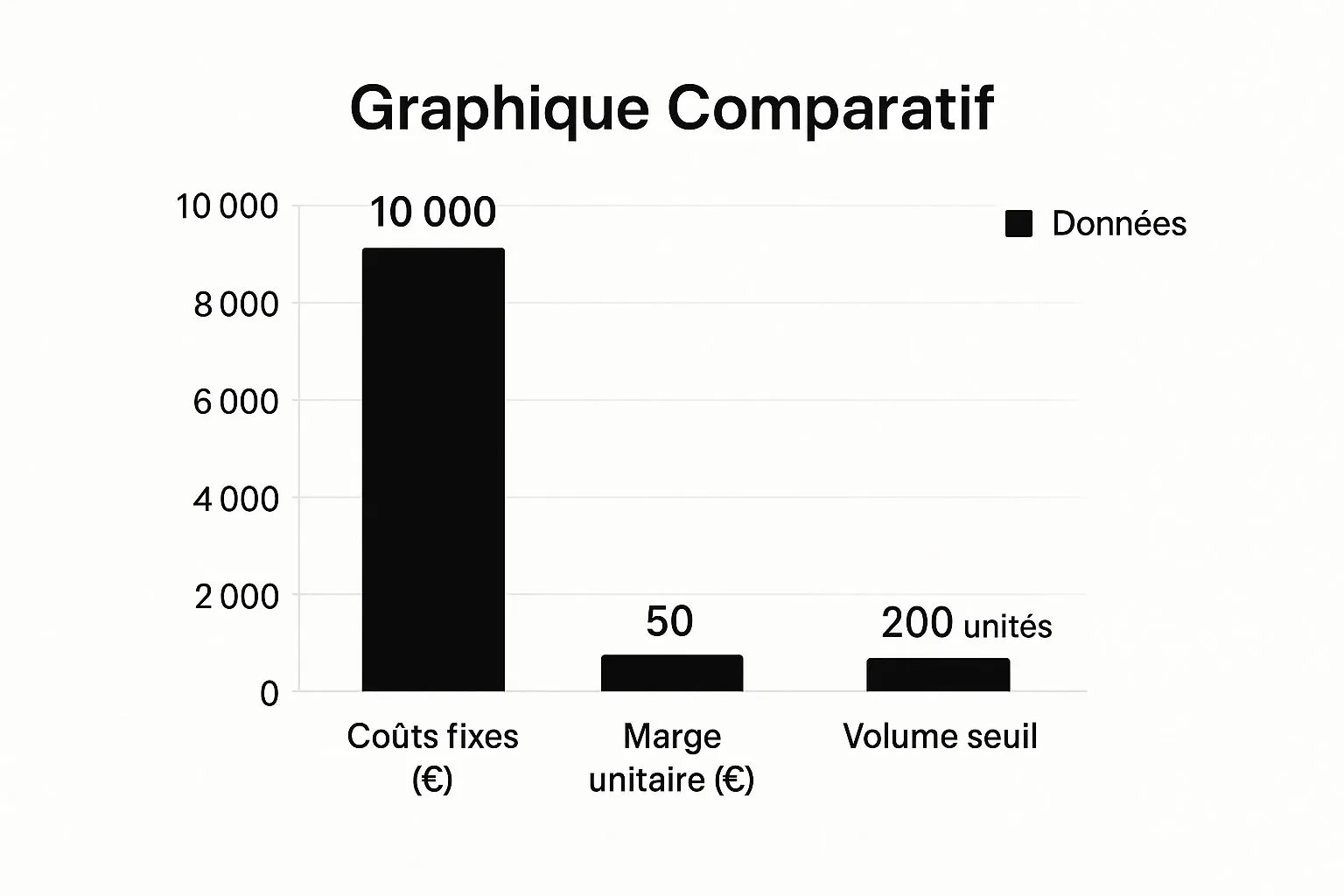
This visual representation highlights the direct relationship between the fixed costs to cover and the margin generated by each sale to ultimately reach the equilibrium point.
Interpreting your results: beyond the raw numbers

Calculating your break-even point is an essential first step, but the real value of this figure lies in its interpretation. It’s not just about knowing when you cover your costs, but understanding what this threshold says about the health and soundness of your business model. A simple number then becomes a genuine guide for your strategic decisions.
Picture a low profitability threshold. This is often a sign of an agile, responsive business. It means you don’t need a huge sales volume to cover your costs, giving you valuable flexibility to become profitable quickly. Conversely, a high profitability threshold can signal a heavy cost structure, making you more vulnerable to drops in activity. It’s a clear sign that it may be time to review your fixed costs for potential optimizations.
Add context with complementary indicators
For a finer analysis, the break-even point alone isn’t enough. Consider using it alongside two other indicators to get a complete picture of your financial situation:
-
Calculation: Revenue - Profitability threshold.
-
Calculation: (Safety margin / Revenue) x 100.
These indicators turn your break-even point into a genuine dashboard. A low safety margin ratio, for example, is a warning sign. It should prompt you to take action to boost sales or control costs. This analysis, even a simple one, is a pillar of sound management, just like keeping a simplified balance sheet.
Your break-even point in a broader context
Profitability is also a matter of sector. It’s always useful to compare your performance to that of your peers. For example, companies’ margin rate is a very telling economic indicator. In 2019, French industry posted an average margin rate of 30.1%. This figure directly influences the average level of the profitability threshold in that sector.
Comparing your own margin rate and break-even point to these averages can highlight strengths or weaknesses in your structure. To explore this data further, you can check out INSEE’s publications on business performance.
Case studies: from theory to practice on the ground
Formulas and concepts are one thing, but nothing beats diving into real-world situations to truly grasp the break-even point, or profitability threshold. To move from theory to practical skill, the simplest way is to see how other businesses have used this tool to guide their decisions. Their experiences, regardless of industry, can inspire strategies you can apply to your own business.
To show just how adaptable this indicator is, let’s look at a few examples. Each situation reveals a different way of using it, but the goal is always the same: find the financial equilibrium needed to then build profitable growth.
The family restaurant optimizing its menu
Imagine a family restaurant that has to pay €12,000 in fixed costs each month for rent, salaries and insurance. After analyzing its costs, the owner finds that its contribution margin (on ingredients, beverages) is about 60%.
The calculation to find the target is fairly simple:
- Profitability threshold = €12,000 / 0.60 = €20,000
This restaurant therefore needs to generate monthly revenue of €20,000 just to cover all its expenses. With this figure in mind, the manager can now act with clarity. For example, they can check the profitability of each dish to highlight the most lucrative ones, or create a special offer to attract customers during off-peak hours and make sure they hit this crucial figure.
The e-commerce shop and its pricing strategy
Now let’s look at an online shop selling handmade accessories. Its monthly fixed costs, including site hosting, software and marketing, come to €1,500. Its flagship product sells for €50, while its variable cost (raw materials, packaging, transaction fees) is €20 per unit.
The contribution margin for each product is therefore €30 (€50 - €20).
- Profitability threshold in quantity = €1,500 / €30 = 50 units
The entrepreneur now knows she needs to sell 50 units each month to avoid losing money. This precise target gives her a clear direction for adjusting her ad campaigns and setting weekly sales targets for her team, ensuring the sustainability of her business.
This analysis of operating profitability is a pillar of business management. In fact, on a larger scale, a company’s ability to generate profit is also tied to the cost of its financing. Data from the Banque de France showed, for instance, that at the end of 2016, the return on equity of large French companies (10%) exceeded their cost of capital (8.4%), highlighting a positive profitability dynamic. To learn more, you can check the details on the profitability of French companies. These examples show that, from small shops to large corporations, the break-even point and profitability threshold is an essential guide for making sound decisions.
Optimization strategies: how to concretely improve your profitability threshold
Once your break-even point is calculated and interpreted, you have a valuable roadmap in hand. The next step is to take action and turn this indicator into a strategic advantage. Improving your profitability threshold simply means easing the pressure on your sales and reaching the profit zone faster. To get there, you can act on several levers, often combined.
Reduce your fixed costs
The first, most direct lever is to lower the amount of expenses you need to cover each month, whether you make sales or not. This is meticulous work that requires analyzing every fixed cost line closely.
- Renegotiate your contracts: Your commercial lease, software subscriptions, insurance policies or contracts with regular suppliers can often be revised downward. A simple phone call can sometimes lead to significant savings.
- Optimize your resources: Outsourcing certain non-essential functions (accounting, customer support) can prove less costly than keeping an in-house position. Also consider pooling certain costs, such as premises or equipment, with other businesses.
The goal is to smartly reduce these costs without ever compromising the quality of your offering or the customer experience. Every euro of fixed cost saved reduces by that much the revenue you need to reach profitability.
Improve your contribution margin
This second lever focuses on increasing the profit you generate on each sale. Your contribution margin is the difference between your selling price and your direct costs per unit sold. Improving it means either selling at a higher price or producing at a lower cost.
- Raise your selling prices: A thorough analysis of your market positioning and the value perceived by your customers can well justify a price increase. This directly boosts your margin without changing your costs.
- Reduce your variable costs: Negotiate better rates with your raw material suppliers, optimize your supply chain to lower shipping costs, or refine your production processes to reduce the cost of each unit sold.
Increase your sales volume
This is the most obvious strategy for quickly moving past your profitability threshold. If you have little room to maneuver on costs or prices, stepping up your sales efforts is the way to go. This can involve targeted marketing campaigns, exploring new distribution channels (online sales, partnerships), or strengthening your sales team to reach a wider audience.
Finally, savvy financial management often goes beyond operating costs alone. For self-employed professionals, for example, it’s worth exploring options like tax optimization for a sole trader, which can free up additional resources to reinvest in growing the business.
To help you visualize the impact of these different actions, the table below compares the main optimization levers.
| Lever | Potential impact | Ease of implementation | Associated risks |
|---|---|---|---|
| Reducing fixed costs | High and direct on the threshold | Medium (depends on contract flexibility) | Risk of hurting quality or operations if cuts are too aggressive. |
| Raising selling prices | Very high (direct impact on margin) | Low to medium (requires market analysis) | Loss of competitiveness, negative customer reaction if the increase isn’t justified. |
| Reducing variable costs | High (improves margin on each sale) | Medium to difficult (depends on supplier relationships and processes) | Lower quality of raw materials, increased logistical complexity. |
| Increasing sales volume | High (faster break-even) | Variable (depends on marketing/sales efforts invested) | Additional marketing costs, pressure on production capacity and customer service. |
This table shows there’s no one-size-fits-all solution. The best approach is often a balanced combination of these levers, tailored to your business’s specific situation. Analyzing these options lets you build a realistic, effective action plan.
Daily tracking with Bizyness: automating your monitoring
Knowing the theory behind the break-even point or profitability threshold is one thing, but its real value shows once you integrate it effortlessly into your daily management. No one wants to spend hours on a spreadsheet — that’s completely counterproductive. That’s where automation becomes your best ally, turning this indicator into a genuine steering tool. A tool like Bizyness is built precisely to move from theory to practice with ease.
Build a smart dashboard
The goal is to see at a glance where you stand relative to your profitability target. With the right software, you can connect your revenue and expense streams so your profitability threshold calculation is always up to date. Say goodbye to endless manual entry and the errors that come with it. You can build custom dashboards showing not only your progress toward the break-even point, but also your safety margin in real time.
This screenshot of the Bizyness interface perfectly illustrates how a clear dashboard can simplify tracking your financial indicators. It shows a centralized view of your finances, enabling fast, informed decisions based on reliable, automatically updated data.
Set up proactive alerts
Steering your business isn’t just about observing facts — it’s above all about anticipating them. One of the great benefits of automation is the ability to set up smart alerts. Imagine receiving a notification if your weekly sales are 20% below the target needed to reach your monthly break-even point. This proactive approach gives you time to react: launch a flash promotion, adjust an ad campaign, or follow up with customers. Instead of dealing with the situation at month’s end, you stay in control.
By connecting your break-even point to other key indicators like average order value or customer acquisition cost, you get a comprehensive view of your performance. This enriched data is valuable for building solid budget forecasts and presenting transparent financial communication to your partners. You thereby turn a simple accounting analysis into a powerful growth lever for your business.
Take your management to the next level and automate the tracking of your profitability. Discover how Bizyness can simplify your day-to-day and help you steer your growth with peace of mind.
