

 Français
Business Process Automation: A Guide to Your Transformation
Discover how business process automation can effectively transform your company. A complete guide to a successful automation journey.

Understanding business process automation without the technical jargon
Picture your company as a large restaurant kitchen. Every day, your teams follow precise “recipes” to serve customers: preparing an invoice, onboarding a new employee, or responding to a support request. Business process automation (BPA) doesn’t aim to replace your cooks with robots. Instead, it aims to equip them with cutting-edge tools to handle predictable, time-consuming tasks.
Think of a professional stand mixer. It doesn’t create the recipe, but it flawlessly executes the kneading step, the same way every time. This frees up the chef to focus on flavor and plating. BPA works on the same principle: it takes over the repetitive steps of a process. For example, instead of manually copying and pasting a customer’s information from an email into your invoicing software, an automated system can do it instantly and error-free as soon as an order comes in.
What exactly is a business process?
A business process is simply the series of steps you follow to reach a specific goal. It’s your company’s “recipe” for a given task. Here are a few concrete examples:
- Onboarding a new employee: From signing the contract to setting up their computer and software access.
- Processing a customer invoice: From creating the initial quote to sending the invoice, through to payment tracking.
- Handling a support request: From receiving the support ticket to resolving it, including gathering customer feedback.
The goal of automation is to orchestrate these steps so they flow smoothly, minimizing human intervention wherever it doesn’t add value.
This illustration nicely captures the difference between a simple manual task and a more complete automated process.
The diagram highlights that automation goes well beyond a simple mechanical action. It encompasses detection, decision-making, and execution, creating an intelligent, coordinated sequence. Business process automation is therefore a strategic approach that optimizes entire workflows, not just an isolated human action. In fact, projections indicate that by 2026, 30% of companies will have automated more than half of their activities, turning these sequences into a genuine competitive advantage.
The quiet transformation of French businesses

Quietly, a major shift is reshaping the professional landscape in France. Business process automation is settling in discreetly, not as a sudden revolution, but as a logical response to today’s economic challenges. From startups to SMEs and large corporations, the question is no longer whether to adopt these technologies, but how best to do so.
Several factors explain this trend. Increased competition, the drive for productivity to stay competitive internationally, and the aspiration for a better quality of work life are all reasons pushing leaders to rethink their methods. Automation is no longer seen merely as a way to cut costs; it has become a lever for gaining flexibility and freeing employees from repetitive tasks, allowing them to focus on more strategic missions like innovation or customer relations.
The trailblazing sectors in France
Adoption of business process automation isn’t happening at the same pace everywhere. Some fields, by nature of their structure and activities, have naturally taken the lead. This is the case for human resources and public services, two sectors that handle large volumes of data and standardized procedures on a daily basis. In fact, studies forecast that by 2025, more than 50% of public institutions will have integrated automation solutions to streamline their operations. The goal is clear: reduce manual tasks and speed up processing times to offer citizens better service. To learn more, you can read the full analysis on automation in France by 2025.
However, this transition is not without obstacles. French corporate culture, sometimes seen as more hierarchical and less inclined to change, can be a barrier. Companies that succeed in their transformation are those that choose a participatory approach, involving their teams from the earliest stages. Rather than imposing a tool, they explain the purpose of the project. They highlight the concrete benefits for each employee: less data entry, fewer errors, and more time for rewarding tasks. It’s this alliance between technology and human support that overcomes resistance and ensures the success of automation.
The hidden benefits that change everything
Reducing business process automation to a simple cost-cutting exercise would be a mistake. It’s a bit like limiting a smartphone to its calling function: you miss the bigger picture. Beyond the obvious productivity gains, automation triggers profound, often unexpected transformations that redefine value within the company.
These indirect benefits are, in fact, the most powerful. Imagine teams freed from repetitive, frustrating administrative tasks. The result? A notable drop in stress and renewed engagement. Employees can finally dedicate themselves to high-value missions: innovation, complex problem-solving, or improving customer relations. This refocusing on stimulating activities fuels creativity and strengthens company culture.
Stronger quality and consistency
One of the least visible but most crucial benefits is improved consistency. An automated process always runs the same way, eliminating the variations and human errors inherent to manual execution.
- For the customer: Every interaction, from order to delivery, becomes predictable and reliable. This consistency builds trust and, in turn, satisfaction.
- For the company: Product or service quality becomes consistent. This not only simplifies regulatory compliance but also strengthens the brand’s reputation over the long term.
This positive impact translates directly into economic performance. The economic impact of business process automation in France is increasingly visible. In 2024, private-sector investment in this area reached around 350 million euros, mainly to digitalize and automate workflows. To dig deeper into the topic, you can find out more about business process automation on the Visiativ website.
To better grasp the difference, the table below compares direct benefits, which are often quantifiable, with indirect benefits, which are more qualitative but just as important.
| Type of benefit | Direct impact | Indirect impact | Time to realize |
|---|---|---|---|
| Financial gains | Reduced operating costs (labor, errors) | Improved cash flow through shorter sales cycles | Short to medium term |
| Productivity | Faster task execution | Teams able to handle more volume without added stress | Short term |
| Quality & Compliance | 0% human error on automated tasks | Stronger brand image, increased customer trust | Medium term |
| Human capital | Less time spent on repetitive tasks | Higher engagement, creativity, and talent retention | Medium to long term |
This table clearly shows that while direct financial gains come quickly, indirect benefits such as improved company culture and customer loyalty build up over time and have a lasting effect.
Unlocking human and financial potential
Ultimately, automation doesn’t replace people; it empowers them. By taking on repetitive work, it lets teams focus on what they do best: thinking, creating, and interacting.
This optimization also has a direct effect on financial health. Fewer errors mean lower correction costs. Faster processes shorten sales cycles and improve cash flow. These gains help strengthen overall profitability. If this topic interests you, you can also check out our article on how to optimize your EBITDA with effective strategies. Business process automation then becomes a genuine driver of sustainable growth.
When artificial intelligence meets automation

Picture classic business process automation as a model employee who follows a task list to the letter. If condition A is met, they execute action B, without a second thought. Now add artificial intelligence (AI) to the mix, and you no longer have a simple executor, but a manager capable of initiative. AI doesn’t just follow the recipe; it adjusts it in real time, a bit like a chef tasting their dish and deciding to add a pinch of spice to improve it.
This alliance gives rise to systems that no longer just execute orders, but analyze and learn. AI can sift through enormous amounts of data to detect patterns invisible to the human eye. It can anticipate a breakdown on an assembly line, optimize inventory based on the weather, or personalize the customer experience with unprecedented precision. Thanks to this combination, we move from reactive automation to predictive automation.
Concrete applications of this new alliance
Combining AI with business process automation opens new doors across many sectors. By 2025, industrial companies, particularly in the automotive and aerospace sectors, are expected to widely use AI to automate repetitive tasks with greater precision and optimize inventory management. To learn more about this topic, you can read the full analysis on AI’s impact on the job market.
Here are a few concrete examples of what this technology makes possible:
- Predictive maintenance: Sensors on an industrial machine continuously collect data. An AI analyzes this information, detects faint signals warning of an upcoming failure, and automatically triggers a spare part order and a service request. The problem is solved before it even happens.
- Inventory optimization: An intelligent system analyzes sales history, social media discussions, and even weather forecasts to adjust stock levels in real time. No more frustrating stockouts or costly surpluses.
- Mass personalization: In the financial sector, AI can review a customer’s profile and automatically assemble a tailored product offer, significantly increasing the chances it will be accepted.
The human challenges of this transition
This technological shift raises important human questions. The fear of being replaced by a machine is a legitimate concern. However, the real issue isn’t so much replacement as collaboration. The goal is to train employees to oversee these systems, interpret their suggestions, and make the final decisions.
It’s about building effective human-machine teams, where technology handles complex calculations and repetitive tasks. This frees up time for employees to focus on what humans do best: creativity, strategy, and emotional intelligence. By learning to automate administrative tasks, teams can refocus on higher-value missions. The success of this transformation depends on companies’ ability to support their teams through this cultural shift.
Real-world use cases: from theory to practice
Business process automation may seem like a complex concept, but its applications very concretely transform the daily work of many departments. Moving from theory to observing tangible examples makes it easier to visualize the potential of this approach. Let’s look at how it takes shape in different functions across the company.
Human resources and accounting: the pioneers
Human resources and accounting departments are, by nature, full of repetitive tasks. These are based on precise rules and involve managing large volumes of documents. They are therefore perfect candidates for automation.
- Leave management: An employee submits a request via a dedicated portal. The system automatically checks their remaining balance, forwards the request to their manager for approval, then updates the team calendar and payroll software once the decision is made.
- Supplier invoice processing: An invoice arrives by email. The system reads it, extracts key information (amount, supplier, date), and compares it to the corresponding purchase order. If everything matches, it sends it for payment approval. The risk of manual entry errors is thus nearly eliminated.
- Onboarding new employees: As soon as the contract is signed, an automated process can trigger the creation of IT access, enrollment in mandatory training sessions, and the sending of welcome documents.
Customer service and supply chain: toward greater responsiveness
Automation isn’t limited to administrative functions. It’s also a performance lever for operations in direct contact with customers and the market. For example, food product traceability systems show how technology can effectively improve safety and compliance.
These applications are just as relevant in other areas. A chatbot can instantly answer customers’ frequently asked questions, freeing up agents to focus on more complex cases. In logistics, a system can monitor stock levels in real time. When a critical threshold is reached, it automatically triggers a restock order, preventing stockouts.
The table below presents a selection of use cases across different sectors, assessing their implementation complexity and return-on-investment potential.
Matrix of use cases by sector and complexity level
Table detailing the main automation applications by industry sector, along with their implementation difficulty level.
| Sector | Use case | Complexity level | Estimated ROI | Implementation time |
|---|---|---|---|---|
| Finance & Insurance | Loan application processing | Medium | High | 3-6 months |
| Retail | Inventory management and restocking | Low | Medium | 2-4 months |
| Healthcare | Appointment scheduling and patient reminders | Low | Medium | 1-3 months |
| Human Resources | New employee onboarding | Low | High | 1-2 months |
| Industry | Predictive equipment maintenance | High | Very high | 6-12 months |
| Customer service | Support ticket triage and response | Medium | High | 2-5 months |
This table highlights that even low-complexity projects, quick to implement, can generate a significant return on investment.
The chart below illustrates the typical financial benefits of an automation project. It compares the initial investment, the time needed to recoup that investment, and the annual savings generated.
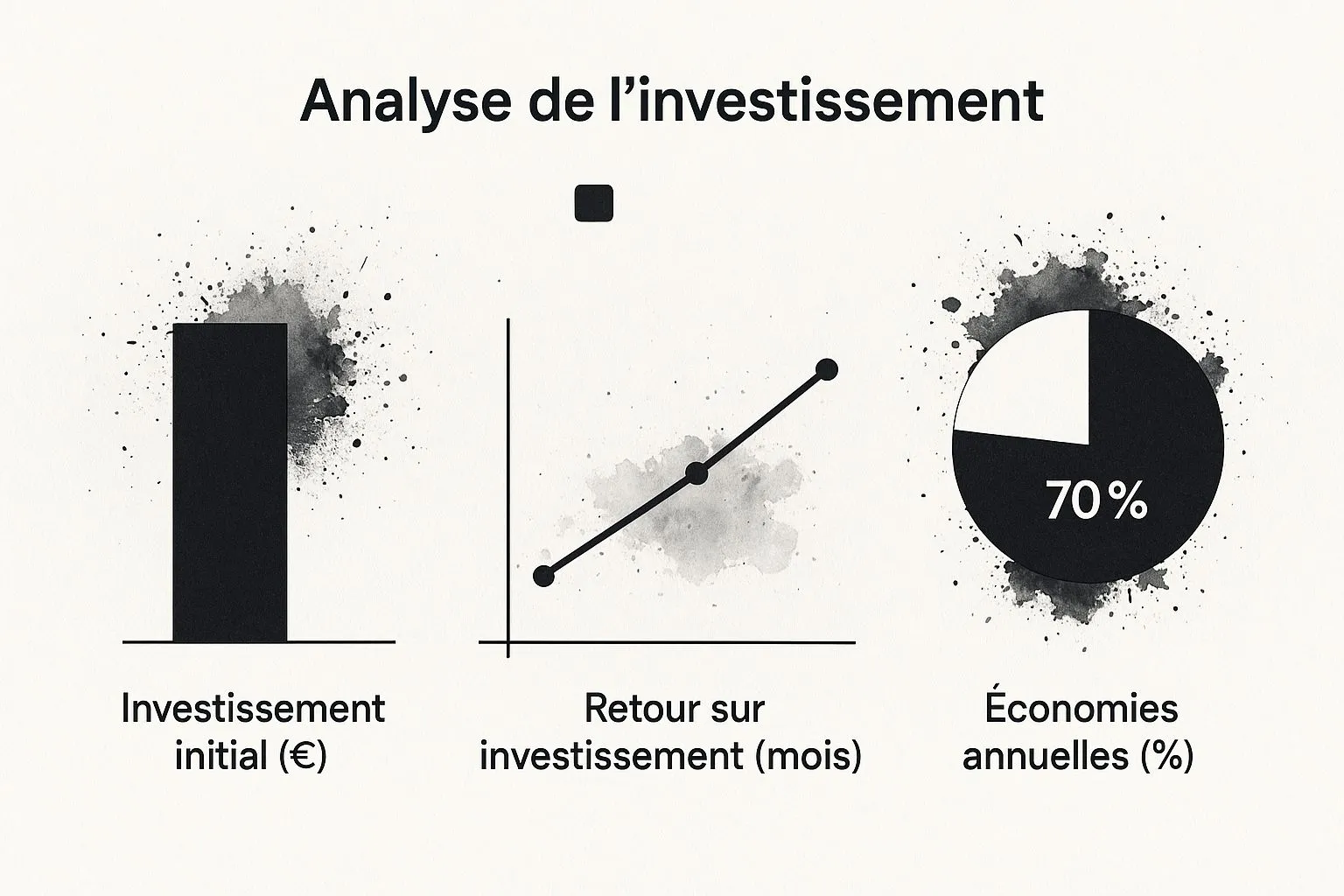
This visual confirms that, despite an upfront investment, the return on investment is often quick and the annual savings substantial, demonstrating the financial relevance of these projects.
Implementation strategies that actually work
Transforming an organization is a major undertaking. Business process automation isn’t just about installing new software; it requires a methodical, thoughtful approach. For the project to succeed, it’s crucial to approach it not as a simple technical update, but as a genuine transformation program for the company.
A successful implementation always starts with an honest assessment of the current situation and the definition of clear objectives. The idea isn’t to automate for technology’s sake, but to solve concrete problems and deliver measurable added value.
The critical steps of a successful rollout
Before even thinking about a tool, it’s essential to understand the fundamentals of your project. Companies that successfully transition to automation generally follow a structured path, very similar to good project management.
- Identify and map processes: The first step is choosing the right candidates for automation. Focus on processes that are repetitive, time-consuming, and where the risk of human error is high. Tasks like invoice or expense report management are often excellent starting points. To dig deeper into this topic, our article on administrative management for businesses offers concrete pointers.
- Set clear, measurable objectives (KPIs): What’s the goal of the initiative? Are you aiming for a 50% reduction in processing time? Or the elimination of 100% of data entry errors? Quantified objectives are essential for evaluating the initiative’s success and justifying the investment.
- Choose the right tools: The market is full of automation solutions. The best tool for your company will depend on the complexity of your processes, your budget, and the systems you already use. Prioritize platforms that integrate easily with your current environment (CRM, ERP, etc.).
The image below, taken from an article on project management, perfectly illustrates the classic phases of a well-run project.

This diagram shows that a project’s success rests on well-defined steps, from launch to closure. Business process automation must be managed with the same rigor and structure to achieve its goals.
Managing the human factor: the key to adoption
Technology is only part of the equation. One of the most common obstacles is resistance to change. Naturally, employees may fear that automation will threaten their jobs or complicate their daily work.
- Transparent communication: Clearly explain the “why” behind the project. Highlight the direct benefits for teams: fewer monotonous tasks, more time for higher-value missions, and reduced stress from repetitive work.
- Team involvement: Involve future users from the design phase onward. Their frontline experience is a goldmine for designing workflows that truly meet their needs and will be readily adopted.
- Training and support: Prepare a comprehensive training plan so that everyone feels comfortable with the new tools. Accessible technical support is also essential for answering questions and resolving issues quickly.
By taking a gradual approach, starting with low-risk pilot projects, you’ll build positive momentum. Every success, even a modest one, will strengthen trust and encourage buy-in from all employees.
Your roadmap to successful automation
Now that we’ve explored the theory and concrete examples, it’s time to move from ambition to action. Embarking on business process automation is a strategic initiative that requires solid preparation. To help you get started and steer your project toward success, think of this roadmap as your personal guide.
The starting point isn’t technology, but analysis. Before even thinking about a tool, it’s crucial to fully understand your own internal workings. The costliest mistake is automating an already flawed process; that would only accelerate the problems. So take the time to identify workflows that are both repetitive and a source of frustration for your teams.
The fundamental steps of your project
A structured approach is your best ally. To ensure a smooth rollout and successful adoption by your teams, it’s advisable to follow a logical progression. Here are the key steps to guide your journey:
- Analyze and select: Identify high-volume processes that are often error-prone and rely on clear rules. To start, focus on one or two pilot projects. This will let you achieve quick results and build positive momentum.
- Set clear objectives: What exactly do you want to achieve? Reduce processing time by 40%? Completely eliminate data entry errors? Setting quantified objectives is essential for measuring return on investment in a tangible way.
- Involve and train: The success of a business process automation project depends on user buy-in. Involve them from the start to design solutions that meet their real needs, and plan comprehensive training to support them.
- Measure and improve: Once the system is in place, closely track the performance indicators you’ve established. Gather feedback and don’t hesitate to adjust your workflows for continuous improvement.
Avoiding common pitfalls
Stay alert to a few common pitfalls. One of the most frequent is underestimating change management. It’s essential to communicate transparently about the benefits for employees in order to overcome potential resistance.
Another pitfall is “over-automation.” Some processes, particularly those requiring complex human judgment or nuanced customer interaction, shouldn’t be fully automated. The goal is to find the right balance between the efficiency brought by technology and human intelligence, which remains irreplaceable.
Ready to simplify your management so you can focus on growth? Discover how Bizyness can automate your invoicing and accounting starting today.
