

 Français
Calculate VAT online easily and quickly
Discover how to calculate VAT online with our simple, reliable tools. Simplify your VAT calculations for greater peace of mind.
For any entrepreneur looking to save time and keep their accounts reliable, calculating VAT online has become second nature. In practice, this means using a digital tool to apply the correct VAT rate – whether 20%, 10% or another rate – to a pre-tax amount (excl. VAT) to get the total price including VAT, or to do the reverse operation. It’s simple, fast, and it avoids calculation errors.
Demystifying VAT for your business
Let’s get straight to the point. VAT, or Value Added Tax, is far more than just a line on your invoices. It’s an essential cog in the tax system that directly impacts your selling prices and the cost of your business purchases. To master it properly, the first step is knowing the different rates that apply in France inside out.

The many faces of French VAT
The rate that comes to mind first is the standard rate, set at 20% since 2014. It applies to the vast majority of goods and services. But where things get a bit more complex is that several reduced rates exist for specific sectors. Identifying them correctly is crucial for your day-to-day management.
To help you see things more clearly, here’s an overview of the main rates you’ll certainly encounter in your business.
Overview of the main VAT rates in France
This table summarizes the different VAT rates applicable in France and provides concrete examples for each category.
| VAT rate | Type | Application examples |
|---|---|---|
| 20% | Standard | Most goods and services: clothing, tech, consulting fees, etc. |
| 10% | Intermediate | Restaurant dining (on-site), passenger transport, home renovation work. |
| 5.5% | Reduced | Basic food products, books (print and digital), cinema tickets. |
| 2.1% | Special | Certain reimbursable medications, press publications registered with the CPPAP. |
Mastering these distinctions is far from trivial, since VAT represents a colossal share of state revenue – around 45%, or nearly 200 billion euros each year. It is simply the country’s top source of tax revenue. To dig deeper into the topic, feel free to consult more detailed resources on calculating VAT.
Did you know? A restaurant owner is a perfect example of the everyday complexity of VAT. The dish you order is taxed at 10%. But if you pair it with a glass of wine, the alcoholic beverage is subject to the 20% rate. It’s a textbook case that shows just how vital it is to know the rules well to avoid a misstep.
VAT collected vs. deductible VAT: the inseparable duo
For sound management, it’s absolutely essential to clearly distinguish between two key concepts: VAT collected and deductible VAT.
On one hand, VAT collected is what you charge your customers on your sales. You essentially act as a tax collector on behalf of the state.
On the other, deductible VAT is the tax you pay on your own business purchases: equipment, supplies, services, and so on. The good news is that you’re entitled to subtract it from the amount you owe the tax authorities.
The final calculation is simple: VAT payable = VAT collected - deductible VAT. Having this mechanism firmly in mind is the foundation of sound bookkeeping. It’s what will let you use tools to calculate VAT online with full confidence.
VAT calculation formulas, decoded
Even if you plan to use a tool to calculate VAT online, understanding the basic mechanics is a real plus. Knowing these formulas gives you the confidence to quickly check a quote, verify an invoice, or simply validate the figures your software produces. It’s a key skill for staying on top of your finances.
Don’t worry, the logic is much simpler than it looks. Everything revolves around two amounts: the pre-tax price (excl. VAT) and the total price (incl. VAT).
How do you go from a pre-tax price to a price including VAT?
Calculating the total amount including VAT from a pre-tax price is probably the most common operation. It’s what you do every time you prepare a quote or invoice for a client. The formula is as direct as it gets:
Total amount (incl. VAT) = Pre-tax amount x (1 + VAT rate)
Let’s take a concrete example to make this clearer. Imagine you’re a consultant and you’re billing a consulting assignment at €1,500 excl. VAT. With the standard VAT rate at 20%, the calculation looks like this:
€1,500 x (1 + 0.20) = €1,500 x 1.20 = €1,800 incl. VAT.
This is the amount your client will need to pay you. Of this sum, €1,500 is your actual revenue, and the remaining €300 represents the VAT you collected on behalf of the state and will need to remit.
Pro tip: To move faster day to day, memorize the multipliers for the most common rates. For 20% VAT, simply multiply by 1.20. For 10%, it’s 1.10, and for 5.5%, it’s 1.055. A handy mental shortcut that will save you precious time.
How do you work out the VAT amount from a price including VAT?
Knowing how to do the reverse calculation is just as essential, especially when it comes to breaking down your own expenses. When you receive a supplier’s invoice, the price is very often shown including VAT. To identify the portion of VAT you can deduct, you need to know how to isolate it.
Calculating VAT online relies on standardized formulas that simplify this process for professionals. The mechanism is simple: to get the VAT amount from a pre-tax price, you multiply the pre-tax amount by the rate (e.g., €100 excl. VAT × 0.20 = €20 of VAT). The reverse calculation, to find the pre-tax amount from the total price, involves dividing the total price by (1 + rate). Discover more tips on methods for calculating VAT online.
To extract the pre-tax amount from a total price including VAT, the formula is as follows:
Pre-tax amount = Total amount (incl. VAT) / (1 + VAT rate)
Let’s put ourselves in a scenario: you buy computer equipment for €240 incl. VAT. The applicable VAT rate is 20%.
The calculation would be: €240 / 1.20 = €200 excl. VAT.
The actual cost of your equipment, before tax, is €200. To find the exact VAT amount, a simple subtraction is enough: €240 incl. VAT - €200 excl. VAT = €40 of deductible VAT. This is the amount you can deduct from the VAT you collected. If you’d like to dig deeper, our full guide on calculating VAT is an excellent resource to go further.
The concrete benefits of an online VAT calculator
Knowing how to juggle VAT formulas is one thing. But let’s be honest: doing it by hand, however educational it may be at first, quickly becomes a burden that drags down your productivity. It’s no coincidence that successful entrepreneurs almost all turn to tools to calculate VAT online. The reason is simple: peace of mind.
A calculator does far more than math. It’s your safety net against human error. We all know how quickly a small typo or an unfortunate rounding can turn into an administrative headache, unnecessary stress, or even penalties during a tax audit. Using these tools is no longer a luxury — it’s a strategic necessity to avoid falling behind.
Saving precious time and avoiding errors
The first benefit you’ll notice is the time saved. It’s almost immediate. Every minute spent double-checking a calculation on your old calculator is a minute not spent on what really matters: growing your business, taking care of your clients, or innovating.
Picture a concrete case, like a quote for a renovation project. You have materials taxed at 20% and labor at 10%. By hand, that’s an open door to allocation errors and headaches. A good online tool, on the other hand, produces the result in seconds, with zero risk of error.
This shift is very real. Digitalization has pushed French businesses to widely adopt solutions for managing VAT. It’s not just an impression: a 2022 DGFiP study showed that more than 80% of French SMEs now use software or a web app for these calculations. The goal is clear: make filings more reliable and lighten the administrative burden. To explore this topic further, you can check out these VAT calculation tools for professionals.
Rock-solid reliability
A good VAT calculator guarantees one essential thing: reliability. It’s constantly up to date with current rates and applies them with surgical precision, which no human can promise over the long run.
Here’s what an efficient, simple tool for calculating VAT online looks like.
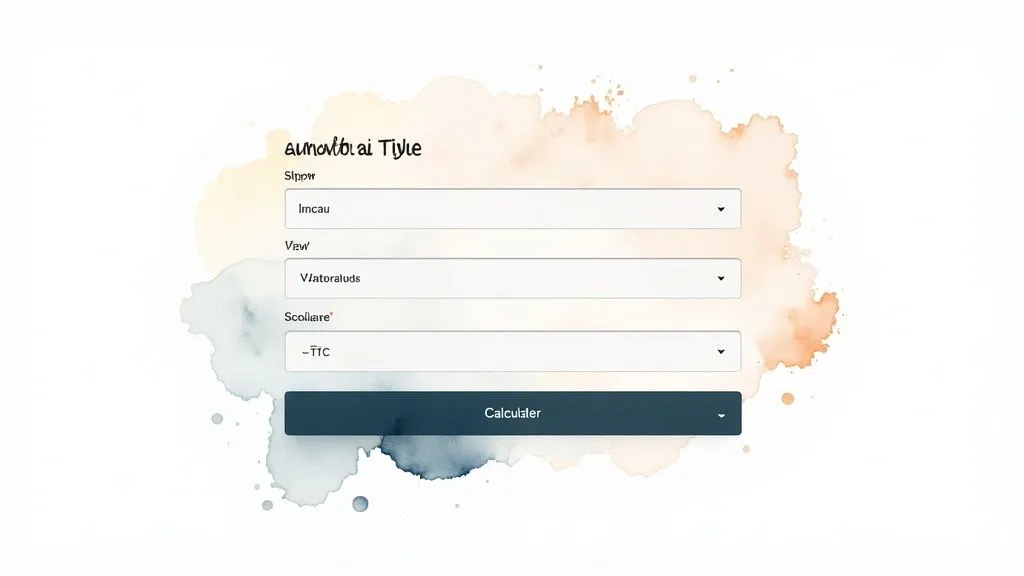
As you can see, the interface is designed for efficiency: you enter an amount, choose whether you’re starting from the pre-tax or the total price, select the correct rate, and that’s it. The result is instant, with no ambiguity whatsoever.
What to remember: Automating VAT calculation goes well beyond simple convenience. It’s a performance lever that secures your bookkeeping, gives you back time, and provides the peace of mind essential to steadily running your business.
By adopting these tools today, you’re also preparing your business for the future, particularly with the arrival of mandatory e-invoicing. It’s a way to get ahead and ensure your compliance effortlessly. In the current context where every detail matters, relying on technology for tasks as critical and repetitive as VAT management is simply a smart choice.
Using a VAT calculator: concrete steps
Theory is good, but practice is better. Now that the formulas and the stakes are clear, let’s see together how calculating VAT online can become second nature for you. Far from being a mere gadget, a good calculator is actually a genuine safeguard for your finances.
To make this clear, let’s work through scenarios you’re sure to encounter day to day. Each example will show you just how easy it is to get accurate figures, whether for a quote, to set a selling price, or even to bill expenses.
Practical case 1: the freelance graphic designer’s quote
Imagine you’re a freelance graphic designer. A client contacts you for a logo, a service you bill at €750 excl. VAT. Your goal? To provide them with a quote showing a clear, final price including VAT, with no room for error.
With an online calculator, the operation is astonishingly simple.
- You enter your amount: 750.
- You specify that it’s a pre-tax amount (excl. VAT).
- You select the applicable VAT rate, i.e. 20% for a standard service.
Instantly, the tool gives you everything you need:
- VAT amount: €150
- Total amount (incl. VAT): €900
And there you have it. In under ten seconds, you have a reliable figure to put on your quote. No more doubt, no more risk of getting it wrong.
This image clearly illustrates how direct and straightforward the process is.
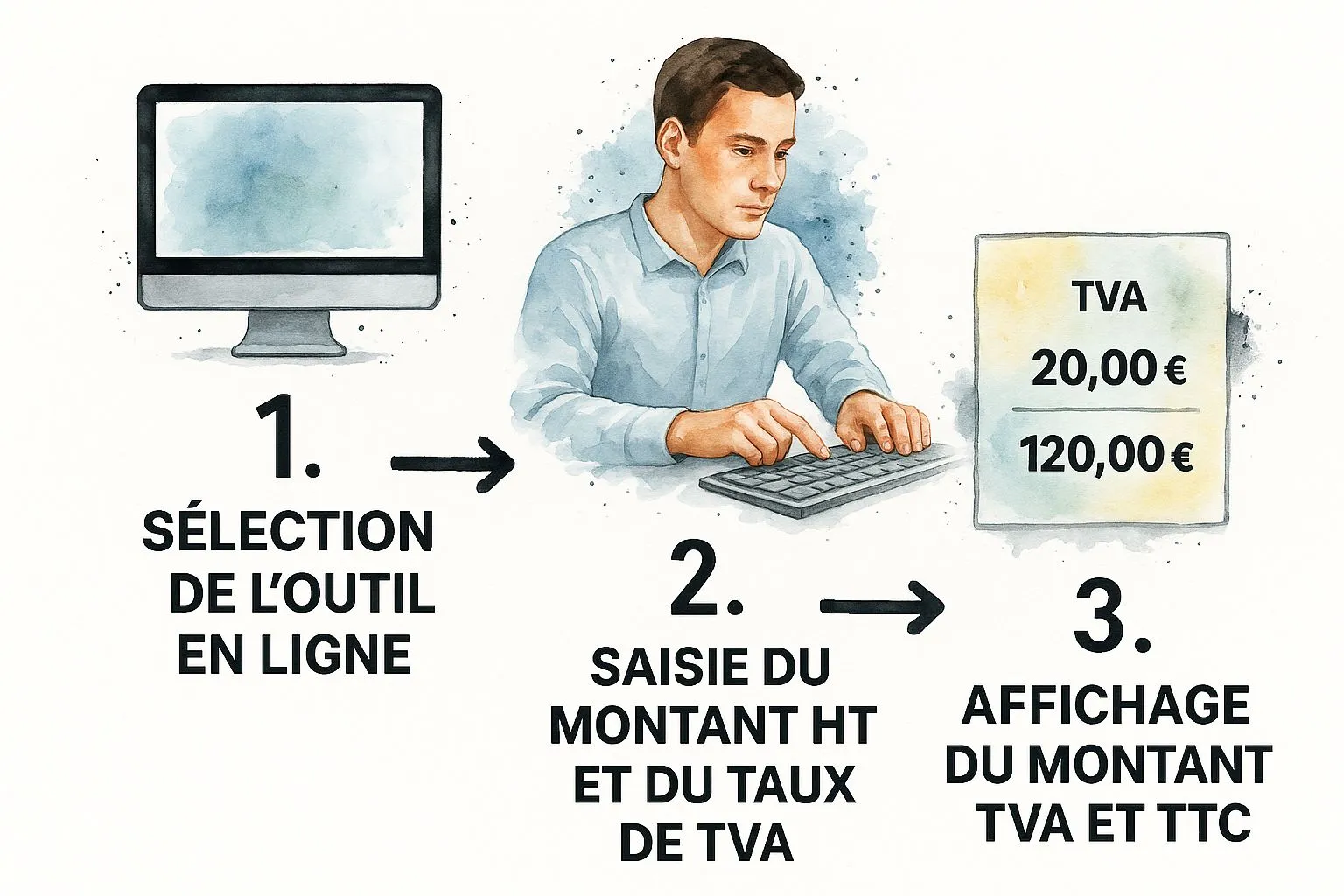
As you can see, it all comes down to entering the right information and reading the result. The machine handles the mathematical gymnastics.
Practical case 2: the e-commerce seller’s selling price
Let’s change scenes. You’re now an online seller wanting to add a product to your catalog. You bought it for €60 incl. VAT from your supplier. To properly set your selling price and, above all, to know your actual margin, you first need to isolate the pre-tax cost of this purchase.
This time, we reason the other way around, starting from the total price including VAT.
- You enter the purchase price: 60.
- You specify that it’s a total amount (incl. VAT).
- The VAT rate on this type of product is 20%.
The calculator immediately reveals the key figures:
- Pre-tax amount: €50
- VAT amount (deductible): €10
So you know the product actually cost you €50, and that you’ll be able to recover €10 of VAT on your next return. This is crucial information for setting a selling price that’s both attractive to your customers and profitable for you. If you’d like to go further, our article on automatic VAT calculation with management software like Bizyness will show you how to integrate this into your entire process.
A good tool doesn’t just calculate. It gives you a clear view of your pricing structure. This is what lets you make informed business decisions and manage your profitability with precision.
Manual calculation vs. online tool comparison
To really grasp the advantage, nothing beats a direct comparison. The table below highlights what you gain (or lose!) by choosing one method or the other for the scenarios we just covered.
This table highlights the differences in terms of time, accuracy, and complexity between a manual calculation and the use of an online tool for various scenarios.
| Scenario | Manual calculation (estimated time / error risk) | Online calculator (estimated time / error risk) |
|---|---|---|
| Graphic designer quote (excl. VAT to incl. VAT) | 2-3 minutes / Moderate risk (reversal, typos) | < 10 seconds / Near-zero risk |
| E-commerce purchase (incl. VAT to excl. VAT) | 3-5 minutes / High risk (complex reversed formula) | < 10 seconds / Near-zero risk |
| Consultant expenses (incl. VAT to excl. VAT, reduced rate) | 3-5 minutes / High risk (wrong rate, formula error) | < 15 seconds / Near-zero risk |
The numbers speak for themselves. The time saved is obvious, but the most valuable gain is probably the peace of mind that comes with accuracy.
Practical case 3: the consultant’s travel expenses
Finally, let’s take the example of a consultant on assignment. They need to bill their client for travel expenses, including a train ticket that cost €88 incl. VAT. Important point: passenger transport is subject to an intermediate VAT rate of 10%.
The reflex is now well established.
- You enter the expense: 88.
- You specify that the price is incl. VAT.
- You choose the correct VAT rate: 10%.
The result is crystal clear:
- Pre-tax amount: €80
- VAT amount: €8
You can therefore bill your client exactly €80 excl. VAT in expenses, in full compliance. These few examples prove it: whatever your business, a tool to calculate VAT online turns a task that could quickly become a chore into a simple, fast, and secure formality.
Common VAT pitfalls to know (so you never fall into them)
Even with the best software in the world to calculate your VAT online, a mistake can happen quickly. That’s why vigilance is crucial to avoid a tax reassessment that can be very costly. Let’s look together at the most common errors I encounter in the field, a sort of blacklist to help secure your VAT management.
Think of it like clockwork: every piece needs to be perfectly in place for everything to work. A single small error can jam the whole mechanism.
Getting the VAT rate wrong
This is the most common mistake, and often the most financially painful. Applying the wrong rate to a service or product can have serious consequences. If you bill renovation work at 20% instead of 10%, you risk losing a client. Conversely, if you wrongly apply the reduced rate, you expose yourself to a correction from the tax authorities.
A typical example? Ancillary costs. Many entrepreneurs don’t realize that delivery or packaging fees generally follow the same VAT rate as the main product they accompany.
My practical tip: Create a simple sheet summarizing the VAT rates specific to your sector. Display it prominently near your desk. This simple visual habit will save you precious time and spare you a lot of headaches.
Forgetting to check supplier invoices
Your VAT isn’t just what you charge — it’s also what you recover on your purchases. Not systematically checking the VAT on your suppliers’ invoices is a classic mistake.
This happens far more often than you’d think. An invoice received with an incorrect VAT rate can lead you to deduct the wrong amount. In the event of an audit, you — not your supplier — will be held responsible for that improper deduction. So make it a habit to take a critical look at every purchase invoice.
Underestimating the importance of rounding
A cent here, a cent there… On a single invoice, a rounding error seems trivial. But multiply that gap by hundreds, even thousands of invoices over the year. The discrepancy can quickly become significant and create an unexplained gap in your books.
Here are a few other points of vigilance never to overlook:
- Forgetting VAT on deposits: A deposit is considered a partial sale. The corresponding VAT must be included and becomes due as soon as you receive it.
- Mixing up VAT collected and deductible VAT: Confusing the two is the surest way to file an incorrect return. Keep clear, separate records.
- Filing late: Late filings almost automatically result in penalties, even if you had no VAT to pay that month.
For sole traders (micro-entrepreneurs) who are just starting to manage VAT, vigilance should be doubled. If that’s your case, our guide on VAT management for sole traders is an excellent resource to help you get through this step with confidence. This is also where a tool like Bizyness becomes a real safety net, automating these calculations and checks for you.
Answering your questions about VAT calculation
Even with the right formulas and the best tools, questions can remain. That’s perfectly natural. To help you see things more clearly and approach your VAT with confidence, I’ve compiled the questions that come up most often among the entrepreneurs I work with.
Is a simple online calculator enough for my tax return?
Absolutely, a tool to calculate VAT online is an excellent habit. It’s the perfect way to double-check your figures before submitting your official return. It helps you precisely work out the VAT collected on your sales and the deductible VAT on your purchases. Think of it as a handy safety net to avoid careless mistakes.
That said, you need to be aware of its limits. A one-off calculator doesn’t replace real accounting software. A management tool like Bizyness, for example, plays in a different league: it keeps a complete history of your transactions, issues compliant documents, and prepares your returns almost automatically.
An online calculator is a handy ally for a quick check. Accounting software is a genuine long-term partner that manages your bookkeeping and tax compliance.
What should I do if I got the rate wrong on an invoice already sent to the client?
No need to panic, mistakes happen. If you realize you applied the wrong VAT rate, the golden rule is to act quickly. You must issue a corrective invoice as soon as possible.
This new invoice must clearly cancel and replace the previous one. Include the correct VAT rate, the corrected pre-tax and total amounts, and, above all, a clear reference to the original erroneous invoice. Acting fast is essential to keep your books accurate and stay compliant with the tax authorities. Never let this kind of mistake linger.
Does VAT calculation change for a sole trader?
VAT management for a sole trader (or micro-entrepreneur) is directly tied to their revenue. By default, they benefit from what’s known as the VAT exemption threshold (franchise en base). In practice, as long as they stay under certain revenue thresholds, they simply don’t charge VAT to their clients. The trade-off is that they also can’t recover VAT on their own business expenses.
Things change as soon as the sole trader exceeds these thresholds. At that point, they become liable for VAT. They must then start applying it on their invoices and calculating it exactly like any other business, using the applicable rates (20%, 10%, etc.). VAT management is then added to their accounting obligations.
Manage your VAT without pulling your hair out and focus on what matters: growing your business. With Bizyness, automate your calculations, invoices, and tax returns in just a few clicks. Discover how Bizyness can truly simplify life as an entrepreneur.
