

 Français
Calculating intra-community VAT: a quick and reliable guide
This guide shows you how to calculate intra-community VAT easily: reverse charge, verifications and returns for secure trading.

Calculating intra-community VAT can seem complex. Yet the basic idea is quite simple: a B2B transaction between two EU countries is generally invoiced tax-free. It’s then up to the buyer to play their part by handling VAT in their own country. This is known as the reverse charge mechanism. At the heart of this system lies a key element: the validity of the VAT numbers of both companies involved.
The basics you need to master for intra-community VAT
To properly calculate and declare VAT on your trade within Europe, you first need to lay the groundwork. A few concepts are essential, but don’t worry — they follow a logic designed to simplify trade within the single market.
The goal is twofold: avoid paying the tax twice, and ensure it’s collected where the goods or services are actually consumed. For the seller, this simplifies invoicing; for the buyer, it shifts the responsibility for declaring the tax onto them.
Supply and acquisition: two sides of the same coin
In tax jargon, two specific terms are used to determine who does what. Depending on whether you’re the seller or the buyer, your role changes completely.
- Intra-community supply: This is the official term for a sale of goods you make from France to another business within the EU. As the seller, this operation is exempt from French VAT. You therefore invoice tax-free.
- Intra-community acquisition: This is the exact opposite. Your company, based in France, buys products from a supplier located in another EU country. You won’t pay VAT in your supplier’s country, but you’ll need to handle it here, in France.
This distinction is truly crucial. Your tax and reporting obligations will be completely different depending on whether you’re making a supply or an acquisition.
Put simply: are you selling? That’s a supply, so you invoice tax-free. Are you buying? That’s an acquisition, so you apply the reverse charge on VAT.
The reverse charge: the cornerstone of the system
This reverse charge mechanism is truly at the center of everything. Specifically, when you make an intra-community acquisition (a purchase), it’s up to you to calculate the amount of French VAT that would have applied had you bought the product in France.
Then, on your VAT return (the well-known CA3 form), you enter this amount in both the output VAT box and the deductible VAT box. The impact on your cash flow is zero — one cancels out the other. But be careful: this reporting step is absolutely mandatory.
The intra-community VAT number: your passport to Europe
No B2B transaction in Europe can be carried out properly unless both the seller and the buyer hold a valid VAT number. This is the non-negotiable condition for the seller to benefit from VAT exemption on their invoice.
In France, this unique number always starts with “FR”, followed by a two-digit computer key, then your SIREN number. This is the key that lets you invoice without VAT throughout the Union, provided of course that you verify your client’s number is also valid. If you’d like to dig deeper into the topic, you can discover more details about intra-community VAT on Advyse.fr.
Validating a European partner’s VAT number
Before diving into calculating intra-community VAT, there’s one absolutely essential step: verifying the validity of your business partner’s VAT number. This should become a reflex — a genuine safeguard for your business.
Imagine the situation: you invoice a European client VAT-exempt, and a few months later, during an audit, their number turns out to be invalid. The tax authorities will come after you and claim the 20% VAT you should have collected. A risk nobody wants to take.
The VIES tool, your best ally
To avoid this kind of setback, the European Commission provides a free, official tool: the VIES system (VAT Information Exchange System). It’s simple, fast, and should become systematic for every new transaction.
In practice, simply go to the VIES portal. You’ll be asked to enter your own VAT number and that of your client or supplier to run the check.
The interface is very clear and guides you through the verification.
Within seconds, you get the verdict: the number is either valid or invalid. This binary answer directly determines how you’ll issue your invoice.
Keeping proof, a step too often forgotten
Once VIES has confirmed the number is valid, your job isn’t quite done. The most important thing is to keep a record of this check. Why? Simply because, in the event of a tax audit, you’ll need to prove you did your due diligence at the time of the transaction.
Here are a few simple tips for archiving this proof:
- Take a screenshot of the result displayed by VIES, making sure the date and time are visible.
- Save the page as a PDF and file it directly in your client’s folder.
- Note the unique consultation number that the VIES tool sometimes generates.
Think of this record-keeping as your insurance against a tax reassessment. This document proves your good faith and justifies the VAT exemption on your invoice. Without it, defending yourself becomes very difficult.
Building this habit truly secures your intra-community trade. It’s a small effort that protects you from major trouble. If you’d like to make this even simpler, take a look at our intra-community VAT calculator, which builds in this logic.
The reverse charge in practice: how does it work?
The reverse charge is truly the cornerstone of intra-community VAT. At first glance, the term can sound intimidating, but the principle is actually quite simple: the roles are reversed. Instead of the seller collecting VAT, it’s the buyer who takes charge of it.
Very concretely, if your company in France buys goods or services from a supplier located in another EU country, they’ll send you a tax-free invoice. That’s when the ball is in your court. You must calculate the French VAT that would apply to this tax-free amount yourself, exactly as if you had made this purchase from a French supplier.
Before you even consider invoicing or the reverse charge, there’s a validation ritual you should never skip.
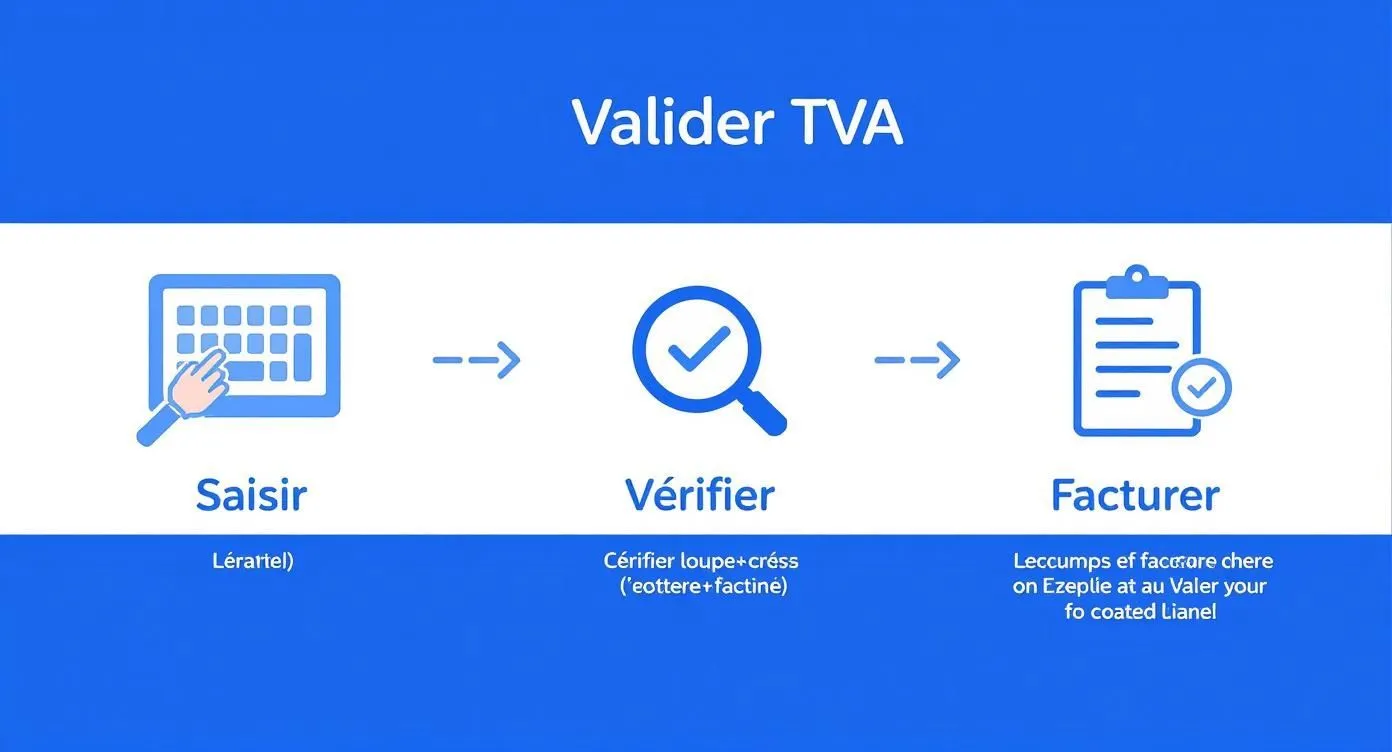
As you can see here, verifying your partner’s VAT number is the central step. It’s what justifies and secures the whole exemption and reverse-charge mechanism that follows.
The double entry on your VAT return
The “magic” of the reverse charge lies in its effect on your cash flow. Even though you have to calculate and declare this VAT, the operation is, in most cases, financially neutral. How is that possible? Simply because you’ll declare this amount in two specific places on your VAT return (the well-known CA3 form).
The VAT amount you calculated must appear in both:
- The output VAT box (as if you had invoiced it to a client).
- The deductible VAT box (as if you had paid it on a purchase).
One cancels out the other, and that’s it. For your bottom line, it’s often a wash. But be careful — this remains an absolutely mandatory reporting obligation. Forgetting this double entry is a classic mistake that can be penalized, even though it has no impact on the amount actually owed.
A concrete example for a purchase of goods
Let’s imagine a common scenario: your company buys €1,000 excluding tax worth of IT equipment from a supplier in Germany. In France, the standard VAT rate is 20%.
Here’s how it plays out, step by step:
- The German supplier issues you an invoice for €1,000 excluding tax, with no German VAT.
- On your end, in France, you calculate the applicable VAT: €1,000 x 20% = €200.
- On your VAT return (CA3), you enter these €200 as output VAT (on the line dedicated to “Intra-community acquisitions”) and, simultaneously, as deductible VAT.
In the end, the balance is zero, but you’ve fully met your tax obligations.
The case of a service
For services, the principle is exactly the same. Let’s say you hire a marketing agency in Ireland for a campaign billed at €500 excluding tax.
You receive an invoice for €500 excluding tax. You apply the French VAT rate: €500 x 20% = €100. These €100 must then be reported on your VAT return, both as output VAT and as deductible VAT.
What you absolutely need to remember: The reverse charge isn’t a favor or an option — it’s a mandatory rule. Even though the direct financial impact is zero, forgetting this declaration can cost you dearly. The tax authorities can apply a fine of 5% of the VAT amount that should have been reverse-charged.
Applying intra-community VAT calculations: some concrete cases
Theory is all well and good, but nothing beats practice for truly mastering the rules of intra-community VAT. The best way to understand is to dive into situations you encounter every day.
Let’s see together how these concepts apply in the real world. Whether it’s selling, buying, or dealing with individuals, each scenario has its own specifics. The goal is to give you the keys to invoice with complete peace of mind.
Scenario 1: B2B sale of goods to a company in Germany
Let’s start with a classic case. Your company, based in France, sells €5,000 worth of equipment to a company in Berlin. This is squarely a case of intra-community supply.
Your first move, even before issuing the invoice, should be to verify the validity of your client’s German VAT number using the VIES service. This is a crucial step. Once that’s done, you can invoice.
Here’s how it plays out on your invoice:
- Amount invoiced: You invoice the tax-free amount, so €5,000.
- VAT: You apply no French VAT. The VAT line shows €0.
- Mandatory wording: To justify this absence of VAT, a specific mention is required. Clearly state: “VAT exemption, Article 262 ter I of the French General Tax Code”.
- VAT numbers: Don’t forget to include your intra-community VAT number as well as your client’s.
Your client in Berlin will then take care of reverse-charging German VAT (the Umsatzsteuer) on their own return. You’ve done your part, and they do theirs.
Scenario 2: B2B purchase of services from an Irish company
Let’s flip the roles. Your company needs marketing services and turns to an agency in Dublin. They send you an invoice for €2,000 excluding tax.
This time, you’re the one making an intra-community acquisition. Your Irish provider has, quite logically, invoiced you without VAT. It’s therefore up to you to apply the reverse charge in France.
The calculation is straightforward:
- Amount of the service: €2,000
- French VAT to apply (standard rate of 20%): €2,000 x 20% = €400
On your VAT return (the CA3 form), you’ll declare these €400 in both the output VAT box and the deductible VAT box. The impact on your cash flow is neutral, but forgetting this declaration can cost you dearly in the event of an audit. To help you, our guide on calculating VAT online can give you a few tips.
The classic mistake is thinking “no VAT on the invoice = nothing to do.” Quite the opposite! For an intra-community purchase, the reverse charge is an active and mandatory step on your part.
Scenario 3: B2C sales to individuals in the EU
This is where things get a bit trickier, especially for e-commerce sellers. Selling to individuals in other EU countries follows different rules.
Since July 1, 2021, a single threshold of €10,000 in annual revenue applies to all your B2C distance sales across the EU.
- Below the €10,000 threshold: You can relax — you simply keep invoicing your European clients with French VAT, just as you would for clients in France.
- Above the €10,000 threshold: From the very first euro over this threshold, you must apply the VAT rate of the country where your client resides.
To spare you the nightmare of registering for VAT in every country where you sell, the One-Stop Shop (OSS) was created. This system lets you declare and pay all the European VAT you collect through a single return, filed in France.
This scheme is a real administrative relief, and its success keeps growing. As proof, in France, VAT collected via the one-stop shops jumped +27.4%, rising from €4.4 billion in 2023 to €5.6 billion in 2024. For those who like numbers, you can check the DGFIP’s tax statistics on the subject.
Correctly declaring your EU operations
Calculating VAT is one thing, but declaring it correctly is another. This is the crucial step that gives full meaning to your upstream work. Don’t neglect it.
The intra-community VAT system is, above all, a matter of trust and data cross-checking between member states. Tax authorities have a very clear view of the flows of goods and services circulating across Europe. The slightest inconsistency between what you declare and what your partner declares on their end can immediately trigger an alert, and potentially an audit.
For the tax authorities, everything must be perfectly aligned: your VAT return, the trade-in-goods declaration, and the VAT summary statement must all tell exactly the same story. If the amounts differ, that’s a red flag. These declarations therefore deserve the same rigor as your general bookkeeping.
The essential trade-in-goods declaration (EMEBI)
If your company exchanges physical goods with partners in other EU countries, you’ve probably already heard of EMEBI (the monthly statistical survey on intra-EU trade in goods). It has replaced the former DEB declaration. It’s not just another administrative formality — it’s an essential tool for tracking trade flows.
In France, the trade-in-goods declaration (DEB) remains a central tax document. For 2025, the reporting threshold for acquisitions of goods within the EU is set at €460,000. Once you cross this threshold, filing a declaration becomes mandatory. This allows authorities to track flows for statistical purposes, but also to effectively fight VAT fraud.
The VAT summary statement, a document not to forget
In addition to EMEBI for goods, if you supply goods or provide services to business clients within the EU, you must also complete a VAT summary statement. This document lists, for each client, the total amount you invoiced them over the period.
It’s thanks to this document that your client’s country’s tax authorities can verify that they correctly applied the VAT reverse charge on their end. A simple oversight on your part can have serious consequences: your client could be denied their right to deduct VAT, and your own VAT exemption could be called into question.
My practical advice: Don’t waste time compiling this information by hand. A good invoicing tool like Bizyness can generate these summary statements for you. It’s a huge time saver and, above all, it drastically reduces the risk of human error.
For many entrepreneurs, managing invoicing and the bookkeeping preparation for European transactions can quickly become a headache. That’s why more and more companies are opting for outsourcing administrative management to ensure their compliance.
My checklist for a smooth declaration
To make sure you don’t leave anything to chance, here are the points I recommend checking systematically:
- Your invoices: Are the VAT numbers (yours and your client’s) present and valid? Is the legal exemption wording correctly stated?
- Your bookkeeping: Are the operations recorded in the correct accounts? Has the reverse-charge entry been properly posted?
- Your VAT return: Are the amounts for your acquisitions and supplies reported in the correct boxes on the form?
- Ancillary declarations: Have you reached the €460,000 threshold that triggers EMEBI? Is your VAT summary statement complete and filed on time?
Tracking these declarations is just as vital as your own revenue declaration. Give it the same level of attention.
Frequently asked questions about intra-community VAT
Let’s now move on to the questions that keep coming up. Because even with the best explanations in the world, real-world cases often raise doubts. This FAQ is here to answer them directly and help you secure your operations.
Think of these answers as habits to build. The goal is simple: to give you enough confidence to never hesitate again.
What should I do if my client’s VAT number is invalid?
This is a classic situation, and it happens more often than you might think. The rule is simple and non-negotiable: if the VIES tool tells you the number is invalid, you’re not allowed to invoice tax-free. This is a red line you must never cross.
In this case, you must invoice your European client applying French VAT at 20%. It’s as simple as that, just as if you were selling to a client in France. Your first move should be to contact your client to inform them of the issue. Explain that without a valid number, the exemption isn’t possible, and ask them to check their details.
Invoicing tax-free with a number that turns out to be invalid is a huge risk. In the event of a tax audit, the authorities will come after you to claim the VAT you should have collected, plus penalties. This is a mistake that can end up costing you a great deal.
Do I really need to reverse-charge VAT on my tiny purchases?
The answer is yes, without the slightest hesitation. The VAT reverse charge does not depend at all on the amount of your purchase. There’s no minimum threshold, no exemption that applies.
Even for a piece of software you pay €15 for, or a €50 order of supplies, the procedure is identical. From the very first euro you spend with a supplier in the EU, you’re required to:
- Calculate the corresponding French VAT (as if you had paid it).
- Declare it in the “output VAT” box of your return (CA3 form).
- Deduct it immediately in the “deductible VAT” box.
It’s the intra-community B2B nature of the transaction that triggers the mechanism, never its amount.
How does it work for sales to individuals in the EU?
Selling to individuals (B2C) within the European Union is a special case, but one that has been greatly simplified in recent years. Everything revolves around a single revenue threshold: €10,000 excluding tax per year, calculated across all your distance sales within the EU.
- Below €10,000: No need to overthink it — you invoice with French VAT, as usual.
- Above €10,000: Here, things change. You must invoice by applying the VAT rate of the country where your client resides.
To spare you the nightmare of having to register for VAT in every country, the authorities set up the One-Stop Shop (OSS). This is a platform that lets you declare and pay, in one go and from France, all the European VAT you’ve collected. For e-commerce sellers, it’s a real breath of fresh air.
Navigating the complexity of intra-community VAT, from invoice wording to declarations, can quickly become a full-time job. To let you focus on your growth, Bizyness automates your invoicing and bookkeeping, ensuring your compliance without you having to think about it. Discover how to simplify your everyday life at bizyness.fr.
