

 Français
Calculating the net amount from a gross price: a quick, precise guide
Calculating the net amount from a gross price: discover the formula, concrete examples, and VAT rates for accurate invoicing.

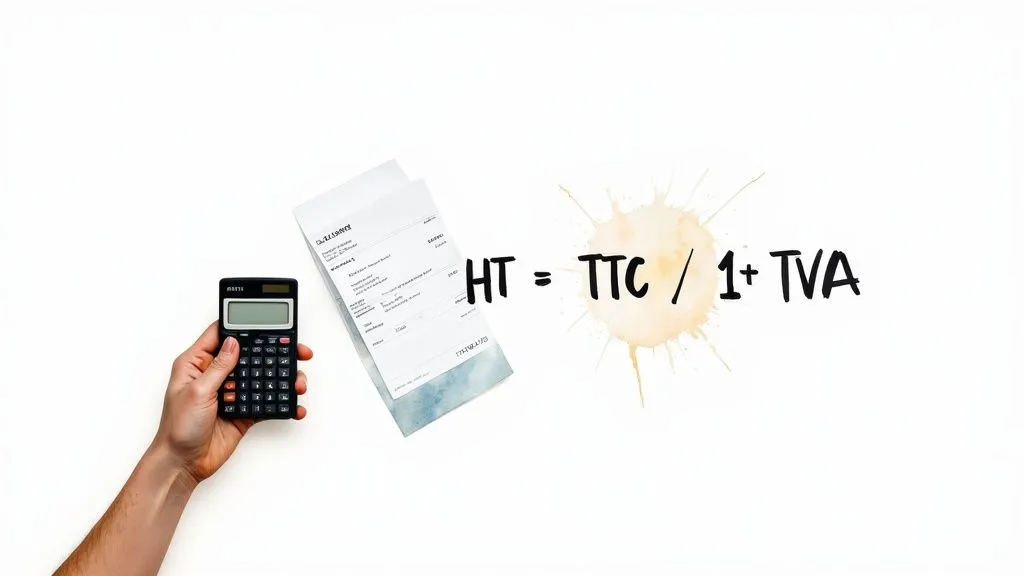
Let’s get straight to the point: to isolate the net price (excluding VAT) from a gross amount (VAT included), use the universal formula. Net amount = Gross amount / (1 + VAT rate). This calculation is more than a mere formality; it’s the backbone of your financial management.
Mastering the calculation of the net amount from the gross price
Calculating the net amount from the gross price is an essential routine for any business owner. Between drafting quotes, filing tax returns and analysing margins, you’ll come back to it constantly. A tiny error in the coefficient carries straight through to your accounts.
Understanding this mechanism also means:
- avoiding discrepancies in your balance sheets
- pricing your offers accurately
- anticipating the VAT amounts to be remitted
Why is this calculation so important?
Beyond simply meeting your tax obligations, mastering this calculation:
- helps you set fair prices, while preserving your margin
- protects your cash flow, by avoiding unpleasant surprises
- guarantees your compliance, ruling out the risk of a tax reassessment
To go further and isolate specifically the VAT amount, check out our detailed guide on calculating VAT from a gross price.
Practical tip: for a 20% VAT rate, simply divide the gross amount by 1.2. Example: €120 gross → 120 / 1.2 = €100 net.
You’re now ready to apply this formula in the blink of an eye and gauge its strategic impact. Let’s move on to the finer points of the different VAT rates: choosing the right rate is just as crucial.
Identifying the right VAT rate for your calculations
Knowing the formula to go from gross to net is one thing. But if you get the VAT rate wrong, your whole calculation falls apart. It’s a common mistake, and it can get costly fast. A simple mix-up of rates and your entire bookkeeping goes off balance: distorted margins, incorrect returns, invoices to correct… in short, a real headache.

In mainland France, there isn’t just one VAT rate, but several. Each rate corresponds to specific categories of products or services. To make sure your calculations are correct, the first step is to know exactly which rate applies to what you sell.
The main VAT rates to know
No need to panic — even though there are several rates, most businesses juggle only one or two on a daily basis. The important thing is to identify them correctly.
Here are the four rates you’ll come across most often:
-
The standard rate at 20%: This is the default, most common rate. It applies to the majority of goods and services. If you sell clothing, IT equipment, or offer consulting services, this is the rate you’ll use most of the time.
-
The intermediate rate at 10%: Found in specific sectors. Think of catering (for food consumed on-site), renovation work on older housing, or passenger transport.
-
The reduced rate at 5.5%: This rate applies to essential goods. It covers most food products, books (print and digital), gas and electricity subscriptions, and cinema tickets.
-
The super-reduced rate at 2.1%: This one is much rarer. It’s reserved for a few very specific cases, such as certain medicines reimbursed by social security or the TV licence fee.
Once you have the correct rate, calculating the net amount becomes child’s play. Simply divide the gross amount by the corresponding coefficient: 1.2 for 20% VAT, 1.1 for 10%, 1.055 for 5.5%, and 1.021 for 2.1%. To dig deeper into the topic, you’ll find more details on the nuances of VAT rates on Mooncard.co.
To make life easier, here’s a handy table summarising it all.
Summary table of VAT rates and coefficients
This table summarises the VAT rates in France and the divisor coefficient to use to easily go from gross to net.
| VAT rate | Divisor coefficient (1 + Rate) | Concrete application examples |
|---|---|---|
| 20% (standard) | 1.2 | Services, clothing sales, electronic equipment |
| 10% (intermediate) | 1.1 | Catering, passenger transport, renovation work |
| 5.5% (reduced) | 1.055 | Food products, books, energy subscriptions |
| 2.1% (super-reduced) | 1.021 | Reimbursable medicines, press publications |
Keep this table handy — it will be very useful for quickly checking your calculations on a daily basis.
Expert tip: Never underestimate the impact of a rate error. Billing a service at 5.5% instead of 20% might seem trivial, but it creates a shortfall for the state. In the event of an audit, the tax authorities will claim the difference, with penalties on top.
Taking a few minutes to check the applicable rate is never wasted time. It’s a simple habit that ensures your management stays compliant and gives you much greater peace of mind.
Putting the formula into practice with everyday examples
Theory is one thing, but nothing beats practice to make it all click. To turn calculating the net amount from the gross price into second nature, let’s see how the formula applies to concrete situations you might encounter.
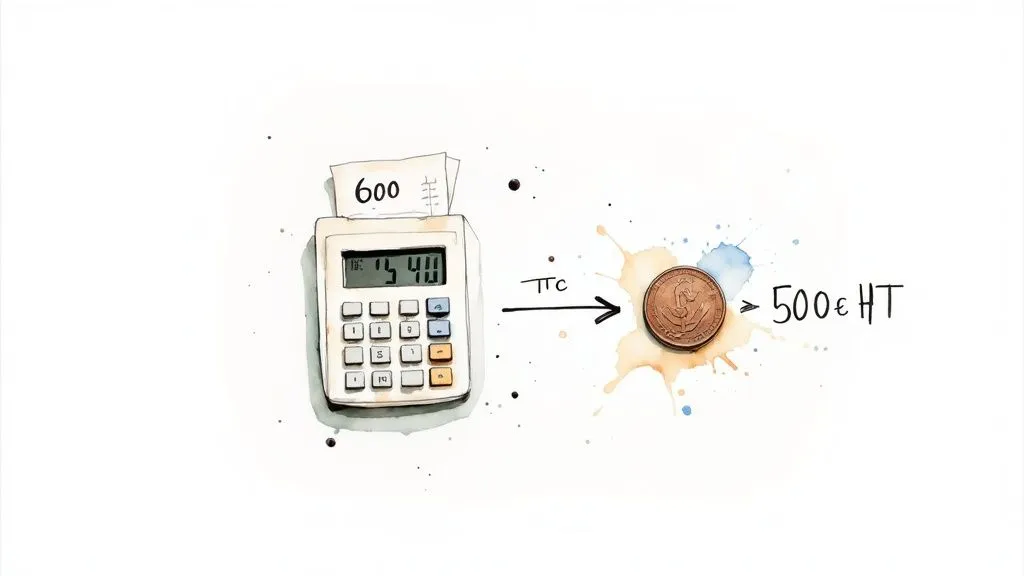
Let’s take a fairly typical service, such as building a website, which you invoice at €600 gross. Here, we apply the standard VAT rate of 20%.
The calculation goes as follows:
- Net amount = €600 / (1 + 0.20)
- Net amount = €600 / 1.20
- Net amount = €500
To be absolutely sure you haven’t made a mistake, simply do the reverse calculation. Take the net amount and add VAT: €500 x 20% = €100. Then, €500 + €100 = €600. It checks out.
Adapting the calculation to each VAT rate
The beauty of this formula is that it works every time, regardless of the VAT rate.
Now imagine a business lunch at a restaurant, with a bill of €33 gross. In catering, the intermediate rate of 10% applies.
- Net amount = €33 / (1 + 0.10)
- Net amount = €33 / 1.10
- Net amount = €30
And finally, let’s take a shopping basket of essential food items, totalling €52.75 gross. These products benefit from a reduced rate of 5.5%.
- Net amount = €52.75 / (1 + 0.055)
- Net amount = €52.75 / 1.055
- Net amount = €50
Once you’ve grasped these few examples, you’re ready for any situation. And if you want to go even faster, our online net/gross converter is here to save you time.
The classic mistake to avoid at all costs There’s a trap many people fall into: trying to subtract the percentage directly from the gross amount. For example, €600 gross minus 20% is not €480, but rather €500 net. This is a common error that can completely distort your bookkeeping, margins, and VAT returns. The only reliable method is to divide the gross amount by the correct coefficient (1 + the VAT rate).
Why VAT is much more than just a line on your invoices
Let’s get straight to the point: understanding how to go from gross to net isn’t just an accounting exercise. It’s a vital habit for the health of your business. Many people see VAT as a mere administrative constraint, when in reality it’s a powerful management lever at the heart of your financial strategy.
Sound VAT management is above all a matter of optimised cash flow. When you calculate the net amount precisely, you instantly distinguish the share that actually stays in your pocket from the share you’re merely collecting on behalf of the state. This clarity protects you from unpleasant surprises when filing your return and lets you anticipate your liquidity with much greater peace of mind.
A direct impact on your profitability
Beyond cash flow, VAT directly influences your ability to set fair selling prices while protecting your margins. A small error in the net calculation, and you risk either selling at a loss without realising it, or ending up with prices too high that drive customers away. Good mastery ensures you position your offers in the right spot: attractive to customers, and profitable for you.
Let’s not forget the legal aspect either. Rigorous VAT management is the foundation of a healthy relationship with the tax authorities. Errors, even unintentional ones, can draw attention and lead to audits or penalties that come at a cost.
Don’t see Value Added Tax as a burden. It’s a consumption tax that merely passes through your business. You’re a collector on behalf of the state — a responsibility that, when well managed, becomes a strength.
From an economic standpoint, its role is major. Since its creation in France in 1954, it has become the state’s leading source of revenue. To give you an idea, it now accounts for nearly 50% of net tax revenue. That shows just how much importance the authorities place on collecting it! For those who want to dig deeper, this report on the economic impact of VAT is very insightful.
In short, by changing your perspective on VAT — seeing it not as a burden but as a strategic piece of your financial puzzle — you make wiser decisions. And that’s how you secure the growth and longevity of your business.
A few tips for automating your calculations and mastering rounding
Going from gross to net on a daily basis shouldn’t be a headache. Once you have the formula down, the goal is to make the process as smooth and reliable as possible. You want to avoid, at all costs, the small manual calculation errors that, without you noticing, can quickly throw off your entire bookkeeping.
In this area, precision really is key, especially once you start juggling figures after the decimal point.
Rounding: the small detail that changes everything
It’s a point that’s easy to overlook, but it’s absolutely fundamental in accounting: rounding management. The golden rule is to keep as many decimal places as possible during your intermediate calculations. Only round at the very end, to the nearest cent. That’s the secret to flawless accuracy.
If you want to dig into this rather technical topic, we have an article that explains how to understand and simply manage VAT rounding.
In accounting, precision is never optional. Poorly managed rounding, repeated across hundreds of invoices, can end up creating fairly significant discrepancies in your annual accounts.
For those who really want to boost efficiency, there are platforms offering automated financial calculators that can save you precious time.
Automation, your best friend for peace of mind
To err is human, as they say. That’s why automation is a genuine lifesaver. Of course, you can already make life easier with a spreadsheet like Excel or Google Sheets by creating a simple formula (such as =A2/1.2) to get the result in the blink of an eye.
But for truly comprehensive, flawless management, nothing beats a good invoicing tool. Solutions like Bizyness do far more than just net/gross calculations. They automatically handle rounding, apply the correct VAT rate, and generate fully compliant documents. The time saved is enormous, and the peace of mind, total.
The Bizyness interface, for example, integrates VAT calculation directly into your invoice creation.
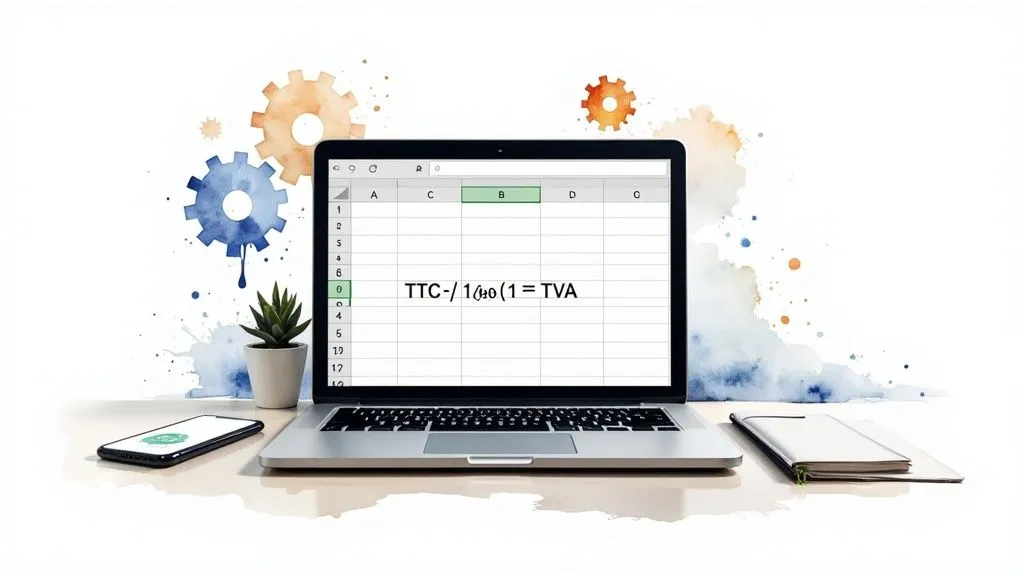
This simple preview shows just how easy it becomes to create accurate invoices, with everything calculated for you. No more risk of mistakes when tapping away on your calculator.
Frequently asked questions about calculating net and gross amounts
Even with the formula in mind, certain practical questions keep coming up. That’s perfectly normal. Let’s demystify together the remaining points that can cause trouble when it comes to calculating the net amount from the gross price.
This mental exercise is part of every entrepreneur’s daily life. Mastering it means gaining peace of mind and rigour in your management.
How do I isolate the VAT amount from a gross price?
Once you have your gross price, there are two approaches to finding the exact VAT amount. The most intuitive is to first calculate the net price, as we’ve just seen, then do a simple subtraction.
- VAT = Gross amount - Net amount
There’s also a direct formula that gives you the result in a single operation, without calculating the net amount first.
- VAT = Gross amount - (Gross amount / (1 + VAT rate))
Let’s take a concrete example: a product sold at €120 gross with 20% VAT. The calculation gives: 120 - (120 / 1.2) = 120 - 100 = €20 of VAT.
This formula is an excellent habit to have for quickly checking the tax portion on a receipt or for validating a selling price.
Does this formula also apply to sole traders?
Yes, the mathematical formula itself doesn’t change. However — and this is an important nuance — the context is radically different for the vast majority of sole traders (or micro-entrepreneurs).
Most of them benefit from the VAT exemption scheme (franchise en base de TVA). In practical terms, this means they don’t charge VAT to their customers. Their prices are therefore naturally “net of tax”, and this calculation isn’t part of their daily routine.
But beware: if their turnover exceeds the legal thresholds, they fall out of this exemption scheme. They then become required to collect VAT on behalf of the state. At that point, these calculations become essential for issuing compliant invoices.
Is there a trick for calculating the net amount in your head?
Of course! For the most common VAT rate, 20%, there’s a really handy mental-maths trick to estimate VAT on the fly. Simply divide the gross price by 6.
Imagine a service invoiced at €180 gross.
- €180 / 6 = €30
The VAT amount is therefore around €30. To get the net amount, all that’s left is to subtract: €180 - €30 = €150 net. It’s a simple and effective method for a quick check. Just keep in mind that this trick only works for the 20% rate.
To put an end to doubts and the risk of error once and for all, the simplest solution is to automate your invoicing. That’s precisely why Bizyness was created. The tool calculates the net amount, gross amount and VAT for you, instantly and without error, whether on your quotes or your invoices. Discover how to simplify your management on Bizyness.fr.
