

 Français
 Calculating your gross margin rate to steer your profitability
Master the calculation of the gross margin rate. A practical guide with concrete examples to analyze and improve your company's profitability.

Calculating the gross margin rate is fairly straightforward. Think of it as a thermometer that takes the temperature of the gross profitability of every sale you make. In practice, you divide the gross margin by revenue excluding VAT, then multiply by 100 to get a percentage.
Let’s dive into the gross margin rate formula
For this indicator to become a genuine steering tool, you need to fully understand what lies behind each element of the formula. It’s not just maths — it’s the very logic of your sales performance.
The formula is as follows:
Gross margin rate = (Gross margin / Revenue excl. VAT) x 100
Every variable in this equation is crucial. A small calculation error on any one of them, and the final result loses all relevance.
What exactly is gross margin?
The first piece of the puzzle is gross margin. It simply represents the gross gain you generate on the sale of a product or service. The calculation is simple:
Gross Margin = Selling Price Excl. VAT - Purchase Cost Excl. VAT
Be careful: the purchase cost isn’t limited to the price you pay your supplier. To be precise, you need to add all the costs directly linked to the acquisition: shipping fees, customs duties, etc. A thorough analysis requires rigorously identifying all these expenses. If you want to dig into this topic, our guide on direct and indirect costs can help you see things more clearly.
Revenue — always excluding VAT!
The second essential element is revenue excluding VAT. This is the price at which you invoice your product or service to the customer, before adding VAT.
Why this obsession with “excluding VAT”? If you work with amounts including VAT, your analysis will be completely distorted. VAT, and this should never be forgotten, is a tax you collect on behalf of the State. It is neither a gain for your business nor a direct cost. Neutralizing it is therefore the only way to measure the real performance of your business.
A practical case to illustrate all this
Let’s imagine your business is selling t-shirts.
- You buy each t-shirt from your supplier at €8 excl. VAT.
- You resell it in-store or online at €25 excl. VAT.
First, let’s calculate your gross margin on a t-shirt: €25 (Selling price excl. VAT) - €8 (Purchase cost excl. VAT) = €17 gross margin.
Now let’s apply the full formula to get the margin rate: (€17 / €25) x 100 = 68%.
The gross margin rate for this product is therefore 68%. In other words, for every euro of revenue generated by selling this t-shirt, 68 cents are available to cover your other expenses (rent, salaries, marketing, etc.) and, of course, to generate a profit.
In retail in France, this indicator is closely scrutinized. It often ranges between 20% and 30%, but this depends heavily on the sector. Large supermarkets, for example, operate with lower margins, sometimes around 20%, relying on volume. Conversely, a specialty store with high added value can quite easily aim for much higher rates. To get your bearings, taking a look at average margin rates by sector is always a good idea.
Putting the calculation into practice with real-world scenarios
Theory is good, but nothing beats practice for numbers to truly make sense. To really master the gross margin rate, you need to work through concrete situations. It’s by seeing how the variables interact in the real world that this indicator becomes a genuine steering tool.
To illustrate this well, we’ll break down two radically different scenarios: selling a physical product and providing a service. The idea is that you can adapt the logic to your own business, whether you sell goods or consulting.
Calculating margin on a product: the example of a clothing store
Imagine you run a ready-to-wear store. You’ve just received a new t-shirt for your collection and want to know its margin. The first thing to do is determine its true purchase cost.
Be careful — this isn’t just the price your supplier charged you. You absolutely must include all the costs that allowed you to put this t-shirt on the shelf.
- Unit purchase price from the supplier: €10 excl. VAT
- Shipping cost (per unit): €1.50 excl. VAT
- Full purchase cost excl. VAT: €10 + €1.50 = €11.50
You decide to sell it in-store at €35 excl. VAT. From here, the calculation is simple.
- Calculate the gross margin: €35 (Selling price excl. VAT) - €11.50 (Full purchase cost excl. VAT) = €23.50.
- Then derive the margin rate: (€23.50 / €35) x 100 = 67.14%.
In concrete terms, this rate of 67.14% means that for every t-shirt sold, you generate a little more than two-thirds of the selling price to cover your fixed costs (salaries, rent, marketing, etc.) and, of course, to make a profit. The accuracy of this calculation depends directly on your ability to set the right selling price — a crucial point you can explore further by reading our guide on how to calculate a fair and profitable selling price.
This diagram perfectly illustrates the link between margin, sales and the bottom line, which is at the heart of this calculation.
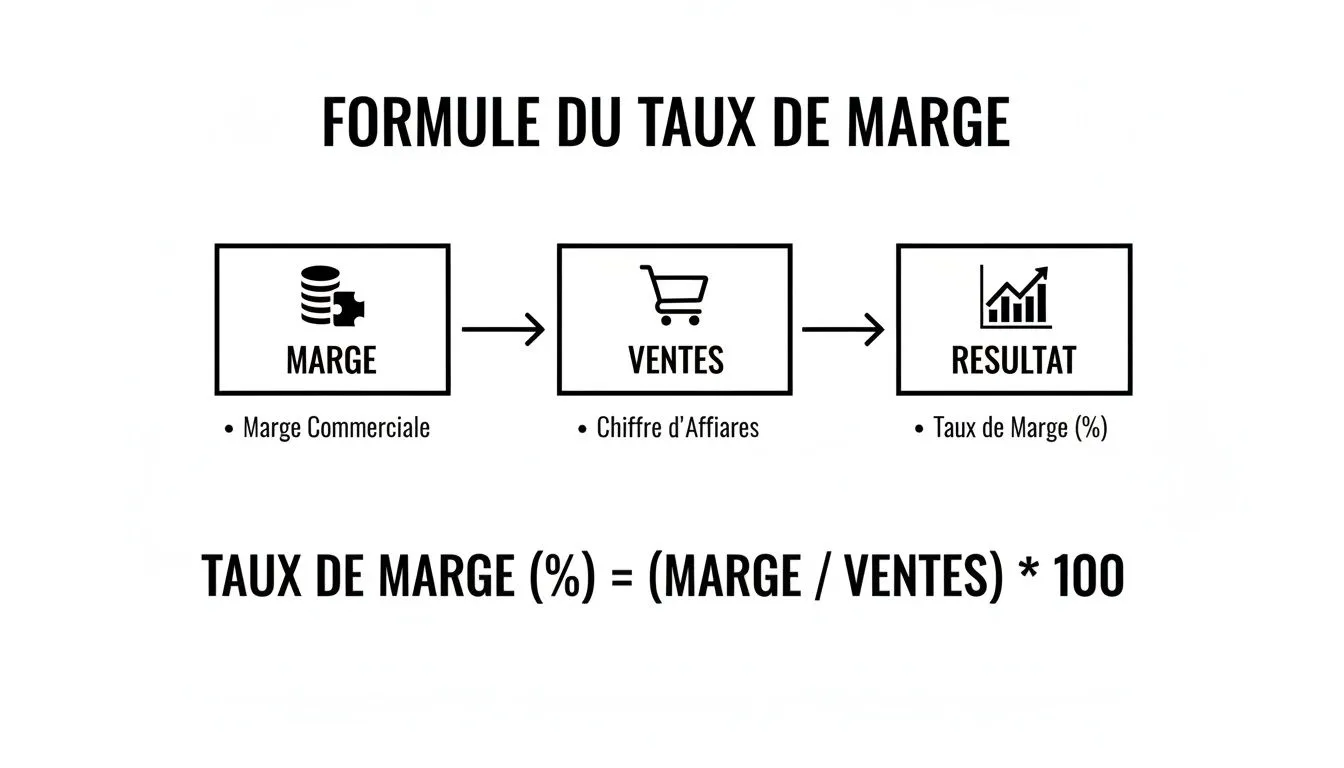
Margin is clearly the financial engine of your business: once measured against sales, it’s what gauges your performance.
Calculating margin for a service: the case of a web agency
For a service business, the concept of “purchase cost” is a little different. We’ll instead talk about the direct cost of the service. Let’s take the example of an agency invoicing €5,000 excl. VAT for building a website.
To calculate this cost, we’ll take into account all the expenses directly linked to this project:
- Time spent by developers: 80 hours x €30/hour = €2,400
- Software license purchases (plugins, themes…): €200
- Total direct cost: €2,400 + €200 = €2,600
This direct cost is the equivalent of the purchase cost for a product. It’s the investment you need to make in order to sell your service.
The margin rate calculation then follows the same logic:
- First, the margin: €5,000 (Selling price excl. VAT) - €2,600 (Direct cost excl. VAT) = €2,400.
- Then, the rate: (€2,400 / €5,000) x 100 = 48%.
A rate of 48% is a very good signal for an agency. It shows that almost half of the revenue generated by the project goes toward funding overhead costs (premises, admin, prospecting…) and ensuring the company’s overall profitability.
Comparing margin calculation between a product and a service
To make things even clearer, this table sets the two examples side by side. You’ll see that while the nature of the costs changes, the calculation logic stays exactly the same.
| Calculation Element | Product Example (Shoes) | Service Example (Website) |
|---|---|---|
| Selling Price Excl. VAT | €35 | €5,000 |
| Direct Cost Excl. VAT | Full purchase cost: €11.50 (supplier + shipping) | Direct cost: €2,600 (labor + licenses) |
| Gross Margin | €35 - €11.50 = €23.50 | €5,000 - €2,600 = €2,400 |
| Margin Rate | (€23.50 / €35) x 100 = 67.14% | (€2,400 / €5,000) x 100 = 48% |
This comparison clearly shows that whether you sell goods or your expertise, the gross margin rate is a universal indicator for measuring the gross profitability of each sale. It’s a habit to develop for every product or service you offer.
Making your margin rate speak: a strategic steering tool
Calculating your gross margin rate is good. But it’s only half the journey. Far from being a simple line in an accounting spreadsheet, this figure is in fact a genuine compass for your business. It tells you whether you’re off course or, on the contrary, heading in the right direction.
Getting this percentage is one thing. Making it speak is another, far more crucial thing. Concretely, what does a margin rate of 35% mean for you? Is it good performance, an average result, or a warning sign? It’s all a question of context.
Positioning yourself within your competitive environment
The first step is to look at what’s happening around you. Compare your performance to that of your sector. A margin rate that would be excellent in mass retail could be disastrous in luxury goods, where marketing investments and overhead costs are on a completely different scale.
To get an idea, reliable data exists. Insee’s figures, for example, are very telling. They show that the average margin rate of non-financial companies in France rose from 26.6% in 2017 to 29.9% in 2021.
But behind this average lie very different realities. In 2021, the rate stood at 21.1% in construction, while transport posted 33.9%. To dig deeper, I’d recommend taking a look at the detailed study on Insee’s website.
The idea isn’t to copy what others do, but to understand the playing field. If you notice a significant gap from your sector’s average — whether higher or lower — it should alert you. It’s a sign that you need to take a closer look at your own business model.
A lever for your everyday decisions
Once you know where you stand, your margin rate becomes a formidable steering tool. It will inform your decisions on several essential fronts.
- Your pricing policy. If your margin is too low compared to your competitors, it’s often a sign that your selling prices are too low or, worse, that your purchase costs are too high. This is the time to review your price list or resume negotiations with your suppliers.
- Identifying your “star” products. Calculate the margin rate for every product or service you sell. You’ll quickly see which ones are the most profitable — your true champions. This simple but powerful analysis can prompt you to promote certain offers and drop others that are dragging down your results.
- Your supplier negotiations. Is your gross margin eroding? It might be a direct symptom of rising purchase costs. With precise figures in hand, you’re in a strong position to discuss rates with your partners and defend your interests.
This analysis is closely tied to another key indicator. A good margin is vital, but it must above all allow you to cover all your expenses and generate a profit. To go further on this topic, check out our practical guide on calculating your break-even point.
And if you’re looking for concrete ways to turn these figures into action, it’s always useful to draw inspiration from tips on improving sales performance.
How to avoid the classic mistakes that distort your analysis

A simple calculation error can quickly derail your entire strategy. Calculating the gross margin rate is an exercise in precision: one oversight, one mix-up, and your entire view of profitability is distorted. For this indicator to remain a reliable ally, you absolutely need to know and avoid the most common pitfalls.
One of the most frequent missteps is using VAT-inclusive amounts in the formula. Never forget that VAT is merely a tax you collect on behalf of the State. Including it in your calculations artificially inflates your revenue and your costs, making the final result completely unusable for serious analysis.
Another very common oversight concerns ancillary costs in the purchase cost. Many people settle for the price shown on the supplier’s invoice, and that’s a mistake. Shipping fees, customs duties, or insurance are direct expenses. They must absolutely be included to get a gross margin that reflects reality.
Margin, markup, mark-on: watch out for mix-ups!
The most widespread confusion — and by far the most dangerous — is between the margin rate and the markup rate. People think they’re interchangeable, but they don’t measure the same thing at all and don’t serve the same purposes. Mixing them up can lead you to set completely unsuitable selling prices and jeopardize your profitability.
The gross margin rate assesses the gain relative to the selling price. The markup rate, on the other hand, measures that same gain relative to the purchase cost.
The whole difference lies in the denominator of the formula. For the margin rate, you divide by revenue excl. VAT. For the markup rate, you divide by the purchase cost excl. VAT. For example, a markup rate of 100% means you’re selling a product at double its cost. But be careful — that corresponds to a margin rate of only 50%.
This table illustrates the difference perfectly. Let’s imagine you buy a product for €50 excl. VAT and resell it for €100 excl. VAT. Your gross margin is therefore €50.
| Indicator | Calculation Formula | Result for the Example | What It Means |
|---|---|---|---|
| Margin Rate | (Margin / Selling Price Excl. VAT) x 100 | (€50 / €100) x 100 = 50% | Half of your selling price makes up your gross gain. |
| Markup Rate | (Margin / Purchase Cost Excl. VAT) x 100 | (€50 / €50) x 100 = 100% | You earned 100% of your initial investment on this product. |
The very real impact of these oversights on your profitability
These mistakes aren’t just technical details; they have a direct impact on your strategic decisions. An overestimated margin could push you to launch overly aggressive promotions or believe a product is far more profitable than it actually is.
Conversely, if you underestimate your margin, you might hesitate to invest or wrongly think your prices are too low when they’re actually well positioned.
Analyzing this indicator is a real challenge, one that depends heavily on the size and sector of the company. In 2019, the median gross margin rate in retail in France was 22.5%, while it only reached 21.1% in construction. These INSEE figures make it clear: there’s no universal “good” rate, only a rate suited to your context. To go further, feel free to check out the detailed INSEE statistics on business performance.
How to boost your margin rate? The levers to pull.

Knowing how to juggle the margin rate formula is good. But the real challenge, the one that changes the game for your cash flow, is finding how to improve it. Forget miracle solutions; it’s really a series of fine, measurable adjustments that, added together, will strengthen your company’s profitability.
To achieve this, there are two main areas of work, two playing fields for every entrepreneur: working on purchase costs and refining your pricing policy. These are concrete actions you can start exploring today.
Taking back control of your purchase costs
The first lever, and often the most accessible, is to pay less for what you sell. Every euro you don’t spend with your supplier goes straight into your pocket as margin. It’s mathematical.
Here are a few avenues to explore:
- Renegotiate, again and again. Prepare before picking up the phone. Highlight your order volumes, your history, your loyalty. And don’t hesitate to leverage competition. A good partnership also thrives on frank discussions about pricing.
- Think collectively. If you’re a small business, strength lies in numbers. Teaming up with other companies to place larger orders will give you a whole different level of leverage in negotiations.
- Track down hidden costs. Logistics can quickly become a financial pit. Compare carriers, optimize routes, consolidate deliveries. Tools for tracking fuel prices, for example, can help you anticipate these highly fluctuating costs and manage them better.
A purchase cost is never set in stone. Seeing it as a variable you can influence is the first step toward boosting your profitability.
Steering your selling prices strategically
The other lever, just as powerful, is to sell better. Be careful — this doesn’t necessarily mean “selling more expensively” to everyone. The idea is to adopt a more surgical approach.
Ask yourself which products a slight price increase would go almost unnoticed by your customers. These are often your best-sellers, products where you have a clear competitive advantage or a strong brand image.
Also think about creating perceived value. A “premium” offer, an extended warranty, careful packaging, or an associated service can easily justify a higher price. You’re selling a solution, not just a product, and that’s worth something.
Finally, don’t lump all your products together. Each product can have its own role and its own margin rate. Some will be loss leaders, with a low margin to attract customers. Others will be your “cash cows,” on which you’ll make your biggest profits. It’s this careful balance that will drive up the overall profitability of your business.
Answering your questions about the gross margin rate
Calculating the gross margin rate often raises a number of questions. That’s perfectly normal. To help you truly master this key indicator, we’ve gathered the most frequent questions — the ones that can make all the difference between precise financial steering and a mere estimate.
Margin rate or markup rate: what’s the real difference?
This is THE most common confusion, and it can be costly. The difference is subtle but fundamental: it’s all a question of the calculation base.
The gross margin rate measures your gain relative to the selling price. It’s the percentage of profit you keep on every euro collected. The formula: (Margin / Revenue Excl. VAT) x 100.
Conversely, the markup rate measures the profit relative to the purchase cost. It tells you what gain you make relative to your initial outlay. Its formula: (Margin / Purchase Cost Excl. VAT) x 100.
A small example to make it crystal clear: you buy a product for €50 and resell it for €100. Your margin is €50. Here, your markup rate is 100% ((50/50)x100), but your margin rate is only 50% ((50/100)x100). Believing you’re marking up at 100% when it’s only 50% of the final price is a sure path to miscalculated selling prices.
Is there such a thing as a “good” margin rate?
The answer is simple: no, there’s no universal magic number. A “good” margin rate depends entirely on your sector, your business model and your market positioning.
To give you an idea, here are a few benchmarks:
- In mass retail, margins are often very tight, sometimes around 20%. Profitability comes from huge sales volumes.
- At the other end, in luxury or highly specialized retail, rates can climb well above 60%. This covers much higher overhead, marketing and staff costs for a smaller number of sales.
The best approach is to compare yourself to your sector’s averages. But the most important thing is that your margin rate is sufficient to cover all your fixed costs (rent, salaries, insurance…) while generating a profit that ensures the sustainability and growth of your business.
How can I improve my margin without raising my prices?
Raising prices is the easy solution, but it’s not always possible, or even desirable. Fortunately, it’s not your only option. The other major lever is reducing your direct costs. A more discreet strategy, but just as effective.
The first, most obvious avenue is to renegotiate with your suppliers. Put your order volumes on the table, or shop around to leverage competition.
Also think about your supply chain. Reducing shipping costs or optimizing storage can have a direct and significant impact on your purchase cost. Sometimes, even revisiting a product’s packaging or how a service is organized can shave off a few points of margin, without the customer noticing.
Tracking all these indicators can quickly become a headache. To automate the calculation of your margin rate, monitor your profitability in real time and simplify your life, take a look at what Bizyness can do for you. Manage your invoices, your VAT and your finances effortlessly at https://www.bizyness.fr.
