

 Français
How to calculate your working hours easily and quickly
Discover how to calculate your working hours with our simple tips and concrete examples, and avoid mistakes to better manage your schedule.

Here’s a fully rewritten version of this section, designed with a human, expert tone while respecting all your guidelines.
Calculating working hours can seem simple at first glance. We often think of the basic formula: (End time - Start time) - Unpaid break time. For example, for a day from 9am to 5pm with a one-hour lunch break, you get exactly 7 hours of work. But in reality, it’s a bit more complex than that.
This simple subtraction is the cornerstone of everything, but for your pay to be accurate and your time management sound, you need to dig a little deeper.
The fundamentals of calculating your working hours
Before pulling out the calculator, it’s essential to understand the rules governing your employment contract and, consequently, your pay. In France, the reference is well known: the legal full-time working week is 35 hours, which is equivalent to 151.67 hours per month.
Keep in mind, however, that this figure is a standard. Your personal count relies on a key concept: effective working time. This is what makes all the difference.
What exactly is effective working time?
Effective working time is simply the time during which you are at your employer’s disposal. You must follow their instructions and cannot attend to your personal activities. It is this time, and only this time, that gives rise to pay.
This naturally covers your main tasks, but also periods of waiting or inactivity during which you must remain available. On the other hand, breaks where you are completely free (such as a lunch break) and commuting time between your home and workplace are generally excluded from this count.
Knowing the difference between regular hours and overtime
The distinction is crucial. As soon as you exceed the legal 35-hour week (or the duration set by your collective agreement), every additional hour worked is considered overtime. And overtime means a pay increase.
The general rule is as follows:
- A +25% increase for the first 8 hours (i.e. from the 36th to the 43rd hour).
- A +50% increase for every hour after that.
Precise tracking is not optional, it’s a necessity. Consider this: a small 30-minute error each day can quickly add up to more than 10 unpaid hours by the end of the month. For an employer, that’s a significant legal risk. For you, it’s a straight loss on your payslip.
Mastering these principles is the first step toward ensuring your payslip reflects the reality of your work. It’s the guarantee that every minute worked is recognized and paid at its true value, which is the foundation of a healthy, transparent working relationship.
How to choose the right tool to track your hours?

To calculate your working hours with surgical precision, the method you choose is just as crucial as the calculation formulas. There’s no one-size-fits-all miracle solution, but there’s bound to be an approach that suits you.
The traditional method, the one many people know, is still the timesheet on a spreadsheet like Excel or Google Sheets. It’s accessible, free, and just requires a bit of discipline. You note your arrival time, departure time, breaks… the classic tracking approach. It’s a good starting point, but let’s be honest, the risk of error is very real. A simple typo, an oversight, and the whole month’s calculation can be thrown off.
Step up a gear with dedicated tools
To avoid this kind of headache and human error, more and more professionals are logically turning to digital time-tracking solutions. These tools automate the entire process, ensuring near-perfect reliability. Whether you’re a freelancer, a manager, or an employee, dedicated software will give you real peace of mind.
The big advantage is that these platforms handle complex calculations for you, such as overtime or compliance with regulations. One technical point that often causes headaches is converting minutes into hundredths of an hour for payroll purposes.
For example, if you worked 7 hours and 30 minutes, you don’t record 7.30 hours on the payslip. You first need to convert the minutes.
- The formula is simple: (Number of minutes / 60)
- Concrete application: 30 minutes / 60 = 0.50. The duration to record is therefore 7.50 hours.
Not mastering this conversion is one of the most common sources of errors. Good time-management software handles it automatically, eliminating any risk of dispute or payroll error.
Don’t forget breaks and special cases
Break management is another key point. Whether paid or unpaid, breaks must be recorded correctly. A digital tool lets you set these rules once and for all, without having to revisit them.
Take the example of a freelancer who bills clients by the hour. Here, every minute has a direct impact on profitability. A tool that precisely tracks time spent on each project lets them not only bill clients fairly, but also analyze their own productivity. For a self-employed professional, this precision is directly tied to their income. It’s therefore essential to properly value your time. If you need a hand, our guide to setting your hourly rate as a sole trader can help.
Ultimately, whether you prefer a simple spreadsheet or full-featured software, what matters is finding a method that feels simple, reliable, and above all, one you’ll use consistently. It’s consistency that makes all the difference.
How to calculate working hours per month and per year?
Once you’ve mastered the weekly count, it’s time to move up a level: the month. This is an essential step, particularly for producing payslips. The catch is that months don’t all have the same number of days. So you can’t simply multiply weekly hours by four, that would be a mistake.
To get a stable and fair calculation base, a standard method called monthly averaging is used. The formula is quite simple: (Number of hours per week) x (52 weeks per year) / (12 months).
Let’s take the most common example, a 35-hour contract. The calculation is as follows: (35 x 52) / 12 = 151.67 hours per month. This figure is probably familiar to you; it’s the base found on most full-time payslips. Thanks to this average, the base salary stays the same every month, whether it has 28 or 31 days. It’s much simpler for everyone.
Getting a full picture with the annual calculation
The annual calculation gives you the big picture. It provides a complete perspective by factoring in all the elements that adjust an employee’s actual working time over the year. For this summary to be accurate, you need to deduct everything:
- Paid leave (generally 5 weeks).
- Public holidays that don’t fall on a weekend.
- Any RTT days (reduced working time compensation days).
The calculation is therefore a simple subtraction. Start with the total number of days in the year, remove Saturdays and Sundays, paid leave, and non-working public holidays. The resulting number of working days is then multiplied by the number of daily working hours to get the annual total.
In France, for full-time work, the legal annual working time is set at 1,607 hours, including the solidarity day. This figure serves as the absolute reference, especially for annual flat-rate contracts or companies that annualize working time. It allows everyone to check at year-end that everything is in order.
Visualizing these calculations can help you understand them better. Picture a simple spreadsheet where these formulas are applied.
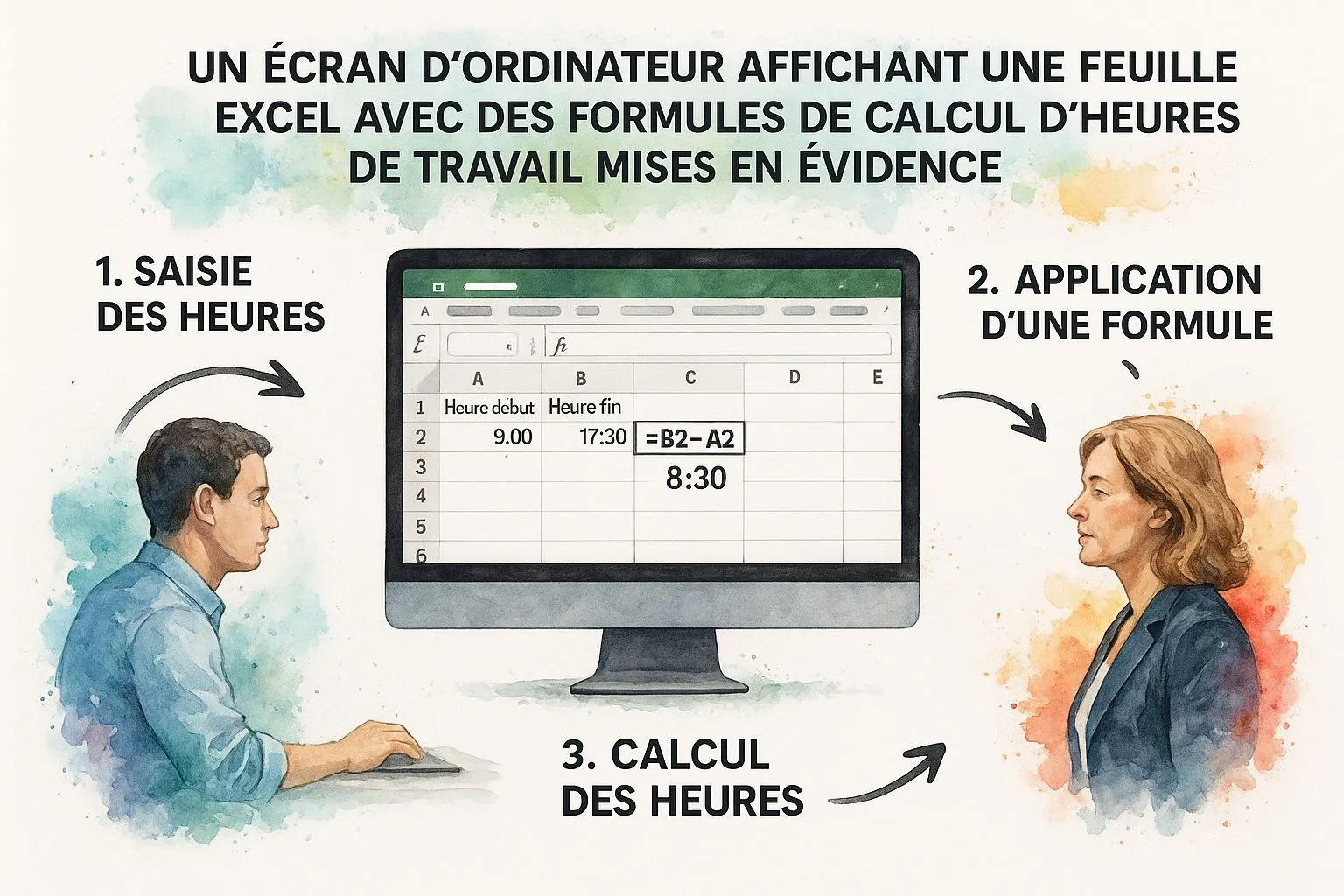
This structured method is the key to moving effortlessly from daily time logs to a monthly summary, and then to a perfectly accurate annual overview.
Why are these calculations crucial for your business?
Let’s be clear, these aren’t just administrative formalities. These figures have a very real impact on managing your teams and on the financial health of your business. Precise hour tracking lets you better anticipate costs, adjust schedules, and ensure that every paid hour is one that contributes to output.
This financial perspective is even more critical if you’re a freelancer or run a small business. If you’d like to dig deeper into the topic, we’ve prepared a guide to help you determine your break-even point in value and thus secure your business model.
Ultimately, mastering these calculations is essential for fair, sound management. It’s what protects your employees’ rights while defending your company’s interests. It’s the foundation of successful, stress-free planning.
A brief look at the history of working time in France
To fully grasp the challenges of calculating working time today, it’s worth taking a quick look back. What we now consider the norm, particularly the famous 35-hour week, is actually the result of more than a century of social struggles and legislative changes. It was simply unimaginable for our great-grandparents.
At the start of the 20th century, workers’ daily lives were radically different. 12-hour days were common, often leading to 70-hour weeks. It wasn’t until the law of April 23, 1919, that a first major change occurred: the working day was set at 8 hours, or 48 hours per week.
But the real turning point came in 1936 under the Popular Front, with the introduction of the 40-hour week and, above all, the first two weeks of paid leave. A major social achievement. For those interested in the history, I recommend consulting the detailed history of these major milestones.
The laws that shaped our daily lives
The path to our current conditions has been marked by several key reforms. Each one has helped reshape our relationship with work.
- 1906: Weekly rest becomes mandatory. A step that may seem obvious today, but was fundamental at the time.
- 1936: The 40-hour week and paid leave. A symbolic date that marked a turning point in social progress in France.
- 1982: Working time drops to 39 hours per week and a fifth week of paid leave is granted.
Over the decades, the trend is clear: a gradual reduction in working time, aimed at improving quality of life, often without harming productivity, quite the opposite in fact.
This historical perspective is not just a simple anecdote. It reminds us that current rules are not set in stone, but are the result of a long evolution. Keeping this in mind helps better understand the importance of an accurate, precise count of hours worked, and the debates that still animate our society on this subject.
The impact of modern reforms on your calculations

While the major historical developments laid the groundwork, it’s the more recent reforms that have truly reshaped the landscape of working time calculation in France. The most obvious example is the gradual reduction of the legal working week, which went from 40 to 39 hours in 1982, before reaching the famous 35 hours in 2000. This last reform was a real turning point.
But these laws didn’t just reduce the number of hours to be worked. They also introduced concepts that have become essential, such as RTT days (reduced working time compensation days), which are now added as a key variable in any annual count.
The equation of leave and reduced hours
The gradual introduction of new weeks of paid leave also played a major role. The arrival of the fourth week in 1969, and especially the fifth in 1982, considerably reduced the effective annual working time. Each reform thus added a new layer of complexity for businesses.
The result is striking: since 1950, the average annual working time for an employee in France has dropped from around 1,900 hours to nearly 1,400 hours. This is a dramatic decrease, directly attributable to these social advances. For those who want to dig deeper into the topic, detailed analyses of this evolution are very insightful.
This transformation has made rigorous management and precise tracking simply indispensable for staying compliant.
Each reform, while positive for employees’ work-life balance, has reinforced businesses’ need to equip themselves with reliable tools. Approximate calculations are no longer an option given such a precise legal framework.
It’s easy to see why calculating working time has gone from a simple administrative task to a genuine strategic issue. Today, you have to constantly juggle legal working time, sector agreements, overtime, leave, and RTT days. Precision is key, not only to guarantee fair pay and effective planning, but also to scrupulously comply with labor law.
Frequently asked questions about calculating working time
Even with the best intentions, certain questions about tracking hours can quickly become a headache. That’s perfectly normal. Let’s untangle the points that often cause confusion so you can approach working time calculation with more confidence.
How should break time be handled?
This is a question that comes up constantly. The basic rule is simple: for six hours of continuous work, an employee is entitled to a break of at least 20 minutes. Important point: unless your collective agreement or a company agreement states otherwise, this break is not considered effective working time.
In practice, this means it’s unpaid and must be subtracted from the total. A workday from 8am to 4:20pm with a 20-minute break therefore equals exactly 8 hours of effective work, not 8 hours and 20 minutes.
Is commuting time paid?
Generally speaking, no. Time spent between your home and your usual workplace is not effective working time. There is therefore no pay associated with it.
Be careful though, there are exceptions! If your employer asks you to travel to a location that is not your usual workplace, such as a job site or a client’s premises, the travel time that exceeds your normal commute may be considered work. In this case, it must be paid.
**What should I do if I find an error on my payslip?**Your first move should be to report it to your HR department or manager. For your request to be taken seriously, come prepared with evidence: your own time records, timesheets, etc. A correction should then be made on your next payslip.
If you have other questions, chances are we’ve already answered them. Take a look at our full FAQ, where we cover many other practical cases.
Tired of manual calculations and mounting errors? With Bizyness, you can automate your time tracking and finally focus on your core business. Discover how to simplify your management today at bizyness.fr.
