

 Français
How to Legally Cancel a Signed Quote
Find out how to cancel a signed quote without risk. Our guide covers the legal grounds, the amicable process, and the consequences to avoid.
Can you actually cancel a signed quote? The answer is a resounding “it depends.” Everything hinges on the legal context in which the agreement was made. For an individual consumer, the law has built in safeguards, such as the famous 14-day cooling-off period, especially for contracts concluded remotely or following door-to-door sales. Between businesses, however, the situation is far tighter: a signature turns the quote into a firm and final contract.
The legal value of a signed quote
Once a client signs a quote, that document radically changes status. It’s no longer a simple commercial proposal — it’s a contract that binds both parties. Article 1103 of the French Civil Code is very clear on this point: legally formed agreements act as law for those who signed them.
What does that mean in practice? From the moment the quote is accepted — whether by a handwritten signature, an electronic signature, or even a simple email saying “Approved” — obligations are created. On one side, the business must carry out the service or deliver the promised product. On the other, the client commits to paying the agreed price.
A quote: where two intentions meet
The legal force of a signed quote comes from this fundamental principle: it’s the meeting of a precise offer (the quote) and an unequivocal acceptance (the signature). It’s this mutual consent that seals the agreement.
Think of it as a handshake formalized in writing. The quote lays all the cards of the agreement on the table, and the signature is the handshake confirming everyone is on the same page. Once the hand is shaken, it can’t be pulled back so easily.
That’s why it’s absolutely essential for the quote to be clear and complete before you even send it. To make sure you don’t forget anything, take a look at our guide on mandatory information on a quote; it will save you a lot of hassle and potential formal defects.
The critical difference: B2C or B2B?
The weight of the commitment is entirely different depending on whether your client is an individual consumer or another business. This is really the first thing to check to know whether a cancellation is even possible.
-
In B2C (Business to Consumer): When dealing with an individual, the Consumer Code is there to protect them. This is where the famous 14-day cooling-off period comes in, allowing the client to change their mind without justification, particularly for online sales or door-to-door solicitation.
-
In B2B (Business to Business): Between businesses, it’s a different story. The law assumes both parties are experts who know what they’re doing. There is therefore no cooling-off right. A signed quote is a rock-solid contract, and to break it you’ll need either a mutual agreement or a very serious reason, such as a serious breach by the other party.
To make things clearer, here’s a summary of each party’s commitments after signing.
Summary of commitments after signing a quote
This table summarizes each party’s obligations once the quote has been accepted, highlighting the key differences between B2C and B2B contexts.
| Commitment | For the client (individual) | For the provider (business) |
|---|---|---|
| Payment of the price | Obligation to pay the agreed amount, unless the cooling-off right applies. | Obligation to invoice the exact amount stated in the quote (excluding amendments). |
| Performance of the service | Obligation to allow performance (grant access, provide information, etc.). | Obligation to carry out the service or deliver the goods in accordance with the terms of the quote. |
| Cooling-off period | 14-day right for distance sales, off-premises sales, or following solicitation. | No cooling-off right. |
| Termination of contract | Cancellation possible within the legal framework (cooling-off, defect of consent, etc.). | Cancellation possible only by mutual agreement or for a legitimate and serious reason (force majeure, client fault…). |
This table highlights just how much the legal framework differs. Knowing whether your client is an individual or a business is therefore the first question to ask before considering any cancellation process.
Valid grounds for canceling a quote
Canceling a signed quote isn’t just crossing out a line on a document. It means breaking a commitment that carries real legal weight. Fortunately, the law provides ways out — but you need to make sure you’re within the rules before taking them. These legitimate grounds exist to protect the client against the unexpected or against abuse, while also preventing businesses from suffering casual cancellations.
Let’s look together at the situations that legally allow an already-sealed agreement to be ended. Mastering these rules is essential for acting with confidence and avoiding disputes that are often long and costly.
To visualize this, imagine a simple quote that, once signed, turns into a solid contract. That’s what this diagram shows.
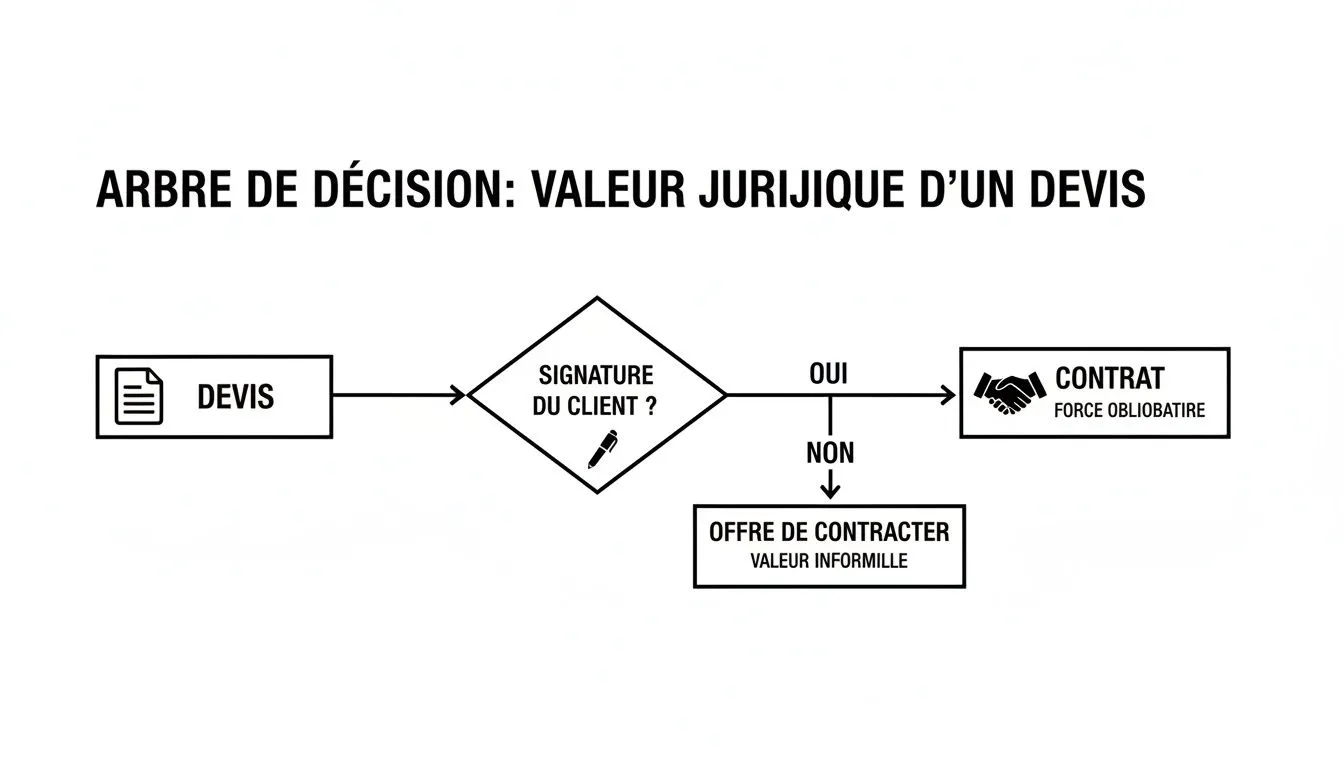
It’s clear that the signature is the key moment: it turns a simple commercial proposal into a firm commitment for both parties.
The famous 14-day cooling-off period
The best-known case is of course the cooling-off right. It gives the individual client a 14-calendar-day window to change their mind, without needing to justify it or pay any penalty. It’s a very strong protection, but be careful — it doesn’t apply everywhere.
This right is tightly regulated by the Consumer Code. Its purpose is to protect the consumer in situations where they might have signed a bit too quickly, under pressure, or without all the information in hand.
In practice, it applies in two main situations:
- Contracts concluded remotely: This is the classic case of a purchase made online, by phone, or by mail. If your client approved your quote via an electronic signature without ever meeting you in person, they’re covered.
- Contracts concluded off-premises: This refers to door-to-door sales, sales at the client’s workplace, or even a sale organized outside your usual place of business.
The starting point of the period is crucial. For a service, the 14-day count starts the day after the contract is signed. For the sale of a product, it starts the day after receipt. So be sure to date all your documents carefully!
There are, however, important exceptions, even for an individual consumer. This right does not apply, for example, to custom-made goods, emergency work requested by the client themselves, or if the service has been fully performed before the end of the 14 days, with the client’s explicit agreement.
Delay in performing the service
Another very common reason to cancel a signed quote: the provider failing to meet deadlines. When a quote states a completion or delivery date, that’s not just a suggestion — it’s a commitment in black and white.
The number to remember is 7 days of delay. In practice, if the work or delivery runs more than 7 days behind the planned date, and there’s no case of force majeure to justify it, the client has the right to terminate the contract. This is clearly stated in Article L216-2 of the Consumer Code.
Do keep in mind the notion of force majeure, though. A completely unforeseeable, irresistible event beyond your control (such as exceptional bad weather blocking a job site) can suspend deadlines without this being considered a fault on your part.
Non-conformity of the service
Finally, a client is entirely entitled to request cancellation if the work delivered doesn’t match what was specified in the quote. The quote is the trust agreement, the specification sheet for the assignment. It must be followed to the letter.
This non-conformity can show up in several ways:
- Different materials: Using cheaper tiling or a different type of wood than what was promised.
- Missing features: If you sold the creation of a website with an online booking feature and it isn’t there, that’s a valid ground.
- A result that falls short: The service simply doesn’t achieve the goal it was ordered for.
To invoke this ground, the client must be able to prove the gap between the quote and the final result. Before/after photos, email exchanges, or, in more serious cases, a bailiff’s report may be necessary. That’s exactly why the precision of your quotes is your best ally. To dig deeper into this topic, our article on the validity period of a quote can give you some useful pointers.
Negotiating an amicable cancellation
Before diving into legal complexities or drafting a registered letter, the simplest, fastest, and most cost-effective reflex remains dialogue. An open, honest conversation can defuse plenty of tension and, who knows, preserve a business relationship for the future. Whether you’re the one initiating the cancellation or on the receiving end, a constructive approach always pays off.
The idea isn’t to enter a power struggle, but to find common ground. It’s about understanding the other party’s constraints and exploring solutions together. This approach demonstrates your professionalism and your willingness to find a fair outcome.

Preparing and starting the conversation
A successful negotiation is one that’s prepared for. Before even picking up the phone, take a moment to clarify your goals. Do you want a straightforward cancellation? Would simply postponing the project be enough? Or perhaps a change to the original scope?
Gather all the useful documents: the signed quote, recent email exchanges, your general terms and conditions of sale. You need to be ready to lay out the facts clearly. If you’re the one canceling, be transparent about the reasons, without falling into endless justification.
A good negotiation starts with careful listening. Showing empathy isn’t a weakness; it’s a powerful lever for understanding the other party’s constraints and finding a solution that minimizes damage for everyone.
As a service provider, try to understand what has changed on your client’s side. Sometimes a simple schedule adjustment or a payment plan can be enough to save the project. If you’re the client, keep in mind the work the provider may have already started.
Here are some sample phrases to open, negotiate, and confirm by email an amicable quote cancellation, depending on your position.
| Communication step | Example for the provider | Example for the client |
|---|---|---|
| First contact | ”Hello [Client name], I’m reaching out about quote No. XXXX. Due to unforeseen circumstances, I’m unfortunately unable to honor our agreement. I’m truly sorry and would like to discuss the best way to proceed." | "Hello [Provider name], I’m following up about quote No. XXXX signed on [Date]. Unfortunately, due to a change in circumstances, I need to reconsider this project. Would you be available to discuss it?” |
| Negotiation | ”I understand your situation. Since we’ve already completed [describe the work], I propose keeping the deposit as compensation, which would allow us to close out our collaboration with no additional costs. Would that work for you?" | "I’m aware that time has already been spent on the project. I propose compensating you [Amount or %] for the preparatory work, in exchange for canceling the remaining balance. What do you think?” |
| Written confirmation | ”Following our conversation, I confirm by this email our mutual agreement to cancel quote No. XXXX. As agreed, we will keep the deposit of [Amount] and no further sum will be due. Thank you for your understanding." | "Following our phone call, I confirm our agreement to cancel quote No. XXXX. As agreed, I will pay you [Amount] to cover the costs incurred, and the deposit paid will be refunded to me. Please confirm this in return.” |
These examples should of course be adapted to your specific situation, but they provide a solid basis for clear, professional communication.
Leaving a written trace of the agreement
Even if the conversation goes perfectly over the phone, a verbal agreement is never enough in business. For the amicable cancellation to be official and secure, it must be formalized in writing. This is what protects both parties in case of misunderstanding or a later dispute.
A simple summary email is usually enough. It should be clear and restate the terms of the agreement.
- Identify the quote in question unambiguously (number, date, subject).
- Explicitly state that both parties agree to cancel the contract arising from that quote.
- Detail the financial terms of the cancellation: refund of the deposit, retention of the deposit, no fees at all, etc.
- End with a request for confirmation, such as: “Please confirm by return email your full agreement with these terms.”
This written record then becomes irrefutable proof of the mutual termination and lets you close the file with peace of mind.
Prevention is better than cure — with solid terms and conditions
The best negotiation is the one you never have to conduct. Clear, precise, well-written general terms and conditions of sale are your best insurance. They set the rules of the game from the start and let you anticipate cancellation scenarios.
By including specific cancellation clauses in your terms and referencing them on your quotes, you professionalize your approach. Your client knows exactly where they stand, which avoids plenty of unpleasant surprises.
Examples of preventive clauses to include:
- Termination clause: Define the cases in which the contract can be broken (for example, if the deposit is not paid within the specified time).
- Compensation clause: Specify the fees that could be withheld if the client cancels without a legal reason (for example, a percentage of the quote to cover administrative costs and time already invested).
- Amendment clause: Offer an alternative to outright cancellation, explaining how the project can be adjusted if the client’s needs evolve.
Let’s imagine a concrete case: a web developer might state that the deposit is non-refundable if the cancellation occurs after the project kickoff meeting. A craftsman making custom furniture might state that cancellation is no longer possible once the wood has been ordered. These precautions turn a simple quote into a secure working framework for everyone.
The risks of wrongful termination
Terminating a contract without a valid reason is never a decision to take lightly. Once the cooling-off period has passed, and if the other party has committed no fault, canceling a signed quote on your own initiative exposes you to financial and legal consequences that can be significant.
This is what’s known as wrongful termination of contract. The party who feels wronged, whether the client or the provider, is fully entitled to seek compensation for the harm suffered. In practice, this most often takes the form of damages, the amount of which will be set by a judge.
What exactly are damages?
Damages are not just a symbolic penalty. Their purpose is to financially compensate for the real loss suffered by the victim of the termination.
Imagine a client cancels without reason a website creation project for which you had blocked out two weeks of work. That’s a clear loss of earnings for you. You would then be entitled to claim compensation to cover the time tied up and the other assignments you had to turn down during that period.
Conversely, if your provider drops you at the last minute, you could suffer operating losses or be forced to find a replacement urgently, often at a higher rate. These extra costs represent damage that is entirely compensable.
Wrongful termination of a contract doesn’t just end future obligations; it creates a new one: the obligation to repair the harm caused. That’s exactly why clear communication and well-written documents are your best allies in never getting to that point.
Deposit vs. down payment: a critical difference
The presence of a deposit or a down payment in the quote completely changes the situation in the event of cancellation. The two terms tend to get confused, but their legal scope is very different, and the impact on your finances is direct.
- The deposit (acompte): This is an initial payment toward the total amount. It seals a firm and final commitment on both sides. If a cancellation occurs, the deposit does not release anyone from their obligations. A client who backs out loses their deposit and can even be legally forced to pay the full amount of the quote.
- The down payment (arrhes): This is a sum paid in advance that provides a right to withdraw. Either party can walk away from the contract. Think of it as a paid exit door.
The way down payments work is quite specific and protects both signatories in a balanced way.
How do down payments (arrhes) work in the event of cancellation?
| Who cancels the contract? | What happens to the down payment? | What are the other consequences? |
|---|---|---|
| The client | They lose the entire down payment they paid. | The provider keeps the down payment but cannot demand payment of the balance or claim any additional damages. |
| The provider | They must refund double the down payment they received. | The client receives a flat-rate compensation (double the down payment) but cannot claim any further damages. |
This distinction is truly fundamental. If serious financial difficulties prevent you from honoring a contract, be aware that legal solutions exist, such as debt restructuring proposals, which can help reorganize debts and thus avoid complex disputes linked to a termination.
Correctly categorizing each cancellation in your management tool, as Bizyness allows, is therefore crucial to avoid unexpected losses or finding yourself in the middle of a dispute that could cost you dearly.
And how does canceling a quote work in Bizyness?
Once you and your client have agreed on the cancellation, whether amicably or after mediation, the work isn’t over. You now need to reflect that decision in your administrative management. This is a crucial step: a poorly recorded cancellation can quickly throw off your projected revenue, complicate your VAT returns, and create a real accounting headache.
Fortunately, a management tool like Bizyness is designed to simplify your life and make sure your books stay spotless. It saves you from risky manual workarounds and costly oversights. For even smoother management of your commercial documents, from the quote to its potential cancellation, it’s often worth equipping yourself with high-performing quoting software.
Moving the signed quote to “canceled” status
The very first thing to do, and the simplest, is to update the quote’s status in your Bizyness interface. A quote that moves from “Signed” to “Canceled” isn’t deleted. It’s simply archived with its new label. This traceability is essential.
This small change has an immediate impact: the quote amount disappears from your revenue projections and your sales pipeline is cleaned up. This gives you a much more accurate picture of the deals that will actually go through.
Changing this status takes only a few seconds from your dashboard.

The interface is clear, letting you see all your documents and adjust them in real time to match the reality of your business.
What if an invoice has already been issued?
This is where things get a bit trickier. Imagine you’ve already created an invoice from the quote, even just a deposit invoice. In that case, a golden rule of accounting applies: an already-issued invoice is never deleted. Never. It’s part of a numbered, chronological sequence, and deleting it would create a “gap” in your bookkeeping, which is strictly forbidden.
The only correct way to proceed is to issue a credit note, also called an “avoir” invoice. This is the document that cancels out the accounting effect of the original invoice.
Think of the credit note as the “negative mirror” of the invoice. It contains the same information, but with negative amounts. Its role is to neutralize the impact of the first invoice on your revenue and the VAT collected, without making it disappear from your records.
Bizyness automates the creation of this credit note for you. Starting from the invoice in question, the software generates the corresponding credit note, reusing the same line items with the correct amounts. It’s the guarantee of compliant management, without the headache.
To fully grasp these concepts, our article on the difference between a quote and an invoice is well worth a read.
The accounting impact and concrete tracking in Bizyness
Handling a cancellation properly isn’t just about changing a status. The entire financial chain is affected. And that’s where the automation offered by Bizyness really pays off.
Case 1: No invoice has been created yet This is the simplest scenario. The quote is simply marked as “Canceled.”
- Accounting impact: None at all. A quote is not an accounting document; it generates no entries.
- Action in Bizyness: A simple status change, and the matter is closed.
Case 2: An invoice has been issued and paid (partially or in full) The client cancels and you’ve agreed to refund them.
-
Accounting impact: You need to reverse the revenue that was recorded and the VAT you collected.
-
Generate a credit note directly from the original invoice.
-
Record the refund you make to the client.
-
Match the credit note with the invoice so the two offset and balance each other out.
The system then ensures that your VAT return for the current period is automatically adjusted. The VAT initially calculated on the invoice will be deducted thanks to the credit note. In practice, you won’t pay tax on money you had to give back. This kind of automated tracking is what lets you maintain healthy cash flow and rock-solid tax compliance, even when things don’t go as planned.
Frequently asked questions about canceling a quote
Managing the cancellation of a quote is a bit like navigating murky waters. You always end up with a bunch of very concrete questions. To help, I’ve compiled here the questions that come up most often among business owners, with clear, directly applicable answers.
Does a simple “OK” by email really count as a signature?
Yes, and it’s essential to understand this clearly. An email with something as simple as “Approved” or “I confirm your quote” is enough to turn your commercial proposal into a proper, binding contract. From a legal standpoint, this act is interpreted as clear acceptance of your offer.
This email validation carries exactly the same weight as a handwritten or electronic signature. Never take these email exchanges lightly. They’re irrefutable proof of both parties’ agreement and mark the start of the contract.
Is a quote valid indefinitely?
No, a quote does have an expiration date! In fact, it’s basic best practice to include a validity period, generally between 1 and 3 months. This simple mention protects you from price increases from your own suppliers and helps you plan your schedule with confidence.
If you forget to state a duration, the law considers the quote valid for a “reasonable period.” The problem is that this notion is vague and can easily lead to disagreements. My best advice is to always set a clear expiration date on the document.
A client cannot force you to carry out work under the terms of a quote whose date has passed. It’s your safety net for keeping control over your costs and your schedule.
Don’t forget the cooling-off right either. In France, an individual client who signs a quote following door-to-door solicitation or a distance sale has 14 days to change their mind without justification. In this specific case, the signed quote only becomes a firm contract once this period has passed. To dig deeper, you can check the details on quote validity and consumer rights.
My client signed the quote but isn’t paying the deposit. What should I do?
When a client signs, they commit to complying with all the terms of the quote, including paying the deposit. If they don’t pay it on time, you have absolutely no obligation to start the work. They’re the one breaking the contract.
Here’s how to handle this tricky situation, step by step:
- First, a gentle reminder. A simple phone call or reminder email is often enough. It may just be an oversight — it happens.
- Next, step it up a notch: formal notice. If the first reminder didn’t work, send a registered letter with acknowledgment of receipt. This is an official letter demanding the client pay the deposit within a specific deadline, for example 8 days.
- Finally, the decision. If the money still isn’t there, you have two options. Either you consider the contract canceled due to the client’s fault, or you decide to go to court to force performance of the contract (payment).
Honestly, in most cases, the formal notice is enough to unblock the situation or, failing that, to officially end the project. At the very least, you’re released from your obligations and can move on.
To make managing your quotes, invoices, and credit notes never a headache again, discover how Bizyness automates your entire financial cycle. Centralize your documents and keep your books spotless, even when the unexpected happens. Simplify your management with Bizyness.
