

 Français
 Client not paying your invoice as a sole trader: how to act effectively
Dealing with a client who won't pay your invoice as a sole trader? Discover our tips to recover your payment quickly and protect your business.

When a client doesn’t pay you, the steps to follow are fairly clear. You start with a friendly reminder, by email or phone, to keep the conversation going. If that’s not enough, you move on to a formal notice (mise en demeure), a registered letter that makes the request official. As a last resort, if nothing changes, there are judicial debt-recovery procedures such as the order for payment (injonction de payer).
The impact of an unpaid invoice on your business

Let’s be clear: an outstanding invoice isn’t just a line in a spreadsheet. It’s a genuine source of stress that weighs directly on your micro-business’s cash flow. And if it’s any comfort, you’re far from the only one going through this.
The domino effect of a simple late payment is often underestimated, especially for a small business. The issue isn’t just the lost revenue. It’s your ability to pay your own expenses, invest in equipment, or even pay yourself a salary that’s at stake.
A much bigger problem than it appears
Unpaid invoices are an economic reality that isn’t easing up — quite the opposite. A recent analysis of payment-default risk shows a fairly clear deterioration of the situation in France.
According to the latest Allianz Trade Client Risk Barometer, 62.6% of French businesses (including many sole traders) experienced at least one unpaid invoice, an increase of 11.6% in one year. Worse still, 58.8% of them had to deal with at least one client default, a figure up 26.4% since 2022. You can find all the details of this study in the 2025 client risk analysis on leanpay.io.
These figures aren’t just statistics. They represent thousands of self-employed professionals who, like you, have to navigate an uncertain economic climate.
Dealing with a non-payment isn’t just about chasing your money. It’s a real test of your organisation and your ability to have the value of your work respected. Every step, from the simple reminder to the formal notice, is there to establish your credibility and protect your business.
Adopting a structured approach
Faced with a client who isn’t paying, the first reaction is often worry, even frustration. Yet your best ally in this situation is a methodical, professional approach. This guide is here to walk you through it, step by step, starting with simple actions before moving on to more formal recourse if the situation requires it.
Here are the key points we’re going to break down together:
- The friendly reminder: How to remind your client of their obligations politely but firmly, without blowing up your business relationship.
- The formal notice: The legal step that makes your claim official and is often a required prerequisite before going further.
- Legal recourse: There are simplified procedures suited to sole traders for obtaining payment of your invoices.
The goal, of course, is to get your money back, but also to equip you to handle these situations with more peace of mind and, above all, to protect your business’s financial health in the long run.
Handling the friendly reminder without damaging the client relationship
Faced with an unpaid invoice, the first reaction is often irritation. That’s human. But before pulling out the big guns, a more diplomatic approach is not only advisable, it’s also far more effective.
This first, “friendly” phase isn’t about harassing your client. The idea is to open a dialogue to understand what’s going on. A simple oversight, an invoice that lands in spam, a temporary cash-flow difficulty… there can be many reasons.
A cordial reminder helps clear things up, while showing that you’re an organised professional who keeps track of their invoicing. It’s the best way to preserve the business relationship, which is crucial if you hope to work with this client again. Kind but firm communication resolves the vast majority of late payments without drama.
Setting up a progressive reminder schedule
Acting with method is key. A simple, progressive reminder schedule keeps you from looking disorganised or, conversely, too aggressive. It lets you stay in control.
Here’s an outline that has often worked well and that you can adapt:
- D+5 after the due date: the courteous reminder email. This is the first contact, gentle and professional. Assume it’s simply an oversight. A brief message recalling the invoice reference and amount is more than enough.
- D+15 after the due date: the phone call. If your email has gone unanswered, direct contact is often more effective. It lets you confirm the invoice was received and sense whether there’s a real blocker. Stay calm, factual, and attentive.
These figures speak for themselves and reflect the reality on the ground for many self-employed professionals.
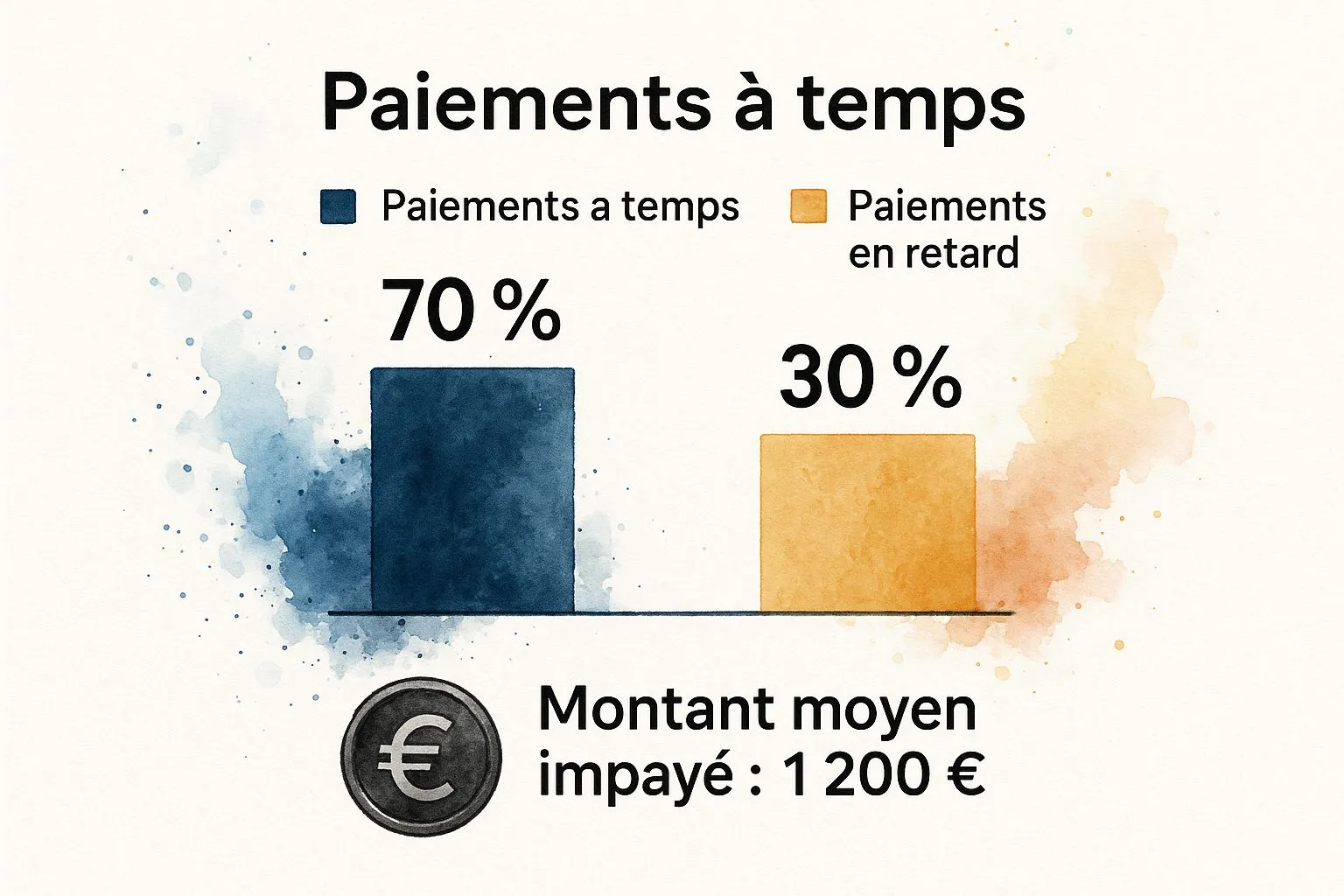
Even though 70% of payments arrive on time, the remaining 30% represent real lost revenue that can quickly weaken your cash flow. Follow-up is therefore far from optional.
Which communication channel to choose?
The choice of channel matters as much as the message itself. Each method has its strengths and weaknesses, so use them strategically.
To make things clearer, here’s a comparison of the most common channels for a first friendly approach.
Comparison of friendly-reminder channels
This table compares the effectiveness, formality, and impact on the client relationship of the different communication channels for a first reminder.
| Communication channel | Effectiveness | Cost | Impact on client relationship |
|---|---|---|---|
| Moderate to high. Perfect for a first reminder, leaves a written record. | Very low | Low (non-intrusive) | |
| Phone | Very high. Ideal for understanding the situation and unblocking things. | Low | Moderate (more personal, can be seen as pushy) |
| SMS | Low to moderate. Best reserved for close relationships. | Very low | High (can be seen as informal or intrusive) |
In short, email is perfect for a soft start, while the phone becomes essential if the situation doesn’t get resolved. SMS, meanwhile, should be handled with extreme caution.
If you need help with wording, feel free to check out templates for your unpaid invoice reminder letter. They’re an excellent starting point for finding the right tone.
The key to a successful friendly reminder is staying factual and professional. Never let your emotions take over. You’re not asking for a favour — you’re simply requesting payment for the work you delivered.
If, despite these attempts, silence persists, it will be time to move to the next step: the formal notice. But this friendly phase will have demonstrated your good faith and will be a solid asset for your case should more formal proceedings become necessary.
Stepping it up: the formal notice

If your friendly reminders have gone unanswered, it’s time to change gears. You now enter a more formal, more serious phase. The formal notice isn’t just another reminder. It’s a legal act that changes the game. Through this letter, you clearly signal to your client that the discussion is over and that, without payment, the next step will be court.
Think of this letter as your last attempt to resolve the conflict before bringing out the heavy artillery. It must be drafted with extreme precision. A clear, firm, well-structured document can sometimes be enough to unblock a situation that seemed stuck. It’s an iron fist in a velvet glove, in a way.
The key elements your letter needs to carry weight
For a formal notice to be valid in the eyes of the law, it must contain very specific information. The slightest omission could render it void and considerably weaken your case if things escalate.
Here’s what your letter absolutely must include:
- The subject line “Mise en demeure” (Formal notice): This is non-negotiable. These words must appear in black and white for the document to have legal value.
- Detailed context: Be factual. Recall the invoice number, its date, the nature of the service or product sold, and of course, the exact amount owed.
- A clear ultimatum: Set a reasonable but firm payment deadline. Generally, a period of 8 to 15 days is considered fair and sufficient.
- The threat of what follows: State very clearly that once this deadline expires without payment, you will initiate legal proceedings to obtain forced payment of the debt.
A friendly piece of advice: always attach a copy of the unpaid invoice to your letter. This avoids any possible dispute along the lines of “I never received it” and shows that you have a solid, well-kept file.
Why registered mail is your only option
Forget email right away, even with a read receipt, or ordinary mail. The formal notice must be sent by registered letter with acknowledgment of receipt (LRAR). It’s the only way to have irrefutable legal proof that your client actually received your letter.
This signed acknowledgment of receipt will be the cornerstone of your case if you need to move to the next step, such as an order for payment. Without it, a judge could rule that you didn’t follow the correct procedure and reject your claim. It’s a detail that’s anything but minor.
Remember that the law is on your side. In France, the legal payment term is generally 30 days. Once this deadline has passed, you’re entitled to charge late-payment penalties as well as a flat-rate compensation for recovery costs of €40. Be sure to mention it! Reminding your client of these penalties in your formal notice can add extra pressure and motivate them to act quickly. If you want to dig deeper, you’ll find good information on late payments on sogexia.com.
Asserting your rights with late-payment penalties
Time is money. This is especially true when you’re waiting to be paid on an invoice. Many self-employed professionals forget or don’t dare, but the law is on your side: you have the right to charge penalties for any late payment. It’s an effective lever, not only to offset the damage, but also to educate and discourage clients who pay late.
For this right to be enforceable, there’s one golden rule: late-payment penalties must be clearly stated on your business documents. That means your quotes, your invoices, and your general terms and conditions of sale (T&Cs). Without this mention, you can’t claim them. It’s a small line that changes everything.
How to calculate the penalties?
Be careful, penalties aren’t set at random. The calculation is tightly regulated by law and follows a precise formula to prevent abuse. This calculation is based on an interest rate.
This rate cannot be lower than three times the statutory interest rate. In practice, many entrepreneurs set a round rate, such as 10% per year, which is common and entirely legal. You can check the current rates on the official service-public.fr website to make sure you’re within the rules.
The formula to apply is fairly simple:
(Invoice amount including VAT x number of days late x penalty rate) / (365 x 100)
Let’s take a concrete example. You have an invoice of €1,500 including VAT that’s been unpaid for 30 days. Your penalty rate is set at 10%. The calculation is: (€1,500 x 30 x 10) / 36500 = €12.32.
It’s not a fortune, we agree. But the main point is to make a statement and encourage your client to settle the situation as quickly as possible.
Flat-rate compensation: an additional right not to overlook
And that’s not all! On top of these penalties, the law allows you to claim a flat-rate compensation of €40 to cover your recovery costs.
This amount is due automatically, from the very first day of late payment. You don’t even need to prove that you incurred any costs. It’s a right.
The €40 compensation is a fixed amount, set by law. It’s added systematically to the late-payment penalties you’ve calculated. Be sure to state it clearly in your reminder letter or email to assert all your rights.
Applying these charges sends a very clear signal to your client: you’re professional and you know your rights. To go further and see concrete examples, I strongly recommend reading our full guide on late-payment penalties on invoices.
When going to court becomes the only option to get paid

If your formal notice goes unanswered, the idea of taking legal action can be intimidating. We often imagine endless, costly proceedings, far removed from the realities of a sole trader. Think again. There are judicial solutions designed to be fast and accessible, perfectly suited to disputes involving self-employed professionals.
Your client’s silence after a formal notice is a message in itself. It’s a sign that the friendly discussion has failed. It’s now time to move to a more formal step to recover what you’re owed. This isn’t aggression, it’s simply the logical next step to assert your rights and protect the health of your cash flow.
The order for payment: the most direct and effective weapon
Faced with a client who isn’t paying and who doesn’t dispute the debt, the order for payment (injonction de payer) is your best ally. It’s a simplified judicial procedure with a major advantage: it’s “non-adversarial.” In practice, the judge rules solely on the basis of the evidence you submit, without even summoning your client.
This is the best route in most scenarios: you have a signed quote, proof that the work was done (or the product delivered), and the matching invoice. The debt is therefore indisputable.
To get started, simply fill out a Cerfa form and file it with the registry of the competent court. If your client is also a business, this will generally be the commercial court. The key to success? An airtight file. Make sure to include:
- The quote or contract approved by your client.
- The unpaid invoice, of course.
- The copy of the formal notice and the acknowledgment of receipt proving they received it.
- All relevant correspondence (emails, delivery notes, etc.) demonstrating your good faith and the reality of the service provided.
The judge reviews your file and, if convinced, issues an “order for payment” (ordonnance d’injonction de payer).
Careful, it’s not quite over yet. Once you have this order in hand, you have six months to have it served to your client by a judicial officer (formerly known as a bailiff). This is crucial, because it’s this notification that opens a one-month window during which your client can file an objection.
If they don’t react within this window, the order becomes enforceable. You can then ask the judicial officer to proceed with forced recovery, for example by seizing your debtor’s bank account. If you want to dig deeper into the topic, this guide on client debt recovery is an excellent resource detailing the various techniques.
Other legal remedies to keep in mind
The order for payment is often the most relevant solution, but it’s worth knowing the other options, since every case is unique.
The référé-provision is an emergency procedure. Imagine this non-payment is genuinely putting your business at risk. If the debt is obvious and hard to dispute, you can use this procedure. Unlike the order for payment, there is a hearing, but it’s very quick. The advantage? If the judge rules in your favour, the decision is immediately enforceable, even if your client decides to appeal.
The assignation en paiement (summons for payment) is the “classic” judicial procedure. It’s longer, more complex, and often more expensive (a lawyer is nearly essential). It’s kept for complicated cases, for example when the client actively disputes the amount or quality of your work. For a sole trader, it’s really the solution of last resort, especially for small debts.
The right procedure to choose will therefore depend on the amount at stake and your client’s behaviour. But the key takeaway is that tools exist to defend your rights, and they’re far more accessible than you might think.
Frequently asked questions about unpaid invoices
Facing an unpaid invoice is a bit like navigating in thick fog. Questions pile up and uncertainty quickly takes over, especially when you’re a sole trader. Let’s go through it together to make things clearer and give you the keys to act with confidence.
My client isn’t paying — can I stop working for them?
Yes, absolutely. This is a fundamental right known as the “exception d’inexécution” (exception of non-performance). If your client seriously fails to meet their obligations, such as ignoring your invoices and reminders, you’re entirely within your rights to suspend your ongoing work.
Be careful, this shouldn’t be done on a whim. The approach matters. Always notify your client in writing — an email with a read receipt is a good first step — that you intend to suspend your work. Give them one last reasonable deadline to settle the situation. This is a professional stance that protects you legally and maintains your credibility.
The exception of non-performance is a powerful tool, but you need to know how to use it. It’s best to plan ahead. Consider including it in your general terms and conditions or contracts. A small preventive clause can save you a lot of trouble.
What if my client disputes the invoice?
Here, the game changes completely. If a client disputes the invoice, your first move should be to pick up the phone or send an email to open a dialogue. You need to understand where the blockage is coming from. Is it the quality of the work being questioned? A misunderstanding about a specific point on the invoice?
Your best ally is your file. Prepare by gathering all the evidence showing you fulfilled your side of the contract:
- The emails where they approved the various stages of the project.
- The initial quote, signed by their own hand. This is the basis of your agreement.
- Any delivery note, report, or other relevant document.
If the dialogue breaks down and the disagreement persists, don’t rush into an order for payment. This procedure only works for clear, undisputed debts. A disputed invoice, however, makes the claim “contentious.” Explore other avenues such as mediation or conciliation. It’s often faster and much cheaper than legal proceedings.
Is it a good idea to use a debt-collection agency?
It’s a card worth playing, especially if you have neither the time, nor the energy, nor the desire to manage this situation, which can quickly become a burden. These agencies are specialists who handle everything, from the first reminder through to potential legal action.
Their business model is often their biggest selling point: most of the time, they’re paid on success. They take a percentage of the amounts they manage to recover for you. In other words, if they fail, you pay nothing. Of course, this comes at a cost on the final amount you receive, but it’s remarkably effective. It’s a solution worth considering for significant debts, where it’s worth the cost.
How can I protect myself from non-payment in the future?
The best remedy against unpaid invoices remains prevention. Putting a few good habits in place from the start can change everything and drastically reduce the risks.
Be crystal clear from the outset. Systematically require a deposit, typically 30%, before starting any assignment. It’s more than just an advance on cash flow; it’s a genuine commitment that makes your client accountable. And of course, tighten up your documents: detailed, signed quotes, and precise T&Cs that clearly state payment terms and late-payment penalties.
Don’t let unpaid invoices put your business at risk any longer. With Bizyness, you can automate your invoicing and keep an eye on the status of every invoice in real time. No more bad surprises. Discover how Bizyness can simplify your management today.
