

 Français
The evolution of the corporate tax (IS) rate
The corporate tax rate is set by the finance law. Discover how the corporate tax (IS) rate has evolved since 2016.

Corporate tax (IS, or Impôt sur les Sociétés) — also known as tax on profits — is a levy charged on a company’s annual results. It applies to all companies carrying out commercial activity in France, since profits made abroad are not subject to IS. The corporate tax rate has been trending downward for several years. Let’s look at how this tax works, what the rate is in 2023, and how it has evolved.
Which companies are subject to IS
Companies fall into two categories with respect to their IS taxation: mandatory taxation and optional taxation.
1 — Business statuses for which IS is mandatory
The following legal statuses are automatically subject to IS. However, for some of them (SARL, SA and SAS) there are options to be subject to income tax (IR) instead, under certain conditions.
- public limited companies (SA);
- limited liability companies (SARL);
- simplified joint-stock companies (SAS);
- under certain conditions, companies for the practice of a liberal profession (SEL, SELARL);
- partnerships limited by shares (SCA);
- civil companies carrying out an industrial or commercial activity.
Real estate civil companies (SCI) can escape IS thanks to an administrative tolerance, provided their revenue of a commercial nature (such as furnished rentals) does not exceed 10% of total revenue.
2 — Business statuses for which IS is optional
For the following legal statuses, IS taxation remains optional, since these types of companies are normally subject to income tax (IR):
- sole traders operating as a limited liability sole proprietorship (EIRL);
- sole traders (EI) who then opt to be treated as an EURL;
- single-member limited liability companies (EURL);
- general partnerships (SNC);
- joint ventures (sociétés en participation);
- certain civil companies carrying out a commercial activity;
- de facto companies.
It is up to each business owner to determine whether it is preferable to opt for IS or IR for their company.
What are the different corporate IS tax rates?
There are several corporate IS tax rates.
1 — The reduced IS rate of 15%
The reduced IS rate of 15% applies to the first bracket of profits, up to €42,500 (in 2023). To benefit from it, a company must meet the following criteria set by the finance law:
- have fully paid-up share capital;
- generate annual revenue below €10 million;
- have more than 75% of its shares held by individuals.
The IS rate for the first financial year is calculated pro rata if it is longer or shorter than 12 months, in order to verify that the company meets the criteria for the reduced rate.
The current reduced IS rate has been in effect since 1 January 2021. Before that date, the annual revenue threshold to qualify was €7,630,000. The first bracket of profits was then capped at €38,120.
2 — The standard IS rate
The standard IS rate has evolved since 2016, when it stood at 33 1/3% above that threshold. The finance laws of 2017 and 2020 lowered these rates.
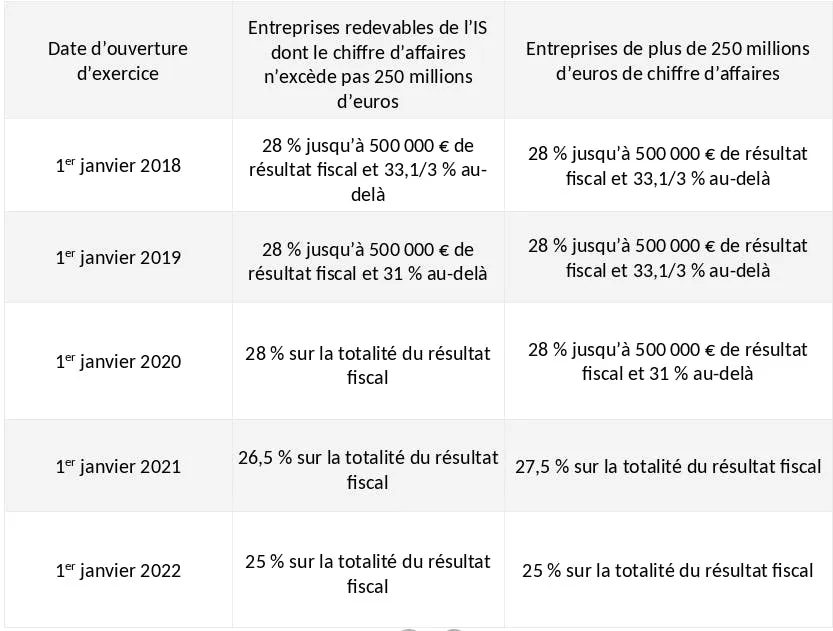
Summary table of the evolution of the IS rate
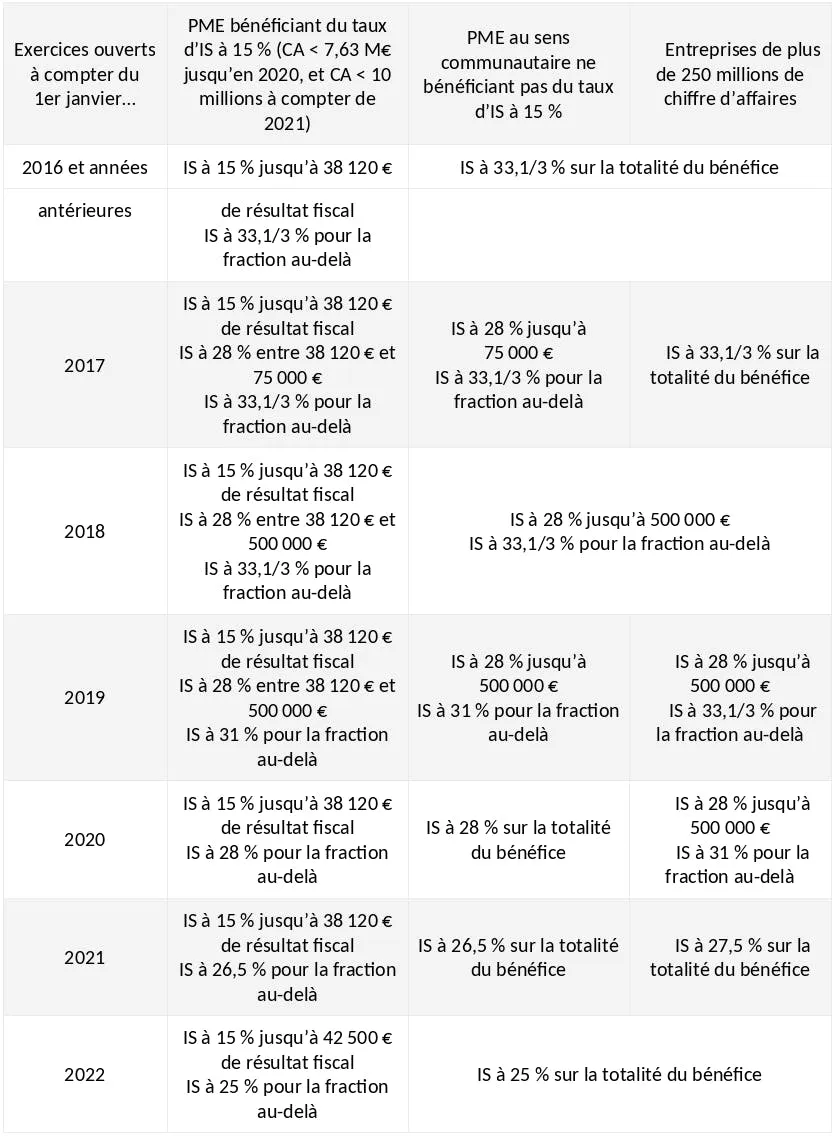
The IS rate for 2023
For 2023, the reduced IS rate is 15%, subject to the following criteria:
- revenue excluding tax below €10 million;
- fully paid-up capital;
- capital held at least 75% by individuals (or by a company meeting this same criterion).
The reduced IS rate applies to the portion of profits up to €42,500. Beyond that, profits are taxed at the standard IS rate.
The standard IS rate is set at 25%, regardless of revenue level, on the entire taxable result for all companies. However, non-profit organizations benefit from specific rates:
- 10% for investment income such as bonds, for example;
- 24% for property income: real estate rentals or farming profits, for example.
The IS payment schedule
The schedule for paying IS instalments depends on the closing date of the fiscal year.
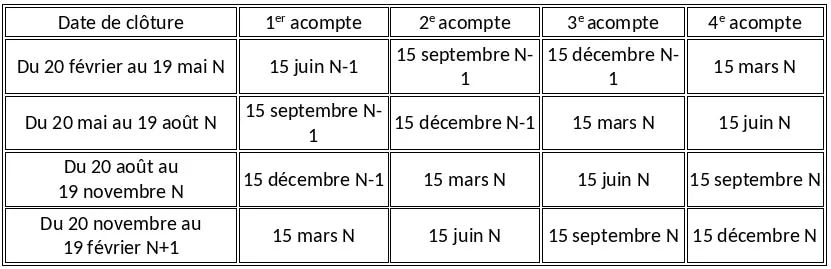
The deadline for paying the IS balance varies depending on the closing date of the fiscal year:
- 15 May of year N for a fiscal year closed on 31 December of year N-1;
- the 15th of the fourth month following the closing date for a fiscal year closed during year N.
