

 Français
 Create an online course: the complete guide for trainers
Discover how to create an impactful online course with our expert tips, essential tools and proven strategies to engage your learners.

The untapped potential of online courses

Creating an online course represents a significant opportunity. This constantly evolving market is transforming professional learning in France and opening up interesting prospects for both learners and trainers. But where does this growing interest in digital learning come from?
The rise of remote training
This phenomenon is partly explained by the evolving needs and expectations of learners. The flexibility of online courses allows people to learn at their own pace, wherever and whenever they want.
This format adapts perfectly to the busy schedules of professionals, letting them balance personal life with skills development. No more commuting or blocked-out days: learning becomes more accessible.
Moreover, online training gives access to a much wider variety of subjects and areas of expertise. Learners can specialize in very specific fields, train on new tools or acquire transferable skills, all from the comfort of home.
This simplified access considerably broadens the possibilities and encourages lifelong learning.
A booming market full of opportunities
The online training market is booming. In 2022, 52% of CPF-funded courses were taken remotely, compared to just 6% in 2019. In some sectors, such as IT, this figure reaches as high as 88%. Discover more statistics on online training.
This exponential growth reflects a genuine transformation in learning habits and creates a favorable environment for course creators.
Creating an online course is also an opportunity to monetize your expertise and share it with a wider audience. Consultant, coach, expert in a particular field, or entrepreneur eager to pass on their know-how — online training lets you generate additional income, or even build a primary activity around your passion.
A profitable investment
Creating online courses is not just a trend, it’s a profitable investment. Creation and distribution costs are generally lower than for traditional training, notably thanks to the absence of room rental and travel expenses.
Digitalization also makes it possible to automate certain tasks, such as participant registration or sending course materials. This optimizes time and resource management.
In conclusion, creating online courses offers considerable potential, both for trainers and learners. The flexibility, accessibility and profitability of this format make it a solution for the future of skills development and continuous learning. The market is expanding and opportunities are plentiful: it’s time to seize this chance and share your expertise.
From expertise to a structured program: the path to follow
Turning your expertise into a compelling online course requires a methodical approach. It’s not enough to share your knowledge — you need to create a genuine learning journey that is clear, progressive and engaging for the learner. This process starts by validating your idea and precisely identifying the needs of your target audience. Who is the course for? What are their goals? What skills are they aiming to acquire?
Setting measurable learning objectives
Once the target audience is defined, it’s crucial to establish precise, measurable learning objectives. These objectives should be SMART: Specific, Measurable, Achievable, Realistic and Time-bound. For example, instead of “Improve digital marketing skills,” a SMART objective would be “Enable participants to learn the basics of SEO and create a Google Ads campaign within 3 months.” This precision helps structure the content coherently and evaluate the effectiveness of the course.
Structuring content: the importance of the storyboard
The storyboard is an essential tool for organizing your course content. It lets you visualize the flow of each module, choose the most relevant teaching formats, and ensure a logical progression of learning. It’s the script for your course: it details every step, every activity and every resource.
-
Introduction: Capture the learner’s attention and present the module’s objectives.
-
Development: Alternate theory and practice with concrete examples, case studies and interactive exercises.
-
Conclusion: Summarize the key points and suggest avenues for further reflection to deepen learning.
This structured process makes it easier to create a clear and coherent learning journey. You can check out this article for more information: How to create an online course.
Choosing the right teaching formats
Varying formats is essential to maintaining learner engagement. Videos, quizzes, discussion forums, practical exercises, case studies… each format has its advantages, and its use depends on the learning objectives. Videos are ideal for explaining theoretical concepts, while quizzes validate what’s been learned and discussion forums encourage exchange and collaboration. A good balance between theory and practice is essential.
In France, professional training is a major issue. In 2025, more than 75% of French people will have taken a professional training course, illustrating the importance of continuous learning. This figure is tied to strong growth in remote training, with 52% of CPF-funded courses taken remotely in 2022. Furthermore, 50% of working people want to train during the year, highlighting the growing demand for flexible, tailored training. Discover more information on professional training.
Sequencing modules for better retention
The organization of your modules directly influences learners’ information retention. A logical progression, from simple to complex, is essential. Each module should build on the previous ones and introduce the next. Using storytelling techniques can make content more memorable. Concrete examples, anecdotes and case studies illustrate concepts and make them easier to absorb. The goal is to create a stimulating and effective learning journey.
Mastering the tools that make the difference
Creating a successful online course requires more than just quality content. Choosing the right tools is essential for structuring, hosting and effectively delivering your course. The overwhelming range of platforms and software can be confusing. This chapter guides you through this ecosystem to help you identify the solutions best suited to your needs and budget.
LMS platforms: at the heart of your setup
LMS platforms (Learning Management System) are the backbone of your online course. They let you host your modules, manage registrations, track learner progress and issue certifications. Choosing the right platform is crucial for a smooth and engaging learning experience. Moodle, 360Learning and Teachable are among the most widely used solutions in France. Each has its strengths and limitations, meeting specific needs.
Before detailing the platforms, here’s a comparison table to help you choose:
| Platform | Type of use | Key features | Monthly price | Qualiopi certification |
|---|---|---|---|---|
| Moodle | Educational institutions, businesses | Open-source, customizable, flexible | Free (excluding hosting and maintenance) | Possible (depends on the training provider) |
| 360Learning | Businesses | Collaborative, social learning, mobile-first | Custom quote | Yes |
| Teachable | Independent creators | Easy to use, built-in marketing, easy monetization | From $29/month | Not applicable (hosting platform) |
This table summarizes the main characteristics of each platform. Keep in mind that the choice will depend on your needs and resources.
-
Moodle: an open-source, highly customizable solution, ideal for complex projects. Its installation and configuration require technical skills.
-
360Learning: a collaborative platform focused on social learning and knowledge sharing. Particularly suited to businesses wanting to encourage interaction between learners.
-
Teachable: a simple, intuitive solution, perfect for independent content creators. It offers built-in marketing features to easily promote and sell your courses.
Creating impactful content: tools to save time and boost efficiency
Beyond the LMS platform, powerful tools make it easier to create professional content. Accessible and affordable solutions exist for video editing, creating interactive quizzes and designing visual materials.
-
Video editing: Camtasia or Kapwing let you create dynamic, engaging videos, even without experience. Adding subtitles improves accessibility.
-
Interactive activities: H5P and Genially are perfect for creating quizzes, games and interactive presentations that boost learner engagement.
-
Visual materials: Canva is a simple, effective solution for designing infographics, presentations and attractive course materials.
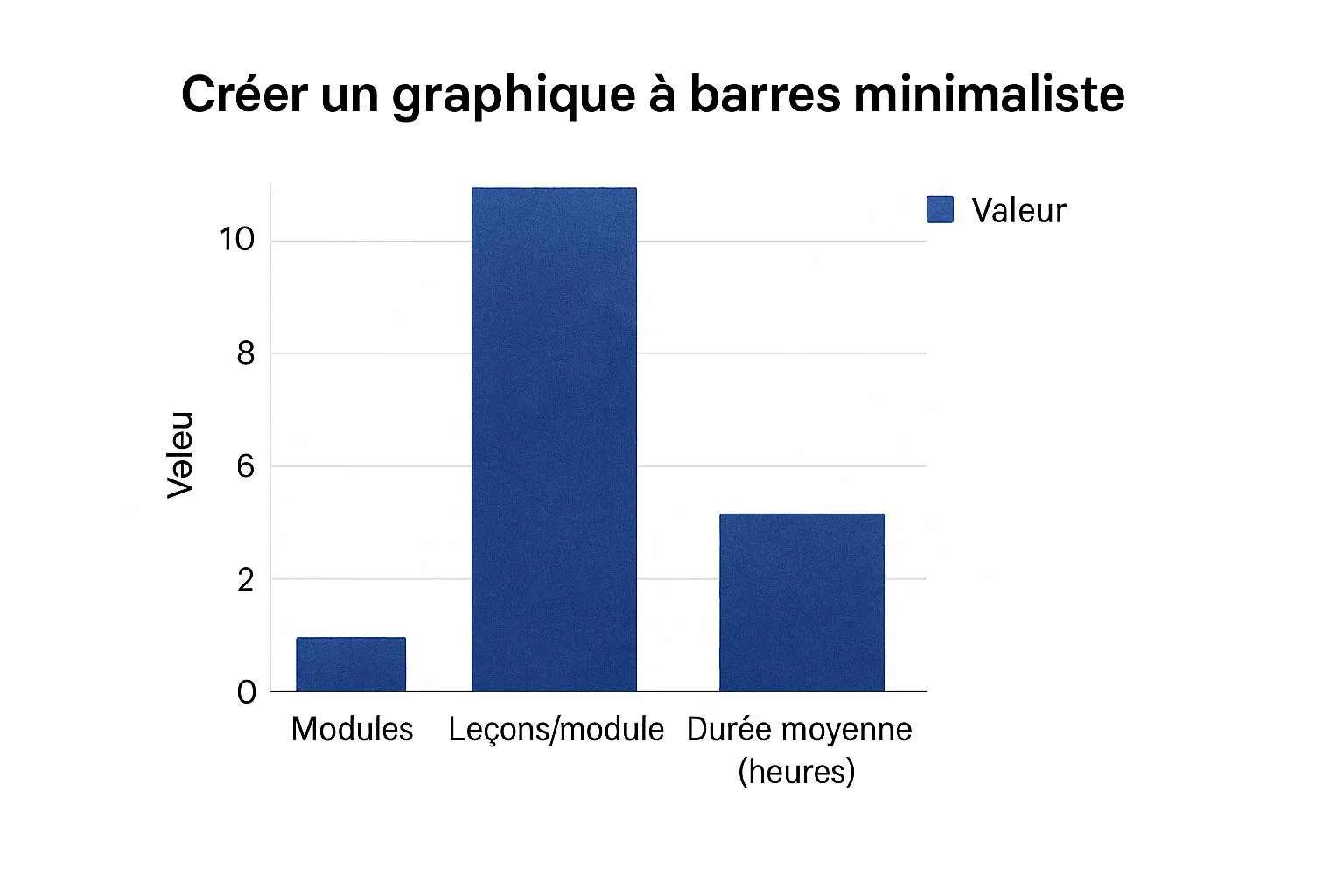
The infographic above illustrates the typical structure of an online course: number of modules, number of lessons per module and average duration per lesson. A course has on average 6 modules, with 5 lessons per module, each lasting an average of 2 hours. This structure encourages progressive learning and optimal understanding of concepts.
Optimizing the use of your tools
The effectiveness of your tools also depends on how you use them. A few optimization tips can make all the difference:
-
Automation: Take advantage of your LMS platform’s automation features for managing registrations, follow-ups and sending notifications.
-
Integration: Check the compatibility and ease of integration of your various tools.
-
Data analysis: Analyze your LMS platform’s tracking data to identify your course’s strengths and weaknesses, and adapt your content accordingly.
By mastering the right tools and optimizing their use, you build the foundations of a successful, engaging and profitable online course. Explore the different options and test the solutions that seem relevant to you. Choosing the right tools is an investment that contributes to the success of your online course project.
Creating content that transforms and retains your learners

Creating a successful online course is not just about transferring knowledge. It’s about designing an enriching learning experience that transforms participants’ skills and makes them want to come back. This section explores techniques for creating truly memorable content.
Andragogy: an approach centered on the adult learner
Andragogy, the science of adult learning, is essential. Adults learn differently from children: they are autonomous, have a rich life experience and look for training that is concrete and applicable to their needs. Your content should therefore be geared toward practice.
Favor self-assessment and the concrete application of what’s learned. For example, case studies, professional simulations and practical exercises let learners experiment with their new skills — a far more effective approach than simple theoretical transmission.
Varying formats for dynamic learning
Monotonous content, even if relevant, can quickly demotivate learners. Format variety is essential to holding their attention and stimulating engagement. Incorporate explanatory videos, written materials, interactive quizzes and discussion forums.
This pedagogical mix adapts to different learning styles and energizes the journey. Take the example of an online cooking course: a simple written recipe is less engaging than a demonstration video paired with a discussion forum.
Gamification: learning while having fun
Gamification can turn learning into a fun and motivating experience. Award points, badges or levels based on learners’ progress. Set up challenges and leaderboards to encourage competition.
These mechanisms, when well used, encourage attendance and perseverance. The principle is similar to that of a video game: level progression and rewards motivate the player to keep going.
Storytelling: stories to captivate and help retention
Storytelling, the art of telling stories, makes your content more captivating and memorable. Incorporate anecdotes, concrete examples and case studies to illustrate your points and create an emotional connection with learners.
Narrative content is more easily absorbed and retained. Like a good film that captivates us, a course that uses storytelling leaves a lasting impression and boosts memorization.
Analyzing successes: drawing inspiration from best practices
Analyzing successful online courses helps identify the key factors behind engagement and retention. What worked? Which formats were most effective? How did they manage to transform participants’ skills?
By observing these successes, you can optimize your own content and create a course that meets your learners’ expectations. The goal is to create a positive, enriching learning experience that makes participants want to return and recommend your course.
Monetizing your course: strategies that pay off
Turning your expertise into a stable, growing source of income through an online course? It’s possible, but it requires a well-thought-out monetization strategy. This section explores the various business models that work in the French online training market and how to position your offer effectively within it.
Setting the right price: perceived value and competitiveness
Setting the price of your course is a crucial step. This price should reflect the value of your expertise, the time invested in creating the content, and the results learners can expect. Also analyze your competitors’ prices to stay competitive while highlighting your value proposition.
A price that’s too low can devalue your expertise. Conversely, a price that’s too high can deter potential learners. Balance is therefore key. A more affordable rate may suit a short, introductory course. On the other hand, a higher price is justified for a certifying, specialized course.
Exploring business models for your course
Several business models are available to you:
-
One-time purchase: The learner buys the course once and has lifetime access. Simple to implement, this model suits short, comprehensive courses.
-
Subscription: The learner pays a monthly or annual subscription to access the course and its updates. Ideal for evolving courses and content that’s regularly enriched.
-
Group training with coaching: This model combines an online course with personalized coaching sessions. It allows for more in-depth support and justifies a higher price.
-
Freemium access: Part of the content is available for free, encouraging the learner to subscribe to unlock full access to the course. Effective for demonstrating the value of your course and attracting a wider audience.
To help you choose the model best suited to you, here’s a summary table of the different pricing options:
| Pricing model | Description | Advantages | Disadvantages | Ideal for |
|---|---|---|---|---|
| One-time purchase | One-time payment, lifetime access | Simplicity, predictable revenue | No recurring revenue | Short, complete courses |
| Subscription | Recurring paid access | Regular revenue, loyalty | Subscription management | Evolving courses, regularly updated content |
| Group training with coaching | Course + personalized coaching | Support, added value | Requires availability | Learners wanting personalized follow-up |
| Freemium | Partially free content | Attracts a wide audience, demonstrates value | Converting to paying subscribers | Generating leads, promoting the full offer |
This table lets you compare the advantages and disadvantages of each model and choose the one that best fits your course and target audience.
CPF and OPCO: levers for funding your course
The Compte Personnel de Formation (CPF) and Opérateurs de Compétences (OPCO) are important funding schemes in France for professional training. Making your course eligible for CPF funding opens it up to a wider audience.
It is therefore essential to meet the eligibility criteria for these schemes. This includes obtaining a training provider registration number (numéro de déclaration d’activité) and, for CPF, being listed on the Répertoire Spécifique.
Promoting your course: effective channels
Once your course is created, promotion is essential. Several strategies are available to you:
-
Webinars: Organize free webinars to showcase your expertise and the value of your course.
-
Content marketing: Create quality content (blog posts, videos, infographics) related to your topic to attract your target audience.
-
Social media: Use social media to interact with your audience and promote your course.
-
Online community: Running an engaged community around your expertise helps build audience loyalty and generate word of mouth.
-
Email marketing: Collect email addresses and send newsletters to inform your prospects of news and promotions.
You might also be interested in this article: How to master invoicing as a sole trader.
By applying these monetization and promotion strategies, you’ll maximize your chances of creating a profitable, sustainable online course, turning your expertise into a genuine source of income.
Navigating the legal framework with confidence

Creating a successful online course involves much more than mastering pedagogical and technical tools. Compliance with the French legal framework, particularly in the professional training sector, is a fundamental element not to be overlooked. This guide walks you through the main legal obligations to follow in order to design and deliver your courses with complete peace of mind.
Obtaining your training provider registration number
The training provider registration number (numéro de déclaration d’activité, or NDA) is mandatory for any organization delivering professional training, whether in person or remotely. Issued by the DREETS (Regional Directorate for the Economy, Employment, Labour and Solidarity), this number attests to your organization’s compliance with legal obligations. As the process can take several weeks, it’s advisable to plan ahead.
Qualiopi certification: an asset for your organization
Qualiopi certification has become a quality standard in the training industry. While not mandatory for everyone, it is nonetheless essential for accessing public and private funding, particularly the Compte Personnel de Formation (CPF). Based on a national quality framework, it guarantees the quality of your processes and your commitment to continuous improvement. For online courses, particular attention should be paid to content accessibility and data security.
Clear and precise terms and conditions
Terms and Conditions of Sale (CGV) are essential for framing your relationship with learners and securing your business. They must be drafted clearly, precisely and in accordance with current legislation. Key points to include are access conditions for the course, payment terms, cancellation conditions and rules relating to intellectual property. Well-drafted terms and conditions help prevent disputes and ensure transparency in your offer.
GDPR: protecting personal data
The General Data Protection Regulation (GDPR) governs the collection and processing of personal data. You must inform your learners how their data is collected, used and protected. Their explicit consent is required for any use of their data, and they must be able to exercise their rights of access, modification and deletion.
Issuing compliant certificates
Issuing attendance certificates or certifications is an important step in showcasing participants’ achievements. These documents must clearly state the name of the course, its duration, the skills acquired and the name of the training organization. Compliance with current standards is essential to guarantee the validity and recognition of your certificates.
Getting listed on the Répertoire Spécifique for CPF eligibility
CPF eligibility requires your course to be listed on the Répertoire Spécifique. Managed by France Compétences, this directory lists certifying courses eligible for CPF funding. Access to this directory is subject to rigorous criteria, particularly in terms of quality and relevance. Learning about the requirements for accessing the Répertoire Spécifique is crucial for course creators looking to expand their audience. Find out more in our article on being a sole trader and unemployment benefits.
By meeting these legal obligations, you ensure the longevity of your business and build a climate of trust with your learners. Don’t hesitate to seek the expertise of legal professionals to support you in your process. A solid understanding of the legal framework is an invaluable asset for success in the world of online training.
Continuous improvement: evolving your course
An online course is not static. To remain relevant and engaging, it must adapt and evolve constantly. This section guides you through setting up a continuous improvement system, without overloading yourself, to keep your course always at its best.
Identifying the right performance indicators
The number of enrollments is an important indicator, certainly, but it doesn’t tell the whole story. What metrics truly reflect the impact of your course? Module completion rate, time spent on each lesson, forum participation and quiz results are all valuable indicators.
This data lets you assess learner engagement and the effectiveness of your teaching approach. It gives you a concrete overview of what’s working and what could be improved.
Analyzing learner behavioral data
LMS (Learning Management System) platforms provide valuable behavioral data about your learners. Analyze it to identify friction points. A high dropout rate on a specific module may indicate a comprehension problem, a lack of interest or a technical difficulty.
By understanding this data, you can adjust your content and optimize the learning experience.
Satisfaction surveys: a valuable tool
Satisfaction surveys are essential for gathering feedback from your learners. Ask precise questions and give them the freedom to express themselves openly. Ask them what they liked, what they found less relevant, and what they would suggest to improve the course.
This direct feedback lets you adapt your content to your audience’s real needs.
Turning feedback into concrete improvements
Gathering feedback is a first step. The next step, and the most important one, is putting it to use. Analyze survey responses and behavioral data to identify areas for improvement.
Prioritize the most important changes and implement concrete solutions. For example, if learners find a module too theoretical, add concrete examples, case studies or practical exercises. It’s also crucial to stay informed of legal developments, such as new French regulations.
Keeping your content up to date without rebuilding everything
The world changes, and your course needs to keep pace. Put a strategy in place to keep your content up to date without having to rebuild everything from scratch. Regularly add new resources, update examples and data, and offer supplementary modules.
This approach helps maintain your learners’ interest and extend the lifespan of your course. Plan regular updates, for example every quarter or every six months, to incorporate the latest developments and learner feedback.
Building a community of learners
An active community of learners considerably enriches the training experience. Encourage exchanges between participants through discussion forums, private social media groups or online events.
This interaction fosters collaborative learning and creates a stimulating environment. A community lets learners help each other, share their experiences and ask questions. It’s a valuable asset for engagement and retention.
By applying these principles of continuous improvement, you’ll create a dynamic, relevant online course that remains attractive over the long term. Listening to learners, analyzing data and constantly adapting are the keys to success.
Looking to simplify the management of your sole trader or freelance business? Bizyness is the ideal solution to automate your invoicing and manage your transactions. Discover how Bizyness can help you: https://www.bizyness.fr
