

 Français
 Creating Online Quotes That Convert in 2026
Discover how to create online quotes for your e-commerce business. A practical guide with concrete tips to convert prospects and mistakes to avoid in 2026.
Let’s be honest: in the age of B2B e-commerce and custom orders, knowing how to create an online quote quickly is no longer optional. It has become a matter of survival. Your customers, even for a specific request, expect the same responsiveness and professionalism as they’d get from the biggest platforms.
A well-oiled quoting process is not just an administrative task. It’s a genuine competitive advantage that can make the difference, secure a sale, and polish your reputation.
Why a good online quoting process can change everything for your e-commerce business

Forget the image of a quote as a simple document with a price list. Today, it’s a crucial touchpoint in your customer journey, especially if you handle complex orders, B2B requests, or customizable products. A fast response and an impeccable document are not mere formalities; they’re the first sign of trust you give.
This expectation of speed and professionalism is even stronger as the market is booming. French e-commerce is expected to top €200 billion in 2025. This growth, driven by increasingly frequent buyers, opens up huge opportunities for online sellers who manage their operations carefully. And the quote is on the front line.
Speeding up the purchase decision
A clear, well-presented quote sent within minutes of the request can radically shorten the decision cycle. When everything is simple and easy to accept, you remove the friction that leads to hesitation. The idea is simple: turn an information request into a firm order, without wasting time.
An online quote isn’t just a price proposal. It’s the first contract of trust you establish with your customer. Its quality and how quickly it’s sent often determine the rest of the relationship.
Strengthening your brand image and building trust
How you handle your quotes says a lot about your business. A clean, error-free document with clear terms and a strong visual identity changes everything. It immediately reassures the prospect. They understand they’re dealing with a serious, organized partner — a crucial detail for high-value sales.
By optimizing this essential link, you’ll also find new ways to increase your e-commerce sales. Specialized tools like Bizyness, for example, are designed to automate creation and follow-up, letting you meet this demand without spending hours on it.
Building a compliant quote that inspires confidence
A quote is much more than a simple price proposal. It’s the first building block of your future business relationship, a document that must both convince and reassure. If you neglect the commercial side, you won’t get the signature. If you ignore the legal side, you expose yourself to complications.
Before even polishing the design, you need to make sure the foundations are solid. Tax authorities don’t joke around with the rules, and a simple oversight can cost you dearly. To create an online quote that is fully compliant, certain details are simply non-negotiable.
Start by clearly identifying yourself. Your company name, address, SIREN/SIRET number, and intra-community VAT number (if applicable) must appear in the header. Just below, or alongside, include your customer’s full contact details. That’s the basis of everything.
The key information that structures your offer
Every quote must carry a unique number and a creation date. This is essential for tracking and for your accounting. Above all, don’t forget to state a validity period (usually 15 or 30 days). Without this mention, a customer could come back to you months later demanding the stated rates, even if your own costs have risen in the meantime.
The heart of your proposal is, of course, the description of your products or services. This is where precision makes all the difference. For each line, detail:
- The exact product name or the nature of the service.
- The quantity.
- The unit price excluding tax (net of VAT).
- The VAT rate that applies to that line.
This clarity prevents misunderstandings and shows your customer that they know exactly what they’re buying. Finally, the totals must be crystal clear: the total amount excluding VAT, the VAT breakdown, and the total amount including all taxes (gross, VAT included) that the customer will have to pay.
A vague quote is an open door to endless negotiations and frustration. A precise, detailed, compliant quote is the shortest path to a signature and a healthy customer relationship.
The strategic additions that make the difference
A quote isn’t just a list of figures. It’s a document that carries your image. Adding your logo, respecting your brand guidelines, and including a small personalized note show that you’ve taken particular care with this proposal.
Also remember to attach your Terms and Conditions of Sale. Making them accessible from the start is a sign of transparency. Your customer knows what to expect regarding payment terms, delivery times, or how a potential dispute would be handled. That’s reassuring for everyone.
To make things clearer, here’s a table summarizing what really matters in a quote. It distinguishes legal obligations from the additions that, in my experience, considerably strengthen the impact of your proposals.
The elements of a quote that make the difference
This table highlights the essential legal information and the strategic additions that reinforce the professionalism and commercial effectiveness of your quotes.
| Element | Requirement | Customer impact |
|---|---|---|
| Complete identification | Legal | Builds a climate of trust and professionalism. |
| Number and validity period | Legal | Secures your offer and creates a sense of urgency. |
| Detailed description | Strongly recommended | Brings clarity and prevents future misunderstandings. |
| Terms and conditions attached or accessible | Strategic | Demonstrates transparency and protects both parties. |
| Logo and polished design | Strategic | Strengthens your brand image and enhances your offer. |
In short, the strategic elements turn an administrative document into a genuine sales tool. They show that you’re not just a supplier, but a reliable partner.
Ultimately, creating an online quote isn’t just about filling in fields in a piece of software. It’s an opportunity to prove your seriousness and give your prospect every good reason to choose you, with complete confidence.
How to create a quote in a few clicks with dedicated software
Theory is all well and good, but let’s see what it looks like in practice. Honestly, who still enjoys spending hours on a spreadsheet, sweating over complex calculation formulas? A specialized tool doesn’t just help you go faster; it turns quote creation into a matter of a few minutes and secures the entire process.
Let’s take a concrete example you might recognize. You run a Shopify store and a B2B customer contacts you for a large order. No more juggling between your Shopify interface, your emails, and a stray Excel file. Software like Bizyness centralizes everything. The process becomes clear, intuitive, and, above all, much more reliable.
From customer request to sending the quote
It all starts with your prospect’s record. If your software is well integrated with your e-commerce store, much of the information is already there. All that’s left is to fill in the details, such as an intra-community VAT number for a sale in Europe, for example.
Next comes the heart of the matter: the products. Instead of manually copying everything — references, descriptions, prices — you pull directly from your Shopify catalog. That’s a phenomenal time saver and, between us, excellent insurance against typos that can quickly become costly.
The software then handles the calculations. Goodbye, fear of a crashing Excel formula! Even better, it automatically applies the correct VAT rate depending on whether your customer is an individual or a business, and depending on their country. A particularly tedious and error-prone task becomes instant and accurate. To get started, a free Excel quote template can help in a pinch, but let’s be clear: automation remains the most sustainable and reliable solution.
The real strength of dedicated software isn’t generating a simple PDF. It’s acting as a smart safeguard that checks the legal and tax compliance of every document you send.
Once the quote is ready, you send it directly from the platform, with a small personalized note. Your customer receives a secure link to review, comment on, and even accept the offer online with a single click.
This small diagram perfectly illustrates how a somewhat cumbersome administrative process turns into a smooth customer experience, from legal compliance all the way to signature.
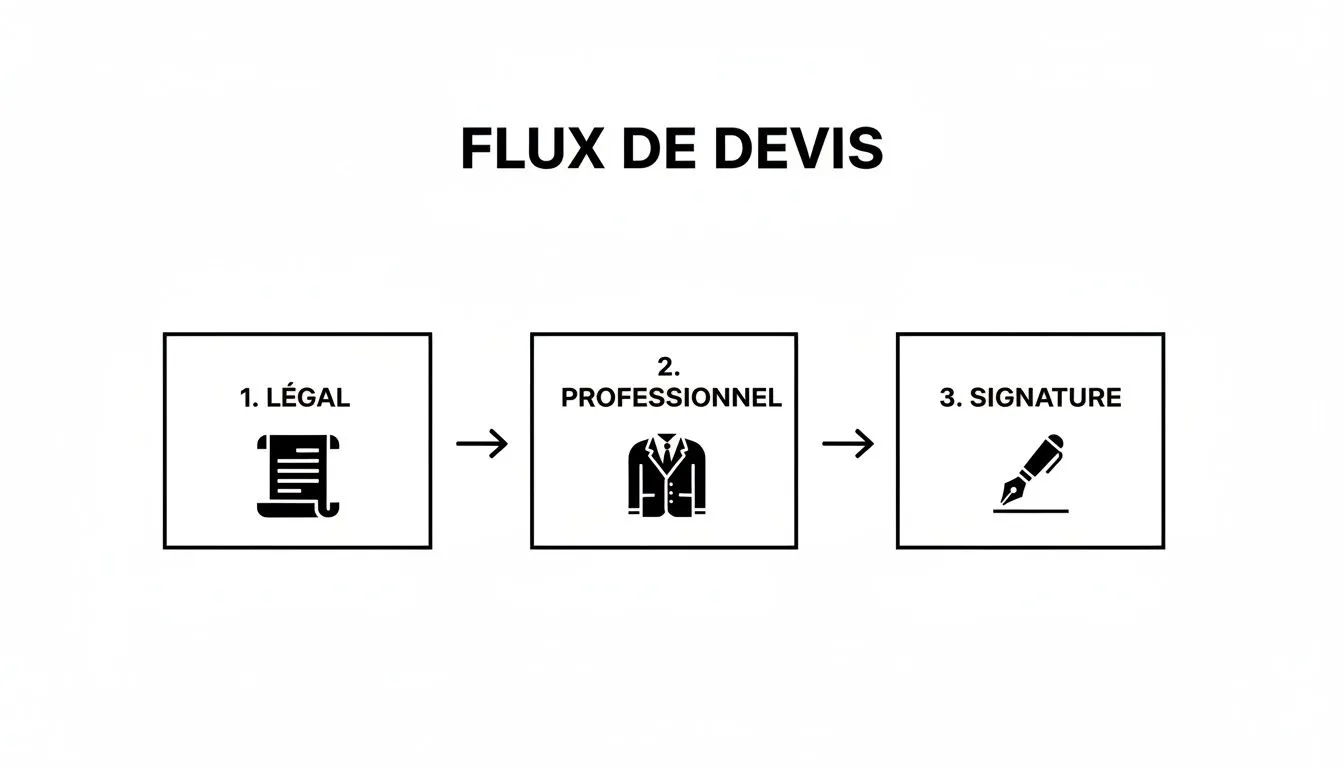
You can clearly see how a tool centralizes everything: the legal framework, the professional presentation, and the acceptance step, which eliminates a good deal of friction.
Automation working for your time
The most obvious gain is, of course, the time you get back. All the time spent on low-value administrative tasks can now go toward what really matters: selling, innovating, and taking care of your customers.
Automation also has a very positive effect on your image. Responding to a complex request with a flawless quote in under 15 minutes sends a powerful message to your prospect. You come across as responsive, organized, and professional. That’s a real edge to help you stand out from the competition. To go further and structure your entire invoicing chain, our guide on choosing invoicing and quoting software will give you concrete leads.
Ultimately, using software to create an online quote frees you from a considerable mental load and gives you the keys to building a relationship of trust from the very first contact.
Mastering quote follow-up to close the deal
Sending a quote is the first step. But the real challenge is converting it into a sale. It’s often in the silence that follows sending that everything is decided. A good follow-up strategy, handled tactfully, can radically change the outcome without ever feeling like you’re hounding your prospect.
The stakes are high. Many businesses struggle to convert their proposals. We often see a ratio of around 1 signed quote for every 4 sent. That means only 25% of efforts pay off. For an online seller, every point gained on this signature rate is a direct competitive advantage. Optimizing follow-up is no longer optional.
Following up at the right time with the right message
So, when should you follow up? Ideally, within 3 to 5 days. That’s long enough for your prospect to have had time to review the offer, but short enough that your proposal is still fresh in their mind.
Your first follow-up should be simple, direct, and service-oriented. The goal isn’t to pressure the customer with a “So, are you signing?” but rather to make sure everything is clear and reopen the dialogue.
A message like this works very well:
Hello [Customer name],
Following up on our quote [Quote number] for your project. Have you had a chance to look it over?
Feel free to reach out if anything needs clarifying. I’m happy to discuss it with you.
This simple approach opens the door to discussion without applying pressure. Your follow-up is perceived as helpful, not as a complaint.
To manage this follow-up in a structured way, tools exist. CRM software like HubSpot or Pipedrive is perfect for scheduling and even automating part of your follow-ups, helping you avoid forgetting.
Good follow-up doesn’t stop there — it fits into a broader strategy. To go further on this topic, our full article on customer follow-up for online sellers will give you more insights.
Turning an accepted quote into an invoice in one click
The long-awaited moment arrives: your quote is accepted. Great news! But the work isn’t quite done. You now need to turn this commercial document into an invoice — an administrative step that, if done manually, can quickly become a source of errors and wasted time.
This is where automation makes all the difference. Well-designed invoicing software, like Bizyness, lets you convert a quote into an invoice literally with one click.
Specifically, what does that change for you?
- Zero data-entry errors: No more risky copy-pasting. All the quote’s information (contact details, line items, prices, VAT) is carried over exactly, with no risk of omissions or typos.
- Perfect continuity: The generated invoice gets its own number while keeping a clear reference to the original quote. Your accounting stays impeccable and traceable.
- Immediate time savings: A task that could take several minutes (and generate a fair amount of stress) is now instant.
This isn’t just a nice-to-have. It’s the secret to smoother management and healthier cash flow. Because an invoice sent quickly is an invoice paid faster. For an entrepreneur, it’s also one less mental burden, and therefore more time to focus on what matters: growing the business.
Common quote mistakes that can cost you dearly
A quote isn’t just an administrative formality to look good. Treating it as such is a strategic mistake that can cost far more than a missed sale. It’s a document that binds you, and the slightest misstep can have serious financial or legal consequences.
Believe me, the most classic mistake is forgetting the mandatory legal notices. A missing SIRET number, an approximate address… and your quote instantly loses its credibility and legal value. It’s the kind of detail that can turn a simple business agreement into an unnecessarily complex dispute.
Another blunder I see far too often: completely vague product or service descriptions. Writing “Website installation” means absolutely nothing. The customer needs to know precisely what’s included (and, above all, what isn’t) to avoid any unpleasant surprises once the work begins.
Forgetting the validity period and managing VAT
Omitting your offer’s expiration date leaves the door wide open to problems. Imagine a customer accepting your quote six months later, when your raw material costs have risen by 15%. Without this clear mention, you could be legally required to honor your old rates at a loss.
VAT management is another major friction point, especially in international e-commerce. Applying the wrong rate or ignoring specific rules, like those of the One-Stop Shop (OSS/IOSS) for sales to individuals in the EU, can quickly lead to very painful tax adjustments.
To sum up, here are the most common pitfalls to avoid at all costs:
- Vague descriptions: The customer doesn’t know what they’re buying, which is the perfect recipe for a dispute.
- No validity period: Exposes you to having to work at rates that are no longer profitable.
- Missing legal notices: Invalidates your document and gives an unprofessional impression.
- Incorrect VAT calculations: Simply put, risk of penalties from the tax authorities.
The relentless pace of e-commerce doesn’t forgive any of these inaccuracies. In 2024, French consumers made 2.6 billion online transactions, or nearly 80 orders per second. At that speed, the reliability of your process for creating an online quote must be flawless, especially on mobile, where a large share of purchases now happen. To get a sense of the scale of the phenomenon, I’d recommend checking out the full analysis of e-commerce market trends on Wizishop.
A quote is a contract in the making. Every mistake, even a minor one, is a crack that can generate dissatisfaction or be exploited. Precision isn’t optional — it’s mandatory.
Software as an essential safeguard
Faced with these risks, specialized software like Bizyness acts as a genuine safety net. It doesn’t just fill in fields for you; it embeds business and tax logic to block errors before they even happen.
For example, if you’re a sole trader (micro-entrepreneur), the software will automatically add the mention “VAT not applicable, art. 293 B of the French General Tax Code.” If you’re an online seller selling across Europe, it will recognize the customer’s country and apply the correct VAT rate via the OSS. These automations save you precious time and, above all, spare you a lot of headaches with the tax authorities. It’s the best insurance you can take out to secure your business.
Answering your questions about online quotes
Let’s move on to practical questions. When you get into online quotes, certain questions come up again and again. Here are clear, direct answers to help you see things more clearly, especially for you, online sellers.
Does a quote accepted online have real legal value?
The answer is yes, without the slightest doubt. A quote your customer accepts with a simple click on an “Accept” button or via an electronic signature has exactly the same legal force as a paper document you would both have signed. The moment it’s accepted, it becomes a firm contract.
In concrete terms, this means you are legally required to provide the products or services described. In turn, the customer commits to paying you the agreed amount.
That’s precisely why your proposal must be flawless before sending it. Modern platforms like Bizyness secure this process by tracing the agreement, which makes it indisputable. In fact, article 1366 of the French Civil Code confirms this: an electronic document has the same evidentiary value as a paper one.
Can you charge for a quote?
In principle, a quote is a commercial courtesy, so it’s free. That’s the market norm, especially in e-commerce for standard services. Charging for it would be an unnecessary friction that could cost you a sale.
There are, of course, exceptions. You’re entitled to charge for a quote if preparing it requires substantial, specific work. Think for example of:
- A detailed feasibility study.
- Creating custom mockups.
- An on-site visit to assess a complex project.
The golden rule in this case is simple: total transparency. You must always inform your customer of the cost upfront and get their explicit agreement BEFORE starting anything.
How do you handle VAT for a customer in the EU?
This is a technical point, but absolutely critical for anyone selling in Europe. How you handle VAT changes radically depending on whether your customer is an individual (B2C) or a business (B2B).
Good invoicing software isn’t just a convenience — it’s your tax shield. It analyzes the customer’s information (country, VAT number) and applies the correct rule for you. That’s what saves you from unpleasant surprises during an audit.
If you’re dealing with a business (B2B) based in another EU country, and they give you a valid intra-community VAT number, your quote must be issued net of VAT. This is the VAT reverse-charge mechanism at work.
For an individual (B2C), the story is different. You must charge VAT at the rate of the country where your customer resides. For this, you generally go through the VAT One-Stop Shop (OSS). Well-designed invoicing software is built to handle these scenarios automatically, ensuring you’re always compliant without the headache.
Ready to take it to the next level? Automate your quotes and secure your invoicing with Bizyness, the platform built for web entrepreneurs. Create compliant quotes in just a few clicks.
