

 Français
 Credit Note Example: Complete 2025 Guide for Professionals
Discover a credit note example to simplify your paperwork. Complete 2025 guide to mastering your credit notes quickly.
The credit note, often seen as a simple administrative formality, is actually an essential strategic tool for financial management and customer relations. It corrects an original invoice, whether for a returned item, a pricing error, or a commercial gesture. Rigorous management of credit notes is not just a legal obligation — it’s also a mark of professionalism that strengthens customer trust and ensures the compliance of your accounting.
However, each situation calls for a specific type of credit note, with its own rules and mandatory mentions. A mistake in this process can lead to accounting and tax complications, while also degrading the customer experience. Knowing when and how to issue the right document is therefore a key skill for any entrepreneur, freelancer, or small business manager.
This practical guide was designed to give you total clarity on the subject. Through a detailed analysis of seven concrete examples, you’ll discover how to draft a credit note example for each common scenario, from product returns to VAT adjustments. We’ll turn this accounting obligation into an opportunity to streamline your processes, strengthen your business relationships, and secure your financial management.
1. Credit note for a defective goods return
The most common case justifying the issuance of a credit note is the return of a defective, non-compliant, or damaged product. Whether it’s a smartphone that won’t turn on, a torn garment, or furniture damaged in transit, the credit note partially or fully cancels the original invoice. It’s an essential accounting document that formalizes your company’s debt toward the customer.
This credit note example is crucial because it directly impacts customer satisfaction. Fast, transparent handling of the return turns a negative experience into proof of professionalism, building customer loyalty.

Strategic analysis and practical tips
For optimal management, every credit note should contain clear information.
- Reference to the original invoice: This is essential to link the credit note to the original sale and ensure perfect accounting traceability. Clearly state the number and date of the cancelled invoice.
- Detailed reason for the return: Don’t settle for a simple “return.” Specify “Product defective on delivery,” “Wrong reference shipped,” or “Damaged in transit.” This precision is useful for internal tracking and quality analysis.
- “Net credit to you” wording: The amount shown must be clearly identified as a sum owed to the customer, to avoid any confusion with an amount due for payment.
Tactical tip: Set up a clear, accessible return policy on your website. Specify the deadlines, conditions, and procedure. This reduces disputes and reassures customers even before they buy.
When to use this credit note
Use this type of credit note whenever a customer returns goods for quality or compliance reasons. It’s both a legal and commercial obligation that protects both parties. Handling the credit note and the associated refund or credit promptly is a powerful lever for maintaining an excellent customer relationship despite the incident.
2. Credit note for a billing error
To err is human, and that applies to invoicing too. An incorrect price, a wrong quantity, a forgotten discount, or an incorrect VAT rate are common errors that require a quick, professional correction. The credit note is the legal accounting tool for correcting these anomalies by cancelling the erroneous original invoice and restoring the financial balance between you and your customer.
This credit note example is fundamental to maintaining your company’s trust and credibility. It demonstrates your diligence and your commitment to ensuring a fair transaction, turning an administrative error into an opportunity to strengthen the business relationship.
Strategic analysis and practical tips
A credit note for a billing error must be transparent to avoid any confusion.
- Clear reference to the original invoice: As with any credit note, it’s essential to mention the number of the incorrect invoice to ensure traceability. This lets your customer and your accountant easily link the two documents.
- Explicit reason for the correction: Be precise. Clearly state “Correction of unit price on item X,” “Error in invoiced quantity,” or “Missing 10% discount.” This transparency is appreciated and simplifies tracking.
- Detailed corrective calculation: Clearly show how the credit note amount was calculated. List the erroneous line with a negative amount and, if needed, the new correct line. This justifies the credited amount.
Tactical tip: As soon as an error is identified, act proactively. Don’t wait for the customer to contact you. Issue the credit note immediately and inform them of the correction. This anticipation demonstrates your integrity and professionalism.
When to use this credit note
Use this type of credit note as soon as a calculation, entry, or commercial-terms error is detected on an invoice that has already been issued and sent. It’s crucial never to simply delete or edit a validated invoice, as this is prohibited by law. Issuing a credit note is the only legal procedure to correct the mistake and ensure the compliance of your accounting.
3. Credit note for a retroactive commercial discount
In business relationships, particularly B2B, it’s common to grant discounts based on performance or purchase volume over a given period. When these conditions are met after the original invoicing, a credit note for a retroactive commercial discount is issued to credit the customer with the agreed amount. It’s a powerful tool for formalizing a business agreement and rewarding loyalty.
This credit note example formalizes a strategic commercial practice. It may involve year-end rebates, volume discounts, or performance bonuses that weren’t applicable at the time of sale. The credit note then adjusts the total cost of past transactions, strengthening the partnership with the customer.
Here’s a visual diagram illustrating the process of issuing a credit note for a retroactive commercial discount.
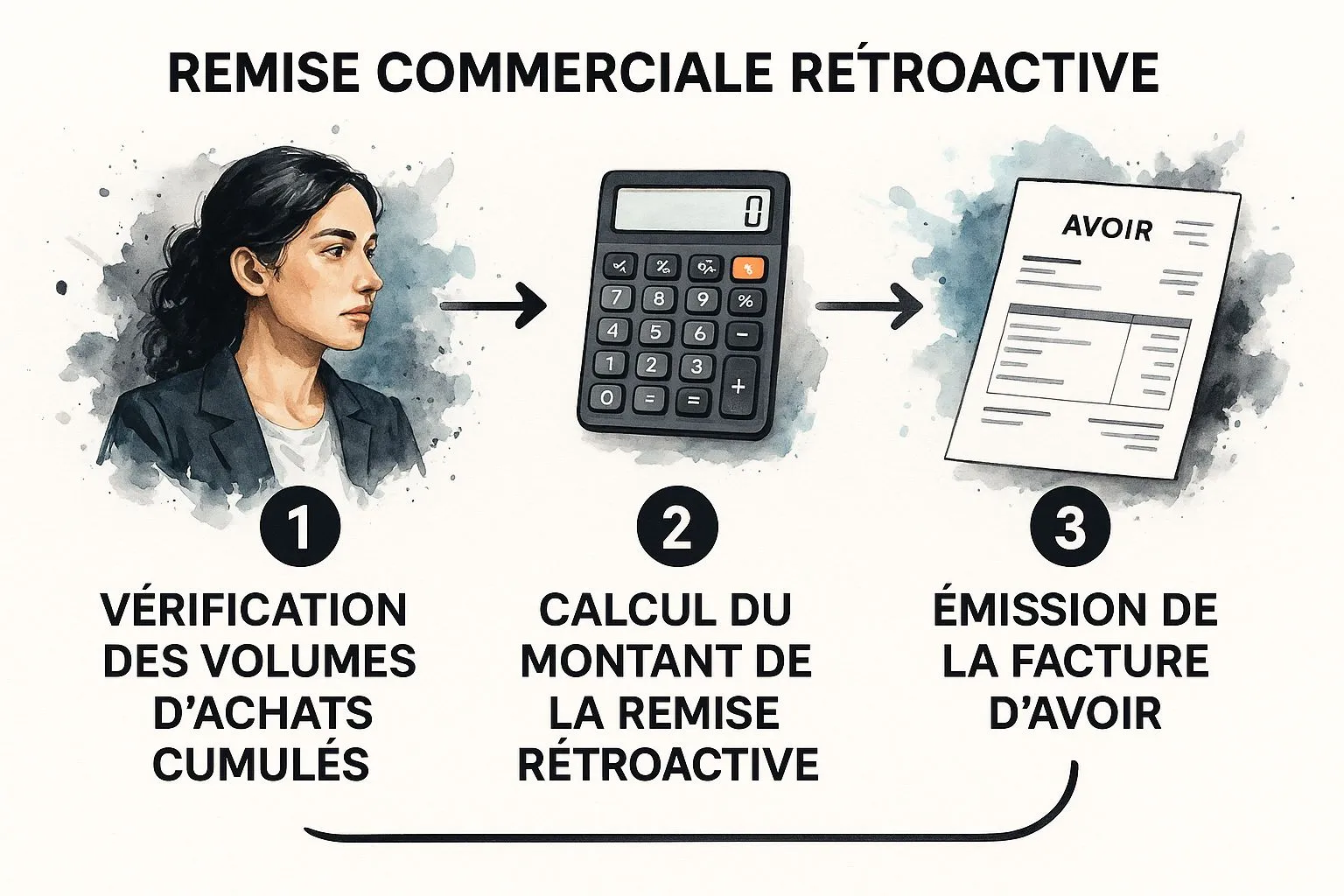
This flow demonstrates a structured approach that guarantees the accuracy and traceability of the commercial benefit granted to the customer.
Strategic analysis and practical tips
For this practice to be effective and unambiguous, absolute clarity is necessary.
- Reference to the contractual terms: The credit note should ideally mention the contract clause or business agreement that justifies the discount. For example: “Year-end discount of 5% on annual revenue, per contract no. 123.”
- Clear reference period: State precisely the period covered by the discount calculation (for example, “for purchases made between 01/01/2023 and 12/31/2023”). This avoids any future confusion.
- Detailed calculation basis: It can be useful to list the invoice numbers or the total purchase amount used as the basis for the discount calculation, for maximum transparency.
Tactical tip: Automate tracking of your key customers’ purchase volumes. Use your CRM or a shared spreadsheet to track their progress toward discount thresholds. This lets you anticipate credit note issuance and even use it as a motivational lever to reach the next threshold before the period ends.
When to use this credit note
Use this type of credit note to finalize long-term business agreements that include conditional discounts. It’s particularly relevant for distributors, wholesalers, and service providers looking to encourage significant business volumes or lasting partnerships. It turns a simple transaction into a dynamic, mutually beneficial business relationship, proving that you honor your commitments and value your partners’ loyalty.
4. Credit note for a partial order cancellation
It often happens that a customer changes their order before delivery, or that you can only fulfill part of it. In this case, a credit note for partial cancellation is issued to adjust the original invoice. This ensures you only bill for the products or services actually delivered, while keeping your accounting fair and transparent.
This type of credit note example is common in sectors like events (adjusting the guest count) or construction (cancelling certain materials). It demonstrates your flexibility and willingness to cooperate, which strengthens trust and the business relationship.
Strategic analysis and practical tips
For effective management of partial cancellations, clarity and communication are essential.
- Detail of the cancelled lines: The credit note must precisely list the products or services removed from the original order, with their quantities and prices. This avoids any ambiguity for the customer and simplifies accounting reconciliation.
- Inventory update: The cancellation should trigger an immediate update of your stock. Automating this process through your invoicing software helps avoid errors and makes products available for sale again.
- Impact on commercial terms: If the partial cancellation changes the total order volume and affects a granted discount, this must be clearly communicated. Transparency on this point prevents misunderstandings.
Tactical tip: Define a clear cancellation policy in your terms and conditions of sale. Specify the deadlines for modifying an order at no cost and any restocking fees applicable in case of late cancellation.
When to use this credit note
Use this credit note as soon as a validated and invoiced order is modified before full delivery. Whether the initiative comes from the customer (a change of need) or from you (a stock shortage on an item), this accounting tool formalizes the adjustment. Proactively managing these situations shows your ability to adapt and helps preserve a positive customer relationship, even in the face of the unexpected.
5. Credit note for debt offsetting
A credit note can also serve as an accounting tool for a debt-offsetting transaction. This situation arises when two companies are simultaneously customers and suppliers to each other. Rather than making two separate payments, they can decide to mutually cancel their debts up to the lower amount.
This credit note example is particularly useful for optimizing cash flow and simplifying financial flows between regular business partners. For example, a marketing agency that buys advertising space from a media company, which in turn orders content-creation services from the agency, can use this mechanism. The credit note then formalizes the cancellation of part of the reciprocal debt.
Strategic analysis and practical tips
For the offset to be legally and accounting-wise valid, clarity is essential.
- Reference to both invoices involved: The credit note must state the numbers of both invoices being offset — the one you issued and the one you received from your partner.
- Explicit reason for the credit note: Clearly state “Offsetting of reciprocal debts and receivables” as the reason. This precision avoids any ambiguity during a tax audit or accounting review.
- Formal agreement: It’s strongly recommended to draw up a written offsetting agreement signed by both parties before issuing the credit note, in order to formalize the process and prevent disputes.
Tactical tip: Keep a reciprocal running account with your key partners. Perform a monthly or quarterly reconciliation of debts and receivables to identify offsetting opportunities and maintain healthy financial relationships.
When to use this credit note
Use this type of credit note when you maintain a lasting, two-way business relationship with another professional. It’s an effective way to reduce banking fees tied to transactions and to simplify administrative management. It also helps secure part of your revenue by guaranteeing “payment” through offsetting, which is a useful strategy as part of customer debt collection. Just make sure the receivables are certain, fixed in amount, and due on both sides.
6. Credit note for a VAT adjustment
A VAT error on an invoice — whether an incorrect rate applied, an incorrect tax classification, or a change in legislation — requires a rigorous correction. Issuing a credit note is the only accounting-compliant method for correcting the mistake without modifying or deleting the original invoice, which is strictly prohibited. This credit note cancels the erroneous VAT line and corrects it, ensuring full tax compliance.
This credit note example is essential for the accuracy of your tax returns. A VAT error, even unintentional, can lead to complications with the tax authorities. The credit note for a VAT adjustment is therefore a protective and compliance tool, proving your diligence and responsiveness in the face of an error.
Strategic analysis and practical tips
For this credit note to be beyond reproach in the eyes of the tax authorities, every detail matters.
- Reference to the original invoice: As with any credit note, the link to the original invoice must be explicit. State its number and date to guarantee perfect traceability of the correction.
- Precise reason for the adjustment: Be very clear about the reason. State, for example, “Correction of the VAT rate applied (20% instead of 10%)” or “Adjustment following a change in VAT regime.” This precision is crucial in case of a tax audit.
- Detail of the calculation: The credit note must clearly show the old VAT amount, the new one, and the credited difference. This transparency makes it easier for both the customer and your accountant to understand.
Tactical tip: Use invoicing software that automatically handles different VAT rates and facilitates the creation of credit notes. This minimizes the risk of manual errors and ensures your documents comply with current legal standards.
When to use this credit note
Use this type of credit note as soon as you identify a VAT-related error on an invoice that has already been issued and validated. This can happen following an internal audit, a customer remark, or a regulatory update. It’s also essential for cross-border transactions, where VAT rules can be complex. To learn more about the mechanics of value-added tax, check out our detailed guide on calculating VAT. Acting quickly to issue this credit note demonstrates your professionalism and secures your company’s accounting position.
7. Credit note for contract termination
Early termination of a service or license contract may require the issuance of a credit note. This scenario arises when prepaid services, annual subscriptions, or deposits must be refunded to the customer following the termination of the agreement before its end date. The credit note then corrects the accounting position by cancelling the receivable corresponding to services not rendered.
This credit note example is particularly important in the software (SaaS), maintenance contract, or subscription service sectors. It formalizes the financial implications of the end of the contract, whether due to mutual agreement, an exit clause, or a breach by one of the parties.
Strategic analysis and practical tips
Clarity is essential to avoid disputes during a contract termination.
- Reference to the original contract: Explicitly mention the number and date of the cancelled contract or order. This ensures perfect traceability between the original commitment and its termination.
- Precise refund calculation: The credit note amount must be calculated pro rata to the services not delivered. Detail the calculation on the document for full transparency: for example, “Refund for the period from DD/MM/YYYY to DD/MM/YYYY.”
- Reason for the termination: Specify the reason for the credit note, such as “Early termination of maintenance contract No. XXX” or “Cancellation of annual software license.” This justifies the accounting operation and can be useful in case of an audit.
Tactical tip: Before issuing any credit note, carefully review the termination clauses of your contract. They define the conditions, notice periods, and any applicable penalties that must be factored into the credited amount.
When to use this credit note
Use this type of credit note as soon as a contractual agreement involving advance payments is terminated before its due date. This applies to the end of an annual software subscription, the termination of a service contract, or the refund of a deposit for a cancelled project. Rigorous management of this situation preserves your professional reputation even when the business relationship comes to an end.
Comparison of the 7 types of credit notes
| Credit Note Type | 🔄 Implementation complexity | 💡 Resource requirements | 📊 Expected results | 💡 Ideal use cases | ⭐ Key benefits |
|---|---|---|---|---|---|
| Defective goods return | Medium - inspection and validation | Quality inspection, inventory management | Improved customer satisfaction | Damaged, defective, or non-compliant product returns | Customer loyalty, clear audit trail, legal compliance |
| Billing error | Medium - verification and recalculation | Administrative review, sign-off | Corrected, transparent accounting | Correcting incorrect prices, quantities, discounts | Transparent customer relationship, tax compliance |
| Retroactive commercial discount | High - complex calculations and cross-referenced tracking | Advanced accounting systems, contract tracking | Cost reduction, B2B loyalty | Managing volume discounts, cumulative rebates | Contract compliance, stronger business relationships |
| Partial order cancellation | Medium - administrative management and stock updates | Customer communication, inventory updates | Accurate invoicing and inventory | Partial cancellation before delivery | Order flexibility, relationship maintenance, stock management |
| Debt offsetting | High - mutual coordination and detailed tracking | Specialized accounting, legal documentation | Reduced cash flow needs, simplified payments | Bilateral debt offsetting between partners | Reduced transaction costs, stronger partnership |
| VAT adjustment | High - strict tax compliance | Tax expertise, automated systems | VAT regulatory compliance | Correcting VAT errors, legal adjustments | Avoids penalties, compliance, precise VAT corrections |
| Contract termination | High - legal aspects and complex calculations | Legal support, dispute management | Clear, legally sound financial resolution | Early contract termination, refunds, penalties | Legal documentation, professional dispute management |
Simplify your credit notes and streamline your management today
We’ve walked through seven concrete scenarios together, illustrating the versatility and crucial importance of the credit note. From simply handling a defective goods return to more complex cases like VAT adjustments or contract termination, each credit note example demonstrates a fundamental principle: accuracy and compliance are non-negotiable.
Mastering these documents is a pillar of your company’s financial health. It goes well beyond simply correcting a mistake. Rigorous credit note management protects your cash flow, strengthens your customer relationship by showing your professionalism in the face of the unexpected, and gives you peace of mind with the tax authorities. Every credit note issued is an indelible record of your management, a mark of transparency for your partners and customers.
Key takeaways
To turn these examples into concrete action, remember these strategic lessons:
- Anticipation and clarity: Every credit note must be justified by a clear, documented reason. Reference to the original invoice, a precise description of the reason (return, error, commercial gesture), and correct amounts are mandatory.
- Legal compliance: Strictly follow the same mandatory mentions as a standard invoice. Omitting a piece of information can invalidate the document and create accounting and tax complications.
- Customer communication: A credit note isn’t just an accounting document — it’s a touchpoint with your customer. Use this opportunity to communicate transparently and build trust, even when the starting situation is delicate.
Your next steps for flawless management
Issuing credit notes manually, while possible, opens the door to errors, oversights, and considerable time loss, especially for sole traders and small businesses juggling multiple roles. A calculation error, a missing mandatory mention, or poor tracking can be costly.
Adopting a suitable invoicing tool is no longer a luxury but a strategic necessity. By automating the creation of your invoices and credit notes, you eliminate these risks. Dedicated software ensures that every credit note example you produce is not only compliant but also correctly linked to its original invoice, guaranteeing perfect traceability. This frees up valuable time to focus on your core business: growing your company and satisfying your customers.
Don’t let credit note management be a source of stress or errors any longer. Discover how Bizyness can automate and secure your entire invoicing process, from quotes to credit notes, in just a few clicks. Simplify your accounting and take full control of your finances today by visiting our site Bizyness.
