

 Français
 Credit Note Example: 7 Templates Explained for 2025
Discover our complete guide with 7 credit note examples for sole traders. Master the creation of your credit notes and simplify your accounting.

Managing billing errors, product returns or commercial gestures is a crucial part of running a business as a sole trader or small company. The credit note is the essential accounting tool for correcting an already-issued invoice and maintaining healthy customer relationships. Yet creating one often raises questions: when should it be issued? Which legal mentions must it include? How does it differ depending on the situation?
This article aims to answer these questions precisely. We will break down 7 concrete examples, ranging from the standard template to more specific cases such as intra-community transactions or partial credit notes. For each credit note example, we will provide a detailed strategic analysis and practical advice to help you apply them immediately to your own business.
The goal is to make you autonomous and confident in your invoicing process, avoiding mistakes that can be costly in both time and money. Rigorous management of these documents is fundamental. For overall, optimized management of your financial documents, discover the best practices for invoice management. Get ready to master this essential tool and strengthen your accounting.
1. Standard Credit Note
The standard credit note is the most common and fundamental accounting document for correcting an original invoice. It is used to fully or partially cancel a sale that has already been invoiced. This document is essential for maintaining clear accounting and complying with legal obligations, particularly regarding VAT. It is the basic tool that every sole trader or small business must master.
Concretely, the credit note acts like a negative invoice. It indicates that your customer no longer has to pay the original amount, or that they hold a credit for that sum toward a future purchase. The most common reasons are a product return, a billing error (price, quantity), a commercial gesture granted after the invoice was issued, or the cancellation of a service.
Strategic analysis and implementation
To be valid, this type of credit note must contain the same mandatory information as a standard invoice, plus a few crucial specifics. The most important element is the explicit reference to the original invoice it cancels or corrects. Without this link, the document has no accounting value and can be rejected by the tax authorities.
Major companies such as SNCF for a cancelled train ticket, or Orange for an adjustment to your phone plan, use this standardized format. It guarantees perfect traceability and simplifies management for both the customer and the business.
Strategic tip: Don’t wait to issue a credit note. Process it as soon as the need is confirmed (returned goods received, commercial agreement validated). Reactive management builds customer trust and ensures your accounting records stay constantly up to date, avoiding complications when filing your VAT return.
For a quick overview of the key elements, here is a visual summary.
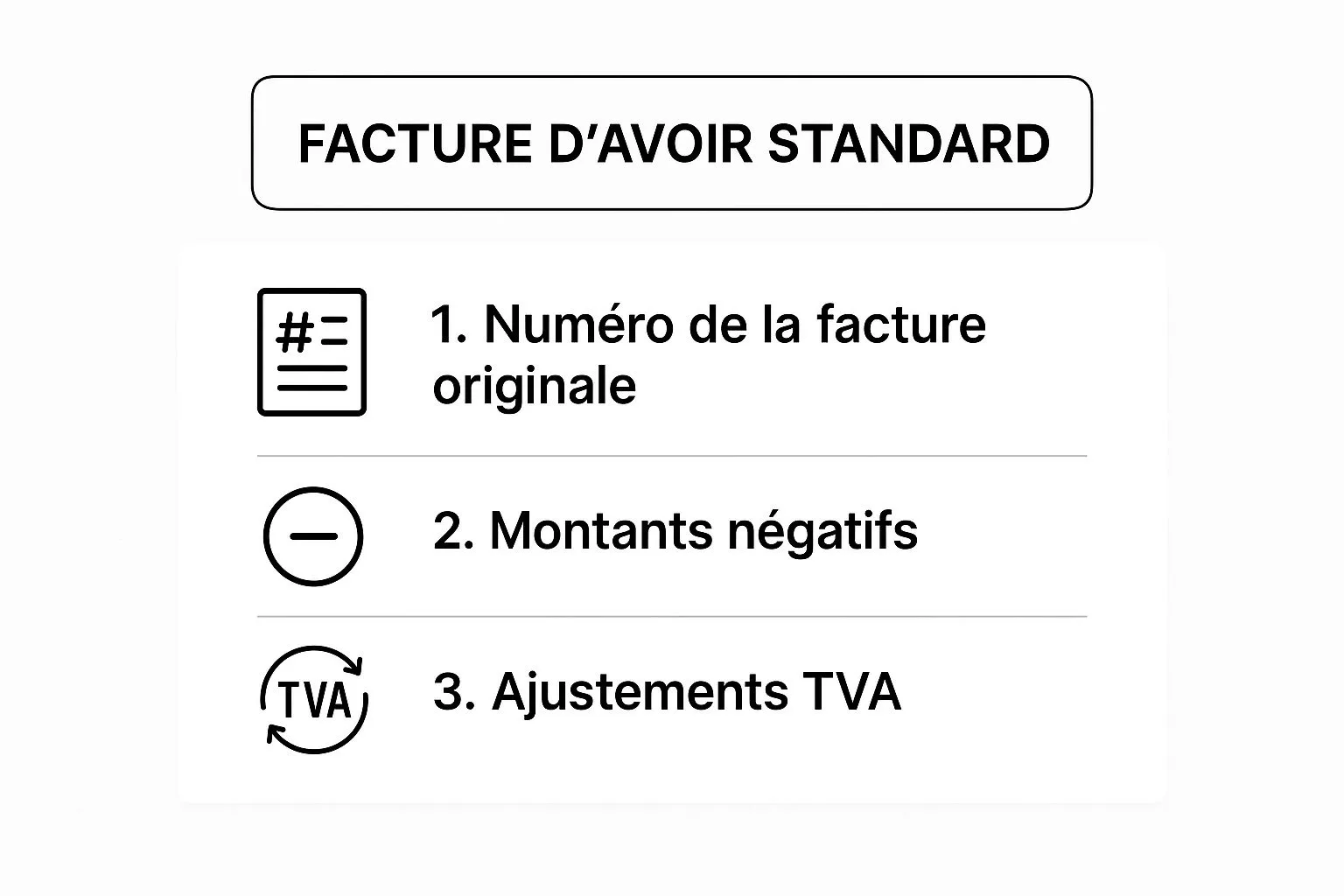
This visual highlights the three pillars of a compliant credit note: the link to the original invoice, the use of negative amounts to cancel the debt, and the precise correction of the VAT collected.
Key takeaways
- Mandatory reference: Always mention the number and date of the original invoice.
- Clear amounts: Clearly show negative amounts (for example, -€50 excl. VAT) to avoid any confusion.
- VAT adjustment: VAT must be corrected based on the rates from the original invoice. You deduct the VAT you had originally collected.
By mastering the creation of this document, you ensure the compliance of your accounting. To go further, check out our complete guide on how and when to write a credit note.
2. Partial Credit Note
The partial credit note is an essential document when a correction only concerns part of an original transaction. Unlike the standard credit note, which cancels an entire sale, this type of credit note example specifically adjusts certain elements: a product returned from a multi-item order, an unused service within a bundle, or a discount applied after the fact on a specific item.
It allows you to credit the customer only for the value of the goods or services concerned, without cancelling the rest of the invoice. This precision is crucial for inventory management, tracking profitability by product, and maintaining a transparent customer relationship. The customer knows exactly what is being refunded and what balance, if any, remains due.
Strategic analysis and implementation
The key to a successful partial credit note lies in clarity and detail. The document must precisely list the product or service lines being cancelled, reproducing their description, quantity and unit price from the original invoice. The reference to the original invoice, of course, remains mandatory.
E-commerce giants like Amazon France excel in this area. When a customer returns one item from an order of five, the resulting partial credit note only concerns that item, recalculating VAT and the total proportionally. Likewise, a home improvement store like Leroy Merlin will use this if a few tiles are damaged within an order of several pallets, simplifying management for both buyer and seller.
Strategic tip: Automate the creation of partial credit notes through your invoicing software. Link this process to your inventory management so that every product return automatically updates your stock levels. This synchronization prevents unexpected stockouts and accounting errors, while saving you valuable time.
Precision is your best ally for avoiding disputes and back-and-forth with your customers.
Key takeaways
- Line-item detail: Clearly specify each item or service credited, with its quantity and price.
- Proportional recalculation: VAT must be adjusted only based on the amounts refunded, not the total of the original invoice.
- Stock updates: Every returned item should trigger an update to your inventory to keep your data reliable.
3. Commercial Discount Credit Note
The commercial discount credit note is a strategic tool used to grant a rebate or discount to a customer after the original invoice has been issued. Unlike a product return, this credit note does not correspond to a cancelled sale but to a commercial gesture aimed at building loyalty, rewarding purchase volume, or correcting a forgotten promotion. It is a powerful lever for customer relationships.
This type of credit note is often planned as part of commercial policies: volume discounts, loyalty rewards, or seasonal promotional adjustments. It formalizes a retroactive price reduction, giving your customer a credit against the amount already invoiced. For the business, it is a formal way to document a reduction in revenue and the corresponding VAT collected.
Strategic analysis and implementation
The validity of this credit note example, like the others, relies on a clear reference to the original invoice. However, the description must be very precise and unambiguously state the nature of the gesture. For example: “Exceptional commercial discount of 10%” or “Credit note corresponding to your loyalty discount on order X.” This justifies the reduction to the tax authorities and to the customer.
Companies such as Renault dealerships use it to apply seasonal promotions after a purchase order has been signed, or supermarkets like E.Leclerc for bulk-purchase rebates validated after invoicing. The goal is to maintain commercial flexibility while ensuring accounting rigor.
Strategic tip: Set clear rules for granting these discounts. Require approval (from yourself or a manager) for significant amounts to avoid abuse and control the impact on your margins. Tracking these discount trends will give you valuable insight into the performance of your promotional actions and customer satisfaction.
This approach turns a simple accounting document into a genuine marketing and loyalty tool.
Key takeaways
- Precise wording: Clearly state “Commercial discount,” “Early payment discount,” or the exact reason for the rebate.
- Governed policy: Establish granting conditions to avoid arbitrary decisions and ensure fairness among customers.
- Data analysis: Track the frequency and amount of commercial credit notes to measure the effectiveness of your pricing and loyalty strategies.
4. Cancellation Credit Note
The cancellation credit note is a specific case that fully cancels an original invoice. Unlike a partial credit note for a product return, this one is issued when the transaction is entirely cancelled before or after delivery — for example in the event of a service contract termination, the cancellation of a full order, or a service that was never performed. It is the accounting equivalent of a financial “reset” on a sale.
This document is crucial for neutralizing the impact of the original invoice on your accounting. It indicates that the total amount is no longer owed by the customer, or, if they have already paid, that a full refund is underway or an equivalent credit has been granted. This process ensures that your declared revenue and collected VAT are accurate, by removing the corresponding receivable and revenue.
Strategic analysis and implementation
To be legally and accounting-wise valid, a cancellation credit note must reproduce exactly the same lines and amounts as the original invoice, but as negative figures. The key point is to clearly state the reason for the cancellation (for example: “Cancellation of order no. XXXX at the customer’s request,” “Termination of the service contract”). This precision avoids any ambiguity during a tax audit.
Companies such as Air France for the cancellation of a refundable flight, SFR for cancelling a fiber installation, or Darty for cancelling an appliance order before shipping, use this type of document. It is a standard procedure that formalizes the cancellation and triggers the refund process, ensuring clean management and a good customer relationship.
Strategic tip: Only issue this credit note after receiving written confirmation of the cancellation from your customer. This formal proof (an email is enough) protects you in the event of a future dispute and justifies the cancellation to the tax authorities. Keep this proof together with the credit note in your accounting records.
Key takeaways
- Clear, documented reason: Explicitly state the reason for the cancellation on the credit note.
- Full cancellation: The credit note amount must exactly match the total amount of the original invoice, but as a negative figure.
- Prompt processing: Issue the credit note quickly after the cancellation is confirmed to maintain a good customer relationship and keep your accounting up to date.
- Trend analysis: If you frequently issue cancellation credit notes, analyze the causes to identify potential issues in your sales or service process.
5. Credit Note for Defective Products
The credit note for defective products is a specific document issued when a customer returns goods due to quality issues, manufacturing defects, or non-conformity. This case goes beyond a simple return, as it often involves the product warranty and requires more thorough management for quality tracking and supplier relations. It is crucial for handling complaints and preserving the company’s reputation.
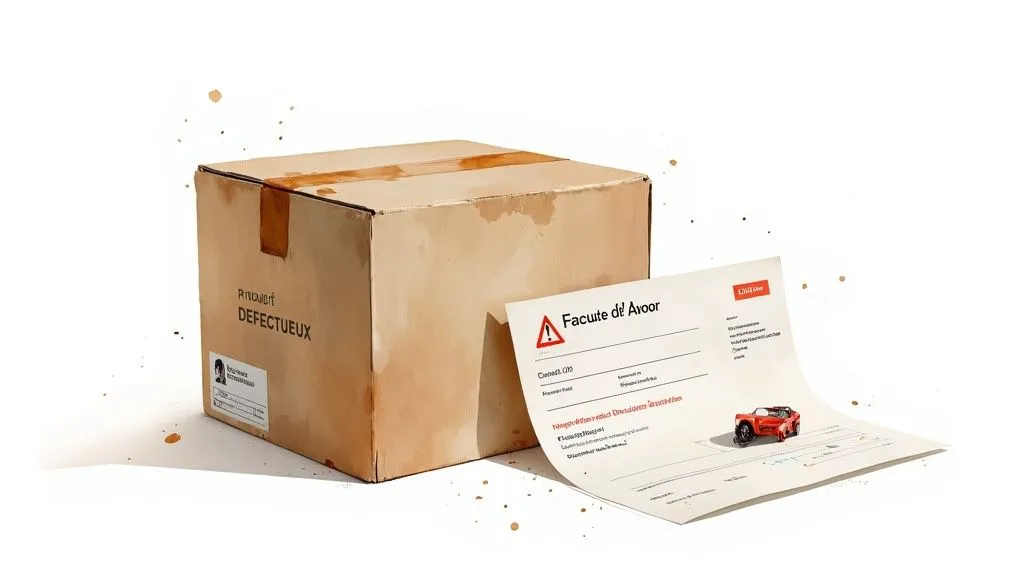
This type of credit note is much more than a simple accounting transaction; it is a key element of after-sales service. Unlike a standard return, it involves analyzing the cause of the defect. Retailers such as Castorama for a faulty power tool, or a Peugeot dealership for a part recalled by the manufacturer, use this process to document the return, initiate a warranty procedure, and recover costs from their own suppliers.
Strategic analysis and implementation
To be effective, this credit note must be accompanied by solid documentation. It is essential to keep evidence of the defect, such as photographs or technical reports. The key element is to clearly link the credit note to the customer complaint and the evidence of the defect. This link justifies the sale cancellation and serves as a basis for any claims against the manufacturer or for internal quality improvements.
Traceability is fundamental here. This credit note example is not just a document for your customer, but also an internal management tool. It allows you to track recurring types of defects, identify problematic product batches, and improve your sourcing or production processes.
Strategic tip: Create a well-defined process for handling defect returns. Train your teams to systematically document each case with photos and precise descriptions. Centralize this information to analyze trends and proactively discuss with your suppliers in order to recover costs or improve the quality of future supplies.
This approach turns a constraint (a defective product) into an opportunity for continuous improvement and stronger business partnerships.
Key takeaways
- Rigorous documentation: Always attach evidence of the defect (photos, detailed description) to your return file.
- Supplier coordination: Use the credit note and the evidence gathered to hold your supplier accountable and obtain compensation.
- Quality tracking: Analyze data from defect-related credit notes to detect recurring quality issues and improve your offering.
6. Electronic Credit Note (E-Credit Note)
The electronic credit note, or e-credit note, is the dematerialized, legally recognized version of the traditional credit note. With the widespread rollout of e-invoicing mandated by the government, this format is becoming essential. It is processed through certified systems that guarantee its authenticity and integrity, often using electronic signatures and timestamps.
This type of credit note example fits perfectly into modern digital workflows. It is generated, sent and archived electronically, which reduces costs, speeds up processing, and minimizes the risk of errors or loss. For businesses using platforms like Chorus Pro to work with the public sector, this format is already an everyday reality.
Strategic analysis and implementation
Adopting the electronic credit note is not just about sending a PDF by email. It involves using partner dematerialization platforms (PDPs) or the public invoicing portal (PPF), which comply with strict standards. The legal validity of this document rests on its traceability and the security of its content. For a deeper understanding of how credit notes are managed digitally, it’s worth understanding what cloud accounting is.
Solutions offered by La Poste (Docaposte) or modules integrated into ERP software such as Sage make it possible to generate compliant credit notes. They ensure that each document contains not only the mandatory legal mentions but also the metadata needed for automated processing.
Strategic tip: Anticipate the shift toward mandatory e-invoicing. Choose a compatible invoicing or accounting solution now. Make sure your system can not only issue invoices but also manage electronic credit notes in full compliance, particularly regarding legally binding archiving.
The following video explains the fundamentals of e-invoicing, a prerequisite for understanding dematerialized credit notes.
Going digital drastically simplifies the management of invoice corrections and strengthens the security of your transactions.
Key takeaways
- Technical compliance: Use a certified system (PDP or PPF) to guarantee the legal validity of your electronic credit notes.
- Security and archiving: Maintain rigorous backup procedures and ensure electronic archiving meets legal retention periods.
- Process integration: Train your teams on the new digital processes to ensure a smooth, efficient transition.
Mastering the issuance of electronic credit notes is a crucial step toward modernizing your administrative management. To go further, discover the benefits of online invoicing and how it can transform your business.
7. Intra-Community Credit Note
The intra-community credit note is a crucial accounting document for businesses trading within the European Union. It is used to cancel or correct a transaction with a business customer located in another member state. Its particularity lies in VAT handling, which follows specific reverse-charge rules for B2B trade within Europe. This type of credit note example is essential for correcting a return of goods, an error on a cross-border order, or for granting a post-invoicing rebate.
This document must neutralize an original sales invoice that was, most often, issued exclusive of tax (VAT-free) under the principle of VAT reverse charge by the buyer. The credit note follows the same mechanism: it is issued VAT-free and allows the buyer to adjust their own VAT return in their country. The complexity of this operation requires absolute rigor to stay compliant with European directives.
Strategic analysis and implementation
To be valid, an intra-community credit note must, in addition to the standard mandatory information, include specific elements. It is essential to include the valid intra-community VAT numbers of both parties (seller and buyer) and to explicitly reference the original invoice. Omitting these numbers can lead to a tax reassessment, with the authorities potentially treating the transaction as a domestic sale subject to national VAT.
Companies such as Renault, for vehicle returns from its dealerships in Germany or Spain, or Airbus for adjustments on spare parts with its European partners, use this format. It ensures perfect traceability of financial and goods flows within the single market, which is essential for trade-in-goods declarations (DEB/Intrastat).
Strategic tip: Before issuing the credit note, systematically verify the validity of your customer’s intra-community VAT number through the European Commission’s VIES service. Keep proof of this verification. This protects you in the event of a tax audit and confirms that you are correctly applying the VAT exemption regime.
Key takeaways
- VAT number verification: The validity of both the seller’s and the buyer’s intra-community VAT numbers is non-negotiable.
- Reverse-charge mention: The credit note must state “Reverse charge by the customer” (or an equivalent mention) to justify the absence of VAT, just like the original invoice.
- Clear reference: Always link the credit note to the original invoice it corrects to ensure a reliable audit trail.
Mastering this type of credit note is a key skill for any business targeting the European market. To better understand the applicable VAT mechanisms, you can go further by exploring the subtleties of VAT rate calculation in different contexts.
Comparison of the 7 types of credit notes
| Type of Credit Note | 🔄 Implementation Complexity | ⚡ Resources Needed | 📊 Expected Results | 💡 Ideal Use Cases | ⭐ Key Advantages |
|---|---|---|---|---|---|
| Standard Credit Note | Low | Moderate | Simple correction of errors or full returns | Standard adjustments, product returns | Legally compliant, clear audit trail, recognized format |
| Partial Credit Note | Medium | Significant | Precise adjustments on part of the invoice | Partial returns, proportional discounts | Precise adjustments, flexible, detailed documentation |
| Commercial Discount Credit Note | Medium | Moderate | After-sale discount with commercial impact | Discounts, loyalty programs, promotions | Improves customer relationship, flexible marketing tool |
| Cancellation Credit Note | Low to medium | Low to moderate | Full cancellation of an invoice | Order cancellation, contract termination | Full cancellation, clear traceability, customer-friendly solution |
| Credit Note for Defective Products | Medium | Medium | Handling returns for quality defects | Defective product returns, warranties | Maintains quality, holds suppliers accountable, builds loyalty |
| Electronic Credit Note (E-Credit Note) | High | High | Fast processing, compliant with digital regulations | B2G transactions, dematerialization, ERP systems | Speed, cost savings, traceability, legal compliance |
| Intra-Community Credit Note | High | High | Complex management of intra-EU adjustments | Inter-business EU transactions, cross-border returns | Facilitates EU operations, clear regulatory framework |
Master Your Credit Notes and Propel Your Business
At the end of our detailed exploration of the different types of credit notes, one conclusion stands out: managing credit notes is much more than a simple accounting obligation. It is a crucial point of contact with your customers and an indicator of your company’s operational health. By understanding the nuances of each credit note example presented, from the partial credit note for a returned item to the intra-community credit note for a cross-border transaction, you equip yourself with strategic tools to strengthen trust and professionalism.
Mastering these documents turns a potential source of friction into an opportunity for loyalty-building. A clear, fast, compliant credit note shows your customer that you handle the unexpected with efficiency and seriousness. This reassures them, strengthens the business relationship, and can even turn an unhappy customer into a brand ambassador.
Summary of Key Strategies
To move from theory to practice, let’s recap the fundamental actions that emerge from our analyses:
- Absolute Precision: Every credit note must contain flawless information. A clear reference to the original invoice, precise item descriptions, and exact amounts (excl. VAT, VAT, incl. VAT) are non-negotiable to ensure compliance and avoid confusion.
- Proactive Communication: Don’t wait for your customer to wonder. Accompany the sending of your credit note with an explanatory message, whether an email or a note. Explain the reason for the credit note and the next steps (refund, deduction on a future order).
- Legal Compliance: Make sure each document meets the mandatory legal requirements, similar to those of a standard invoice. Continuous, distinct numbering is particularly important for impeccable accounting.
- Process Standardization: Use templates, like the ones we’ve analyzed, for each scenario. This ensures consistency, reduces the risk of error, and saves you valuable time.
Your Next Actionable Steps
The goal now is to turn this knowledge into a robust system for your business.
- Audit Your Current Templates: Compare your credit note templates with the examples and best practices covered in this article. Identify areas for improvement, whether in clarity, missing information, or design.
- Choose the Right Tool: Manual management is a source of errors and wasted time. To secure your process, switching to invoicing software is a logical step. A good tool will automate the creation, numbering and sending of your credit notes, while ensuring their compliance.
- Train Yourself (and Your Teams): Make sure everyone involved in invoicing at your company understands when and how to issue each type of credit note. A clear, shared procedure is the key to efficiency.
By adopting these practices, you’re not just managing administrative documents. You’re optimizing an essential process that directly impacts your cash flow, your customer relationships and your reputation. Every well-executed credit note example is another building block in creating a solid, reliable business ready to grow.
Radically simplify your management and stay compliant effortlessly. Bizyness is invoicing software designed in France for sole traders and SMEs, letting you create compliant invoices and credit notes in just a few clicks. Save time and peace of mind by visiting Bizyness to discover how to automate your invoicing today.
