

 Français
Deposit Invoice Example: 6 Templates for 2025
Discover our deposit invoice examples for every situation: construction, services, e-commerce. Download our 6 compliant templates and save time.
Deposit invoicing is an essential practice for securing your cash flow and formalizing your clients’ commitment, whether you’re a freelancer, an SME director, or a tradesperson. Requesting a partial payment before starting a service or delivering a product minimizes the risk of unpaid invoices and finances the initial costs of the project. However, creating a deposit invoice that complies with legal requirements can seem complex. Which details are mandatory? How do you adapt it to your industry, whether that’s services, construction, or e-commerce?
This practical guide is designed to simplify the task for you. You’ll find six detailed templates, each accompanied by a strategic analysis to help you choose and customize the format best suited to your needs. From the standard French structure to the specialized construction template, each deposit invoice example is broken down to give you concrete, immediately applicable advice. To fully understand the nuances of deposit invoices, it’s helpful to grasp the broader context of commercial invoices and their documentary requirements. Get ready to optimize your invoicing process and strengthen your company’s financial management.
1. Standard French Template for Deposit Invoices
The standard French template for a deposit invoice isn’t just a suggestion — it’s the foundation of invoicing in France. It’s designed to be in perfect compliance with the French General Tax Code (CGI) and tax authority requirements. Using this format guarantees that your document is legally and accounting-wise valid, avoiding any risk of a tax reassessment.
This template requires specific mandatory information. The heading “Deposit invoice” must appear clearly to distinguish it from a standard invoice. In addition, an explicit reference to the initial quote or contract (for example, “30% deposit on quote No. DV2024-056”) is essential to link the payment to the overall service. This is a non-negotiable prerequisite, particularly in heavily regulated sectors such as construction or public procurement.
Strategic analysis of the template
Adopting this standard isn’t just a constraint — it’s a strategy for securing your cash flow and professionalizing your image.
- Legal compliance: This is the main advantage. By respecting this format, you can be certain you meet the expectations of URSSAF and the tax authorities, particularly regarding the collection and reporting of VAT on deposits.
- Clarity for the client: The formal structure of the document leaves no room for ambiguity. The client knows exactly what they’re paying, what percentage it represents, and what balance will remain due.
- Simplified accounting process: Your accountant or invoicing software will immediately recognize the structure, making it easier to integrate into your accounting ledgers and financial tracking. Continuous chronological numbering, identical to that of your standard invoices, is a requirement that prevents errors and gaps in your bookkeeping.
The infographic below illustrates the widespread use and importance of this standard template within the French business ecosystem.
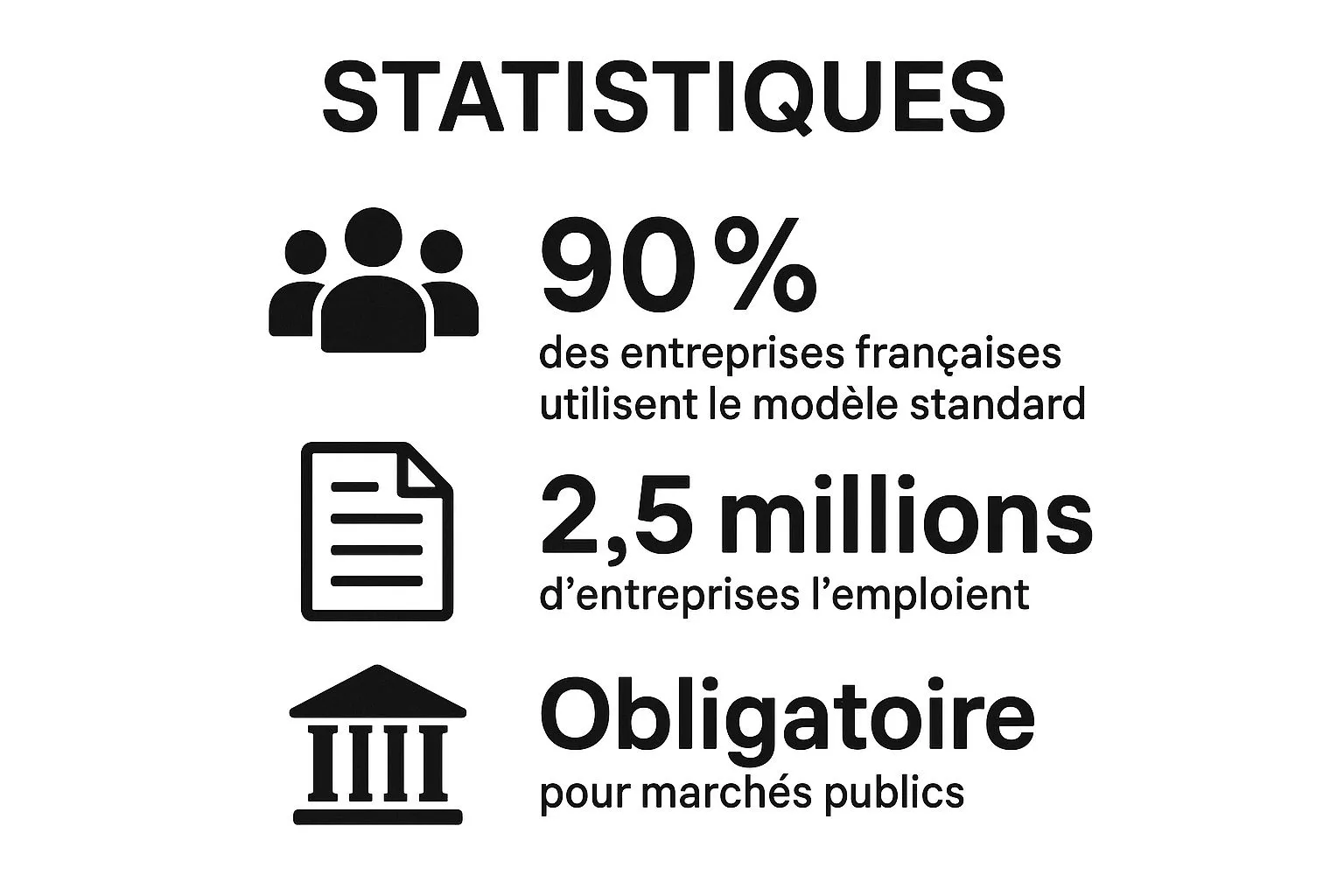
These figures confirm that respecting this format is the absolute norm for operating smoothly in France, whether in the private or public sector.
Key takeaways
To correctly apply this deposit invoice example, here are the essential actions:
- Check the VAT rate: Make sure the VAT rate applied is the one in effect at the time the deposit invoice is issued.
- Strict numbering: The deposit invoice must fit into the chronological sequence of your invoices. Don’t create a parallel series.
- Reference the quote: Always link the invoice to the accepted quote for perfect traceability.
- Legal archiving: Keep a copy of the invoice (digital or paper) for a minimum of 10 years, as required by law.
2. Sage Template for Deposit Invoices
The template offered by Sage, France’s leading management software provider, represents an integrated, automated approach to deposit invoicing. Designed to work seamlessly with the brand’s accounting solutions, this template goes beyond a simple document — it’s a process. It automates calculations, VAT management, and accounting entries, ensuring perfect consistency between commercial documents and financial records.
This format is particularly popular in structured professional environments, such as CAC 40 large corporations or accounting firms. Its strength lies in its ability to standardize and secure the workflow. Using this type of deposit invoice example isn’t just a matter of convenience — it’s a strategic decision aimed at making the entire financial chain more reliable, from the initial quote to the final balance invoice.
Strategic analysis of the template
Adopting a template from an ecosystem like Sage turns invoicing from an administrative task into a lever for operational performance.
- Native accounting integration: The main benefit is eliminating double entry. Creating the deposit invoice automatically generates the corresponding accounting entries (VAT collection, recording of deferred revenue), reducing the risk of human error to near zero.
- Enhanced traceability: The system natively links the deposit invoice to the quote, the purchase order, and then the final invoice. This unbroken document chain is a major advantage during audits or tax inspections.
- Optimized cash flow management: Sage software allows real-time tracking of deposit collections and their impact on cash flow forecasts, giving business leaders a clear, dynamic view of their liquidity.
The fact that entities like Bouygues Construction, or that 60% of French accounting firms according to figures from the profession relayed by IFEC, rely on these systems demonstrates their robustness and reliability for managing complex, high-volume financial flows.
Key takeaways
To make the most of a Sage-style deposit invoice example, here are some crucial actions:
- Use the pre-configured templates: Sage provides templates that comply with legislation. Start from this base to ensure your documents are valid before any customization.
- Customize for your industry: Adapt the fields and specific mentions to your business (for example, legal notices for construction) directly within the software settings.
- Train your teams: Make sure staff understand the automated process to avoid manual workarounds that could break the traceability chain.
- Plan for updates: Management software evolves alongside legislation. Enable automatic updates to ensure your invoice templates always stay compliant.
3. Specialized Construction Template for Deposits
The deposit invoice template for the construction and public works sector is a highly specialized version, far more complex than the standard one. Designed to address the realities of long, evolving projects, this format incorporates crucial elements such as progress statements, retention (warranty holdback), and subcontractor management. It’s mandated by industry standards (notably the NF P 03-001 standard) and is essential for public contracts, as well as for large-scale projects such as those carried out by Eiffage or Vinci.
This type of deposit invoice isn’t a simple partial payment; it represents the actual progress of the work at a given date. Rather than stating a fixed percentage, it details the work completed, valued according to the project’s unit price schedule (DPGF). This deposit invoice example is therefore inseparable from site monitoring and serves as the basis for payment approval by the project owner or project manager.

Strategic analysis of the template
Using this specialized construction template is a regulatory requirement that becomes a strategic tool for project and cash flow management.
- Fine-grained cash flow management: Payments are directly tied to actual work progress. This ensures a steady cash flow proportional to the effort delivered, protecting the company against high material and labor costs.
- Transparency and traceability: Each deposit invoice is a detailed snapshot of the site. This clarity prevents disputes with the client or project owner, since every invoiced line corresponds to visible, approved work.
- Regulatory compliance: This is the only format that incorporates retention (generally 5%), an amount held by the client until reserves are lifted. It also handles the VAT reverse charge in cases of subcontracting, a key tax point for the industry. For seamless management, equipping yourself with construction-specific invoicing software is often essential.
This template, promoted by organizations such as the FFB (French Building Federation), turns an administrative constraint into a lever for financial and operational control.
Key takeaways
To correctly issue a construction deposit invoice, the following steps are critical:
- Link to the progress statement: The invoice must always be accompanied by the detailed “draft statement” or “progress statement” approved by the project manager.
- Manage the retention: Clearly state the retention amount (if applicable) and how it’s calculated on the pre-tax amount of the work.
- Apply the VAT reverse charge: If you’re invoicing as a subcontractor to a main contractor, the invoice must be issued excluding VAT with the mention “Reverse charge.”
- Track cumulative progress: Each invoice must state the total amount of previous progress statements and calculate the balance for the current period, ensuring a clear overall view.
4. E-commerce Format with Automated Deposit
The deposit invoice template for e-commerce is a digital evolution designed for online sales platforms. It automates the management of partial payments for pre-orders, customized products, or expensive items requiring deferred delivery, such as large appliances. This format integrates directly with payment gateways (Stripe, PayPal) and customer relationship management (CRM) systems, creating a seamless workflow from order to final invoicing.

Automation is key to this model. When a customer pays a deposit, the system instantly generates a compliant deposit invoice example and sends it by email, while recording the transaction in the accounts. Platforms like Shopify, or major players like Cdiscount and La Redoute, use this system to secure sales of high-value or made-to-order products, while offering a smooth, professional customer experience.
Strategic analysis of the template
Adopting this format isn’t just a matter of convenience — it’s a strategic decision to optimize conversion and financial management in online commerce.
- Reduced cart abandonment: By offering a deposit, you lower the initial financial barrier for expensive items, which can significantly increase conversion rates.
- Secured cash flow: The deposit confirms the customer’s commitment and covers the initial costs of production or ordering, reducing the financial risk linked to cancellations. For online businesses, a good understanding of how Shop Pay and Shopify payments work is essential for automating deposit management.
- Automation and time savings: Integration with payment and accounting tools eliminates manual invoicing tasks. The system handles the generation, sending, and tracking of invoices, freeing up time to focus on business growth.
The video below illustrates how modern payment solutions facilitate these processes.
Automating online invoicing is a significant performance lever for any e-commerce business.
Key takeaways
To effectively implement this deposit invoice example in an e-commerce context, here are the crucial actions:
- Optimize for mobile: Make sure the deposit payment process is simple and intuitive on mobile devices, where the majority of purchases are initiated.
- Clarify cancellation terms: Clearly display your deposit refund policy in case of cancellation by the customer to avoid disputes and maintain trust.
- Test payment scenarios: Rigorously test all possible payment flows (full payment, deposit, failed payment) to ensure a flawless user experience.
- Integrate customer service: Connect your invoicing system to your customer service team so they can quickly access payment information and respond effectively to customer questions.
5. Professional Services and Consulting Template
The template for professional services and consulting is specifically tailored to intellectual services. Unlike the sale of products, value here lies in expertise, time, and intangible deliverables (audit reports, strategies, training). The deposit invoice in this context serves to financially secure the different phases of a long engagement and to formalize the mutual commitment.
This type of deposit invoice example stands out for its strong connection to project milestones. Each deposit is generally tied to reaching a goal or delivering an intermediate deliverable defined in the contract. For example, a deposit might be requested at kickoff, another after the diagnostic presentation, and so on. This is a practice standardized by organizations such as Syntec Numérique and adopted by top consulting firms (McKinsey, Big Four) to manage risk and cash flow on engagements spanning several months.
Strategic analysis of the template
Adopting this template is a strategic necessity for any consultant, freelancer, or agency looking to sustain their business and professionalize their client relationships.
- Cash flow security: For long engagements, waiting until the end to invoice is a major financial risk. Milestone-based deposits ensure regular cash inflows, covering operating costs and time invested.
- Validation of client commitment: Paying a deposit confirms the client’s involvement in the project. They become an active partner rather than a simple buyer, which is crucial for the success of consulting projects.
- Structured project management: This template requires breaking the project down into clear phases with specific deliverables. This structuring benefits both the provider, in organizing their work, and the client, who has full visibility into progress.
This approach has become standard practice in the industry, used by more than 80% of French IT services companies (ESN), because it aligns financial interests with the operational progress of the project.
Key takeaways
To effectively implement this deposit invoice template, follow these recommendations:
- Define milestones upfront: The contract or quote must unambiguously list the different phases, associated deliverables, and corresponding deposit percentages.
- Link each invoice to a deliverable: The deposit invoice should clearly state the milestone reached or the deliverable submitted (e.g., “Deposit for consulting engagement - Phase 1: Audit and diagnostic”).
- Communicate proactively: Inform your client in advance when a milestone is reached and that the deposit invoice will soon be issued. This transparency builds trust.
- Formalize approvals: Obtain written approval (a simple email is often enough) from the client for each deliverable before issuing the associated deposit invoice. This prevents later disputes.
6. Simplified Template for Tradespeople and SMEs
The simplified template for tradespeople and SMEs is a lightweight, accessible version of the invoicing document, specifically designed for freelancers, shop owners, and small businesses. Its main goal is to combine ease of use with legal compliance, eliminating unnecessary fields to keep only what’s essential under French regulations. This format is often pre-built into simplified accounting software or dedicated mobile apps, such as those offered by the Chambers of Trades and Crafts (CMA).
This deposit invoice example prioritizes speed of execution. Rather than starting from a blank page, the tradesperson or SME manager uses a pre-filled template where they only need to customize the key information: client details, description of the service, deposit amount, and reference to the original quote. Platforms like Pole-autoentrepreneur.fr or apps like ‘Mon Expert-Comptable’ have widely popularized this template, making it accessible to hundreds of thousands of entrepreneurs.
Strategic analysis of the template
Adopting this simplified template is a strategic decision to optimize administrative management time and focus on core business activities.
- Time savings and efficiency: This is the major advantage. By automating the creation of deposit invoices, a tradesperson can generate a compliant document in under two minutes, directly from their smartphone on a job site.
- Reduced risk of error: The required fields are predefined, minimizing the omissions that could make the invoice invalid (missing VAT number, incorrect numbering, etc.).
- Accessible professional image: Even without graphic design skills, business owners can issue clean, professional documents, often customizable with a logo, reinforcing customer trust.
- Encouraged compliance: Organizations such as URSSAF and the Chambers of Commerce (CCI) promote these tools because they make it easier to meet accounting and tax obligations, particularly for sole traders. To learn more about the specifics of this status, see this guide on invoicing for sole traders.
This template isn’t a “low-cost” version of invoicing, but a smart adaptation to the operational realities of small businesses.
Key takeaways
To make the best use of this simplified deposit invoice example, follow these recommendations:
- Check software compliance: Make sure the tool or template used is up to date with current French legislation (notably the anti-VAT-fraud law).
- Customize your template: Always include your logo, complete contact details, and payment terms to give the document a professional look.
- Back up regularly: If you use an app or software, enable automatic cloud backups so you never lose accounting data.
- Send a test invoice: Before using the template with your clients, send yourself a test invoice to check that the format is correct and all information displays properly.
Comparison of 6 Deposit Invoice Templates
| Template | Implementation complexity 🔄 | Resources required ⚡ | Expected results 📊 | Ideal use cases 💡 | Key benefits ⭐ |
|---|---|---|---|---|---|
| Standard French Template for Deposit Invoices | Medium to high (rigidity and updates) | Medium (regulatory knowledge) | Guaranteed legal compliance 🇫🇷, simplified accounting | French businesses, public contracts, construction | Legal compliance, accepted by authorities |
| Sage Template for Deposit Invoices | High (training + software integration) | Significant (license + technical support) | Time savings, full traceability | Large companies, accounting firms | Automation, fewer errors, professional support |
| Specialized Construction Template for Deposits | Very high (sector and admin complexity) | High (construction expertise required) | Precise work tracking, construction compliance | Construction and public works sector, public contracts | Suited to construction, complex management, CCAG compliance |
| E-commerce Format with Automated Deposit | High (technology and API integration) | Significant (development and ongoing maintenance) | Full automation, improved customer experience | E-commerce platforms, pre-orders, split payments | Automation, fewer unpaid invoices, scalability |
| Professional Services and Consulting Template | Medium to high (milestone and tracking management) | Medium (project management and reporting) | Transparency, financial security | Intellectual services, consulting, audit | Engagement security, advanced tracking, cash flow |
| Simplified Template for Tradespeople and SMEs | Low (simple, intuitive interface) | Low (simplified tools, mobile) | Ease of use, speed | Tradespeople, shop owners, micro-businesses | Simplicity, low/no cost, accessibility |
Your action plan for flawless deposit invoicing
Looking across the different deposit invoice templates, from the standard French version to the specialized construction or e-commerce format, one fundamental truth emerges: a deposit invoice is not just an administrative document. It’s an essential strategic tool for your company’s financial health, acting as a first line of defense for your cash flow and a symbol of professionalism for your clients.
Each deposit invoice example analyzed in this article highlights a different facet of this strategy. Whether securing a commitment for a service, financing the purchase of raw materials for a tradesperson, or automating revenue flows for an online store, the goal remains the same: turning a payment promise into a tangible, predictable cash flow. The challenge, then, isn’t just knowing how to fill out an invoice, but why every field and every legal mention matters for protecting your business.
Your concrete next steps
To move from theory to practice and durably adopt these best practices, here’s a simple action plan:
- Choose your base template: Select the template closest to your industry from the examples provided (services, construction, e-commerce, trades). This will be your starting point.
- Customize with rigor: Consistently include your specific legal notices and logo, and adapt the fields to precisely match your offerings. Clarity for your client should be your top priority.
- Integrate deposit invoicing into your sales process: Don’t treat it as optional, but as a standard step. Clearly define the deposit terms (percentage, due date) in your quotes and contracts from the outset to avoid any ambiguity.
- Automate for efficiency: As soon as possible, use invoicing software. Automation reduces human error, ensures legal compliance, and frees up valuable time to focus on your core business.
Key strategic point: Mastering deposit invoicing is an indicator of how mature your business management is. It shows your partners, clients, and even your banker that you manage your cash flow proactively and professionally, reinforcing the credibility and sustainability of your business.
Ultimately, excellence in managing your deposit invoices directly translates into better financial visibility, fewer unpaid-invoice risks, and healthier, more transparent client relationships. It’s a small investment of time and rigor for a maximum return on your company’s stability.
Ready to take it to the next level and fully automate this process? Bizyness invoicing software was designed for entrepreneurs and SMEs who, like you, want to simplify their administrative management. Generate compliant quotes and deposit invoices in just a few clicks and track your payments in real time on Bizyness.
