

 Français
6 Down Payment Invoice Examples for 2025: A Practical Guide
Discover 6 down payment invoice examples to help you create compliant invoices and secure your transactions. Get our tips for 2025.
A down payment invoice is an essential tool for securing your cash flow and formalizing your clients’ commitment. Whether you’re a freelancer, a craftsperson, or a small business owner, mastering its creation is a real asset for the financial health of your business. But how do you structure it effectively? What legal requirements must it meet to be compliant?
This practical guide was designed to answer these questions. We present 6 concrete templates, each accompanied by a detailed analysis and strategic advice. You’ll find more than just a simple down payment invoice example; we break down cases from a range of sectors, from construction to web development to event planning. The goal is to give you clear strategies and practical tips to optimize your invoicing process. Using these templates, you’ll be able to create professional, compliant down payment invoices perfectly suited to your trade, protecting your revenue from the very start of each project.
1. Down payment invoice for residential construction - 30% on order
In the building trade, and especially in residential construction, requesting a down payment is a standard and essential practice. A 30% down payment invoice issued as soon as the quote or contract is signed helps secure the project financially. This initial down payment covers the purchase of the first materials, the rental of specific equipment, and the mobilization of teams, ensuring a smooth start to the job.

This down payment invoice example is crucial because it formalizes the mutual commitment between the client and the construction company. For large-scale projects, such as building a single-family home or a full renovation, this financial commitment is a mark of seriousness and trust.
Strategic analysis of this example
The 30% down payment acts as protection against last-minute cancellations and secures part of the cash flow needed to start the work. It’s a fair balance: the client makes a firm commitment, and the contractor has the funds to move forward without straining their own cash flow.
Key point: The down payment invoice must clearly reference the accepted initial quote (number and date) and state that the balance will be invoiced according to the terms agreed in the contract (for example, based on work progress or upon final delivery).
Tips and practical applications
To implement this approach effectively:
- Detail the mandatory information: Make sure your document includes all the required legal details. For a complete overview, check out our guide on the down payment invoice template on our blog.
- Secure the transaction: Offer secure payment methods such as bank transfer and keep proof of every transaction.
- Be transparent: Explain to your client the purpose of this down payment to build trust in the relationship.
- Plan for clear clauses: Include cancellation and refund terms in your contract to protect both parties in case of unforeseen events.
2. Event down payment invoice - Wedding planner with payment schedule
In the events industry, organizing a wedding or a corporate seminar involves significant financial commitments well before the big day. A down payment invoice, often paired with a payment schedule, is the norm. A substantial first payment, typically between 40% and 50% of the total amount, is requested upon signing the contract. It secures the dates and books key vendors (venue, caterer, photographer), who themselves require deposits.
This infographic illustrates the typical payment flow in event planning, from the initial down payment to interim payments.
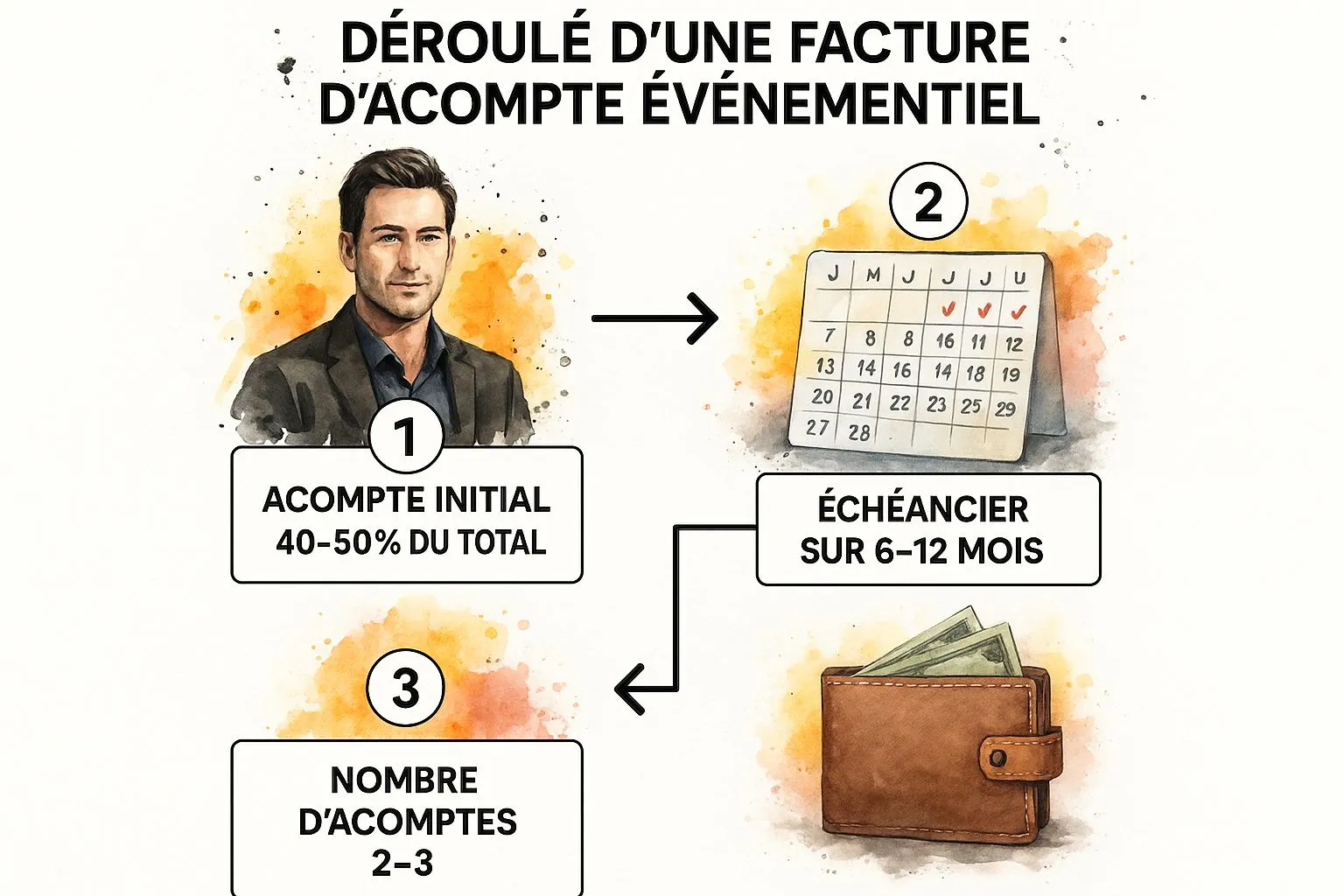
The payment schedule breaks the total cost into several manageable payments, which benefits both the client and the organizer. For example, for a €25,000 wedding, an initial down payment of €10,000 might be followed by a second payment of €5,000 at 90 days before the event, with the balance due just before or after.
Strategic analysis of this example
The payment schedule secures the event agency’s cash flow over several months, providing vital protection against cancellations and unforeseen events. It funds progressive expenses and guarantees the availability of the best vendors. This method establishes a clear, professional financial framework, avoiding misunderstandings over payments. For wedding planners and other event professionals, the seasonal nature of the business makes cash flow management particularly challenging. Down payment invoices and payment schedules are valuable tools in this respect. For more general advice, discover how to maximize profitability and cash flow for seasonal businesses.
Key point: Each down payment invoice must specify which installment it corresponds to (e.g., “Payment 2/3 - Due date D-90”). It must reference the main contract and clearly detail the remaining balance due.
Tips and practical applications
To structure your event payments effectively:
- Define a clear payment schedule: Specify the dates and amounts of each payment in the initial contract. Transparency is essential.
- Plan for late payment penalties: Include clauses on penalties for late payments to encourage on-time payment.
- Document every change: If the budget or services change, formalize the changes through a contract amendment and adjust the payment schedule accordingly.
- Offer cancellation insurance: Suggest or include cancellation insurance to protect both parties in the event of force majeure.
3. IT consulting down payment invoice - Fixed-price web development package
For intellectual services such as web development or IT services, requesting a down payment is an almost universal practice. A 50% down payment invoice for a fixed-price package is the industry standard, as it secures the project for both parties. This down payment firmly commits the client and provides the agency or freelancer with the cash flow needed to allocate resources and start the research, UX/UI design, and initial development phases.
This down payment invoice example is essential for long, complex projects such as building an e-commerce site (for example, a €7,500 down payment on a €15,000 project) or a mobile app. It formalizes the start of the engagement and triggers the production schedule.
Strategic analysis of this example
The 50% down payment reflects the intensity of the initial work on IT projects. The first weeks are often the busiest in terms of design, wireframing, and technical architecture. This down payment covers these initial costs without risk to the service provider. For the client, it guarantees resource reservation and adherence to the start timeline.
Key point: The down payment invoice should be issued right after the specifications document and quote are signed. It marks the official starting point of the project and triggers the launch of the work. The balance is generally invoiced upon final delivery or according to interim milestones.
Tips and practical applications
To apply this method successfully:
- Define the deliverables: The specifications document should precisely list the expected features to avoid any ambiguity.
- Set validation milestones: Plan checkpoints (mockups, beta version) to review progress with the client.
- Structure your costs: For web development packages, a clear approach to costs is essential; check out an essential guide on website development cost.
- Protect intellectual property: Include a clause specifying that full transfer of intellectual property rights occurs only after the final invoice is paid in full.
- Refine your invoicing: To learn more about the specifics of invoicing in the IT industry, check out our dedicated resources.
4. Professional training down payment invoice - Certified training organization
In the professional training sector, issuing a down payment invoice is a common and necessary practice, especially for certified organizations (such as those Qualiopi-certified). A down payment, often set at 30% of the total cost, is requested at the time of enrollment to firmly confirm it. This initial payment allows the training organization to secure the participant’s spot, book the pedagogical and logistical resources (trainers, rooms, equipment), and manage administrative workflows.
This down payment invoice example is essential to formalize the financial commitment between the trainee (or their employer) and the training center. For qualifying or certifying courses, such as a €3,000 management training program (€900 down payment) or a €2,000 IT certification (€600 down payment), this down payment guarantees the session is properly organized.
Strategic analysis of this example
The 30% down payment serves as a commitment lever and a filter against half-hearted enrollments, reducing the dropout rate. For the organization, it ensures minimum cash flow to cover costs incurred even before the training begins. It’s a balanced arrangement: the participant confirms their intent, and the organization can plan with confidence.
Key point: The down payment invoice must clearly state the exact title of the training program, the dates, and reference the training agreement or signed quote. It should also specify that the balance is due according to the general terms of sale, usually before the training starts or at its end.
Tips and practical applications
For effective management of this process:
- Check certifications: Make sure the organization genuinely holds the certifications it claims (Qualiopi, etc.), a mark of quality and often a prerequisite for funding.
- Clarify refund conditions: Carefully read the general terms of sale, particularly the clauses on cancellation and refunds.
- Explore funding options: Look into funding schemes (CPF, OPCO, etc.) that may cover part or all of the costs, including the down payment.
- Put everything in writing: For course creators, structuring the offer properly is crucial. Discover how to create an online course professionally and profitably.
5. Automotive down payment invoice - Dealership with trade-in
In the automotive sector, reserving a new or used vehicle is almost always formalized with a down payment. A down payment invoice, typically around 10-20%, is issued when the order form is signed. It formalizes the customer’s commitment and allows the dealer to reserve the specific model, begin preparing it, or order it from the manufacturer. This process secures the transaction and initiates the administrative procedures.

This down payment invoice example is particularly interesting when it includes a trade-in of an old vehicle. The trade-in value is then deducted from the total price of the new vehicle, and this information must appear clearly on all documents, including the down payment invoice, for full transparency.
Strategic analysis of this example
The down payment in the automotive sector locks in the sale and protects the dealer against cancellations, especially when specific options have been ordered. The trade-in, meanwhile, is a powerful sales lever. By including it as early as the down payment stage, the dealer simplifies the customer’s buying journey, sparing them the need to sell their old vehicle themselves. It’s a win-win strategy that speeds up the purchasing decision.
Key point: The down payment invoice must detail the vehicle price, the down payment amount paid, as well as the agreed trade-in value and, where applicable, any environmental bonuses or other deductions. This ensures impeccable financial traceability.
Tips and practical applications
For optimal management of this type of transaction:
- Clarify the trade-in value: Make sure the trade-in value is firmly established and stated in writing on the order form and the down payment invoice to avoid any misunderstanding.
- Check delivery timelines: Delivery times can be long. Confirm them in writing and ask about the terms in case of delay.
- Read the general terms: Pay close attention to cancellation clauses, which may provide for forfeiture of the down payment if you change your mind.
- Detail every element: The document should list the vehicle price, options, registration fees, trade-in value, and the net down payment amount.
6. Real estate down payment invoice - Off-plan new-build reservation (VEFA)
For a real estate purchase under an off-plan sale agreement (VEFA in France), the down payment invoice takes the form of a security deposit. It is issued by the property developer upon signing the reservation contract. This deposit, generally capped at 5% of the sale price, formalizes and secures the buyer’s commitment to a home that has not yet been built. It’s a key, heavily regulated step.
For example, for a new €300,000 apartment, the security deposit would amount to €15,000. This sum is placed in an escrow account, often held by a notary or a bank, and remains frozen until the final deed of sale is signed. This mechanism protects the buyer if the project does not go through.
Strategic analysis of this example
The VEFA security deposit is not a simple down payment; it’s a legal instrument that firmly commits both the developer and the buyer. It allows the developer to validate the commercial viability of the program and reassure financial partners about the project’s feasibility. For the buyer, it’s the guarantee that the property is reserved for them at the agreed price and terms.
Key point: The law strictly regulates this process. The buyer has a 10-day cooling-off period after signing the reservation contract. If the mortgage is declined or the project falls through, the security deposit must be fully refunded.
Tips and practical applications
To approach this crucial step with confidence:
- Check the developer’s guarantees: Make sure the developer holds a completion guarantee (GFA - “garantie financière d’achèvement”), which is mandatory and covers the completion of the work in the event of default.
- Study the plans carefully: Review all documents attached to the contract (plans, materials specifications, etc.). Any later change will require a contract amendment.
- Plan your financing: Payment for an off-plan home is staggered according to construction progress. Prepare a financing plan that matches this schedule to avoid unpleasant surprises.
- Negotiate the details: Before signing, discuss finishes, options, and any custom modifications you want. Once the contract is signed, making changes becomes much more complex.
Comparison of 6 down payment invoice examples
| Type of down payment invoice | 🔄 Implementation complexity | ⚡ Resources required | 📊 Expected results | 💡 Ideal use case | ⭐ Key benefits |
|---|---|---|---|---|---|
| Residential construction - 30% on order | Medium: single payment | Moderate: contract management | Securing initial financing | Residential projects requiring materials | Secures financing and client commitment |
| Events - Wedding planner with payment schedule | High: schedule spanning 6-12 months | Significant: tracking multiple payments | Booking services and better planning | Weddings, seminars with staged payments | Payment flexibility and stronger commitments |
| IT consulting - Fixed-price web development package | Medium: technical milestones and validations | Technical: IT resources and tracking | Securing the project’s initial phases | IT projects with interim deliverables | Confirmed client commitment and reduced risk |
| Professional training - Certified organization | Medium: administrative management and certifications | Moderate: pedagogical resources | Securing spots and enrollments | Certified training with external funding | Certified quality and funding options |
| Automotive - Dealership with trade-in | Medium: trade-in and financing | Moderate: administrative management | Model reservation with trade-in terms | New vehicle purchases with trade-in | Simplified process and manufacturer guarantees |
| Real estate - Off-plan new-build reservation (VEFA) | Medium: strict legal framework and schedule | Moderate: legal and financial tracking | Home reservation with legal guarantees | Off-plan new-home purchases | Secure reservation and strong guarantees |
Simplify your down payment invoices and accelerate your growth
You now have a clear, strategic understanding of down payment invoices. By examining a range of examples, from construction to intellectual services, we’ve seen that a well-crafted down payment invoice is far more than a simple administrative formality. It’s a powerful tool for securing your cash flow, building client trust, and formalizing a mutual commitment.
Success lies in the details: precise legal information, clear descriptions of services, and an approach tailored to the context of each engagement. Every down payment invoice example in this article highlighted a specific tactic: using payment schedules for long projects, detailing the phases of a fixed-price package, or incorporating specific conditions such as a trade-in. Mastering these nuances turns an accounting obligation into a genuine financial management tool.
Key takeaways
To move from theory to practice, focus on these fundamental actions:
- Secure every project: Never start a large-scale job without a confirmed down payment. It’s your best protection against non-payment and last-minute cancellations.
- Be crystal clear: Make sure the client understands exactly what the down payment covers. Explicitly state the percentage, the amount, and the remaining balance due.
- Adapt to your industry: Apply the standard percentages and terms of your field (30% in construction, payment schedules in events, etc.) to stay credible and competitive.
- Automate for efficiency: Use invoicing software to eliminate manual errors, ensure legal compliance, and track your payments in real time.
By adopting these practices, you’re not just issuing documents. You’re building a solid management system that actively supports your growth. To truly simplify your processes and ensure smooth transactions, discover how to streamline invoice processing to further optimize your workflow.
Ultimately, rigorous down payment management reflects the professionalism of your business. It’s a proactive approach that builds trust, stabilizes your revenue, and lets you focus on what you do best: growing your business.
Ready to turn this administrative chore into an asset for your business? With Bizyness, create and send compliant down payment invoices in under a minute. Simplify your management and secure your cash flow today by trying Bizyness.
