

 Français
Dunning letter for an unpaid invoice: the complete guide
Don't let an unpaid invoice hurt your cash flow any longer. Our guide to the dunning letter for unpaid invoices gives you templates and steps to take action.

An unpaid invoice isn’t just another line in your books. It’s a direct hole in your cash flow — one that can seriously slow your growth or, in the worst cases, put your entire business at risk. The dunning letter for an unpaid invoice is your best ally in this situation, an essential tool for protecting your revenue professionally.
Why managing your payment reminders matters
Chasing a client for an unpaid invoice… is a task many people dread. You worry about seeming pushy, upsetting a client, or creating a conflict. That’s the wrong way to look at it. In reality, good reminder management isn’t aggressive at all. Quite the opposite — it’s proof of seriousness and good organization.
By putting a clear reminder process in place, you protect not only your business but also the quality of your client relationships. You simply show that you’re a professional who takes cash flow seriously. If you let a late payment slide without saying anything, you send the wrong signal: that your payment terms are flexible. And that opens the door to more delays down the line.
The very real consequences of late payments
When you’re self-employed or running a small business, every euro matters. A late payment isn’t just a minor administrative inconvenience. The consequences are immediate and concrete:
- Your cash flow under pressure: You have your own bills to pay, expenses, and salaries. When a client doesn’t pay you, it creates a gap that can put you in serious difficulty.
- Wasted time and precious energy: The time you spend chasing your money is time you’re not spending growing your business or taking care of your good clients.
- Hidden costs that pile up: An unpaid invoice that drags on can quickly cost you in collection fees or overdraft charges if your bank account goes into the red, not to mention the stress it causes.
The trick is to not dramatize it. Don’t see the dunning letter as a confrontation, but as a simple conversation that’s necessary for the health of your business relationship.
In today’s economic climate, this discipline matters more than ever. In France, payment terms have unfortunately worsened. A recent study showed that the average payment delay has climbed to 14.1 days. Worse still, fewer than half of businesses (45.2%) pay their invoices on time. These figures speak for themselves: having a systematic reminder process is no longer a luxury, it’s a matter of survival. To learn more, feel free to check out the details on how payment delays have evolved.
Setting an effective reminder schedule
Dealing with an unpaid invoice isn’t something you improvise. The key isn’t a single knockout action, but rather a series of well-orchestrated interventions. Think of your reminder process as a crescendo: start gently, assuming the client simply forgot.
The goal isn’t to create conflict, but to guide your client toward payment as professionally as possible. Each step — from a simple email to a registered letter — should be thought through in terms of timing, channel, and tone. This approach lets you stay in control and avoid knee-jerk reactions that could damage a good client relationship. Think of it as a dialogue: your client’s silence calls for your next move, each time a bit more formal.
This diagram illustrates the journey well, from the outstanding invoice to its resolution.
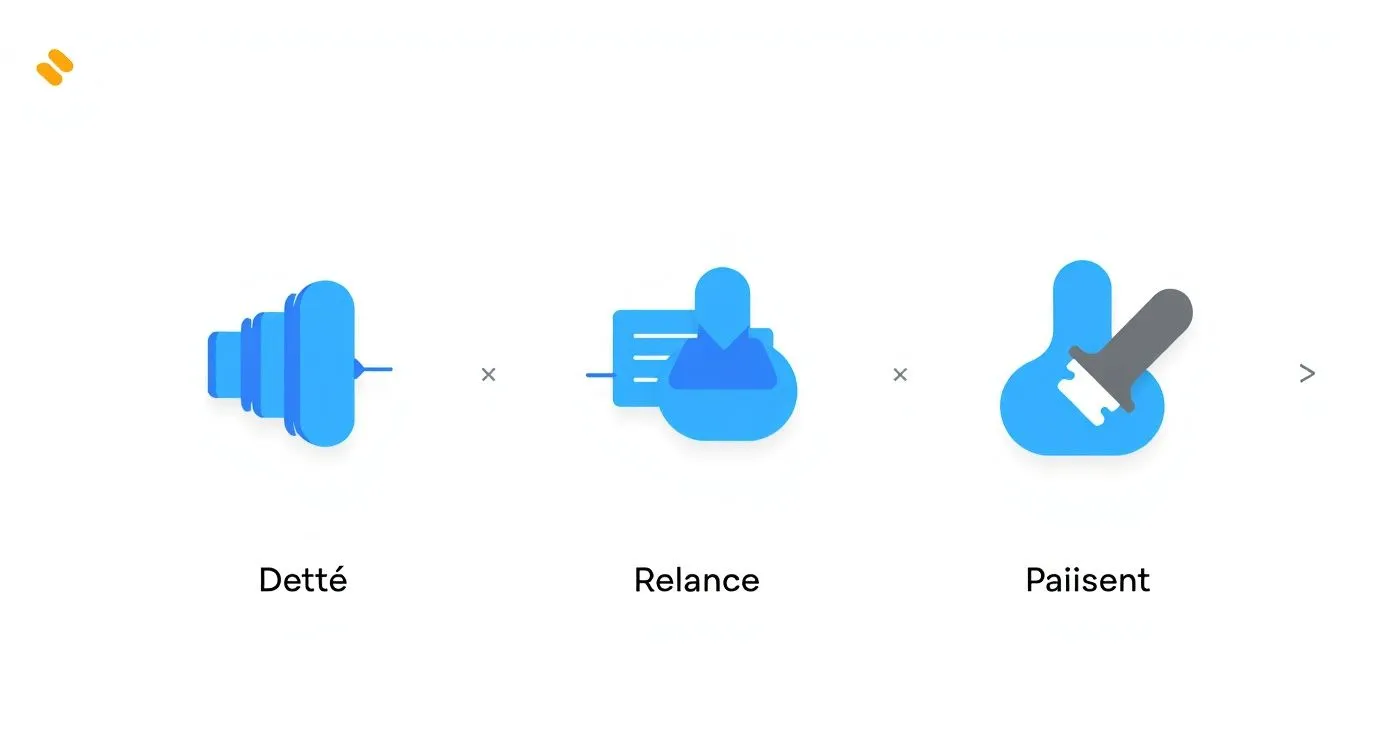
The dunning letter, in its various forms, is really the bridge between the problem (the debt) and the solution (the payment). It turns a stalled situation into concrete action.
For clarity, here’s a typical timeline you can adapt.
Timeline of a reminder process for an unpaid invoice
This table presents the key steps, the suggested communication channel, and the tone to adopt for a structured, amicable collection process.
| Step | Delay after due date | Communication channel | Tone and main objective |
|---|---|---|---|
| Reminder 1: The friendly nudge | 5-7 days | Courteous and helpful. Remind of the due date, assuming a simple oversight. | |
| Reminder 2: The tone firms up | 15 days | Email + Phone call | Direct, but professional. Confirm the messages were received and understand the reason for the delay. |
| Reminder 3: The final warning | 30 days | Registered letter with acknowledgment of receipt | Formal and non-negotiable. Set an ultimatum before pursuing legal action. |
This structure gives you a clear framework to act without hesitation and without letting unpaid invoices pile up.
The first step: a courteous reminder
The first intervention should be quick. Act between 5 and 7 days after the due date. Not before, so as not to seem impatient, but not too late either. At this stage, keep a very friendly tone. A simple email does the job perfectly.
The goal is twofold:
- Simply flag the due date: An invoice can easily get lost in an inbox or be set aside and forgotten. It’s human.
- Open the dialogue: Your message should be an outstretched hand. It invites the client to contact you if they have a question, spotted an error, or are facing a difficulty.
This first dunning letter for an unpaid invoice feels more like customer service than hard-nosed collection. Always remember to attach a copy of the invoice — it makes their job easier.
Never assume a first delay is in bad faith. In the vast majority of cases, a simple reminder is enough to unblock everything without creating any tension. It’s the best way to preserve your business relationship.
The second step: firmer communication
If your first email went unanswered after about a week, it’s time to step things up. We’re now at around 15 days after the due date. The tone shifts a bit: it stays professional, of course, but becomes more direct.
Email is still a good option, but pairing it with a phone call is often very effective. A call lets you confirm your messages were actually seen and get a direct explanation for the silence. In your communication, make clear that this is your second reminder and that the delay is becoming significant.
The final warning: formal notice
A month has now passed since the invoice was due, and still nothing despite your efforts. This is where things get serious: the formal notice (mise en demeure). Be aware — this is no longer a simple reminder, it’s a legally significant act. It’s the clear signal that if nothing changes, you’ll move to the next level (legal proceedings).
This final communication must be sent by registered letter with acknowledgment of receipt. It’s the only way to have proof it was received. The tone here is purely formal, factual, and to the point.
Your letter must include very specific legal wording:
- The words “formal notice” (mise en demeure) must appear clearly.
- A brief reminder of the amicable steps already taken.
- The total amount owed, including statutory late payment penalties, if applicable.
- A final, mandatory payment deadline (often 8 days).
- A warning that failure to pay will result in legal debt collection proceedings.
By following this timeline, you turn a potentially stressful situation into a controlled process. You protect your cash flow while remaining fair and professional throughout.
Writing a dunning letter that gets results
Knowing when to send a reminder is good. Knowing what to write so it actually works is even better. An effective dunning letter isn’t just a copy-paste job. It’s a careful blend of clarity, professionalism, and a firmness that builds gradually. The goal isn’t to find a miracle template, but to understand what, in a message, actually pushes a client to act.
Every word matters. A sentence that’s too curt can come across as aggressive, while a message that’s too vague will end up straight in the trash. Precision is your best friend. It removes any ambiguity and shows that you’re on top of your follow-up.
The ingredients of a reminder that hits the mark
Whether it’s your first or third reminder, a good dunning letter for an unpaid invoice absolutely must contain certain elements. They’re there so your client immediately understands what’s going on and can pay without needing to contact you again.
Think of it as a simple recipe to follow:
- An email subject line that gets straight to the point. No more generic “Reminder” subjects. Be direct: “Friendly reminder: Invoice no. [invoice number] outstanding”. The client knows immediately what you’re talking about.
- The essential information. The invoice number, its issue date, the due date, and of course, the amount owed. Everything should be visible at a glance.
- A clear action to take. State exactly what you expect. “Could you please proceed with payment?” or, later, “Please settle your account within 8 days.”
- The invoice, always attached. It’s a habit to have. It defuses the classic excuse of “I can’t find the invoice.”
This basic structure guarantees a professional message that leaves no room for interpretation. To polish your very first approach, take a look at our guide to the courteous dunning letter. It’s perfect for starting off gently.
Ramping up the tone, step by step
The whole art of the reminder is knowing how to shift the tone. You won’t speak the same way on day 5 as on day 30. This progression is what shows your seriousness without fanning the flames on day one of the delay.
First reminder: stay friendly
Subject: Quick reminder regarding invoice F-2024-123
Hello [Client name],
Unless I’m mistaken, it looks like invoice F-2024-123 for [amount] €, which was due on [date], is still awaiting payment.
If this is simply an oversight, could you take a look? I’ve attached it again for your convenience.
Best regards,
Here, the tone is light. We’re assuming it’s an oversight. It’s a non-confrontational approach that resolves the vast majority of delays.
Second reminder: the tone firms up
Subject: Reminder - Invoice F-2024-123 unpaid
Hello [Client name],
Despite my previous email, I see that invoice F-2024-123, due since [date], has still not been settled.
I ask that you please resolve this situation as soon as possible. Without a response from you shortly, we will be forced to suspend our services.
Regards,
The language is more direct. It reminds the client that a first attempt was already made and introduces a concrete consequence. The pressure ratchets up a notch.
This escalation has become crucial. The tense economic climate is driving late payments through the roof: 62.6% of businesses report experiencing them, an increase of 11.6 points. Knowing that 70% of small businesses and sole traders see their payment terms lengthening, it’s clear that the dunning letter for an unpaid invoice is no longer optional — it’s an essential management tool.
The final warning: formal notice
The third and final communication before going further is the formal notice. Here, the register changes completely. The tone is no longer commercial, it becomes legal. Every word is chosen to lay the groundwork for possible legal action. Terms like “formal notice”, “final deadline”, and “legal proceedings” must appear in black and white. This is your final message before handing things over to a collection professional.
The legal aspects you must not overlook
When you move from a simple friendly reminder to a more formal one, and especially to the formal notice, you enter different territory. You’re no longer in simple communication, you’re in legal territory. Your letter then becomes an official document that must be absolutely flawless to carry its full weight if things escalate.
Every detail counts. The slightest imprecision can be used against you and weaken your case. This is the rigor that turns a simple dunning letter for an unpaid invoice into a key piece of evidence for defending your rights and, ultimately, protecting your cash flow.
The essential legal mentions
For a reminder to have real legal value, especially the formal notice, it must contain very specific information. Leaving out even one could render your approach void if you need to move to the next stage.
Think of it as your compliance checklist before sending:
- Your full contact details (as the sender) and those of your client (the recipient). That’s the baseline.
- The place and date the letter was written.
- A clear and unambiguous subject line: for the final step, don’t hesitate to write plainly, “Formal notice to pay.”
- The reference to the unpaid invoice: its number, issue date, and exact amount.
- A reminder of the contract: mention the signed quote, purchase order, or service that justifies this invoice.
This isn’t administrative overkill — it’s the very foundation of your collection action.
Late payment penalties and the flat-rate compensation fee
Good news: the law protects you against bad payers. You are fully entitled to apply late payment penalties starting from the first day after the due date. The only condition? You must have clearly stated this in your terms and conditions of sale and on your invoices.
On top of that, a flat-rate compensation fee for collection costs of €40 is owed by any business client who pays late. It’s automatic and non-negotiable. You must mention both of these points in your formal notice in order to claim them officially. To understand the mechanics, our article explains how to calculate late payment penalties on an invoice, with an example.
Expert tip: never skip these fees. Mentioning them in your formal correspondence not only shows that you know your rights, but also adds significant financial and legal pressure on your debtor.
The current climate in France makes this vigilance even more crucial. Did you know that 86% of French businesses report experiencing late payments? This figure is alarming and hits small businesses hard, with average delays climbing to 44 days. The impact on cash flow is even considered “critical” for more than half of them. This shows just how important it is to act quickly and decisively from the very first unpaid invoice. You can also check out the findings of the study on payment delays to learn more.
Finally, make it a habit to keep everything. Carefully archive every exchange: emails, acknowledgments of receipt for your registered letters, even a short summary after a phone call. These elements make up your file and will serve as tangible proof of your good faith and your efforts to find a solution.
What if we automated invoice follow-up?
Sending a first dunning letter for an unpaid invoice is a good start. But the real challenge is setting up rigorous, systematic follow-up without spending all your time and energy on it. Honestly, tracking every invoice manually is a recipe for oversights, mistakes, and considerable wasted time.

One look at this screenshot from Bizyness and you immediately see the appeal. You can create your own reminder scenarios, step by step: set a delay, choose the message template, select the sending channel… The idea is simple: build a sequence that launches itself automatically as soon as an invoice becomes due. No need to think about it anymore.
The magic of automatic reminder scenarios
Automation changes everything. No more daily checking of the invoice list and manually sending each email. You set the system up once and for all, and it works for you. It’s a huge time saver and one less source of stress.
In practice, it could look like this:
- 5 days after the due date: A first reminder email, courteous and friendly, is sent automatically.
- 15 days after the due date: Still unpaid? A second message, a bit firmer this time, goes out without you having to lift a finger.
- 30 days after the due date: You receive an alert suggesting you move to the next step, such as sending the formal notice by registered letter.
With this approach, every invoice is handled with the same rigor. No more oversights or clients slipping through the cracks. You become far more efficient, and your cash flow will thank you.
Automation isn’t just another tool. It’s a change in philosophy. You stop merely reacting to unpaid invoices and start anticipating them in a structured way. And that makes a huge difference to your payment terms.
The goal isn’t to robotize the client relationship — quite the opposite. By delegating repetitive tasks to a system, you free up precious time to handle the cases that need a real conversation. You can finally pick up the phone and find a human solution with the clients who need it.
This is exactly why tools like Bizyness exist. They integrate seamlessly with your invoicing to create a smooth process, from sending the invoice all the way through to payment. By the way, if this topic interests you, take a look at our article on how to automate your administrative tasks so you can focus on what really matters. You’ll turn a burdensome chore into a reliable ally that protects your business.
Frequently asked questions about chasing unpaid invoices
Even with the best guide in the world, when you’re dealing with a client who isn’t paying, you often end up with very concrete questions. That’s normal. Here are direct, practical answers to the most common questions to help you see things more clearly.
When should I send the very first reminder?
The sooner, the better. Don’t hesitate: from the day after the due date, you’re entitled to send your first dunning letter for an unpaid invoice.
At this stage, no need to bring out the heavy artillery. A simple, friendly email — a polite reminder — is enough in most cases. Assume it’s an oversight, a small slip-up. It’s the best way to preserve your good business relationship while subtly showing that you’re rigorous in your follow-up.
Is a registered letter with acknowledgment of receipt required every time?
Absolutely not. For the first reminders, an email or even a phone call is much more effective. It’s faster, less formal, and often resolves the situation without creating tension.
That said, things change radically once you reach the formal notice stage. There, yes, the registered letter with acknowledgment of receipt is essential. It’s what gives your approach legal value and proves, beyond dispute, that your client was indeed notified.
The acknowledgment of receipt isn’t just a piece of paper. It’s the document that triggers legal deadlines and will become your best evidence if, unfortunately, you have to go further and start legal proceedings.
Can I apply late payment penalties right away?
Legally, yes. The law allows you to charge penalties from the very first day of delay. The only condition is that this must be clearly stated in your terms and conditions of sale and mentioned on the invoice in question.
Now, from a purely commercial standpoint, this isn’t always the best strategy. It’s often better to first mention them as a warning in your early reminders. Save the actual application of penalties for the formal notice. It’s a powerful psychological lever that shows the tone has changed.
What if the client completely ignores the formal notice?
If, after the deadline you set (generally between 8 and 15 days), the formal notice goes unanswered, the amicable phase is over. You have to face facts: your client isn’t cooperating.
The next step is legal. Several options exist, such as the payment order procedure (injonction de payer). At this point, don’t go it alone. It’s strongly recommended that you get support from a legal professional (lawyer, bailiff) to give yourself the best chance of success.
Stop chasing after your money and don’t let another unpaid invoice weaken your cash flow. With Bizyness, you can automate your reminders in just a few clicks and free your mind to focus on what really matters: your business. Discover how Bizyness can transform your invoicing.
