
Ecommerce and ERP: Boost Your Business Automation
Discover how integrating ecommerce and erp automates your accounting and unlocks business growth. Get the complete guide for e-merchants.

Running an online store that’s taking off is a bit like piloting a plane. At first, with a few sales a day, manual mode works just fine. But as traffic picks up, juggling orders, payments, and accounting quickly turns into a nightmare. To avoid the crash, pairing e-commerce with an ERP becomes your best insurance policy.
Why an ERP is the autopilot of your e-commerce business
Your store is taking off, and that’s great news! The flip side is that administrative complexity explodes right alongside it. Every sale on Shopify, every payment through Stripe, every shipment from your warehouse adds a new line to a spreadsheet that quickly turns into an unmanageable maze. It’s the daily reality of every e-merchant moving up a gear.

Back to our cockpit. At the launch of your business, you’re at the controls. You process each order one by one, you update your stock by hand, you issue your invoices manually… It works, but it’s terribly time-consuming and the risk of error is everywhere.
From manual management to autopilot
To shift into “long-haul” mode — that is, growing your business with peace of mind — you need an autopilot. The ERP (Enterprise Resource Planning) is exactly that intelligent copilot. It’s a central brain that connects your sales, your stock, your payments, and your accounting into a single unified system.
Far from being just another tool, an ERP turns the chaos of manual tasks into a smooth, automated workflow. Concretely, what does that look like?
- Real-time synchronization: A flash sale on Amazon? Your stock is instantly updated on your WooCommerce site, avoiding any stockout or overselling.
- Absolute data reliability: No more data-entry errors between your bank statement and your accounting software. The numbers match, always.
- 360° visibility: You know at a glance which product generates the most margin or which sales channel performs best.
An ERP isn’t an expense, it’s an investment. An investment in your peace of mind that frees you from low-value tasks so you can focus on your real mission: driving your growth.
This shift has become crucial. In an e-commerce market in France that has topped €150 billion, automation is no longer a luxury. A study reveals that 92% of retailers in Europe have already adopted an ERP to stay in the race, even managing to cut their IT costs by up to 40% by streamlining their operations. If these figures interest you, you can check out current ERP statistics on bluelinkerp.com.
By connecting all your tools, an ERP guarantees frictionless financial and operational management. To dig deeper into this topic, our article on business process automation gives you all the keys to finally focus on strategy instead of admin.
How an ERP finally unifies your e-commerce tools
If you’re an e-merchant, your day-to-day probably looks like constant juggling between different tools. Your Shopify handles sales, Stripe collects payments, your accounting software tries to keep up, and in the middle, an army of spreadsheets tries to bridge the gap. Each tool works in its own silo. This fragmentation is an endless source of manual tasks, wasted time and, let’s be honest, errors.
Now picture a conductor who gets all your instruments speaking the same language. That’s exactly the role of an ERP in the e-commerce world. It’s not just another piece of software — it’s the central hub that finally connects your entire ecosystem.
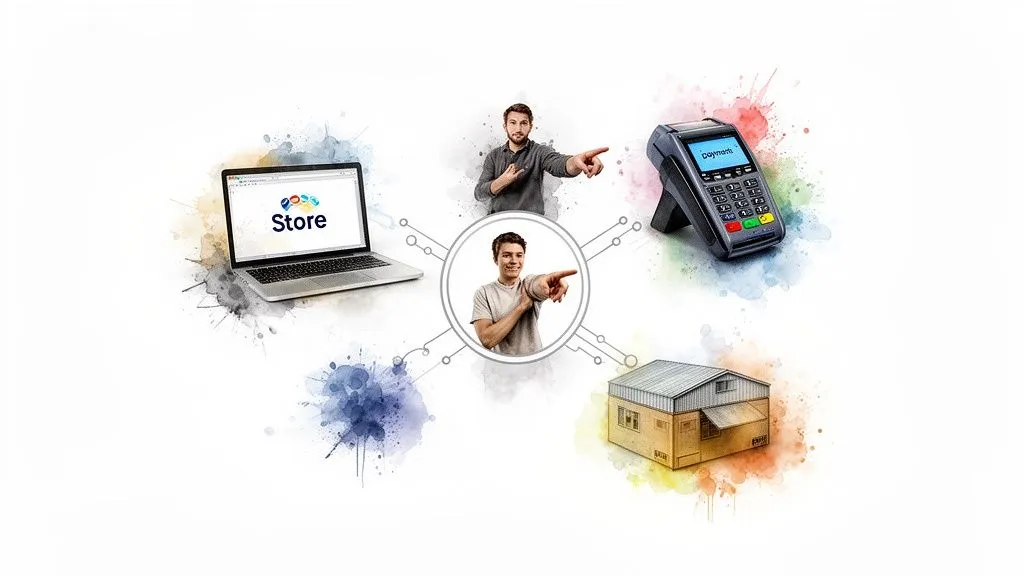
The ERP acts as a genuine control tower for your data. No more hopping between the interfaces of WooCommerce, PayPal, and Amazon. The ERP centralizes all information to create a single, logical workflow. Every sale, every payment, every product return is captured, translated, and synced everywhere, in real time.
From chaos to centralization
Without a unified system, a typical day for an e-merchant is an obstacle course. The issues around shared Excel file management are a perfect illustration of this mess: versions get mixed up, data is wrong, and no one knows who did what anymore. An ERP puts an end to this chaos by becoming your single source of truth.
An ERP isn’t out to replace your favorite tools like Shopify or Stripe. On the contrary, it multiplies their power by ensuring they work together, based on reliable, always up-to-date data.
Let’s take a very concrete example. An order is placed on your store. Here’s what the ERP triggers automatically behind the scenes:
- Stock update: The product’s stock is instantly decremented, not just on your site but also across all your other sales platforms (marketplaces, other stores).
- Invoice generation: A compliant invoice is created, applying the correct VAT rate based on the buyer’s country.
- Accounting preparation: The corresponding journal entry is generated and pre-assigned, ready to be reconciled with the payment received.
This orchestration guarantees absolute consistency. The risk of selling a product already out of stock disappears. Your accounting, meanwhile, reflects the reality of your business, with no manual entry at all. To go further, our guide on e-commerce tool integrations shows you how these connections can transform your operations.
Management before and after ERP: the comparison
To really grasp the difference, the table below compares an e-merchant’s daily tasks, with and without an ERP to automate processes.
Comparison between manual management and management with an ERP
| Task | Manual management (without ERP) | Automated management (with ERP) |
|---|---|---|
| Invoice creation | Manual entry from order data, risk of VAT errors. | Invoice automatically generated and sent to the customer as soon as the order is confirmed. |
| Stock tracking | Manual update on each sales channel after an order. | Instant, multi-channel synchronization of stock levels. |
| Bank reconciliation | Manual, line-by-line matching between the bank statement and invoices/payments. | Automatic reconciliation of bank transactions with corresponding invoices and payments. |
| Accounting | CSV file export/import, manual entry of journal entries. | Automatic generation of journal entries, ready to be exported to your accountant. |
| Sales analysis | Compiling data from multiple sources (Shopify, Amazon, etc.) into a spreadsheet. | Unified dashboard with reliable, real-time performance indicators. |
This comparison highlights an essential point: an ERP doesn’t just save you time. It makes your data more reliable, drastically reduces the risk of errors, and frees your mind to focus on what really matters: growing your business.
This unification brings the clarity you need to steer your business. You can finally analyze your performance with numbers you can trust, whether it’s a product’s profitability or a sales channel’s efficiency. The ERP turns a collection of independent tools into a coherent, powerful business management system.
What are the concrete benefits of an ERP for your profitability?
Pairing an ERP with your online store isn’t just about organization. It’s a real lever to boost your profitability, secure your operations and, frankly, get some peace of mind back. Many see it as an expense, but it’s a strategic investment whose returns show up very quickly.

Let’s look together at the five benefits that will genuinely change your daily routine and strengthen your finances over the long term.
1. Time savings you can put a number on
For an entrepreneur, time is money. An ERP designed for e-commerce saves you an enormous amount of it by taking over all the repetitive tasks that drain your energy and productivity.
No more manually entering orders into your accounting software, or tediously checking every line of your bank statement. The ERP becomes your conductor. For an e-merchant handling 500 orders a month, the savings can easily add up to more than 20 hours of work a month. That time can finally go toward what really matters: marketing, customer relationships, and your growth strategy.
2. Data you can finally trust
To err is human, that’s true. But in management, it’s costly. A stock error? That’s a canceled sale and a disappointed customer. An accounting entry error? Your balance sheet is skewed and the tax authorities might come knocking.
The ERP is the guardian of your information’s consistency. It becomes your single source of truth, putting an end to discrepancies between your different tools.
- Synchronized stock: Your inventory is accurate, everywhere, all the time. A sale on Amazon instantly updates the stock on your Shopify, avoiding frustrating overselling.
- Consistent figures: The revenue on your dashboard matches your accounting down to the cent. Makes sense, since they come from the same source.
This reliability is the foundation of sound management and confident decision-making.
An ERP doesn’t just gather information; it guarantees its integrity. You can finally run your business based on accurate figures, without ever having to second-guess them.
3. Tax compliance that runs on its own
Managing VAT in e-commerce, especially with international sales, is a real headache. The OSS (One-Stop Shop) and IOSS (Import One-Stop Shop) single windows have added complex rules on which VAT rate to apply depending on the buyer’s country.
A modern e-commerce ERP is built to handle this. It becomes your personal tax expert, able to:
- Identify the customer’s destination country.
- Automatically apply the correct local VAT rate for your B2C sales in Europe.
- Break down your sales by country to prepare your one-stop-shop filings.
This automation secures your business and protects you from a painful tax audit. No need to be a European tax expert to sell internationally with peace of mind.
4. A clear view of your performance
Which product is most profitable? Which sales channel brings you the most margin? Without an ERP, answering these questions means juggling multiple spreadsheets — a long process prone to errors.
Thanks to centralized dashboards, the ERP gives you a real-time, 360-degree view of your performance. You can finally precisely analyze:
- Gross margin by product or category.
- Profitability by channel (your site, marketplaces, etc.).
- The evolution of average order value or customer lifetime value (CLV).
With these key performance indicators (KPIs) based on reliable data, you make strategic decisions faster and adjust course to maximize your profitability.
5. A structure ready for growth
The biggest advantage of an e-commerce and ERP architecture is its ability to grow with you. A well-designed system can handle 100 orders a day just as smoothly as 10,000.
When sales take off, a manual system collapses. You have to hire to handle the admin work, which eats into your margins. With an ERP, your infrastructure is already ready. Automated processes absorb the increased load effortlessly. Your administrative management will never be a brake on your ambition.
From sale to accounting: the journey of an order, step by step
To really understand the value of connecting your e-commerce to an ERP, the best way is to follow an order from start to finish. Let’s set aside the big concepts for a moment. Instead, we’ll walk you through the complete lifecycle of a purchase, from the customer’s click to its translation into your books. Seeing this perfectly orchestrated, automated dance in action is how you understand why an ERP becomes vital.
Picture this: it’s 2am. You’re fast asleep, but your store never stops. A customer just placed an order. Let’s see what happens behind the scenes.
Step 1: The sale and the stock update
A visitor in Germany is browsing your Shopify store. One of your products catches their eye, they add it to the cart and complete the purchase. The instant they click “Pay,” your ERP gets to work.
Without you lifting a finger, the system records this new sale. But that’s just the beginning:
- It adjusts stock: The ERP immediately removes the sold item from your inventory.
- It syncs everywhere: If you sell that same item on Amazon or another store, the stock is updated in real time everywhere. The risk of selling a product already out of stock? Eliminated.
This first step ensures one essential thing: the reliability of your data. No more manual inventory checks and no more disappointed customers whose orders get canceled for lack of stock.
Step 2: Invoicing and the VAT puzzle
The order was paid with Stripe. The payment is confirmed. This is where automation shows its true strength, tackling a task that’s often complex and a frequent source of errors: taxation.
Connected to both Shopify and Stripe, the ERP pulls together all the pieces of the puzzle. It sees that the customer is an individual residing in Germany. From that single piece of information, it generates a fully compliant invoice.
This is precisely where an ERP built for e-commerce makes all the difference. It doesn’t just create a document. For this B2C sale in Germany, it knows it must apply the German VAT rate of 19%, as required by the OSS (One-Stop Shop) rules.
Managing VAT this precisely means considerable time savings and peace of mind. The ERP guarantees you’re compliant with European tax rules, without needing to become a tax expert yourself. To dig deeper, our guide on e-commerce accounting is an excellent resource.
Step 3: Hands-free bank reconciliation
A few days later, the funds from this sale land in your business account, net of the fees taken by Stripe. Manually, this is the start of a tedious scavenger hunt: which order, which invoice does this transfer correspond to?
With a well-connected ERP, this process is fully automated. The system acts as your best financial assistant:
- It spots the transfer: The ERP detects the Stripe payout on your bank statement.
- It makes the connection: It instantly matches this amount to the Shopify order and the invoice it created itself.
- It isolates the fees: At the same time, it identifies the Stripe commission and records it as an expense.
Bank reconciliation, which takes many e-merchants hours every week, is wrapped up in seconds. Zero data-entry errors, zero headaches.
Step 4: Preparing the accounting entries
End of the month. Time to prepare documents for your accountant or file your VAT return. Without an ERP, this is often a chore: exporting dozens of CSV files, trying to merge them, and attempting to make sense of thousands of rows of data.
But thanks to the continuous flow of information, your ERP has already prepared everything. Every step of the order’s journey has been converted into journal entries. In just a few clicks, you can generate:
- The sales journal: A complete report of all sales for the month, broken down by country and VAT rate.
- OSS filing data: Revenue by EU country, ready to be reported on the one-stop shop.
- The Fichier des Écritures Comptables (FEC): A standardized export file your accountant can import directly into their software, with no re-entry needed.
From the overnight sale to closing the books, the order’s journey has become a smooth, reliable, and fully autonomous process. You did nothing, and yet your bookkeeping is flawless. That’s the true promise of a well-integrated e-commerce and ERP system.
How to choose the right ERP for your online store
Choosing an ERP for your e-commerce business is a bit like choosing a rocket engine. The market is full of promising solutions, but not all of them will put you into orbit. Make the wrong choice, and you risk staying grounded, stuck in manual tasks and costs you never saw coming. Your mission is to find the technology partner that truly speaks the language of online selling.
Ultimately, choosing an ERP is above all a matter of compatibility. It’s not about aiming for the most powerful tool, but the one that fits naturally into your ecosystem. The real question isn’t “what can this ERP do?” but rather “what will it do for my store, with my tools?” That’s a fundamental shift in perspective.
The diagram below clearly shows the ideal journey an ERP must be able to handle smoothly, from the sale to the accounting entry.
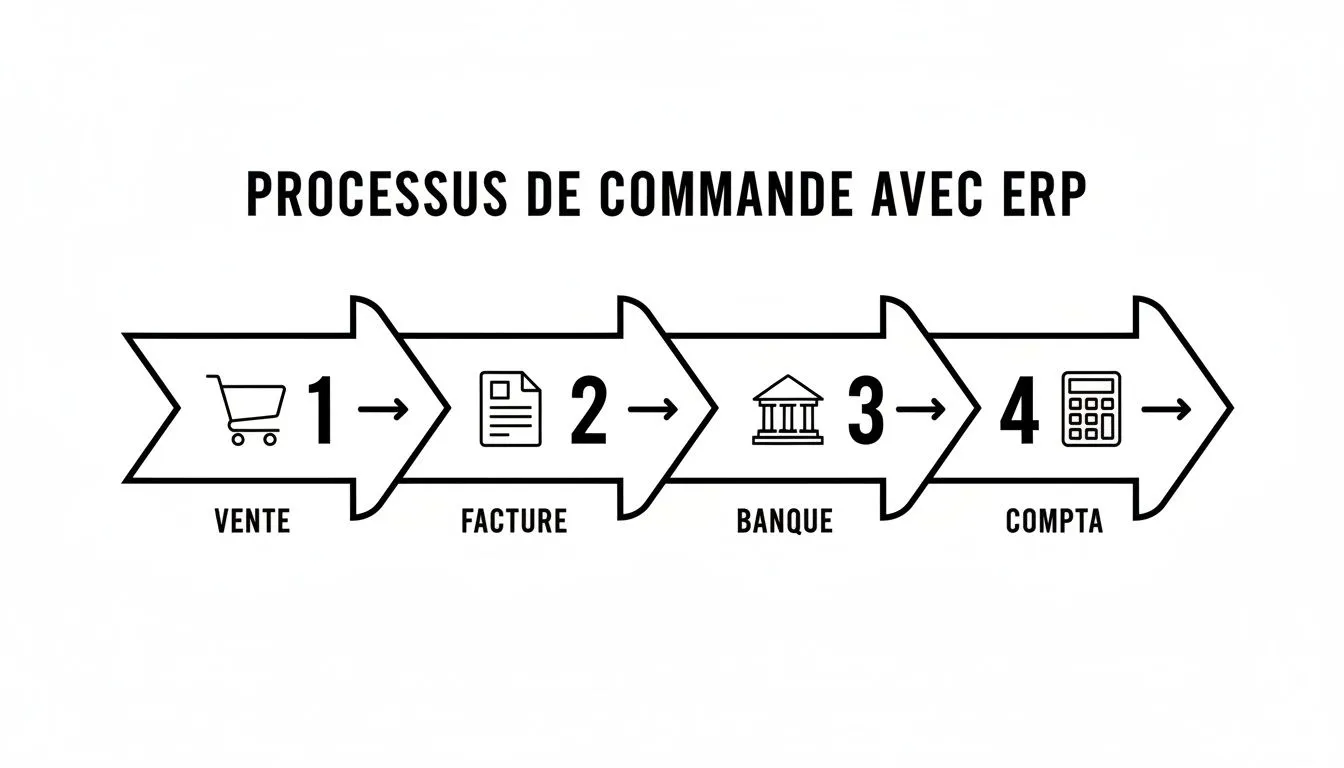
You can clearly see here that each step must smoothly trigger the next to create a genuine automated value chain.
Are the native integrations up to the task?
The starting point, the non-negotiable criterion, is the quality of the integrations. An ERP that doesn’t communicate directly with your sales platforms (Shopify, WooCommerce, Amazon) and your payment solutions (Stripe, PayPal) isn’t an e-commerce ERP. It’s a future cost center.
Be uncompromising: demand “plug-and-play” integrations. Concretely, that means the connection should happen in a few clicks via an API, without the costly involvement of a developer. If a salesperson starts talking about “custom connectors” in the very first meeting, be wary. That’s often a sign of hefty setup fees to come.
Essential e-commerce specialization
Even the most renowned generalist ERP will never grasp the subtleties of your business. Online selling has its own rules of the game, especially on the tax and operational side. Your ERP needs to be a specialist.
Check that it natively handles these crucial points:
- International VAT (OSS/IOSS): Does the software automatically apply the correct VAT rate based on the destination country?
- Platform fees: Can it isolate and properly record Amazon commissions or Stripe transaction fees?
- Returns and refunds: Is the process automated from the customer’s request all the way to the credit note entry?
A good e-commerce ERP should simplify your life, not force you to twist your processes to fit its boxes. It needs to speak the language of e-commerce, not just general accounting.
The depth of accounting automation
The ultimate goal of pairing e-commerce and ERP is to produce reliable accounting, effortlessly. Your choice should therefore hinge on the software’s ability to deliver ready-to-use data for your accountant.
Make sure the solution can generate a fully compliant Fichier des Écritures Comptables (FEC). That’s the holy grail of automation. A file your accountant imports directly into their own software, with no re-entry needed. That’s exactly what a solution like Bizyness is designed for: turning every sale into a clean, structured journal entry.
To go further on selection criteria, this practical guide to choosing an ERP will give you more food for thought.
Ease of use and cost transparency
Finally, never underestimate two aspects: usability and the pricing model. Was the interface designed for an entrepreneur or an engineer? You should be able to find your way around and analyze your figures without needing a three-day training course.
Also pay close attention to the pricing structure. Beyond the monthly subscription, are there hidden fees?
- Setup or installation fees?
- Cost per additional user?
- Billing based on order volume?
A trustworthy partner will always be transparent about the total cost of ownership (TCO). A clear, predictable rate is a sign of trust. Choosing the right ERP is a decision that will shape your growth for years to come, so take the time to evaluate these points with the utmost care.
Mistakes to avoid when connecting your ERP
Launching an ERP integration project is a bit like taking on a major renovation. On paper, the promise is appealing: more efficiency, less stress. But in reality, the path is full of pitfalls that can quickly turn the dream into a technical and financial nightmare.
From experience, we’ve seen projects derail for reasons that could have been avoided. Knowing these pitfalls is already half the solution to making sure your investment pays off. Ignoring these warning signs risks jamming the whole machine instead of oiling it.
So, to spare you some cold sweats, here are the four most common mistakes we see in the field.
Mistake #1: Choosing a generalist ERP not suited to e-commerce
This is the most common mistake. And the most costly. Many e-merchants turn to “does-everything” ERPs, designed for industry or services, thinking “whatever can do more can do less.” Big mistake.
A generalist ERP simply doesn’t understand online selling. It won’t natively handle B2C-specific VAT regimes like the OSS and IOSS one-stop shops. It will ignore the commissions taken by marketplaces and PSP transaction fees.
The result? You end up doing manual Excel exports to fix VAT errors, reprocessing sales to deduct fees, and hoping you don’t get hit with a tax audit. You lose all the benefit of automation. The only viable solution is to choose an ERP that speaks the language of e-commerce.
Mistake #2: Underestimating the importance of connectors
Almost every ERP on the market will promise you integration with Shopify, Stripe, or Amazon. But be careful, the devil is in the details. A poor-quality integration is like a machine translation: it looks like the right language, but the meaning is lost.
If your “automation” still forces you to juggle CSV files or check every day that orders are properly synced, the integration has failed. It’s costing you time instead of saving you time.
An ERP project is only as good as its connectors. They should be a given, a natural extension of your tools that works silently, without you having to think about it.
Our advice: demand real-condition demos, with your own actual data flows. Ask to speak with customers who have the same setup as you (same CMS, same PSP). A good connector handles everything, including returns, credit notes, and hidden fees.
Mistake #3: Migrating “dirty” data
Thinking you can plug a brand-new ERP into a chaotic database is a bit like putting a Formula 1 engine in a car with no wheels. It won’t work. It’s the classic “garbage in, garbage out” principle: if you feed in poor-quality data, you’ll get completely inaccurate financial reports and analyses.
Product sheets with inconsistent SKUs, duplicates in your customer files, an order history riddled with errors… all of this will pollute your new tool and make it useless.
Take the time, even before starting the project, to do a thorough spring cleaning of your data. Standardize your SKUs, merge duplicates, archive what’s no longer relevant. This preparatory work is long and tedious, but it’s the essential foundation for starting off on solid ground.
Finally, one last mistake would be to see the ERP as a magic wand. Once installed, it doesn’t run your business for you. The tool automates repetitive tasks, but it’s still up to you to analyze the dashboards, make the strategic decisions, and make sure your processes stay aligned with your business’s growth.
Frequently asked questions about ERP in e-commerce
Got questions about ERPs for your online store? That’s completely normal. To help you see things more clearly, we’ve gathered here the most frequent questions we hear in the field, with clear, jargon-free answers.
Do you need an ERP from the moment you launch your store?
The short answer? No, it’s not mandatory. At the very start, when you’re handling a handful of orders, a well-organized spreadsheet can be enough.
The real warning sign is when manual management (tracking orders, generating invoices, updating stock) starts eating up several hours of your week. That’s when it’s time to start thinking seriously about it. Waiting too long means risking having to untangle real chaos later.
Starting off on solid foundations is what makes growth much less stressful.
What’s the difference from a simple invoicing tool?
Comparing invoicing software to an ERP is a bit like comparing a kitchen knife to a multifunction food processor. The first does one thing, usually quite well: creating invoices. Useful, but limited.
A specialized e-commerce ERP is the true conductor of your business. It doesn’t just invoice. It connects everything:
- It centralizes sales from all your channels (Shopify, WooCommerce, marketplaces…).
- It automatically calculates and files VAT internationally (via the OSS/IOSS one-stop shops).
- It links your sales to your bank statements for effortless reconciliation.
- It prepares clean, reliable accounting data for your accountant.
In short, invoicing software produces a document. An ERP runs your entire financial and operational flow to make sure your numbers are accurate, from the order all the way to the journal entry.
Is integrating an ERP with Shopify complicated?
Times have changed! The image of integration projects that drag on for months and cost a fortune is now outdated, especially with modern solutions.
Platforms like Bizyness are natively designed for the e-commerce ecosystem. Integration with Shopify or other platforms happens literally in a few clicks via a secure API connection. You can sync months, even years, of data in just a few minutes, not several weeks.
With Bizyness, accounting no longer chases after sales — it becomes their logical, automatic continuation. If you want to transform your financial management to finally focus on your growth, discover a platform built for e-merchants.
