

 Français
6 Expense Report Examples Explained for 2025
Discover our complete guide with 6 detailed expense report examples (mileage, meals...) for perfect, compliant management in France.

Managing expense reports is a cornerstone of accounting for any business, from sole traders to SMEs. When poorly handled, this process can quickly become a source of stress, errors, and tax non-compliance. Between receipts to keep, scales to follow, and different expense categories, it’s easy to get lost and waste precious time.
This article aims to demystify this administrative task. We’ll analyze in detail six of the most common expense report examples, providing you with not only templates but above all a strategic analysis for each case. You’ll discover practical tips and best practices to optimize your reimbursements, ensure your compliance with URSSAF and the tax authorities, and turn this chore into a lever for efficiency.
Each expense report example, from mileage allowance calculations to representation expenses, will be broken down to give you directly applicable tactics. You’ll learn how to avoid common pitfalls, properly justify each expense, and structure your documents for fast, friction-free processing. Get ready to master your expense reports and lighten your administrative load.
1. Transport expense report (mileage expenses)
The mileage expense report is an essential document for any employee using their personal vehicle for business purposes. It allows them to request reimbursement of expenses incurred based on the distance traveled, according to an official scale. This is one of the most common expense report examples, particularly for traveling sales reps, on-site technicians, or executives attending external meetings.
Managing these expenses is crucial for both the company and the employee. For the company, it ensures cost control and compliance with URSSAF rules. For the employee, it guarantees fair and prompt reimbursement of advanced expenses.
Strategic analysis of the mileage expense model
The main objective is to formalize a reimbursement request that is clear, verifiable, and compliant with company policy and legislation. A well-structured mileage expense report must include precise information to avoid any dispute.
Key point: Precision and systematic justification are the pillars of this type of expense report. Every kilometer declared must correspond to a real, documented business trip, including the date, starting point, destination, and purpose of the trip.
The infographic below summarizes the fundamental elements to include for optimal management of your mileage allowances.
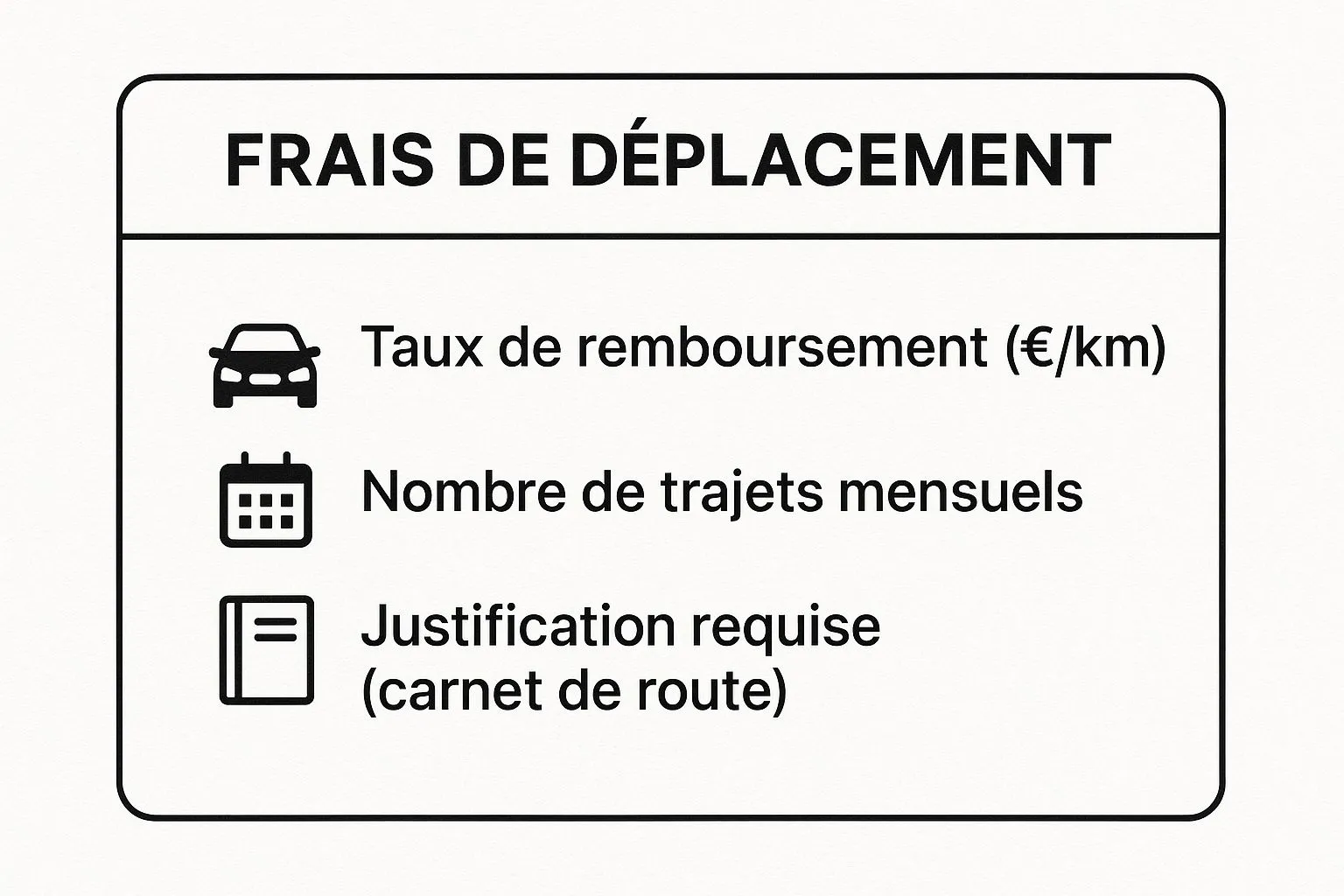
This visualization highlights the need to rigorously track every trip and apply the appropriate reimbursement rate, which is reassessed annually by the tax authorities.
Best practices and actionable tips
To optimize the creation and tracking of your mileage expense reports, here are some effective tactics:
- Use the official tax scale: Always apply the mileage scale published by the tax authorities. It accounts for vehicle depreciation, maintenance costs, fuel, and insurance.
- Document ancillary expenses: Carefully keep all receipts related to travel, such as toll and parking tickets. They must be attached to the expense report.
- Adopt a tracking app: Mobile apps can automatically track trips via GPS, calculating distance and generating ready-to-use reports. This saves considerable time and improves reliability.
- Be specific about the purpose: Clearly state the reason for each trip (e.g., “Client meeting with Dupont”, “Site visit X”).
For managing mileage expenses related to rental vehicles, it’s worth looking into unlimited-mileage car rental, an option that can simplify calculations and control costs over long distances.
To learn more about the specifics for the self-employed, you can explore the mileage expense rules for sole traders.
2. Business meal expense report
The business meal expense report covers meals eaten in a strictly professional context, generally in the presence of clients, prospects, or partners. This expense report example is fundamental for sales teams, executives, or any employee whose role involves external relationships. It allows them to be reimbursed for expenses incurred to develop or maintain the company’s professional network.

Rigorous management of these expenses is essential to justify their professional nature to the tax authorities and URSSAF. For the employee, it ensures compliant reimbursement, while for the company, it guarantees VAT deductibility and expense deductibility, while preventing abuse.
Strategic analysis of the meal expense model
The main objective is to prove that the expense was incurred in the direct interest of the company and not for personal purposes. A valid business meal expense report must therefore contain detailed information that leaves no room for ambiguity.
Key point: Justifying the business interest is the cornerstone of this type of expense report. It’s not enough to provide an invoice; you must explicitly name the guests, their respective companies, and the professional purpose of the meal (e.g., “Contract Y negotiation”, “Product Z presentation”).
The receipt must be an official document (invoice or detailed till receipt) rather than a simple card payment slip. The clarity of the information provided is essential for fast processing and to avoid a tax reassessment in the event of an audit.
Best practices and actionable tips
To ensure compliance and efficient processing of your meal expense reports, adopt the following habits:
- Systematically detail the information: As soon as the meal ends, note directly on the receipt the name of all participants, their role, their company, and the precise purpose of the meeting.
- Respect company caps: Be clear on your company’s internal policy regarding spending limits per person and per meal. URSSAF also sets a tax-exemption cap (€19.40 for 2022 for a meal outside company premises).
- Digitize receipts immediately: Take a photo of the invoice with your smartphone as soon as you receive it. This avoids loss, degradation (fading ink), and makes submission via a management app easier.
- Limit the number of guests: A meal with a reasonable number of participants (generally fewer than 5) is more easily justifiable as a targeted business meal rather than a private event or pure entertainment.
3. Accommodation expense report for business trips
The accommodation expense report is a key document for employees on business travel who need to spend one or more nights away from home. It allows reimbursement of expenses incurred for lodging, such as hotel nights, a furnished apartment rental, or a guesthouse. This is an essential expense report example for long-term missions, training sessions, or participation in events such as conferences or trade shows.

Proper management of these expenses is essential. For the company, it’s about controlling the travel budget while ensuring the comfort and safety of its employees. For the employee, the stakes are being fully and promptly reimbursed for amounts advanced, without administrative complexity.
Strategic analysis of the accommodation expense model
The objective of this type of expense report is to formally and indisputably justify lodging costs during a business trip. To be validated, the request must be transparent, backed by a receipt, and aligned with the company’s travel policy, which may set reimbursement caps.
Key point: The validity of the accommodation expense report relies on providing a paid, detailed invoice. This document must include the employee’s name, the dates of the stay, the breakdown of services (room, breakfast, taxes), and the total amount paid.
Unlike mileage expenses, which follow a scale, accommodation expenses are reimbursed based on actual costs. It is therefore crucial to keep the original receipt to guarantee reimbursement.
Best practices and actionable tips
For smooth and efficient management of your accommodation expense reports, follow these recommendations:
- Plan bookings ahead: Booking your hotel or lodging several weeks in advance often gives you access to better rates and a wider choice.
- Check the internal policy: Find out about any per-night reimbursement caps or partnerships your company has negotiated with certain hotel chains.
- Keep the detailed invoice: A simple card payment slip is not enough. Always request a full, itemized invoice (a “paid invoice”) from the establishment.
- Clarify extras: If breakfast is included, make sure this is clear. Ancillary expenses such as the minibar or on-demand video are rarely reimbursable and should be paid for personally.
4. Professional training expense report
The professional training expense report is a key document that allows employees to be reimbursed for expenses incurred as part of developing their skills. This expense report example generally covers registration fees, the purchase of documentation or teaching materials, as well as ancillary costs such as transport or accommodation if the training takes place off-site.
For the company, investing in training is a strategic lever for maintaining competitiveness and fostering employee engagement. Rigorous management of these expense reports ensures not only precise budget tracking, but also optimization of funding schemes (such as OPCOs) and associated tax benefits. For the employee, it’s the guarantee of being able to upskill without personally bearing the cost of the training.
Strategic analysis of the training expense model
The objective is to structure a reimbursement request that justifies the company’s investment in human capital. The document must be detailed enough to allow the accounting department to validate the expenses and allocate them correctly, while also serving as proof in the event of an audit or a request for external funding.
Key point: Justification must go beyond a simple receipt. It must link the expense to a clear skills-development objective validated upstream by management, demonstrating alignment with the company’s needs.
This type of expense report is essential for situations such as a technical certification for a developer, a management course for a new executive, or language training in preparation for international expansion.
Best practices and actionable tips
To optimize the management of training expense reports and maximize return on investment, here are some effective approaches:
- Validate eligibility upfront: Before incurring any expense, check funding options via the company’s skills-development plan or the employee’s Personal Training Account (CPF).
- Centralize receipts: Gather all relevant documents: training agreement, provider’s invoice, detailed program, and attendance certificates. These documents are essential.
- Negotiate group rates: If several employees have similar needs, contact training providers such as CEGOS or Demos to negotiate preferential rates for in-house sessions.
- Assess post-training impact: Set up a process to evaluate the skills acquired and their practical application in the employee’s work. This justifies the investment and guides future training decisions.
For experts and companies looking to go further, it’s even possible to structure and sell their own expertise. To learn more, you can discover how to create an online course.
5. Telecommunications expense report
With the rise of remote work and professional mobility, the telecommunications expense report has become an essential document. It allows an employee to request reimbursement of costs related to using their personal communication tools (phone, internet subscription) for professional purposes. This is an expense report example whose importance has grown considerably, affecting both full-time remote workers and mobile teams such as sales reps.
Covering these expenses is a significant issue. For the company, it’s about providing the resources needed for business continuity while respecting the legal framework, particularly URSSAF rules on benefits in kind. For the employee, it’s the guarantee of fair compensation for using their personal resources.
Strategic analysis of the telecommunications expense model
The objective is to formalize the reimbursement of part or all of the employee’s personal subscriptions used for work. Unlike a restaurant invoice, these are often recurring costs shared between professional and personal use, which complicates their management.
Key point: Justification relies on the proportion of professional use. The company must define a clear policy, often in the form of a flat allowance, to avoid complex calculations and potential disputes over the usage split.
Setting up a remote-work charter or a clear communication policy is therefore essential. It should specify the reimbursement terms: a fixed monthly amount, reimbursement of a percentage of the bill (for example 50% of the internet subscription for a remote worker), or full reimbursement if the use is exclusively professional.
Best practices and actionable tips
To effectively manage telecommunications expense reports, here are some pragmatic approaches:
- Establish a clear policy: Define and communicate a charter for the use of communication tools. Specify reimbursement caps, eligible plan types (mobile, internet), and required receipts (provider’s invoice).
- Opt for professional plans: Where possible, providing a phone and a professional plan directly greatly simplifies administrative management and eliminates the need for expense reports for this use.
- Set a flat-rate reimbursement: For home internet expenses during remote work, allocating a fixed monthly allowance (e.g., €20) is a simple solution accepted by URSSAF, which spares the employee from having to justify the exact usage split.
- Systematically justify equipment purchases: If the employee buys small equipment (headset, webcam), the expense report must be accompanied by the purchase invoice and prior managerial approval.
6. Representation and hospitality expense report
Representation and hospitality expense reports cover expenses incurred to promote the company’s image and develop its business relationships. They are strategic because they directly concern interactions with clients, partners, or prospects, through events such as cocktail parties, seminars, or business gifts.
This expense report example is particular, as it sits at the crossroads of sales and marketing. Rigorous management is essential to justify the professional nature of the expense to the tax authorities and ensure its deductibility.
Strategic analysis of the representation expense model
The objective is to formalize the reimbursement of expenses aimed at strengthening business relationships and enhancing the company’s brand image. Unlike a simple meal expense report, this one must clearly demonstrate that the event or gift serves the company’s direct interests.
Key point: Justifying the business interest is paramount. Each expense must be explicitly linked to a business objective, such as a product launch, retaining a major client, or prospecting a new market. The identity of the beneficiaries and the context must be documented.
Traceability of these expenses is a major issue. It’s about proving that the expense is neither excessive nor personal, but rather an investment in business development.
Best practices and actionable tips
For your representation expenses to be approved without difficulty and optimized, follow these recommendations:
- Precisely document the objective: Note on the receipt the nature of the event (e.g., “Contract-signing dinner, Martin Co.”), the names of the guests, and their role.
- Respect gift caps: For business gifts, the value must not be excessive. The tax authorities set a threshold (historically around €73 including tax per recipient per year) beyond which VAT is not recoverable.
- Avoid personal-nature expenses: A gift must remain strictly professional. Overly personal or luxury items could be reclassified by URSSAF.
- Plan events strategically: Organize your receptions and seminars according to your sales cycles or annual communication objectives to maximize their impact and ease justification.
Effective management of these expenses requires a clear policy and suitable tools. To go further, you can consult guides on expense report management that detail the specific rules for each expense category.
Comparison of the 6 types of expense reports
| Type of expense report | Implementation complexity 🔄 | Resources required 💡 | Expected results 📊 | Ideal use cases | Key advantages ⭐ |
|---|---|---|---|---|---|
| Transport expense report (mileage expenses) | Medium: mileage log, scale calculation | Mobile app, toll receipts | Simplified reimbursement, partial tax relief | Frequent trips in a personal vehicle | Favorable tax scale, no receipts needed |
| Business meal expense report | High: strict receipts, caps | Detailed invoices, guest list | Client relationship development, partial deductibility | Business meals with clients/prospects | Fosters negotiation, improves company image |
| Accommodation expense report for business trips | Medium: itemized invoices, comfort standard | Bookings, complete receipts | Full reimbursement, flexible lodging choice | Business trips with overnight stays (hotel, rental) | Flexibility, full deductibility |
| Professional training expense report | Medium to high: receipts, planning | Certificates, OPCO funding | Skills valorization, significant tax benefit | Job-specific training, certifications | Improves employability, values human capital |
| Telecommunications expense report | Medium: pro/personal use split, tracking | Detailed statements, usage charter | Facilitates remote work, tax optimization | Mobile plans, internet, professional equipment | Improves responsiveness, organizational flexibility |
| Representation and hospitality expense report | High: strict caps, heavy documentation | Invoices, participant list | Brand image reinforcement, network development | Business events, business gifts | Measurable business impact, professional network |
From theory to practice: simplify your management starting today
We’ve explored several concrete models together, from the mileage expense report to the representation one. Each expense report example has been broken down to extract applicable strategies, equipping you with the knowledge needed to turn a dreaded administrative task into a smooth, well-managed process. Beyond the models themselves, the common thread remains rigor and anticipation.
Expense report management isn’t simply a matter of filling out forms; it’s a strategic exercise that directly impacts your company’s financial health and productivity. A methodical approach not only ensures tax compliance and VAT recovery, but also strengthens trust within your teams by establishing clear, fair rules.
Summary of key strategies
To recap, here are the pillars of optimized management:
- Standardization: Use clear, uniform templates for each expense type. This simplifies submission for employees and speeds up approval for managers.
- Documentation: Every expense must be accompanied by an original, legible receipt. The golden rule is simple: no proof, no reimbursement or deduction.
- Internal policy: Establish a clear expense policy, communicated to everyone. It should define caps, authorized expense types, and submission procedures. It’s your best safeguard against abuse and errors.
- URSSAF compliance: Always keep the tax authorities’ requirements in mind. Every expense must be incurred in the direct interest of the company and be reasonable in nature.
Moving to strategic action: No longer view expense report management as a chore, but as an opportunity. It’s a chance to optimize your financial flows, reduce non-compliance risks, and free up precious time for you and your teams.
Automation: your growth lever
For freelancers, sole traders, and SMEs, time is the most precious resource. Every minute spent looking for a receipt or calculating mileage allowances is a minute not spent growing your business. This is where technology becomes your best ally.
Automation is no longer a luxury reserved for large companies. Modern solutions make it possible to digitize receipts with a single click, automate calculations, track reimbursements in real time, and integrate all this data directly into your accounting. Adopting such a tool means choosing peace of mind and efficiency. You secure your processes, eliminate the risk of human error, and gain full visibility over your business expenses.
By mastering each expense report example and applying these principles, you lay the foundations for sound, scalable administrative management. Don’t wait for the paperwork to pile up. Decide today to simplify, automate, and focus on what really matters: the success of your business.
Ready to say goodbye to spreadsheets and paper receipts? Discover how Bizyness turns expense report management into a simple, automated process. Centralize your expenses, digitize your receipts in one click, and integrate everything into your accounting effortlessly on Bizyness.
