

 Français
 Simplify your expense report management
Optimize your expense report management. Discover concrete strategies to simplify the submission, validation and reimbursement of your expenses.

Good expense report management is much more than a simple checkbox on your administrative to-do list. It’s above all a process that needs to be efficient, compliant and fast. The idea is to turn what is often a chore into a smooth workflow that benefits both the company and its teams.
Why it’s crucial to rethink your expense report management
Let’s be honest, expense reports are rarely a pleasure. Receipts pile up, approvals drag on, and reimbursements take forever. Yet behind this administrative task lie very real stakes, both financial and human.
Failing to optimize this process is a bit like leaving a door open to hidden costs. Manual management, for example, isn’t just slow — it’s also incredibly expensive. Fully processing a single expense report can take 20 to 30 days. A delay that weighs not only on your cash flow, but also on your team’s morale.

The financial impact of an outdated process
Every manual step — from data entry to manager approval, then accounting review — adds time, and therefore money. The average cost of processing a single expense report is around 53 euros. This figure covers everything, from initial submission to the final transfer. To learn more about this calculation, you can check out this excellent guide on expense report management.
Multiply that by the number of expense reports you handle each month, and you’ll quickly understand the impact on your budget.
Inefficient management isn’t just a waste of time. It’s a silent financial hemorrhage that eats away at your profitability, month after month.
Beyond the numbers: the human and strategic stakes
But the consequences don’t stop there. A heavy, endless reimbursement process is a major source of frustration for employees who have advanced their own money. Over time, this can seriously undermine their engagement and their perception of the company.
Putting a structured approach in place and equipping yourself with the right tools changes everything. It allows you to:
- Drastically reduce errors in data entry and missing receipts.
- Ensure regulatory compliance, whether with URSSAF or for VAT recovery.
- Free up valuable time for your administrative teams and managers, who can finally focus on higher-value tasks.
Ultimately, optimizing expense report management is a direct investment in your operational efficiency and your employees’ well-being.
Setting up a clear and fair expense policy
Before jumping on the latest trendy tool, the foundation of sound expense report management is setting clear ground rules for everyone. Think of your expense policy as your best defense against frustration, misunderstandings, and endless back-and-forth between your teams and accounting.
The idea is simple: every employee should know exactly what’s expected of them when they incur an expense on behalf of the company. No more vague documents and “verbal” rules that only sow confusion. A well-designed framework guarantees that the company is protected while remaining fair to its employees.
Spelling out reimbursable expenses in black and white
The first thing to do is to concretely list the expense categories the company covers. It may sound obvious, but spelling out these details is exactly what removes any ambiguity.
Your policy should at minimum cover the most common situations:
- Meals: What exactly are we talking about? A meal alone while traveling, a team lunch, dinner with a client? Be precise.
- Accommodation: This includes hotel nights, but also other forms of lodging during business trips.
- Travel: Think of everything: train or plane tickets, tolls, parking, and of course, the famous mileage allowances.
- Supplies and small equipment: Under what conditions can an employee purchase office supplies or small equipment needed for their assignment?
For each category, don’t forget to set caps. They should be reasonable, of course. For example, a cap of €25 for a solo lunch or €90 for a hotel night in a provincial city are fairly common figures. What matters is that these limits are realistic and appropriate to the context, so as not to put your employees in an uncomfortable position.
A good expense policy isn’t there to police people, but to guide them. It should strike the perfect balance between cost control for the company and the flexibility employees need in the field.
To help you structure your document, here’s a summary of the essential elements.
Summary table: Key elements of an effective business expense policy
This table summarizes the essential components to include in your expense report management policy to ensure clarity and compliance.
| Component | Objective | Practical example |
|---|---|---|
| Authorized expense categories | Avoid misinterpretation and out-of-scope requests. | List precisely: meals, transport, accommodation, supplies… |
| Reimbursement caps | Control the budget and ensure fairness among employees. | Cap of €80/night for hotels, €20 for a solo meal. |
| Required receipts | Ensure legal compliance and enable VAT recovery. | Require an itemized invoice with the payer’s name, not a simple card receipt. |
| Submission process | Make the process smooth and predictable for everyone. | Submission via the internal tool before the 5th of each month. |
| Approval workflow | Clarify responsibilities and speed up processing. | Approval by the direct manager, then automatic transfer to accounting. |
| Reimbursement timeline | Reassure employees about when they’ll be reimbursed. | Reimbursement processed with month M+1’s payroll. |
By formalizing these points, you create a framework of trust that makes life easier for everyone.
Defining submission and approval steps
Once the rules are set, the path to getting reimbursed should be a highway, not an obstacle course. Put in place a clear workflow for submitting, approving and paying expense reports.
A few points are essential to clarify:
- Required receipts: Is a full invoice needed, or is a simple receipt enough? Remember to point out that a card payment slip alone is worthless in the eyes of the tax authorities, since it doesn’t show VAT.
- Submission timing: Give a clear deadline. For example, ask your teams to submit their expenses before the 5th of the following month to ensure timely processing.
- Approval workflow: Who gives the green light? The direct manager? HR? This path should be known to everyone to avoid requests getting lost along the way.
By communicating on these points, you give your employees the keys to being autonomous and make life much easier for the people in charge of approval and accounting. Expense report management then becomes a simple formality, rather than a source of tension.
The journey of an expense report, from receipt to bank transfer
To fully grasp what’s at stake in good expense report management, there’s nothing like following the life cycle of an expense, from the moment it’s incurred to the final transfer. This process, often imagined as tedious, can actually become remarkably smooth with a clear method and the right tools.
It all starts with a situation we all know: an employee incurs an expense for work purposes. A lunch with a client, a train ticket, a hotel night… Each transaction produces a receipt, which is the true cornerstone of the whole system.
The receipt, captured on the spot by the employee
We can finally say goodbye to the days of handwritten expense reports and receipts hastily stapled together! Today, everything starts with a simple photo. The habit to build is using your smartphone to scan the receipt immediately after the expense. It’s the best way to lose nothing and forget nothing.
This first step is absolutely crucial. A modern digital solution will analyze the image and automatically extract the essential information using optical character recognition (OCR) technology:
- The supplier’s name;
- The date of the expense;
- The total amount including tax;
- The amount of deductible VAT.
The employee just has to glance at it to check that everything is correct, add a note if needed (such as the names of guests for a business meal), and submit the expense. It’s simple, immediate, and it eliminates almost all risk of data entry errors. For a more concrete idea, feel free to check out this expense report example that shows how to structure this type of document well.
Manager approval: an essential first filter
Once the expense is submitted, it’s sent directly to the manager for approval. No more stacks of paper piling up on a desk corner waiting for a signature. The manager receives a notification and can approve (or reject) the expense within seconds, whether from their computer or their phone.
Their role is simple: make sure the expense complies with company policy. In the blink of an eye, they check:
- The nature of the expense (is it actually authorized?);
- Compliance with the defined caps;
- The presence of a solid receipt.
This near-instant approval avoids bottlenecking the process and adds an essential first layer of control. If everything checks out, the expense report continues on its way to the accounting department.
The idea behind manager approval isn’t to police teams. It’s above all a way to ensure upstream compliance to avoid painful back-and-forth with accounting later.
The infographic below perfectly summarizes the three pillars of a sound expense policy: clear rules, known caps, and compliant receipts.
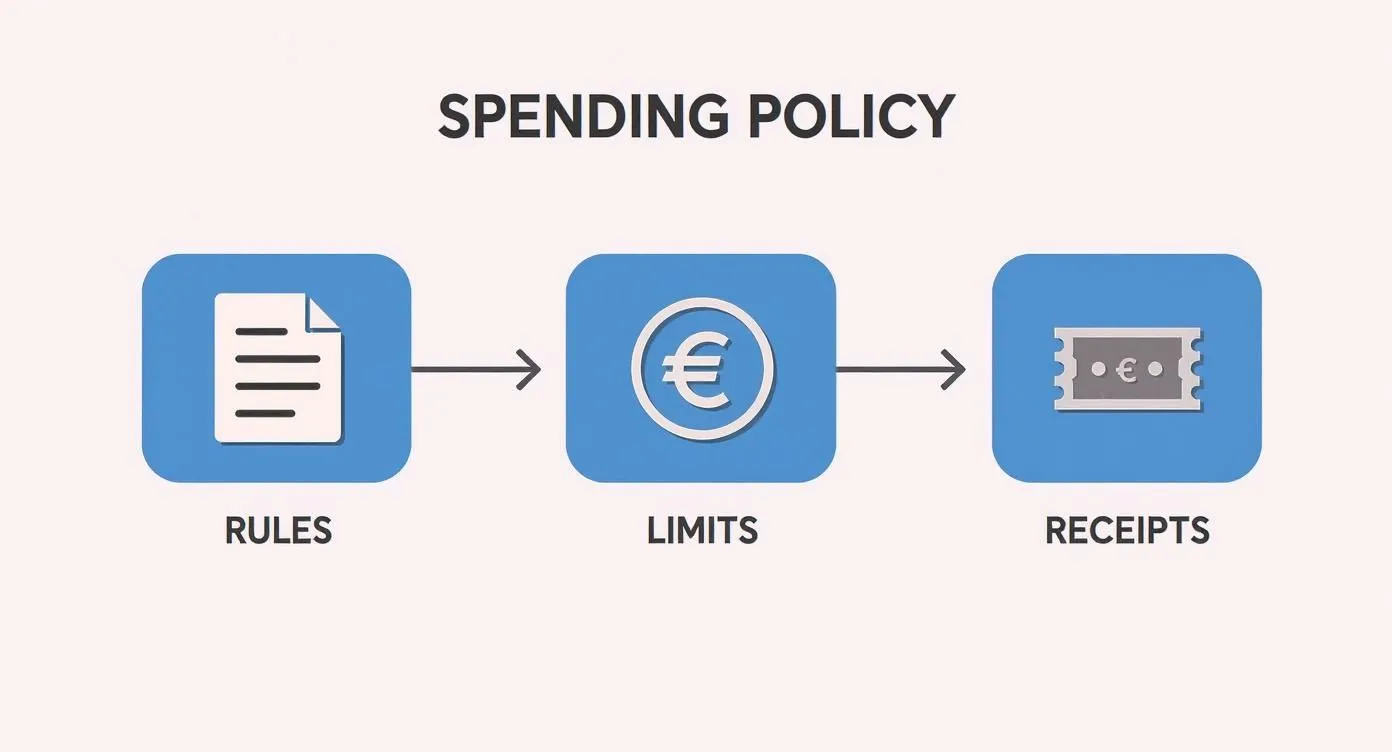
You can clearly see here that every link in the chain is connected to ensure a reimbursement that’s both fast and fully compliant.
Accounting review before reimbursement
This is the last human intervention in the workflow. The accounting team takes over for a final, more technical check. The accountant makes sure the expense is correctly categorized, verifies that VAT has been correctly calculated and that it’s indeed recoverable.
This is also when compliance with URSSAF rules is checked, to rule out any risk of the expense being reclassified as a benefit in kind. A good tool will have already done most of the work by preparing the accounting entries, ready to be imported into the company’s accounting software.
Once this final check is validated, reimbursement is triggered. The transfer goes out to the employee, often via a batch payment order that groups together all the expense reports validated over a given period.
Legally-binding archiving to close the loop
The employee has been reimbursed, but the work isn’t quite finished. One crucial step remains: preserving the digital receipt. This is what’s known as legally-binding archiving (archivage à valeur probante), a legal requirement that ensures the digital document remains authentic and unaltered over the long term (generally 10 years).
Thanks to this system, the company can finally get rid of paper originals. No more shoeboxes and archive cabinets gathering dust! In the event of a tax or URSSAF audit, all receipts are accessible in a few clicks — irrefutable proof of how rigorous your management is.
Rely on automation to make management reliable and eliminate errors
Let’s be honest: manual data entry is the number one source of errors and wasted time in expense report management. It’s a real headache. Fortunately, this is where automation comes in and completely changes the game by putting technology to work for you.
Rather than spending hours deciphering crumpled receipts, imagine a system that reads and extracts the information for you. That’s the whole principle behind OCR technology (Optical Character Recognition).
With a tool like Bizyness, the process becomes child’s play. The employee takes a simple photo of their receipt. The OCR analyzes the image, identifies the merchant, the date, the pre-tax amount, the VAT, and then pre-fills the expense report. The risk of human error is virtually eliminated from the start.
Speeding up approvals with smart workflows
Another well-known friction point is the approval workflow. We’ve all seen expense reports sit on the desk of an overwhelmed or absent manager, delaying reimbursements by several weeks.
Automation makes it possible to set up smart approval workflows. You define the rules once and for all: for example, an expense under €50 is approved by the direct manager, while one over €500 requires double approval from both the direct manager and the department head. The system then takes care of sending requests to the right people at the right time, without you having to think about it.
By removing manual bottlenecks, you ensure smooth and much more predictable processing. Your employees know their request is being handled, and managers can approve expenses with a single click, even from their phone.
This smoothness naturally continues through to the accounting step. It’s the integration with your accounting software that will let you finally put an end to double data entry.
The interface below shows how a modern solution centralizes all the information for effortless tracking.
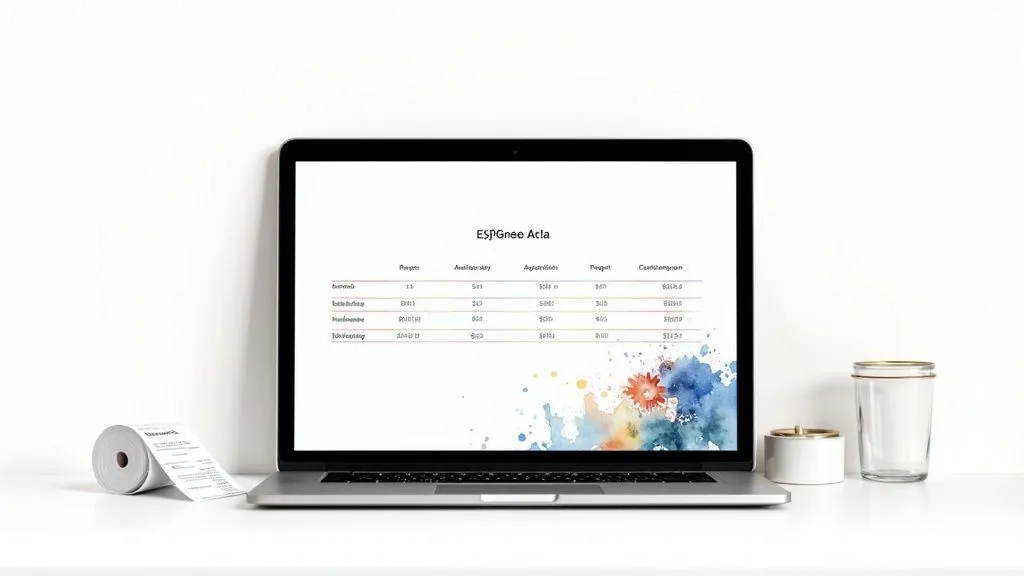
You can clearly see that the data, once extracted, is ready to be exported. This radically simplifies the work of the finance team.
Accounting integration: the key to a 100% digital chain
Once the expense report is approved, a powerful tool will automatically generate the corresponding accounting entries. Gone are the days of juggling between paper receipts and accounting software.
The benefits are clear:
- Reliable data: Information stays consistent from start to finish, with no risk of transcription error.
- Massive time savings: The accounting team can finally focus on analysis and control rather than pure data entry.
- Faster closings: Since entries are recorded in real time, monthly closings become much simpler to manage.
The example of ISS France, which processes more than 1,000 expense reports per month, speaks for itself. By going digital, the company saw its compliance rate jump to over 80%. To learn more about their experience, I invite you to read their case study on optimizing business travel expenses.
This level of performance frees your teams from repetitive tasks and lets them focus on much higher-value work. If you’d like to dig deeper into the topic, our dedicated article gives you concrete ideas for automating your administrative tasks.
Ensuring tax compliance and recovering VAT
Good expense report management isn’t just about reimbursing your employees. It’s above all your best defense in the event of a tax or URSSAF audit. This is where rigor pays off, letting you not only cover yourself, but also optimize VAT recovery.
For a receipt to be accepted by the authorities, it must include specific details. A simple card payment slip? Forget it — it’s worthless in the eyes of the tax office. What you need is a genuine, itemized invoice that clearly states:
- The supplier’s name
- The date of the expense
- A clear description of what was purchased
- The pre-tax amount
- The VAT rate and amount
Without this information, VAT deduction is impossible. And every euro of unrecovered VAT is a net loss for your company.
The subtleties of VAT recovery
Be careful, VAT isn’t recoverable on all business expenses, and the rules can sometimes get complicated.
Take hotel expenses, for example. As a general rule, VAT on accommodation for an employee isn’t deductible. However, if the hotel invoice itemizes the breakfast line separately, the VAT on that meal can be recovered. A small detail that makes all the difference.
The same goes for fuel expenses. Deductibility varies depending on the type of vehicle (passenger or commercial) and the fuel used. Meticulous tracking is therefore crucial so you don’t miss any opportunities. To dig deeper into the topic, our guide on calculating VAT is an excellent resource.
And if you really want to know everything about how VAT works, this comprehensive guide on VAT for training organizations is very enlightening, even if that’s not your sector.
Compliance isn’t optional, it’s a requirement. Every euro of VAT not recovered because of a non-compliant receipt is a direct cost to the company. Good management turns this constraint into a financial advantage.
What to do if a receipt is lost?
Losing a receipt is the classic scenario. But it’s not the end of the world. If an employee misplaces a receipt, the first move is to contact the supplier to get a duplicate.
If that’s not possible, a detailed sworn statement, accompanied by the bank statement proving the expense, can be tolerated in exceptional cases. But be careful, this practice should really remain the exception that proves the rule.
The solution to put an end to this problem? Legally-binding digital archiving. By scanning each receipt instantly with an app, the document is secured in a digital vault. This copy has exactly the same legal value as the paper original. No more need to store piles of receipts for years.
The questions everyone asks about expense reports
Even with a well-oiled process, certain questions keep coming up. Let’s clarify together a few points that often cause doubt. Good expense report management also means knowing how to navigate everyday edge cases.
What is the legal deadline for reimbursing an expense report?
Contrary to what many people think, the law doesn’t set any specific deadline. The Labor Code simply refers to a “reasonable time.” In practice, it’s the rules defined in your internal expense policy, or sometimes your collective bargaining agreement, that apply.
A widely adopted good practice is to aim for reimbursement within 30 days. It’s a fair compromise that avoids straining your employees’ personal cash flow, while still giving you time to carry out your checks without rushing.
Is a card payment slip enough as a receipt?
The answer is a firm and definitive no. A simple card payment slip proves that a payment took place, that’s all. It gives no information about what was purchased, nor the amount of VAT. For the tax authorities, this little piece of paper has no value whatsoever.
To be compliant, you absolutely need an invoice or a detailed receipt. This document must show:
- The supplier’s name
- The date and nature of the expense
- The pre-tax amount and the amount including tax
This is the golden rule to never forget. Without this information, VAT recovery is impossible, and you’re putting yourself at risk in the event of a URSSAF audit.
Can a company refuse to reimburse an expense report?
Of course. A company is fully entitled to refuse reimbursement if the expense doesn’t comply with the established rules.
The most common reasons for refusal are pretty logical:
- Cap exceeded: The employee spent more than the authorized limit.
- Unauthorized expense: The purchase doesn’t fall into a reimbursable category (for example, personal expenses).
- Missing or invalid receipt: The document is illegible, incomplete, or simply lost.
- Late submission: The expense report is sent well after the internally set deadline.
All of this shows just how crucial it is to have an expense policy that is clear and known to everyone. Transparency really is your best weapon against tension and misunderstanding. It’s worth noting that this practice is common: an IFOP study showed that around 80% of French executives regularly submit expense reports, mainly for restaurants (87%) and transport (81%). If you’re interested in the topic, you can check out the details of this survey on executives and their expense reports.
What if you stopped drowning in expense reports and focused on your core business instead? With Bizyness, data entry, approval and accounting integration become child’s play. Save valuable time and ensure compliance effortlessly. Discover how Bizyness can truly change your day-to-day life as a business owner.
