

 Français
7 Tips to Find Freelance Clients in 2025
Discover how to find freelance clients quickly with our effective tips. Boost your business in 2025 starting today!

Beyond Talent: The Art of Prospecting for Freelancers
Having sharp expertise is one thing; monetizing it sustainably is another. For many freelancers, the biggest challenge isn’t the quality of their work, but breaking the dreaded “feast or famine” cycle. Active prospecting and seeking out assignments can seem intimidating, even exhausting. Yet finding freelance clients isn’t a matter of luck — it’s a strategic skill that can be learned and refined. It’s the cornerstone of a calm and profitable independent business.
This guide was designed to give you a clear, pragmatic roadmap. No more vague advice or abstract theories. We’ll explore in detail seven concrete, complementary acquisition channels, suited to different personalities and industries. Whether you’re a fan of direct outreach or prefer letting clients come to you, you’ll find strategies that fit.
Each section of this article is designed as an action plan. You’ll discover proven methods, precise examples, and steps to follow to set up an effective, lasting prospecting system. The goal is simple: to give you the tools not just to survive, but to thrive as a freelancer, by building a steady flow of qualified projects.
1. Professional networking and word of mouth
Professional networking, combined with word of mouth, is arguably the oldest and most durable method for finding freelance clients. This approach involves actively cultivating and nurturing your existing professional relationships: former colleagues, satisfied clients, partners, or contacts in your industry. Unlike cold outreach, it relies on an essential asset: trust. A prospect referred by a mutual acquaintance is already pre-qualified and far more inclined to listen to you.
This strategy isn’t passive; it requires a proactive, consistent effort to pay off. For example, a web developer can generate up to 70% of their contracts through referrals from former colleagues, while a consultant can build a thriving business based solely on their network.
How do you effectively activate your network?
Turning your contacts into a source of qualified leads requires a structured approach.
- Stay in touch regularly: Don’t reach out to your network only when you need something. Check in, share a relevant article, or comment on their achievements on LinkedIn.
- Explicitly ask for referrals: At the end of every successful project, simply ask your client if they know anyone else who could benefit from your services. Most will be happy to help.
- Offer value before asking: Share your expertise, connect two of your contacts, or offer a quick tip. This generosity strengthens ties and encourages reciprocity.
- Attend events: Local meetups, industry conferences, or webinars are ideal opportunities to meet new people and strengthen existing relationships.
To visualize the impact of this method, here’s a summary of the key performance indicators.
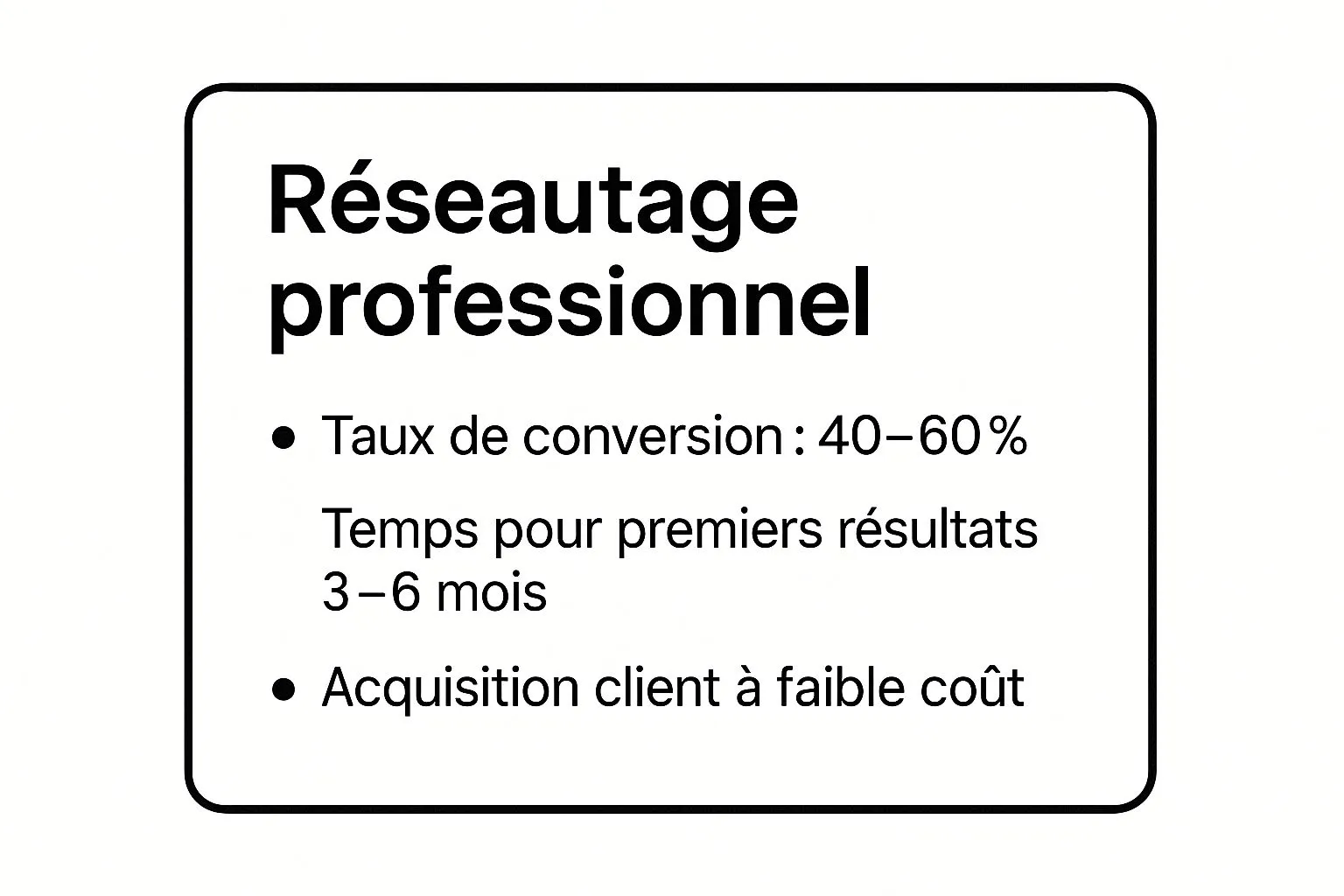
As the infographic shows, while initial results may take a few months to materialize, the high conversion rate and low acquisition cost make this a top-choice strategy for finding freelance clients over the long term.
2. Specialized freelance platforms
Freelance platforms are essential marketplaces for independents looking to connect with clients around the world. They act as intermediaries, offering a structured framework to showcase your services, apply for projects, and secure payments. For many, this is the primary acquisition channel to find freelance clients quickly, especially early in their business, since they provide direct access to a steady stream of potential assignments.

The earning potential on these platforms is very real and depends on your industry and reputation. On international platforms like Upwork, top-performing freelancers can reach earnings of €3,000 to €5,000 per month. On Fiverr, certified “Pro” sellers sometimes generate more than €50,000 a year. In France, an IT consultant on Malt can bill an average daily rate of between €400 and €800, while a designer on 99designs can win logo or website contests worth €500 to €2,000.
How do you perform well on freelance platforms?
Competition is fierce, but a strategic approach lets you stand out and turn these platforms into a reliable source of income.
- Optimize your profile with keywords: Think like a client. Use the terms they’d search for to find you. A well-optimized profile is your best advertisement and ranks higher more easily in the platform’s search results.
- Start with competitive pricing: To land your first assignments, offering a slightly lower rate can be a good strategy. The goal is to quickly earn positive reviews, which are key to building trust and your future credibility.
- Specialize in a specific niche: Rather than being a generalist “web developer,” become “the Shopify expert for D2C brands.” A clear niche attracts more qualified clients and justifies higher rates.
- Respond quickly to requests: Most platforms favor responsive freelancers. Aim to reply within an hour to show your seriousness and increase your chances of winning the project.
- Build a professional portfolio: Your portfolio is tangible proof of your skills. Present detailed case studies, show concrete results, and vary your examples to demonstrate the breadth of your expertise.
While these platforms take a commission on your earnings, in return they offer visibility and payment security that make them an excellent lever for growing your business.
3. Content marketing and blogging
Content marketing is a powerful strategy for finding freelance clients by flipping the traditional dynamic. Instead of chasing prospects, you attract them by creating and sharing valuable content that demonstrates your expertise. Whether it’s blog posts, videos, podcasts, or case studies, the goal is to educate your target audience, answer their questions, and position yourself as the natural solution to their problems.
This approach is about building a capital of trust even before the first sales contact. A developer who publishes technical tutorials on their blog attracts companies that specifically need that skill. Likewise, a marketing consultant who analyzes the latest trends in in-depth articles becomes known as a go-to expert — much like figures such as Neil Patel or Ann Handley, who built empires through their content.
How do you set up an effective content strategy?
For your content to turn into a steady flow of leads, it needs to be strategic, relevant, and well distributed.
- Solve real problems: Your content should provide direct solutions to the challenges your ideal client faces. Before writing, ask yourself: “What urgent question of my prospect am I solving here?”
- Optimize for search (SEO): Use keyword research tools to identify the terms your target audience uses. Weave them naturally into your titles and text to be visible on search engines.
- Include calls to action (CTAs): Every piece of content should guide the reader to the next step. Offer a downloadable guide, a newsletter signup, or a discovery call to discuss a project.
- Be consistent and patient: Content marketing is a marathon, not a sprint. Publish consistently (at least one quality piece of content a month to start) to build your credibility and audience.
- Promote your work: Don’t just publish. Actively share every piece of content on your professional social networks, in your newsletter, and on relevant forums to maximize its reach.
This foundational strategy can also strengthen your profile on platforms like Upwork, where a portfolio of relevant content can make all the difference in convincing a potential client. By investing in content, you create a lasting asset that works for you around the clock, continuously attracting qualified leads.
4. Direct outreach (cold outreach)
Direct outreach, or “cold outreach,” is a proactive approach to finding freelance clients by contacting prospects who don’t yet know you. Unlike passive methods, it gives you full control over your pipeline by letting you precisely target the companies that match your ideal client. This technique, when executed well, is a powerful growth lever that involves presenting your services via email, LinkedIn, phone, or even mail.
The potential of this method is immense and adapts to many industries. For example, B2B consultants build businesses worth more than €100,000 a year by using LinkedIn Sales Navigator to identify and contact key decision-makers. Similarly, web agencies secure a steady flow of projects with well-targeted cold email campaigns, achieving conversion rates of 3%. We also see copywriters successfully approach e-commerce brands on Instagram, or developers contact startups via platforms like AngelList for specific technical assignments.

How do you succeed at direct outreach?
To keep your messages from ending up in the trash, a personalized, value-focused approach is essential.
- Research and personalize thoroughly: Forget generic messages. Reference a company’s recent project, a LinkedIn post, or a challenge specific to their industry to show you’ve done your homework.
- Offer value before asking: Offer a free mini-audit, a concrete improvement idea, or share a relevant resource. Demonstrating your expertise upfront — for example via an article from your Blog — builds trust and opens the conversation.
- Use social proof: Include case studies, client testimonials, or compelling statistics in your messages to reassure prospects and prove the value of your services.
- Test and iterate: Vary your outreach channels (email, LinkedIn), your email subject lines, and your message content. Analyze what works best for your target audience and continually refine your approach.
- Comply with regulations: Make sure you comply with GDPR by targeting professional (B2B) contacts and giving them a simple way to opt out of your communications.
To learn more about building an effective prospecting strategy, discover how to find clients with proven methods.
While direct outreach requires persistence and can generate plenty of rejections, it remains one of the most direct and effective paths to finding freelance clients in a predictable way. It’s a skill that, once mastered, ensures you’ll never run short of work.
5. Professional social media
Professional social networks, such as LinkedIn, Twitter, or even Instagram in some creative industries, have become essential channels for finding freelance clients. This approach goes far beyond simply creating a profile; it involves building a strong personal brand, actively sharing your expertise, and engaging with a targeted community. By publicly demonstrating your know-how, you naturally attract prospects who are already convinced of your value.
This method turns your online presence into a genuine business asset. For example, a digital marketing consultant can use LinkedIn to publish trend analyses, generating qualified leads every week. Similarly, a graphic designer can turn their Instagram or Behance account into a dynamic portfolio, attracting contracts from international brands drawn to their unique style, without ever sending a single prospecting email.
How do you strategically use social media?
To turn your profile into a genuine client magnet, a disciplined and consistent approach is essential.
- Choose 1 or 2 key platforms: Focus your efforts where your ideal clients are. A developer will find more success on Twitter and GitHub, while a life coach will excel on Instagram and LinkedIn. To go further, discover which social network is right for you and your goals.
- Publish high-value content: Regularly share practical tips, case studies, tutorials, or insights that help your audience. The goal is to educate and inform, not just to sell.
- Engage authentically: Don’t just publish. Comment on other experts’ posts, answer questions in groups, and take part in relevant conversations in your industry.
- Show your behind-the-scenes: Sharing your work process, the challenges you face, or the tools you use humanizes your brand and builds trust. Clients like seeing the person behind the service.
By investing time in building your online reputation, you create a steady flow of inbound leads. This strategy not only helps you find freelance clients, but also positions you as an authority in your field, giving you a decisive edge over the competition.
6. Partnerships and affiliations
Partnering with other professionals is a powerful, often underrated strategy for finding freelance clients on a regular basis. Rather than searching for clients one by one, this approach involves building an ecosystem of partners who bring you qualified opportunities. This can include other freelancers with complementary skills, agencies, consultants, or companies whose clients might need your services.
This method turns competition into collaboration. For example, a web developer can partner with a graphic designer and an SEO copywriter to offer a complete website creation package. Similarly, a digital agency can recommend a specialized freelancer for a specific assignment in exchange for a commission, typically between 10% and 20% of the project amount.
How do you build winning partnerships?
For this strategy to pay off, it needs to be structured and based on mutual trust.
- Identify complementary partners: Look for professionals who target the same clientele as you, but with a non-competing offer. To attract quality partners, your own profile needs to inspire trust and professionalism. To help with that, tools like a LinkedIn Bio Generator can be useful for crafting a compelling bio that highlights your expertise.
- Set clear agreements: Leave no room for ambiguity. Formalize the relationship with a simple partnership agreement that defines responsibilities, commission rate, payment terms, and confidentiality. Good administrative management as a freelancer is key to formalizing these agreements and ensuring rigorous follow-up.
- Guarantee flawless quality: Your reputation and your partner’s are on the line. Every referred client should receive exceptional service to build trust and encourage future collaborations.
- Set up a tracking system: Use a simple tool, such as a shared spreadsheet or a CRM, to track leads sent, converted projects, and commissions owed. Transparency is essential to maintaining a healthy, lasting relationship.
7. Events and conferences
Attending professional events is a powerful way to step outside the digital sphere and find freelance clients through direct, personal interactions. Whether as an attendee, speaker, or even organizer, conferences, workshops, and meetups let you demonstrate your expertise in real time, build trusting relationships, and understand your prospects’ needs firsthand. This approach turns prospecting into a human conversation, creating a memorable impression.
The impact of this strategy can be significant and immediate. For example, a consultant specializing in SaaS software can generate qualified leads worth more than €100,000 by speaking at a single technical conference. Similarly, a developer can land a long-term assignment by standing out at a hackathon, or a trainer can build their audience by leading workshops at business schools or universities.
How do you turn events into assignment opportunities?
For your attendance to be a profitable investment rather than a simple expense, a strategic, well-prepared approach is essential.
- Target the right events: Don’t spread yourself too thin. Look for conferences and meetups where your target clientele shows up in force. Analyze past years’ attendee lists and speaker profiles to validate your choice.
- Prepare a 30-second pitch: You’ll only have a short window to capture attention. Prepare a concise presentation that clearly explains who you are, the problem you solve, and the value you bring.
- Offer to speak: Moving from simple attendee to speaker immediately positions you as an expert. Offer to lead a workshop or mini-conference, even for free at first, to maximize your visibility and credibility.
- Follow up quickly and personally: A collected business card is not a client. Within 24 to 48 hours of the event, reach out to every relevant prospect via LinkedIn or email, referencing the context of your conversation to re-engage the connection.
While this method requires an upfront investment of time and sometimes money, the quality of the contacts generated and the strength of the relationships built make it an extremely effective strategy for finding freelance clients ready to commit.
Comparison of the 7 Methods to Find Freelance Clients
| Method | Implementation complexity 🔄 | Resources needed ⚡ | Expected results 📊 | Ideal use case 💡 | Key benefits ⭐ |
|---|---|---|---|---|---|
| Professional networking and word of mouth | Medium (significant time investment) | Low (mainly time) | High conversion rate (40-60%), results in 3-6 months | Building lasting relationships, high-value B2B | Low cost, qualified clients, loyalty |
| Specialized freelance platforms | Medium to high (profile, platform management) | Medium (time + 5-20% commissions) | Fast results, immediate access to many projects | Beginner to experienced freelancers, seeking volume | Payment protection, global exposure |
| Content marketing and blogging | High (regular content creation) | Medium to low (writing skills) | Slow results (6-12 months), lasting organic traffic | Building expertise, attracting qualified leads long-term | Low cost, stronger authority |
| Direct outreach (cold outreach) | High (personalization, rigorous follow-up) | Medium (automation tools) | Potentially fast results, low reply rate (1-5%) | Very precise targeting, proactive prospecting | Full control, scalable via tools |
| Professional social media | Medium to high (content creation and management) | Medium to high (daily time) | Variable results, gradual visibility and engagement | Building personal branding, broad interaction | Massive visibility, potential virality |
| Partnerships and affiliations | Medium to high (negotiation, relationship management) | Medium (time + commission management) | High conversion, access to new markets | Collaboration between freelancers/companies | Pre-qualified clients, bigger opportunities |
| Events and conferences | High (organization, preparation) | High (financial costs and time) | Strong impact but medium-term results | Direct networking, live expertise demonstration | Access to decision-makers, strong credibility |
Your Action Plan for a Continuous Flow of Clients
We’ve explored together a complete arsenal of seven powerful strategies, ranging from human networking to the sharpest digital tactics. Your goal is no longer just to land a one-off assignment, but to build a reliable, lasting system for attracting a steady flow of qualified leads. The question is no longer “how do I find freelance clients?” but “what’s the best combination of methods for me?”
Summary of Strategies: From Theory to Practice
Each method presented follows different logic. To build your plan, it’s essential to understand their respective strengths.
- The relationship-based approach: Networking, partnerships, and in-person events capitalize on trust and human connection. They’re perfect for high-value services where the freelancer’s personality is a key decision factor.
- The proactive digital approach: Direct outreach (cold outreach) and the strategic use of social media like LinkedIn put you in the hunter’s seat. You don’t wait for the client to come to you — you go find them. It’s a direct, measurable, and remarkably effective method when well executed.
- The attraction (inbound) approach: Content marketing and the use of specialized platforms work like magnets. By demonstrating your expertise or positioning yourself on active marketplaces, you naturally attract clients who are actively searching for your skills.
Create Your Own Personalized “Marketing Mix”
The most common mistake is spreading yourself too thin. Trying to apply all seven methods at once is the surest way to master none of them. The key to success lies in selection and focus. To build your own action plan, follow these three steps:
- Choose 2 or 3 priority channels. Be honest with yourself. If you’re introverted, content marketing and platforms might be more comfortable than networking events. If your target is very specific (e.g., CFOs at SMEs), a targeted LinkedIn outreach approach will be more relevant than a general-interest blog.
- Set measurable (SMART) goals. Don’t say “I’m going to network.” Say instead: “I’m going to attend one professional event a month and get three qualified contacts each time.” Don’t say “I’m going to prospect.” Say: “I’m going to send 10 personalized prospecting emails every weekday.”
- Analyze and adjust. After 90 days, take stock. Which channel brought you the most interesting leads? Which one requires the least effort for the most results? Double down on what works and don’t hesitate to replace a strategy that isn’t paying off.
Discipline: The Engine of Your Success
Finding freelance clients is a marathon, not a sprint. The actions you take today, done consistently and repeatedly, will build your project pipeline for the next three, six, and twelve months. Prospecting isn’t a task to do only when your calendar empties out; it’s a fundamental routine of your business, just like delivering your assignments. Mastering the art of finding freelance clients is what will give you freedom, financial security, and the ability to choose the projects you’re truly passionate about. It’s the most profitable investment you can make in your independent career.
Once your efforts pay off and contracts start flowing in, a new challenge appears: managing that growth without being overwhelmed by administrative tasks. Every hour spent creating an invoice, chasing a payment, or organizing your bookkeeping is an hour you’re not spending on your clients or your prospecting.
To turn this administrative complexity into a simple formality, an all-in-one management tool is essential. Bizyness was designed for successful freelancers, automating invoicing, payment tracking, and accounting preparation. Free your mind and focus on what really matters: the value you bring to your clients.
