

 Français
 6 Forecast Balance Sheet Examples for 2025: Templates and Tips
Discover forecast balance sheet examples tailored to every project. Templates for sole traders, e-commerce and SMEs to download and analyze.
Building a forecast balance sheet is a fundamental step, whether you’re launching a business, seeking financing, or in the middle of growth. Far from being a mere administrative formality, this document is the pillar of your financial strategy. It translates your vision and objectives into concrete figures, offering a clear roadmap for steering your business, anticipating challenges and seizing opportunities. A well-built forecast balance sheet is your best ally for convincing bankers and investors of your project’s viability and potential.
Yet finding the right format can prove tricky. Do you need a simplified template for a sole trader, or a detailed structure for a fundraising round? Each situation calls for a specific approach. This article aims to demystify this exercise by providing not one, but six concrete, annotated examples.
We’ll analyze each forecast balance sheet example in detail to extract the key strategies and points of attention. You’ll discover models suited to different contexts:
- The chartered accountant’s format for a 3-year projection.
- The Chamber of Commerce template, a reference for founders.
- The business-plan-oriented model for ambitious entrepreneurs.
- A simplified Excel file for sole traders.
- A specialized example for the e-commerce sector.
- The Banque de France (FIBEN) format for major financing requests.
Get ready to turn this accounting tool into a genuine strategic decision-making lever.
1. 3-Year Forecast Balance Sheet Model by a Chartered Accountant
The 3-year forecast balance sheet, prepared by a chartered accountant, is the absolute benchmark for any company seeking external financing or looking to validate the viability of its business model. This document doesn’t just project figures; it tells the future financial story of your company based on a rigorous structure and precise accounting standards, notably the French General Chart of Accounts (PCG).
Its credibility comes from the involvement of a certified professional who puts their reputation on the line. This forecast balance sheet example is essential for banks, investors (such as Bpifrance) and strategic partners, as it demonstrates a seriousness and rigor that inspire confidence. It details the future composition of assets (what the company will own) and liabilities (its debts and equity), offering a clear view of the expected financial health and solvency.
Strategic analysis of the model
This model is particularly powerful for high-stakes projects. Take the example of a tech startup targeting a €500,000 funding round. The chartered accountant won’t stop at a simple projection; they’ll build scenarios (optimistic, realistic, pessimistic) to assess the impact of different revenue or cost trajectories on the balance sheet structure.
Similarly, a manufacturing SME seeking a €200,000 loan for new equipment will use this balance sheet to prove that the investment will generate enough value (via fixed assets) and profitability to meet repayments without straining cash flow. The analysis will focus on the evolution of working capital and working capital requirements.
To better understand the fundamental steps of building a balance sheet, you can check out this detailed guide on how to create a balance sheet.
The infographic below illustrates the structured process a chartered accountant follows to build a reliable, standards-compliant forecast balance sheet.
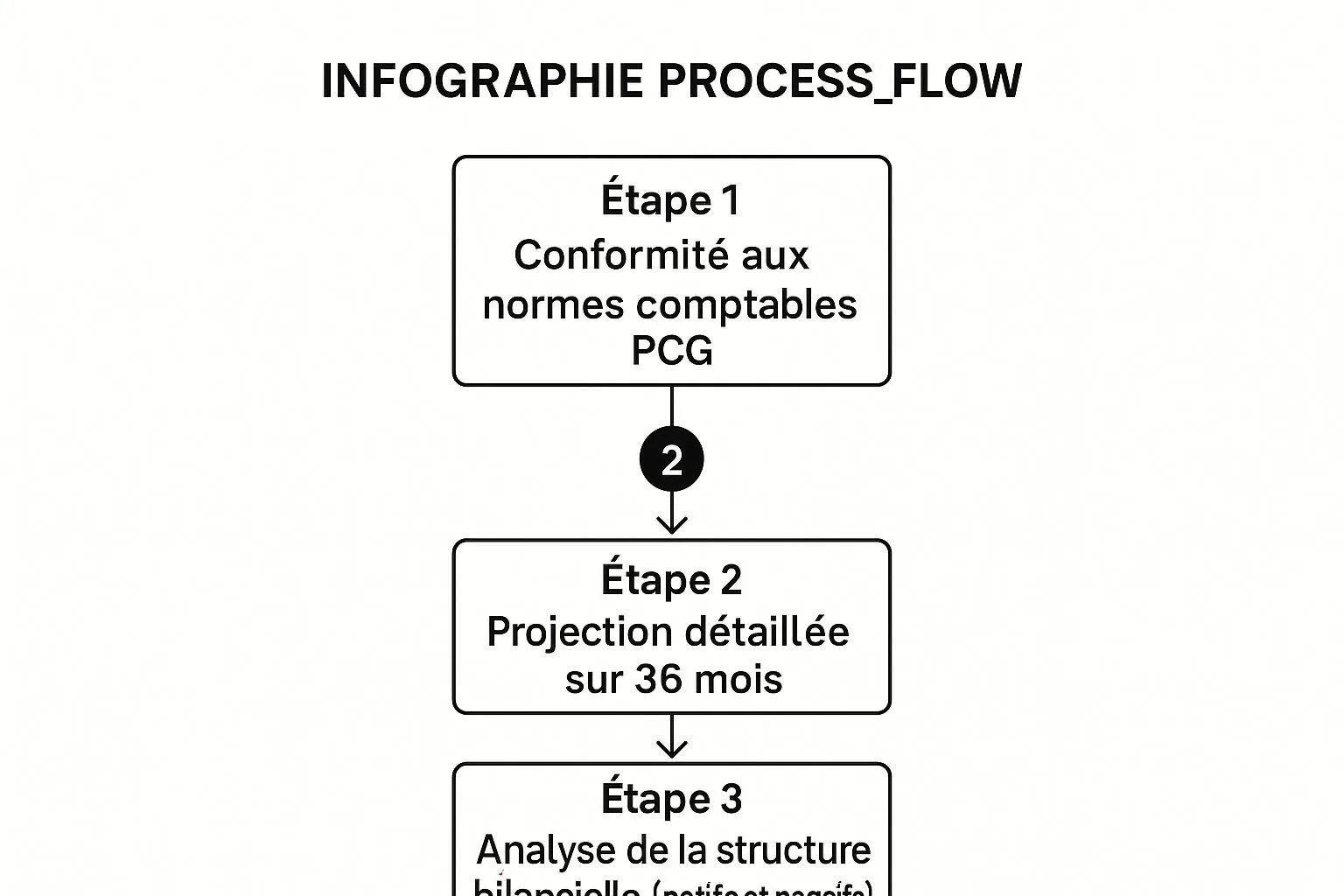
This flow highlights that rigor starts with compliance with standards, continues with granular projection, and results in a structural analysis that reveals the company’s future financial soundness.
Why is this model essential?
This format is not just a forecasting tool but also an instrument of strategic management. The video below explains how to interpret the different elements of a balance sheet to make informed decisions.
Strategic tip: Don’t treat this document as a mere formality. Use the chartered accountant’s analyses to identify potential risks, such as poorly anticipated working capital needs or an unbalanced financing structure. Update it quarterly to adjust your strategy in real time.
2. Chamber of Commerce (CCI) Forecast Balance Sheet Template
The forecast balance sheet model offered by the Chambers of Commerce and Industry (CCI) is a fundamental, accessible tool, specially designed for business founders and small-business owners. Often provided as an Excel spreadsheet, this free template aims to demystify financial forecasting by making it understandable and actionable, even for those with no accounting background. Its main strength lies in its pedagogical approach and its grounding in the reality of the local economy.
This forecast balance sheet example is the go-to tool for structuring one’s thinking and formalizing a first quantified vision of a project. It’s often requested as part of startup support schemes, such as those offered by Pôle emploi or Initiative France. Although simpler than a balance sheet prepared by a chartered accountant, it covers the essentials: assets (investments, inventory, cash) and liabilities (capital, loans, supplier debts), laying the groundwork for a constructive discussion with an advisor or banker.
Strategic analysis of the model
This model is particularly suited to traditional business or service projects with a proven business model. Take the example of setting up an artisan bakery-pastry shop. The founder will use the CCI template to list their investments (oven, mixer, display case), estimate their initial working capital needs (purchasing raw materials, setting up a cash float) and project their debts (bank loan for equipment, personal contribution).
Similarly, a marketing consultant launching their business will rely on this Excel file to model a simple cost structure (computer, software, prospecting costs) and forecast a gradual ramp-up in revenue. The goal isn’t absolute accounting precision, but verifying the overall consistency of the project: do the projected revenues cover expenses and allow for a decent income?
Why is this model essential?
This format is an excellent starting point that forces the entrepreneur to ask the right questions and quantify their assumptions. It serves as a solid working base before seeking more advanced expertise.
Strategic tip: Don’t just fill in the boxes. Take advantage of workshops and meetings with CCI advisors. They can provide valuable sector data (average basket, margin rates by industry, etc.) to refine your assumptions and make your forecast more credible. Have your final document validated by an advisor; their outside perspective is a major asset for identifying weaknesses in your project before presenting it to financiers.
3. Business Plan Winner Forecast Balance Sheet Model
Software solutions dedicated to building business plans, like Business Plan Winner, have transformed how entrepreneurs build their financial forecasts. These platforms include sophisticated forecast balance sheet models, designed to produce professional, visually striking and analytically robust documents. Their strength lies in their ability to guide the user step by step, while offering advanced features such as scenario simulation and integration of sector benchmarks.
This forecast balance sheet example is particularly popular with startups in fundraising phases and fast-growing companies. It combines an intuitive interface with the rigor expected by investors and credit committees. By automating complex calculations (depreciation, VAT, payroll taxes), it lets the entrepreneur focus on strategy rather than accounting technicalities, while ensuring consistency between the balance sheet, income statement and cash flow plan.

Strategic analysis of the model
The added value of this type of model becomes clear in high-stakes financial projects. Take the example of a fintech targeting a €2M Series A round. The software allows you to model the impact of the capital injection on equity, simulate share dilution and project the company’s valuation over several years. Customizable charts are essential for clearly communicating this vision to investors.
Similarly, a food franchise planning its national expansion will use the built-in sector benchmarks to validate its revenue and gross margin assumptions. The sensitivity (or Monte Carlo) simulation tool will help test how resilient the business model is against a rise in raw material costs or a drop in footfall, reassuring financial partners about the viability of the development plan.
For those using tools like Business Plan Winner, it’s essential to know how to master your business plan’s financial projections to ensure the accuracy of your forecast balance sheet.
Why is this model essential?
This format is a genuine strategic asset for convincing demanding partners. It’s not just a number generator, but a financial communication tool designed to inspire confidence and demonstrate a firm grasp of your project. The ability to generate professional, customized PDF reports in a few clicks is a decisive advantage when presenting to investors.
Strategic tip: Make full use of the simulation features. Don’t settle for a single realistic scenario. Model extreme cases (loss of a major client, production delay) to anticipate cash needs and prove you’ve considered every eventuality. Customize the charts to highlight the key performance indicators (KPIs) most relevant to your sector and audience.
4. Simplified Excel Forecast Balance Sheet Template for Sole Traders
The Excel forecast balance sheet model is the go-to tool for sole traders and freelancers. Its simplicity, flexibility and zero cost make it an ideal starting point for structuring a financial vision without getting lost in the complexity of professional accounting software. This document is designed to be pragmatic and focuses on the essentials: expected income, fixed and variable expenses, and the tax impact specific to the micro-entrepreneur regime.
This spreadsheet-based forecast balance sheet example is often the sole trader’s first contact with financial management. It helps turn a project into something concrete, check whether projected revenue covers social security contributions and expenses, and anticipate net income. While it lacks the formal rigor of a balance sheet prepared by a chartered accountant, it’s crucial for personal management and for preparing startup support applications (such as ACRE) or a small honor loan.
Strategic analysis of the model
This model is particularly well suited to service activities with a simple cost structure. Take the example of a freelance graphic designer just starting out. Their Excel forecast balance sheet will list potential contracts, average daily rates, software subscriptions (Adobe Creative Cloud), coworking costs and URSSAF contributions. The goal is to define a clear monthly break-even point: how many days must they bill to pay themselves a decent salary?
Another use case is a personal coach. Their Excel template will let them model different revenue scenarios based on the number of clients, package types (single session, pack of 10 sessions) and estimate key expenses such as professional liability insurance, travel costs or small equipment purchases. This tool helps them set prices based on informed calculation rather than intuition.
For those who want to dig deeper into this document’s structure, this guide offers valuable information on the simplified balance sheet.
Why is this model essential?
This format is a true Swiss Army knife for launching a business. It makes the entrepreneur accountable by forcing them to quantify their ambitions and constraints. It becomes a dynamic dashboard for tracking the gap between forecasts and reality, allowing for quick adjustments to commercial strategy or cost reduction. Its strength lies in being fully owned by the business founder.
Strategic tip: Don’t limit yourself to a single tab. Create separate tabs for your monthly cash flow plan, detailed expense tracking and contribution calculations. Automate calculations as much as possible (for example, the amount of URSSAF contributions based on revenue). Keep regular backups and plan for an annual review by a professional as your business grows.
5. E-commerce Sector-Specific Forecast Balance Sheet Template
The forecast balance sheet for an e-commerce business is a strategic tool suited to the unique dynamics of online selling. Unlike a classic balance sheet, this model incorporates performance indicators (KPIs) specific to digital business, such as customer acquisition cost (CAC), customer lifetime value (LTV), and conversion rates. It doesn’t just list assets and liabilities — it translates digital marketing strategy into solid financial projections.
This forecast balance sheet example is essential for managing a business whose profitability depends directly on the effectiveness of advertising campaigns and customer retention. SaaS platforms like Shopify or PrestaShop, as well as tech incubators like Station F, have popularized this type of forecast because it directly links marketing investments (an expense) to future value creation (the customer asset).

Strategic analysis of the model
This model is crucial for assessing the viability and scalability of an online business. Take the example of a marketplace for handcrafted products. The forecast balance sheet must anticipate seasonal order peaks (year-end holidays, Mother’s Day) by planning an increase in working capital needs to fund inventory and advertising campaigns. The analysis will focus on the balance between CAC per channel (Google Ads, social media) and the margin generated by each sale.
Similarly, for a B2B sales platform, the balance sheet will highlight the longer sales cycle. The “accounts receivable” asset will be closely monitored, and forecasts must incorporate scenarios based on contract signature rates. For a mobile delivery app, the analysis will focus on user cohorts, projecting LTV to justify initial development and acquisition costs. If you’re considering an online business, learning how to properly structure your launch is essential. Discover how to build a dropshipping business to master these fundamental concepts.
Why is this model essential?
For an online seller, this balance sheet is a dashboard that goes beyond basic accounting. It offers a clear view of marketing investment performance and allows for quick strategy adjustments. The video below details how to use e-commerce metrics to build reliable financial forecasts.
Strategic tip: Sync your forecast balance sheet with your analytics tools (Google Analytics, CRM, e-commerce platform). Track your CAC and LTV by cohort monthly. A rising CAC without a proportional LTV is a warning sign that your business model may not be sustainable.
6. Banque de France (FIBEN) Forecast Balance Sheet Model
The forecast balance sheet in FIBEN format (Fichier Bancaire des Entreprises, the French national business credit file) is the reference standard for financial institutions in France. Managed by the Banque de France, this model is not just a forecast document; it’s a credit-analysis and rating tool that assesses a company’s financial soundness and default risk. Its structure is extremely standardized and rigorous, allowing for objective comparison between companies.
This forecast balance sheet example is required for structured financing operations, major guarantee requests or debt restructurings. Its credibility rests on its alignment with bank analysis standards. It details assets and liabilities in a specific presentation that highlights the company’s ability to generate sufficient cash flow to meet its financial commitments.
Strategic analysis of the model
This format is essential for companies with high financial stakes and complex banking relationships. For example, an industrial group seeking a multi-million-euro syndicated loan will need to provide a FIBEN forecast balance sheet so each bank in the pool can assess the risk in a standardized way.
Similarly, an exporting SME requesting an international guarantee from its bank for a large contract will need to demonstrate its future solvency using this format. The analysis will focus on key indicators such as self-financing capacity (CAF), adjusted EBITDA (EBE), and the evolution of net debt. This model allows analysts to simulate the company’s resilience against external shocks (rate hikes, sector crisis).
To master the construction and reading of this document, a solid understanding of balance sheet structure is necessary. You can dig deeper into this topic by consulting this guide on the balance sheet table.
Why is this model essential?
The FIBEN format is more than a forecasting tool — it’s a common language between a company and its financial partners. It allows the conversation to move from a simple discussion to a factual, figure-based credit analysis. Anticipating its construction means preparing effectively for bank negotiations.
Strategic tip: Never submit a FIBEN forecast balance sheet without stress-testing it yourself first. Apply pessimistic scenarios (revenue decline, rising raw material costs) to see how your solvency and profitability ratios react. Prepare a solid case for each key assumption and show that you’ve anticipated risks and planned action plans.
Comparison of the 6 Forecast Balance Sheet Models
| Model / Criterion | 🔄 Implementation complexity | ⚡ Resources required | 📊 Expected results | 💡 Ideal use cases | ⭐ Key advantages |
|---|---|---|---|---|---|
| 3-Year Forecast Balance Sheet Model by a Chartered Accountant | High, requires accounting expertise | High cost, professional support | Detailed analysis, 3-year projection | Established SMEs, projects requiring bank validation | Bank credibility, strict compliance |
| Chamber of Commerce (CCI) Forecast Balance Sheet Template | Medium, simplified interface | Free, CCI support available | Simple forecasts suited to small businesses | Founders, small businesses, micro-entrepreneurs | Free of charge, CCI training support |
| Business Plan Winner Forecast Balance Sheet Model | Medium to high, advanced tools | Monthly subscription, internet connection | Advanced simulations, sector benchmarks | Innovative startups, fundraising rounds | Polished presentation, in-depth analysis |
| Simplified Excel Forecast Balance Sheet Template for Sole Traders | Low, ultra simple | Minimal cost, no technical support | Basic calculations, cash flow tracking | Sole traders, freelancers | Ease of use, speed |
| E-commerce Sector-Specific Forecast Balance Sheet Template | High, complex sector metrics | Potentially high cost, e-commerce expertise | Precise CAC/LTV cost analysis, seasonality | E-commerce businesses, marketplaces | Suited to e-commerce specifics, sector metrics |
| Banque de France (FIBEN) Forecast Balance Sheet Model | Very high, highly structured and standardized format | Specialized training, significant cost | Very thorough risk and solvency analysis | Large companies, complex groups | Universal bank acceptance, maximum credibility |
From Example to Action: How to Choose and Succeed With Your Forecast Balance Sheet
At the end of our exploration of the different models and examples, one truth stands out: the forecast balance sheet is not a mere administrative formality. It’s the rudder of your company, an essential strategic management tool that turns uncertainty into opportunity and ambitions into tangible figures. We’ve broken down six distinct approaches, each with its own specific strengths, from the rigor of the chartered accountant model to the targeted simplicity of the sole trader template.
The common thread running through every forecast balance sheet example analyzed is clear: customization and strategic analysis are the keys to success. A model, however excellent, is only a starting point. Your true competitive advantage will come from your ability to adapt it to your unique reality, whether you’re an e-commerce freelancer, a growing small business, or a founder seeking to convince investors.
Summary of key takeaways
To turn these examples into a concrete action plan, keep the following in mind:
- Context dictates the choice: The CCI model is ideal for a solid business plan, while a simplified Excel template is enough for a sole trader’s internal management. The e-commerce sector model offers the granularity essential for online sellers. Don’t pick a model at random; align it with your main objective (financing, management, compliance).
- Assumptions are the engine: The quality of your forecast balance sheet depends entirely on the accuracy of your assumptions. Base your estimates on concrete data: market research, supplier quotes, sector benchmarks. A weak assumption invalidates the whole document.
- Analysis matters more than filling in boxes: Don’t just fill in the cells. Question your figures. Why is your working capital requirement evolving that way? How sensitive is your break-even point to a 10% drop in sales? That’s where the strategic value lies.
Your next steps toward a well-controlled balance sheet
Now move from theory to practice. Start by listing your objectives: Do you need to secure a loan? Better manage your cash flow? Prepare a fundraising round? This clarification will point you to the right forecast balance sheet example to adapt. Then, spend time researching to build robust assumptions. To help put this article’s advice into action, a complete guide to preparing financial statements can give you the foundations needed to build a reliable forecast balance sheet.
Ultimately, mastering the art of the forecast balance sheet means giving yourself the means to navigate the entrepreneurial world with confidence. It’s the tool that lets you not only present a viable project, but above all steer it toward sustainable, profitable growth. Armed with these models and this methodology, you’re now ready to build a clear, powerful financial vision for your future.
Ready to automate the creation of your financial documents without getting lost in complex spreadsheets? Discover Bizyness, the all-in-one management solution designed for modern entrepreneurs. Generate your forecast balance sheet and all your financial reports in a few clicks, and focus on what really matters: growing your business.
