

 Français
Free Quote Template for Sole Traders – Easy & Quick to Fill In
Download our free quote template for sole traders — simple, customizable and compliant. Create professional quotes in just a few minutes.

Much more than just a piece of paper, a free quote template for sole traders is your very first sales tool. It’s what helps you land contracts and give a professional image from day one. A well-crafted quote turns a simple conversation into a real commitment, protecting everyone involved and making things clear with your clients.
Why a pro quote is your best ally for selling
The quote is often the first official document your client will see from you. It’s not just an administrative formality to rush through. It’s a golden opportunity to show you’re serious and to lay healthy foundations for the future collaboration. In short, this document sets the rules of the game, clarifies what each party expects from the other, and avoids plenty of misunderstandings.

An immediate mark of credibility
Picture a clear, well-presented document, free of errors, with all the required legal notices. It instantly boosts your credibility. What message does it send? That you’re on top of your subject, including the paperwork. That’s hugely reassuring for a client, who will tell themselves you’ll handle their project with the same rigor. It’s a bit like your professional business card.
Think of it as the showcase of your work. A quote thrown together in a hurry may raise fears that the service will be just as rushed.
An essential legal protection
As soon as your client signs it with the famous “Approved” mention, your quote turns into a contract. It then becomes your shield in case of disagreement over what was planned or over pricing. If a client ever fails to pay, this document is the proof you’ll need to start a collection procedure.
A precise, signed quote is the simplest way to avoid disputes that cost time and money. It replaces “we agreed that…” with a written agreement and protects both the sole trader and their client.
A formidable sales tool
A well-thought-out quote doesn’t just line up numbers. It sells a solution. By taking the time to detail each line, you explain what you concretely bring to the table, justify your price, and show the value of your work. For your quote to become a real commercial asset, it’s essential to know how to optimize your profit by correctly calculating your margins, a key skill for keeping your business healthy.
In a market crowded with micro-entrepreneurs, you need to stand out. Even though registrations have seen a slight dip of 0.3% recently, the sector remains very dynamic, with an overall rise in business creations of 4.0% year-on-year. An impeccable quote is a direct competitive advantage to help you get ahead of the pack.
The mandatory legal notices on your quote
A well-crafted quote is one thing. A perfectly legal quote is another. For a simple free quote template for sole traders to become a genuine contract that protects you, it absolutely must contain a series of mandatory notices. Leaving one out can seriously weaken your position in a dispute, not to mention the damage to your credibility.
Think of these notices not as an administrative chore, but rather as the foundations of the trust relationship you’re building with your client. Every piece of information you provide is evidence of your professionalism and your compliance with regulations.
Clearly identify who’s who
The very first step for a rock-solid quote? Making sure everyone is correctly identified. This is the basis of any commercial agreement and it removes any ambiguity about who is committing, and to whom.
Here’s the information that must appear in black and white:
- Your full details: Your first and last name, followed by the mention “Sole Trader” or “ST”, the address of your registered office, your phone number, and your email.
- Your business registration number: This 14-digit number is your professional ID card. It’s absolutely essential.
- Your client’s details: Their name (or company name if it’s a business) and their address. This also protects you, particularly if you ever need to start a collection procedure.
This clarity from the outset avoids plenty of headaches and sets a professional, reassuring framework.
Detail the offer and terms
Once the parties are clearly identified, we get to the heart of the matter: the precise description of what you’re offering. A vague quote is an open door to all kinds of misunderstandings. Be as specific as possible — it’s your best insurance against “I thought that…”.
To make sure your quote meets every requirement, it’s crucial to understand what the law expects from professionals. Don’t hesitate to look into the mandatory legal notices to get the full picture.
Here’s the logical flow of information, from the client’s details through to the final price.
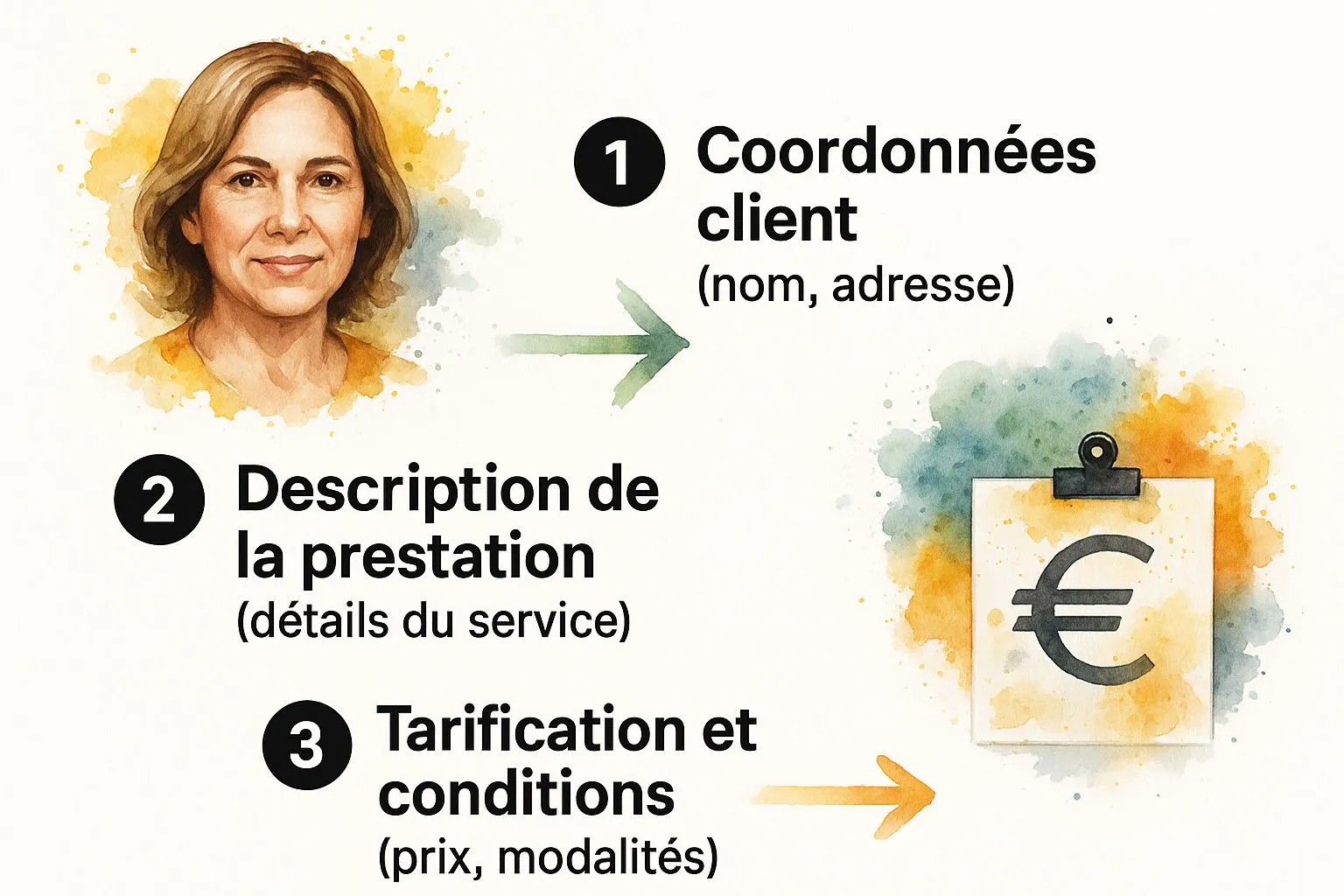
As this infographic shows, clarity — from client information to service descriptions — is truly the key to a quote that inspires confidence.
Pro tip: I’ve seen too many entrepreneurs get lost in their own documents. Set up a logical numbering system for your quotes (for example, YEAR-MONTH-NUMBER). It makes tracking incredibly easy and gives a very organized image of your business management. A quote with no number, or with a chaotic sequence, can raise a red flag for some clients.
To help you not forget anything, here’s a quick recap of the essential points. It’s a good checklist to keep handy every time you prepare a quote.
Checklist of mandatory notices for a compliant quote
| Item | Description | Example or Tip |
|---|---|---|
| Your details | Name, “Sole Trader” mention, address, business registration number, contact info. | Put this information in the header for immediate visibility. |
| Client details | Name (or company name) and full address. | Double-check the spelling to avoid any administrative issues. |
| Date and number | Issue date and unique quote number. | Use a logical sequence, e.g. 2024-06-001, for easy tracking. |
| Description of services | Detail of each service or product, with quantity and unit price. | Be precise. “Logo design” is fine, “Logo design — 3 proposals, 2 rounds of revisions” is better. |
| VAT mention | Indication of your VAT regime. | If you’re VAT-exempt, the mention “VAT not applicable, art. 293 B of the French Tax Code” is mandatory. |
| Professional insurance (if required) | Your insurer’s details and geographic coverage. | Essential for trades and craft businesses (professional liability, 10-year warranty). |
| Total amounts | Total amount due before and after tax (or just the net amount if not subject to VAT). | Make the final total bold so it’s clearly visible. |
| Offer validity | The period during which your prices are guaranteed. | Usually 1 or 3 months. It protects you if your own costs rise. |
This list may seem long, but once you’ve built these elements into your template, it becomes second nature.
The crucial matter of VAT and insurance
VAT management is a central point when you’re a sole trader. If you benefit from the VAT exemption scheme, your quote must carry the mention: “VAT not applicable, art. 293 B of the French Tax Code”. This isn’t optional, and leaving it out can create serious tax confusion for you and your client.
Watch out, things are changing. A major shift is coming, as the VAT exemption threshold is set to be lowered. Once revenue reaches €25,000, charging VAT will become mandatory for sole traders. It’s therefore wise to stay informed about this upcoming reform.
Finally, for certain professions, particularly in construction and craft trades, mentioning your professional insurance is mandatory. You must state the insurer’s name and the geographic coverage of your policy. It’s a powerful mark of trust and seriousness for your client. For a detailed overview, our article on the mandatory notices on a quote provides a complete checklist on the subject.
Let’s get practical: download and customize your quote template
Theory is great, but nothing beats getting hands-on. Now that we’ve covered the mandatory legal notices, it’s time to roll up your sleeves and create a quote that reflects who you are. Using a good free quote template for sole traders is an excellent starting point, but customization is what will make all the difference.
Starting from a ready-made template guarantees you won’t forget anything essential and saves a huge amount of time. But for this simple administrative document to become a genuine commercial asset, it must above all reflect who you are professionally.
Assert your visual identity
First impressions count, and they’re often visual. A quote in your company’s colors is instantly more professional. It’s not just an aesthetic matter — it’s a question of consistency.
A few simple adjustments can have a huge impact:
- Add your logo: It should be clearly visible, usually top-left or centered. It’s your signature, the first thing your client will see.
- Play with your colors: Apply your brand colors to headers, key lines, or totals. It creates a direct link with your website or business cards.
- Choose a sober, legible font: Avoid overly fancy fonts. The goal is clarity. A professional font inspires confidence.
These small touches are enough to turn a standard document into a commercial proposal that carries your brand’s signature.
Optimize the template for efficiency
Customization doesn’t stop at design. The goal is also to make creating your quotes as fast and simple as possible. Think of your template as a tool to pre-configure to make your life easier.
A well-designed template isn’t just a file to fill in. It’s a genuine system that works for you. Every minute saved on admin work is one more minute to focus on what you do best: your craft.
Take the time to pre-fill everything that never changes:
- Your name, address, business registration number, and contact details.
- The famous legal mention “VAT not applicable, art. 293 B of the French Tax Code”.
- Your payment terms (deposit, deadline, etc.) or a link to your terms of sale.
By preparing all this in advance, you drastically reduce the risk of forgetting something or making a mistake when you’re in the thick of it.
Small tips for Word and Excel
Whether you’re more Word or Excel, each piece of software has its own features to save you time. Starting from a free quote template for sole traders is a good thing, but knowing two or three tricks is even better.
If you’re on Excel:
- Automate calculations: It’s basic, but it changes everything. Use simple formulas (
=SUM,=A1*B1) so that totals, VAT (where applicable), and the final amount calculate themselves. No more calculation errors! - Create drop-down lists: If you often offer the same services, a drop-down list lets you choose a service, and the “description” and “unit price” fields fill in automatically. Magic.
If you prefer working in Word:
- Use “Quick Parts” (or “Building Blocks”): This feature is brilliant. You can save chunks of text you use regularly, such as the detailed description of a complex service. Then a single click is enough to insert it into a new quote.
These techniques turn your static template into a dynamic, smart tool. To see how it all comes together in practice, take a look at our complete guide with a sample quote for sole traders — you’ll find more ideas to borrow.
How do you write a quote that makes people want to sign?
A quote that follows the law is the bare minimum. But a quote that turns a prospect into a client — that’s the real challenge. Far beyond the mandatory notices, how you write your commercial proposal is an art that can radically boost your conversion rate. The idea is simple: stop seeing this document as a mere price list. Think of it as your first real sales pitch.
The secret is to speak your client’s language. They don’t just want to know what you’re going to do, but above all why it will solve their problem or improve their situation. That’s a crucial shift in perspective, especially given that the population of entrepreneurs is getting younger and more dynamic.
Highlight benefits, not features
Most quotes just list technical tasks. “Creation of a 5-page website,” “Writing 4 blog articles,” “Social media management.” It’s factual, sure, but it doesn’t sell a dream.
To really stand out, try translating every line of your quote into a concrete benefit for your client.
- Instead of “Website creation,” write: “A professional online showcase to attract your first clients 24/7”.
- Rather than “Writing 4 articles,” go for: “4 optimized articles to boost your Google visibility and generate qualified traffic”.
- Replace “Social media management” with: “Community management to strengthen your brand image and build audience loyalty”.
This approach changes absolutely everything. You’re no longer selling a service, you’re selling an outcome. You show that you’ve grasped your client’s ultimate goal, not just the task they’re handing you. To go further on this topic, our complete guide explains in detail how to create an effective quote to help you at every step.
Structure your offer to increase its value
Your quote should never be a take-it-or-leave-it proposal. By structuring your offer intelligently, you can not only increase your chances of getting it signed, but also the average value of your contracts.
A remarkably effective technique is to offer options. Present a base offer that perfectly meets the initial need, then add one or two complementary options. For example, for a logo design project, you could offer, as an option, adapting the logo for social media or creating a business card template.
By offering choices, you give the client a sense of control and open the door to a broader collaboration. It’s a subtle way to upsell without any pressure.
Clarify the terms to avoid friction
A quote that converts is a quote with no grey areas. Two points are particularly sensitive and deserve your full attention: validity period and payment terms.
- Validity period: Set a clear limit, usually 30 days. This creates a slight sense of urgency and protects you against a rise in your own costs if the client takes a while to decide.
- Payment terms: Be as explicit as possible. “30% deposit on signature, balance on delivery.” “Payment by bank transfer within 15 days.” The clearer it is, the fewer discussions there will be at invoicing time.
This clarity matters even more as the profile of micro-business founders gets younger. The average age is now 35, and nearly 39% are under 30. This generation, seeking flexibility, particularly values transparency and well-structured processes. You can also check the key figures on business creation for more details on this trend.
Take care with the email that accompanies your quote
Above all, never send your quote as an attachment to an empty email. It’s a golden opportunity to strengthen the bond with your prospect, and it would be a shame to waste it. The accompanying email is your last chance to convince.
Here’s a simple, effective template you can adapt:
Subject: Your proposal for [Project name]
Hello [Client name],
Following our very interesting conversation, please find attached my detailed proposal for [summarize the project goal in one sentence].
I’ve tried to structure the quote to be as clear as possible, particularly highlighting [mention a key point or benefit].
Feel free to reach out if you have any questions at all — I’m available to discuss [suggest a time slot or call].
Have a great day, [Your Name]
This email is short, personalized, and proactive. It shows you’re much more than just someone who executes tasks: you’re a partner invested in the success of their project.
Common mistakes to avoid on your quotes
Even with the best free quote template for sole traders, certain mistakes can quickly hurt your credibility and even cause you trouble. We often think we’re doing well, but a small omission or imprecision is enough to turn a reassuring quote into a source of problems.
A quote lacking rigor is a bit like a limp handshake: it doesn’t inspire confidence. Your client might think that if the document is sloppy, the service will be too. Let’s go through the most common pitfalls so you don’t fall into them anymore.
Lacking precision in the description of services
This is mistake number one, by far. Vague lines like “Website creation” or “Marketing support” are genuine highways to misunderstanding. Your client might picture a full e-commerce site, while you had a simple five-page showcase site in mind.
The solution? Be precise, almost surgical. Take the time to break down each project into concrete, well-defined tasks.
- Absolutely avoid: “Writing articles”
- What to write instead: “Writing 4 blog articles of 1,000 words each. The service includes SEO keyword research and a round of revisions per article.”
By detailing your offer, you not only justify your price, but also show your professionalism. The client knows exactly what they’re buying, and you’re protected. There’s no room left for doubt.
Forgetting administrative and legal details
Administrative oversights are just as damaging. They can render your quote void or create confusion that proves costly. Here are the most common ones:
- The famous VAT mention: If you benefit from the VAT exemption, it’s essential to state “VAT not applicable, art. 293 B of the French Tax Code”. Forgetting it can sow doubt and complicate your client’s bookkeeping (and your own).
- Disorganized numbering: Quote numbers that don’t follow a sequence, or that are picked at random, look amateurish. Continuous, chronological numbering is a sign of seriousness and greatly simplifies your tracking.
- No stated validity period: Without this detail, a client could come back to you six months later to sign the quote, even though your prices or availability have since changed. Set a clear period (15 or 30 days, for example).
Always keep this in mind: a signed quote becomes a contract. Every detail, every mention, is there to protect you and build a healthy relationship with your client.
By taking a few minutes to check these points, you turn a simple sales document into a real shield for your business. It’s the foundation of your professionalism.
Frequently asked questions about sole trader quotes
Even with the best free quote template for sole traders in hand, practical questions always come up. That’s perfectly normal. Administrative management is often a journey filled with small doubts. Let’s go through the most common ones together so you can move forward with confidence.
Can a quote be modified once it has been signed?
The short answer is no. Once signed, a quote has the value of a contract. It binds both parties and can’t be changed on a whim.
If an adjustment is needed, whether at the client’s request or because something unexpected comes up on your end, the clean, professional solution is to draft an amendment. This document supplements the original quote, precisely describing the changes (new tasks, timelines, costs, etc.). And of course, it must also be dated and signed by both you and your client to be valid.
Managing quotes day to day
Do my quotes really need to have sequential numbers?
Yes, absolutely! Chronological, gap-free numbering (for example, QUOTE-2024-001, QUOTE-2024-002…) isn’t just good practice. It’s a legal requirement, especially for the invoices that will follow, and it says a lot about how serious you are. It makes your own bookkeeping much easier and immediately reassures your clients.
Can a quote serve as an invoice?
Never. The two must be clearly distinguished. The quote is your commercial proposal, the offer you’re making. The invoice is the payment request that comes after the service has been performed. It’s an essential accounting document that formalizes your client’s debt. So always remember to issue a clearly separate invoice, taking care to reference the corresponding quote number.
A crucial point: record-keeping. A signed quote is a commercial contract. The law requires you to keep it for 5 years. It’s best to play it safe by keeping a digital copy (on a cloud service, for example) and a paper version.
Do I always have to create my quotes for free?
Generally, yes. The quote is part of the sales process. However, there are exceptions. If preparing your proposal requires an in-depth study, extensive research, a site visit, or creating plans, that work has value.
You’re entirely within your rights to charge for it. The one golden rule: inform your client clearly and in advance. Announce the price of this study and get their agreement before starting anything at all. Transparency is key.
What if a client asks me to start work without having signed the quote?
Watch out, red flag! This is a risky situation. Never start a project without a properly signed quote in hand. A simple agreement by email or verbally doesn’t carry the same legal weight and exposes you to unpaid invoices or disputes. Calmly but firmly explain that this signature is a safeguard for both of you — it frames the collaboration and avoids misunderstandings.
To take things to the next level and eliminate any doubts, Bizyness offers you compliant, automated quote templates. Create professional proposals in just a few clicks and turn them into invoices effortlessly. Discover how Bizyness can simplify your management today.
