

 Français
Friendly Payment Reminder Letter: A Guide to Collecting Unpaid Invoices
Learn how to write an effective friendly payment reminder letter to recover unpaid invoices. Practical tips and examples for quick results.

The art of the friendly reminder that protects your cash flow
Late payments can weaken cash flow, especially for small businesses. The friendly payment reminder letter then becomes an essential tool. It helps recover amounts owed while maintaining a good client relationship. With this approach, it’s possible to recover a significant share of unpaid invoices without harming the company’s image.
This method is far more than a simple administrative procedure. It’s a genuine strategy for protecting your financial health. Like a complex mechanism, every part plays a precise role. The friendly payment reminder letter is one of these key pieces for your company’s financial stability.
Why courtesy matters in payment reminders
Taking a courteous approach when following up on payments is essential for several reasons. It helps preserve trust with your clients, fostering long-term business relationships. A respectful tone can also encourage faster payment.
Moreover, this approach helps avoid legal proceedings, which are often long and costly. Late payments have a significant impact on cash flow, particularly for micro and small businesses. In 2023, 82% of French companies faced payment delays, with “significant” or even “critical” consequences for half of small businesses. For more information on this topic, see this article: Statistics on late payments.
The benefits of a well-defined reminder strategy
Implementing an effective reminder strategy optimizes your chances of collection. This involves defining a precise timeline, with messages tailored to each stage of the process. The first reminder can be a simple friendly note, while subsequent ones gradually become firmer.
To communicate with international clients, using their native language is an asset. De can prove useful in this context. Tools like Bizyness simplify accounting management for small businesses and sole traders.
The effectiveness of a friendly payment reminder letter relies on its ability to remind the client of their obligation while preserving the business relationship. Clear, concise and respectful communication is essential to achieve positive results and strengthen your cash flow.
Anatomy of a friendly payment reminder letter that converts
Now that we’ve covered the importance of friendly reminders, let’s break down their structure to maximize their impact. An effective friendly payment reminder letter is a major asset for collecting unpaid invoices. It follows a logical sequence of steps, aimed at one precise goal: getting paid.
The subject line: capture attention at first glance
The email subject line is the first thing the client reads. It should be clear, concise and relevant. Skip generic subjects like “Unpaid invoice.” Favor a personalized approach: “Follow-up on your invoice [invoice number]” or “Friendly reminder regarding invoice [invoice number].” A well-crafted subject line can significantly increase the open rate.
The table below summarizes the key elements of an effective friendly payment reminder letter. It details each component and its influence on the collection process, along with sample wording.
This table presents the essential components of a friendly payment reminder letter and their importance in the collection process.
| Element | Description | Impact on collection | Recommended wording |
|---|---|---|---|
| Subject line | First contact with the client | Determines whether the email gets opened | Follow-up on your invoice [number], Friendly reminder regarding invoice [number] |
| Body of the message | Recap of the context and payment request | Clarifies the situation and prompts action | We understand that unexpected circumstances can arise. Feel free to contact us if you’d like to discuss a payment plan. |
| Conclusion | Call to action and next steps | Facilitates payment and encourages communication | We look forward to your payment and remain at your disposal. Please confirm receipt of this message. |
| Adaptation to client profile | Personalization based on client history | Optimizes impact and preserves the client relationship | A friendly reminder for a loyal client, a firmer reminder for a client with a history of late payments. |
In short, every element of the reminder letter plays a crucial role in collecting unpaid invoices. Adapting to the debtor’s profile is a key success factor.
The body of the message: clarity and understanding
The body of the message recalls the invoice context (date, number, amount) and states the payment request. Use a courteous, understanding tone, without aggression. Offer solutions such as a payment plan: “We understand that unexpected circumstances can arise. Feel free to contact us if you’d like to discuss a payment schedule.” Encouraging dialogue is essential.
The conclusion: prompting action
The conclusion encourages the client to act quickly. Restate your request and outline the next steps. “We look forward to your payment and remain, in the meantime, at your service.” Include payment details and add a call to action: “Please confirm receipt of this message.”
Adapting the letter to the debtor’s profile
The effectiveness of a reminder depends on how well it’s adapted to the debtor’s profile. A friendly reminder is enough for a loyal client. For a client with a history of late payments, a firmer but still courteous reminder is needed. Bizyness lets you segment your client base and automate the sending of personalized reminders, optimizing collection.
Example of an optimized structure:
- Subject: Friendly reminder regarding your invoice [invoice number]
- Body: Recap of invoice details, polite request, payment plan proposal.
- Conclusion: Call to action, payment details, polite closing.
By applying these principles, you’ll improve your collection rate while preserving the client relationship.
Orchestrating your reminders to maximize collections
Timing is crucial for optimizing debt collection. Knowing when to follow up with a client can make the difference between fast payment and an unpaid invoice. This section presents strategies for turning your outstanding invoices into cash.
The infographic below illustrates the three key steps of an effective, friendly payment reminder letter: a concise subject line, clear content with a recap and request, and a polite closing with signature.
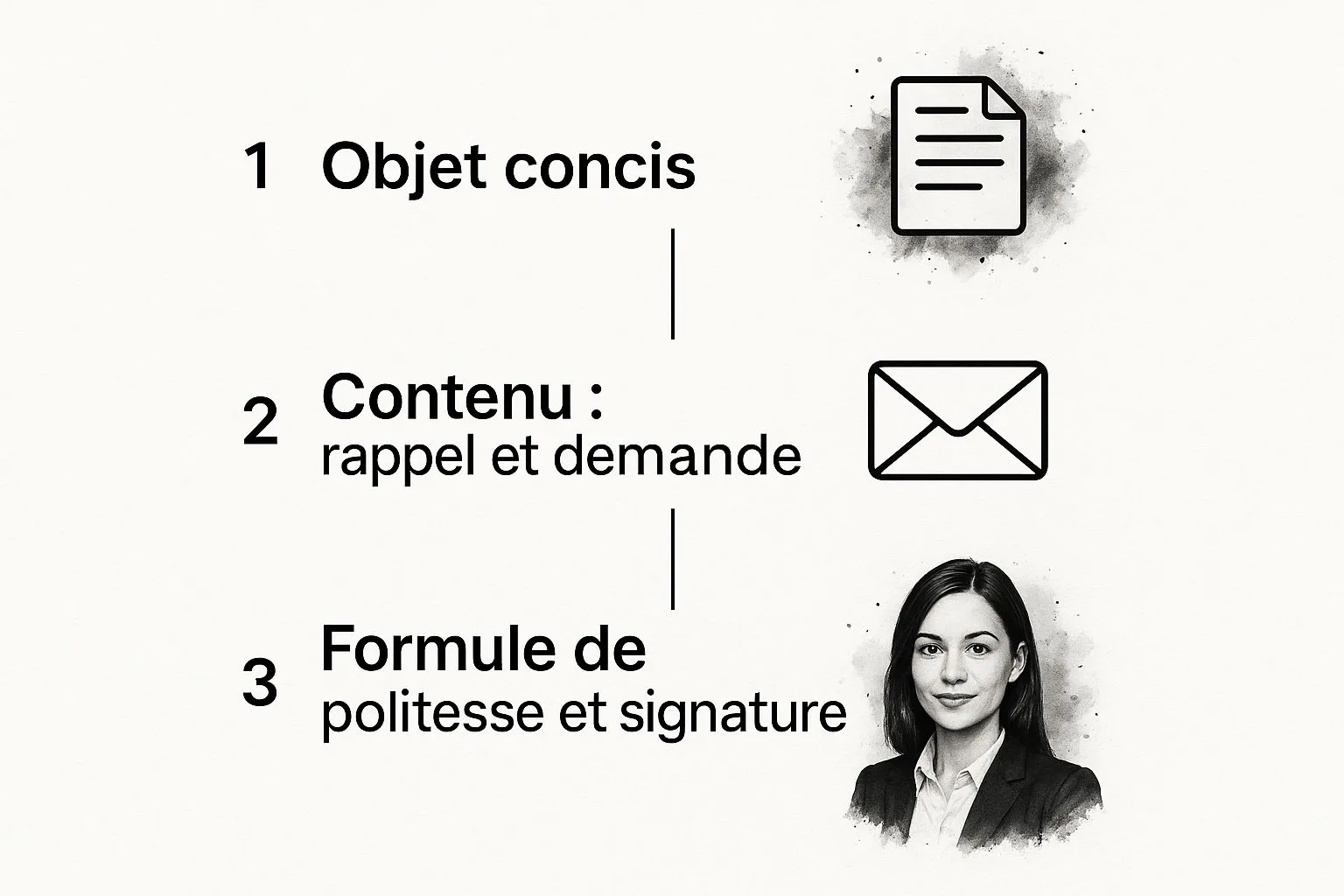
As the infographic shows, an effective friendly payment reminder letter is structured and concise. It clearly lays out the situation while maintaining a professional and respectful tone, maximizing the chances of collection.
Defining the ideal reminder frequency
Reminder frequency is a determining factor. Following up too often can irritate the client, while too little can suggest payment isn’t a priority. Balance is key. A first reminder one week after the due date is generally a good starting point.
After that, reminders spaced one to two weeks apart are recommended. The tone and content should adapt to the client’s responses. The goal is to maintain steady pressure without being intrusive. A tool like Bizyness (https://www.bizyness.fr) lets you automate and personalize reminders.
Identifying the right moments to follow up
Beyond frequency, the timing of the send impacts response rates. Certain days and times work better. Tuesday and Wednesday mornings tend to be more effective for emails.
Adapting the timing to the client’s activity is also relevant. For a B2B client, favor business hours. In France, managing late payments through friendly reminder letters is essential for companies’ cash flow. According to an Infogreffe study, about 40% of unpaid invoices are settled after the third email reminder. Learn more about the effectiveness of email reminders This demonstrates the importance of structured reminders. This amicable approach often avoids costly legal proceedings, which have a collection rate below 50%.
Before detailing how to adapt strategy by client, here’s a summary table of reminder best practices:
The table below, “Recommended reminder schedule,” presents the different reminder stages, their optimal timing and the communication channel to favor. It will help you structure your reminders and maximize your chances of collection.
| Reminder stage | Delay after due date | Recommended channel | Tone to adopt | Average success rate |
|---|---|---|---|---|
| First reminder | 1 week | Friendly, simple reminder | 20% | |
| Second reminder | 2 weeks after the first reminder | Email/Phone | Firmer, request for explanation | 20% |
| Third reminder | 2 weeks after the second reminder | Registered letter with acknowledgment of receipt | Formal, formal notice | 10-15% |
| Fourth reminder | 1 week after the third reminder | Formal notice via bailiff | Legal | Variable, depends on the situation |
This table highlights the importance of acting quickly and adapting the tone and communication channel as reminders progress. The success rate generally decreases at each stage, underscoring the need for early action.
Adapting your strategy based on the client
Personalizing the frequency and tone of reminders based on client history is essential. A simple reminder is enough for a loyal client with a flawless payment history.
For a client with a history of late payments, more frequent reminders and a firmer tone are needed. Analyzing each client’s history allows for a personalized strategy and maximizes reminder effectiveness. Bizyness lets you segment clients and automate the sending of personalized reminders.
Ready-to-use friendly payment reminder letter templates
Writing an effective friendly payment reminder letter can be time-consuming and requires a certain level of expertise. Fortunately, templates exist to make the task easier. This section offers tested and approved examples, ready to be customized to your needs. Adapted to different contexts, these templates will help you optimize your reminders and speed up collections.
Templates for a first reminder
A first reminder should be friendly and understanding. Its main goal is to recall the payment due date and encourage the client to settle quickly.
-
Subject: Follow-up on your invoice No. [Invoice number]
-
Body:
Hello [Client name],
We hope this message finds you well. We’re writing regarding invoice No. [Invoice number] for an amount of [Amount] €, which was due on [Date]. Could you confirm whether payment has already been made? We remain available for any questions.
-
Conclusion: Best regards, [Your name/Your company]
This simple, direct template assumes an oversight and invites the client to respond. Bizyness lets you automate the sending of these reminders while personalizing the name and invoice number. Discover how to automate your reminders with this software.
Templates for a second reminder
If the first reminder goes unanswered, the second should be firmer, without losing courtesy. It’s about reinforcing the importance of payment.
-
Subject: Reminder regarding invoice No. [Invoice number] - Important
-
Body:
Hello [Client name],
We’re following up regarding invoice No. [Invoice number] for an amount of [Amount] €, which remains unpaid. We kindly ask you to settle your situation as soon as possible. Please note that late payment penalties may apply in accordance with our terms and conditions of sale.
-
Conclusion: Best regards, [Your name/Your company]
This template introduces the notion of penalties, encouraging the client to act quickly. Bizyness also lets you track the status of your invoices and schedule the automatic sending of this second reminder.
Templates for a third reminder (formal notice)
If the previous reminders go unanswered, a formal notice becomes necessary. As the final notice before legal proceedings, this letter must be formal.
-
Subject: Formal notice - Invoice No. [Invoice number]
-
Body:
Hello [Client name],
Despite our previous reminders, invoice No. [Invoice number] for an amount of [Amount] € remains unpaid. We are giving you formal notice to settle your situation within [Number] days. After this period, we will be compelled to initiate legal proceedings.
-
Conclusion: Sincerely, [Your name/Your company]
This final template, firmer in tone, clearly lays out the consequences of non-payment. Bizyness lets you generate and send professional formal notices in just a few clicks, ensuring rigorous follow-up of your receivables.
These templates are examples. Adapt them to your context and client relationship. The key is to remain clear, concise and courteous throughout the reminder process.
Controlled escalation: adjusting your tone without alienating the client
Following up with a client over an unpaid invoice can be delicate. It’s essential to take a strategic, progressive approach — a controlled escalation — that increases pressure while preserving the business relationship. The goal is to strike a balance between firmness and courtesy.
The first reminder: a simple nudge
The first reminder should be a friendly nudge. Think of it as a simple sticky note on a desk. The tone is courteous and understanding, suggesting a simple oversight on the client’s part. Use phrases like “Please kindly check…” or “Could you confirm receipt of…”. The main goal is to reopen the dialogue and facilitate payment.
The second reminder: more explicit
If the first reminder goes unanswered, the second adopts a more direct tone, while remaining courteous. Clearly restate the amount owed and the due date. “We have still not recorded your payment for invoice [invoice number] in the amount of [amount] € due on [date]” is an example of appropriate wording. The goal is to signal the importance of payment without accusing the client. Let’s not forget the impact of late payments on businesses: 86% of French business leaders acknowledge their impact on financial stability. The average payment delay in France is 13 days. More information on late payments.
The third reminder: the formal notice
If there’s no response to the first two reminders, the third takes the form of a formal notice. The tone becomes more formal. Mention possible consequences, such as late payment penalties or a collection procedure. Referencing legal provisions, such as Article L. 441-10 of the French Commercial Code, becomes relevant at this stage. The goal is to underline the seriousness of the situation and announce the next steps in case of non-payment. Solutions like Bizyness offer customizable templates and an automation system to manage reminders efficiently. Discover Bizyness.
Keeping it courteous, always
At every stage, courtesy remains paramount. Even in a formal notice, respect and professionalism are essential. Avoid accusations or threats. “We would be compelled to…”, or “We would have no choice but to…” are more appropriate phrasings. Respectful communication, even when firm, preserves the client relationship and optimizes collection chances.
Adapting your approach
Escalation should be adjusted based on the client and their history. A loyal client with a good history may warrant a softer approach. On the other hand, a client with a history of late payments will require faster, firmer escalation. Bizyness lets you segment your clients and adapt your reminder strategies. Optimize your reminders with Bizyness.
Automating your reminders without losing the human touch
Automating invoice reminders is essential for optimizing collection management. However, keeping a human touch remains vital for preserving the client relationship. This article explores how to combine efficiency and personalization using tools available today. The goal? Transform your reminders without compromising the quality of your exchanges.
The benefits of automation
Automating friendly payment reminder letters offers many benefits. The time savings are considerable, as repetitive tasks are eliminated. Automation also reduces the risk of errors and ensures regular follow-up on unpaid invoices. Finally, some solutions offer the ability to personalize messages, preserving a human dimension.
Tools for automating your reminders intelligently
Many tools allow you to automate reminders efficiently while personalizing communications. These solutions offer a variety of features suited to companies of any size.
- Bizyness: Ideal for small businesses and sole traders, this French solution makes managing reminders simple and intuitive. It offers customizable friendly payment reminder letter templates and automated tracking of unpaid invoices.
- [Other tool 1]: [Description and link]
- [Other tool 2]: [Description and link]
The choice of tool will depend on your specific needs, company size and budget. A cost-benefit analysis is essential to select the most relevant solution.
Personalizing communication through client segmentation
Client segmentation is a common practice for tailoring communications. By grouping clients based on precise criteria (payment history, industry, etc.), you can automatically personalize the tone and content of reminders. A loyal client with a flawless payment history will receive a friendly reminder, while a client with a history of late payments will receive a firmer, but still courteous, reminder.
Adjusting reminders in real time with behavioral triggers
Behavioral triggers allow you to adjust reminders in real time. For example, if a client opens a friendly payment reminder letter and views the invoice online, sending a follow-up email a few days later, offering assistance or a payment plan, can be a smart move. These dynamic adjustments optimize reminder effectiveness and improve the client experience.
Integrating tools into your existing ecosystem
Choosing tools compatible with your current ecosystem (CRM, accounting software, etc.) is essential. This integration simplifies reminder management and centralizes client data. It also allows you to automate other tasks, such as updating invoice status or creating collection reports.
Concrete results through automation
Case studies demonstrate the positive impact of reminder automation. Some companies have reduced the time spent managing unpaid invoices by 62%, while increasing their collection rate by 43%. These productivity and efficiency gains contribute to companies’ financial health.
To simplify your accounting management and optimize your reminders, discover Bizyness, the ideal solution for sole traders and small businesses: https://www.bizyness.fr
