

 Français
 Going freelance the guide to getting started right
Ready to go freelance? Discover how to choose your legal status, set your rates and find your first clients with our practical guide.

We often hear that going freelance is just an alternative to being an employee. In reality, it’s much more than that: it’s a genuine career project, a decision embraced by more and more professionals in France seeking to reclaim autonomy, flexibility and, above all, meaning in their work.
Freelancing, a real career choice
Forget the old cliché of the freelancer who merely puts up with their status. Becoming your own boss is no longer an obstacle course. Thanks to administrative procedures that are much simpler than before and a digital ecosystem that makes everything easier, freelancing has become a solid, attractive way of working.
The desire to become self-employed goes well beyond simply managing your own schedule. It’s about taking back control of your professional life, being able to choose who you work with, and focusing on assignments where your expertise is truly recognized and valued. That freedom is an incredible driver of fulfillment.
A deep shift in the French market
If so many people are taking the leap, it’s no coincidence. The world of work is undergoing a major transformation. Companies themselves have understood the value of bringing in outside talent for specific needs. They recognize the value and agility an independent expert can bring.
The numbers speak for themselves. Freelancing in France has grown spectacularly over the past ten years, with a 92% increase between 2009 and 2020. The million-freelancer mark has been comfortably passed, and estimates predict more than 1.5 million self-employed workers by 2030, a boom driven in particular by the digitalization of the economy. If you’d like to dig deeper, you can check out the key figures on freelancing in France.
Going freelance means setting up your own business, where you’re the only one in charge. It’s a chance to build a career tailored to your skills and your ambitions.
The keys to a successful launch
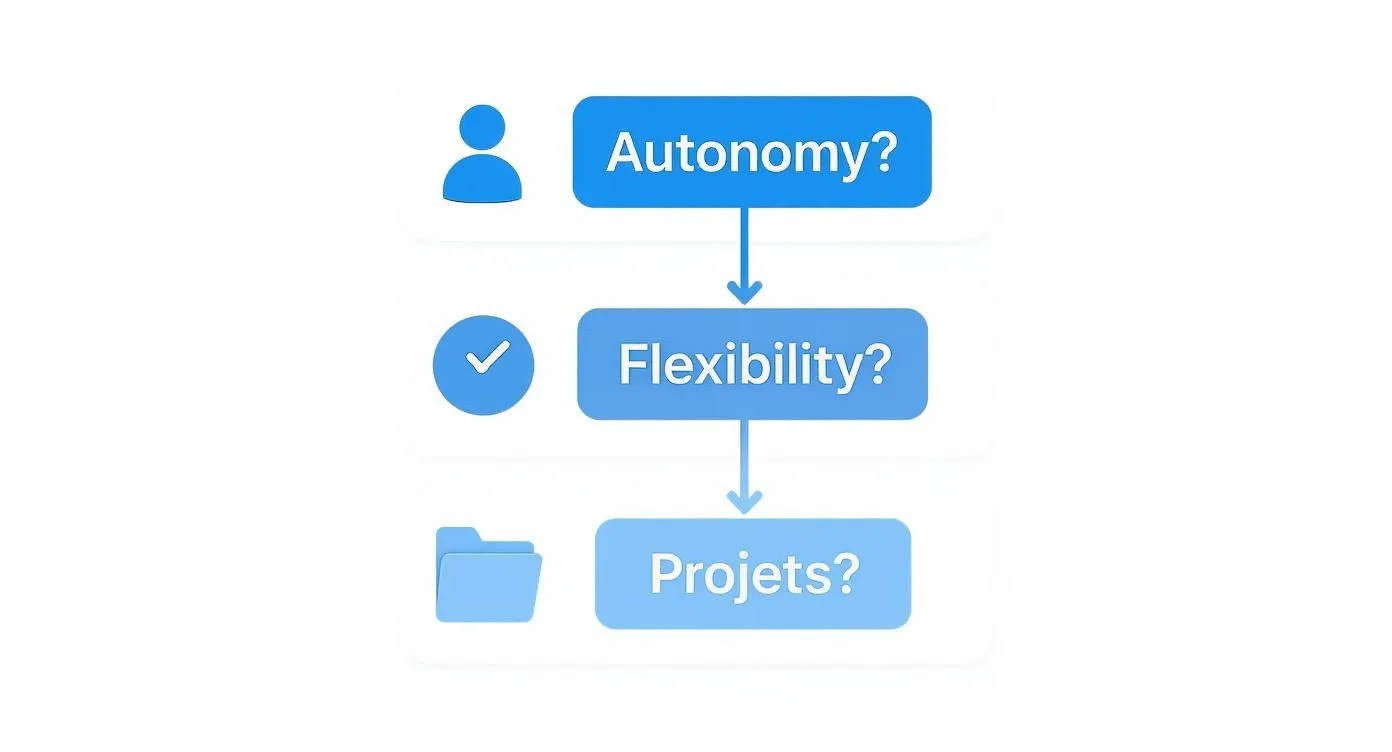
For this adventure to succeed over the long run, everything rests on three pillars:
- Autonomy: You’re in charge of everything: finding clients, handling the paperwork and guaranteeing the quality of your work.
- Flexibility: It’s great to be able to organize your own days, but it takes real self-discipline to stay efficient and deliver on time.
- Choice of assignments: It’s the luxury of being able to turn down a project that doesn’t excite you, so you can focus on the ones you’re passionate about and that help you grow.
This guide was designed to support you every step of the way. It will give you all the keys to confidently manage the administrative, financial and commercial aspects of your new life as a self-employed professional.
Which legal status should you choose for your freelance activity?
Going freelance is a bit like building a house: everything starts with the foundations. And in your case, the foundation is your legal status. It’s a crucial choice that will directly affect your taxation, your social security coverage and, let’s be honest, your day-to-day administrative workload.
When starting out, we tend to look for simplicity. And that’s an excellent strategy! That’s why the micro-entrepreneur (sole trader) status has naturally become the favorite starting point for most freelancers.
This status offers a truly reassuring framework for testing an idea and probing a market, without getting bogged down in complex procedures. Its greatest strength? Ultra-simplified management that lets you focus on what really matters: your craft.
The micro-entrepreneur status: the obvious choice for getting started
Choosing the micro-entrepreneur (sole trader) scheme clearly means choosing administrative peace of mind. The principle is simple: you declare the revenue (turnover) you’ve collected, every month or every quarter, and your social contributions are calculated on that basis. That’s it.
No revenue? No social contributions. This golden rule is a breath of fresh air when you’re starting out and cash inflows are still uncertain. It lets you keep control of your cash flow without any unpleasant surprises.
Even setting it up is a breeze. One online declaration on the INPI’s Guichet Unique (Single Business Registry), and boom, you receive your SIRET number. You’re ready to invoice. No articles of association to have validated by a lawyer, no capital to deposit at the bank.
Expert tip: Think of the micro-entrepreneur status as a fantastic sandbox. It’s perfect for validating your business model, refining your offer and building your first client base, all with virtually no financial or administrative risk.
Of course, this scheme has its limits. The main thing to watch is the revenue caps. For 2024, they are set at:
- €77,700 for services (freelance professions, consulting, etc.).
- €188,700 for commercial activities (selling goods, accommodation).
If you exceed these thresholds two years in a row, you automatically switch to the standard sole proprietorship (entreprise individuelle) regime. Nothing serious, but the accounting obligations become heavier.
When should you consider setting up a company (EURL or SASU)?
The micro-entrepreneur status isn’t an end in itself. If your project requires significant upfront investment or you have a lot of operating costs (expensive equipment, software, subcontractors), it’s worth looking at company structures like the EURL or the SASU.
The fundamental difference is that with a company, you can deduct all your business expenses from your revenue. In concrete terms, you’re only taxed on your actual profit. The tax impact can be huge.
Take the example of a developer who invests €5,000 in a new computer and software licenses. Under the micro-entrepreneur status, that amount changes nothing about their taxes. Under an EURL or SASU, it directly reduces their taxable income, and therefore their taxes and contributions.
These structures also create a genuine wall between your personal assets and those of your business. If something goes wrong, your personal property is protected. That’s a significant safeguard. To better understand the different options, our comparison of umbrella employment (portage salarial) versus freelance status can shed light on the alternatives to traditional employment.
Comparing legal statuses for freelancers
To help you quickly visualize which status might suit you, here’s a summary of the key points.
| Criteria | Micro-entrepreneur (Sole trader) | EURL (single shareholder) | SASU (single shareholder) |
|---|---|---|---|
| Accounting management | Very simplified (revenue ledger). | Full accounting required. | Full accounting required. |
| Social contributions | Fixed percentage of revenue. | Based on the manager’s compensation (self-employed status). | Based on the president’s compensation (employee-equivalent status). |
| Expense deductions | No (flat-rate allowance instead). | Yes, all actual expenses are deductible. | Yes, all actual expenses are deductible. |
| Revenue caps | Yes (€77,700 or €188,700). | No. | No. |
| Asset protection | Limited (business assets separated by default). | Protected, limited to contributions. | Protected, limited to contributions. |
| Ideal for… | Starting out, testing an activity, or a project with low costs. | Projects with investments, high revenue, need for optimization. | Ambitious projects, high revenue, seeking the best social protection. |
The choice between EURL and SASU often comes down to social protection and taxation. The SASU affiliates you with the general social security regime (like an employee), offering better coverage but with higher contributions. The EURL attaches you to the Social Security for the Self-Employed (SSI), which is cheaper but offers somewhat less protection.
In short, there’s no “bad” status, only a status that doesn’t fit your situation. The micro-entrepreneur status remains the perfect springboard for taking the plunge without risk. You’ll always have the option to move to a more complex structure once your business has taken off.
The steps to set up and register your business
There you go, you’ve chosen your legal status. Now it’s time to bring your project to life, to make it official. The registration step can seem a bit administrative and intimidating, but believe me, it’s much simpler than you’d imagine. Since 2023, everything has been centralized on a single platform: the INPI’s Guichet Unique (Single Business Registry).

The idea behind this single registry is to simplify life for all business founders, including us freelancers. Your goal is simple: officially declare your activity to receive your SIRET number. This is the essential key that will let you legally invoice your clients.
Get ready before you start on the Guichet Unique
A friendly tip: before you even open the INPI website, take a moment to gather all the necessary documents. Having everything on hand will save you precious time and keep you from having to pause the process to go hunting for a paper.
Here’s the little checklist of what you’ll need:
- A valid ID document: Your national ID card or passport. Remember to scan or photograph both sides.
- A recent proof of address: A bill (phone, electricity, etc.) less than three months old will do.
- Your social security number: Essential for your affiliation with the Social Security for the Self-Employed (the famous SSI).
- A sworn statement of no criminal conviction: No worries, this is a standard document you can generally download directly from the site. It’s just there to confirm you have the right to run a business.
Once you have this small file ready, the rest is fairly smooth. The online form will guide you step by step through describing your activity, providing your business address (often your home to start with) and making a few important tax choices.
The strategic choices to make from the start
Watch out, some of the boxes you’ll tick during your declaration will have a direct impact on your day-to-day management. Don’t take them lightly.
How often you’ll report to URSSAF
You’ll be asked whether you’d prefer to report your revenue monthly or quarterly. To get off to a good start, I often recommend the monthly option. It smooths out the payment of your contributions and lets you better anticipate your cash flow. It’s simpler to pay a little each month than a larger sum every three months.
The option for the flat-rate income tax withholding (versement libératoire)
This is an absolutely crucial point. If your taxable income from year N-2 is below a certain threshold, you can opt for the flat-rate income tax withholding.
In concrete terms, with this option, you pay your income tax at the same time as your social contributions. It’s a fixed percentage of your revenue, and that’s it. No more nasty surprise with a big tax adjustment the following year!
This decision must be made either at setup or within the following three months. It offers real peace of mind, so carefully review your situation to see if you’re eligible.
Don’t forget the ACRE to lighten your contributions
The ACRE (Aid for Business Creation or Takeover) is a breath of fresh air for any freelancer just starting out. If you meet the conditions (job seeker, under 26 years old, etc.), you can benefit from a 50% exemption on your social contributions during your first year.
Good news: the request is now made automatically through the Guichet Unique. Just tick the right box. It’s a significant saving that can really make a difference for your cash flow in the first few months.
Once your file is complete and sent, the INPI takes care of forwarding it to all the relevant bodies (URSSAF, tax authorities, INSEE). Wait one to four weeks, and you’ll receive your registration certificate by mail with your precious SIRET number. That’s the official starting gun: you’re ready to send your first invoice.
Managing your invoicing and tax obligations
There you go, your business is officially up and running! Now you’re getting into the thick of it: day-to-day management. Knowing how to invoice properly and meet your tax deadlines is what will ensure your business lasts. This is your new routine as a business owner, but don’t worry, once you’ve got the hang of it, everything will run smoothly.
The first step, and not the least important, is creating flawless invoices. An invoice isn’t just a piece of paper to ask for your money. It’s a legal and accounting document that must contain very specific information. A simple mistake or omission can cause payment delays, or even disputes with your clients.
The perfect invoice as a micro-entrepreneur
Every invoice you send should be a model of clarity and compliance. It’s a real mark of professionalism that will build your client’s confidence and protect you legally. One simple tip to start: set up a sequential numbering system with no gaps (for example, Invoice 2024-001, 2024-002, etc.).
Here are the details that absolutely must appear on your invoices:
- Your complete information: Your first and last name, your registered address, and of course your SIRET number.
- Your client’s details: Their name (or company name if it’s a business) and their address.
- The invoice number and date: Essential for tracking.
- The details of the service: Precisely describe the work carried out, the quantity and the unit price excluding tax (pre-tax).
- The VAT notice: If you benefit from the VAT exemption threshold (as most freelancers just starting out do), you must add the mention “VAT not applicable, art. 293 B of the French Tax Code”.
Issuing compliant documents is simply fundamental. To make sure you don’t forget anything, check out our complete guide on the rules for invoicing as a sole trader (auto-entrepreneur), which breaks down every mandatory item.
Your appointments with URSSAF
Your main point of contact for everything related to social contributions will be URSSAF. Depending on the option you chose when registering, you’ll need to report the revenue you’ve collected either monthly or quarterly.
Fortunately, the process is very simple. You log into your online account, enter the amount you actually received during the period in question, and the site instantly calculates what you owe.
Friendly tip: Even if your revenue is zero, the declaration is mandatory. A simple oversight, even for declaring €0, can lead to a penalty. My trick: set a recurring alarm in your calendar so you never miss a deadline!
This system has a huge advantage: you only pay contributions on the money you actually earn. It’s a major benefit of the micro-entrepreneur scheme for keeping control of your cash flow when starting out.
Understanding your other tax obligations
Beyond URSSAF, you’ll have two other major tax deadlines to keep in mind.
-
Income tax return: Once a year, in the spring, you’ll need to declare the income from your freelance activity along with your other personal income. You’ll simply need to report your gross annual revenue in the “micro-BNC” or “micro-BIC” section of your return. The tax authorities will then apply a flat-rate allowance to calculate your taxable income.
-
The CFE (local business tax, Cotisation Foncière des Entreprises): This is a local tax that almost all businesses must pay. It’s paid once a year, toward the end of the year.
- The good news: You’re fully exempt from the CFE in the year your business is created.
- For this exemption to be properly applied, you must file an initial declaration (form 1447-C-SD) before December 31 of your first year of activity.
By familiarizing yourself with these few obligations, you ensure calm, surprise-free administrative management. You’ll then be able to focus on what matters most: finding new assignments and satisfying your clients.
Finding your first clients and building your reputation
There you go, your status is set up, you have your SIRET number in hand. This is probably the most exciting moment, but also the most intimidating: now you need to find those first assignments. Starting from zero can feel like climbing a mountain, but with a bit of method, you’ll quickly land your first contracts and start building the reputation that will drive your success.
The first thing to do is polish your online presence. Your LinkedIn profile, for example, is much more than just a resume. It’s your storefront. It should shout your expertise, show what you bring to the table, and immediately make people want to contact you.

To really stand out and build credibility, it’s essential to learn how to optimize your LinkedIn profile for visibility. We’re talking about a professional photo, a headline that grabs attention and says more than just “Freelancer,” and an “About” section that tells your story and highlights the concrete benefits you bring.
Start with your network: the foundation of everything
Before diving into cold outreach, which can be pretty discouraging at first, tap into what you already have: your network. Talk about your new activity to your friends, your family, your former colleagues. We tend to underestimate the power of this inner circle.
- Make an official announcement: A well-crafted, enthusiastic post on your social networks is often enough to let everyone know you’re available for assignments.
- Reach out directly: For the most relevant people, a private message explaining in more detail what you offer is an excellent idea. It’s more personal and more effective.
- Don’t be afraid to ask for introductions: Your network probably knows someone who needs you. A recommendation is priceless when you’re starting out.
This simple approach is often the fastest path to landing a first assignment and, above all, a first client testimonial.
Playing the hyperspecialization card to avoid getting lost in the crowd
Facing increasingly tough competition, trying to please everyone is the best way to interest no one. The key is to become THE go-to expert in one very specific niche. This is what’s known as hyperspecialization.
This approach has become the norm. Recent figures show that 78% of freelancers focus on fewer than two sectors. The preferred fields remain creative professions (29%), tech (23%) and digital marketing (23%). And it works! 57% of French companies have already worked with freelancers, proof that the market is there and looking for experts.
Specializing doesn’t mean closing doors. It means choosing the playing field where you’ll be unbeatable. A client will always prefer to pay a specialist who knows their sector inside out rather than a generalist.
Concretely, instead of presenting yourself as a simple “web copywriter,” become the “web copywriter specializing in fintech startups.” Your pitch instantly becomes more compelling and your target audience much clearer.
How do you build a portfolio when starting from scratch?
“How do I show what I can do if I’ve never had a client yet?” This is the great paradox of the beginner freelancer. The solution is simple: if no one gives you experience, create it yourself to fill your portfolio.
- Work on fictional projects: Invent a client, a need, and carry out the assignment from start to finish. Create a logo for an imaginary brand, write a series of articles for a fake company, develop a mini-app that solves a real problem.
- Offer your services at a reduced rate (or for free): Reach out to a local nonprofit or a small business in your circle. It’s an excellent way to get a real project, a recommendation, and do a good deed along the way.
- Create for yourself: Launch a blog, a YouTube channel, a personal project related to your field. It’s the ultimate proof of your skills and your passion.
The goal is to have 2 or 3 solid pieces to show. That will immediately reassure your first prospects about your ability to deliver quality work and turn a simple initial contact into a real opportunity.
Answering your last questions
Even after reading a complete guide, a few very concrete questions often remain. That’s completely normal! This last section is here to clear up the points still on your mind and give you the confidence you need to take the leap.
Can you really be freelance and employed at the same time?
Yes, absolutely no problem! It’s actually an excellent strategy for starting out with a financial safety net. You test your project while keeping the stability of your job.
The only line you shouldn’t cross is loyalty to your employer. Your employment contract probably contains a clause forbidding you from directly competing with them. As long as your freelance activity doesn’t step on your company’s toes and you develop it in your free time, everything’s fine. Transparency is often the best policy, don’t hesitate to discuss it if the context allows.
Is a dedicated business bank account really mandatory?
Legally, for a micro-entrepreneur, the obligation to open an account dedicated to the business only applies if your revenue exceeds €10,000 for two consecutive years.
Friendly advice: don’t wait until you’re forced to. Open a separate account right from the start. It will dramatically simplify your life. No more headaches trying to distinguish business expenses from Saturday’s grocery run. Your finances will be clear, and your bookkeeping much, much simpler.
How do you survive periods without any assignments?
Quieter periods are part of the game when you’re self-employed. Everyone goes through them. What matters is not seeing them as a fatality, but preparing for them so you can turn them into opportunities.
The foundation is having a cash reserve. Try to set aside enough to cover 3 to 6 months of your fixed expenses. That changes everything for your peace of mind. Once that cushion is secured, use this time to invest in yourself:
- Go on the offensive: This is the perfect time to follow up with clients, reach out to new prospects and go through your network.
- Level up your skills: Take that training you’ve been putting off for months. Learning a new tool or a new method can allow you to raise your rates.
- Work on your image: Update your portfolio with your latest projects, polish your LinkedIn profile, write one or two articles to showcase your expertise.
By seeing these periods as building phases rather than dead time, you adopt a mindset that will make all the difference in the long run.
Ready to shift into high gear? Bizyness was designed for freelancers who’d rather spend time on their assignments than on admin work. Quotes, invoices, payment tracking… it’s all simplified. Discover how to free up your time at https://www.bizyness.fr.
