

 Français
How much does it cost to become a sole trader in 2020
Setting up a sole trader business is free, but it later comes with various charges throughout its existence. Find out which ones so you can build an accurate budget forecast.

Registering as a sole trader (auto-entrepreneur / micro-entrepreneur) is free, but you need to plan for the charges that will arise from your business activity. At startup, and then throughout the life of your business, you’ll need to pay various amounts, which we detail here.
Sole trader charges when you start out
Registration itself is completely free; however, depending on the activity you choose, you may be liable for additional fees.
Craft activities
If you’re a craftsperson, the SPI (Stage de Préparation à l’Installation) training course is no longer mandatory, following the enactment of the Pacte law on 24 May 2019. Before that date, sole traders registered with the Chamber of Trades and Crafts had to complete a Business Start-up Preparation Course. Some self-employed workers could be exempted under certain conditions if they held specific qualifications. Now, this course is optional.
You can therefore choose to take part in an SPI course, and to do so, contact your local Chamber of Trades and Crafts. The cost is €194 (it used to be €250). Find out exactly what the course covers, so you make sure it’s genuinely useful to you.
The topics new sole traders generally want to explore revolve around accounting, particularly notions around VAT application and administrative formalities. However, since sole trader accounting and administrative obligations are extremely simplified, it may be wiser to save your money for another investment.
As a side note, it was the Pinel law of 20 June 2014 that made this costly and unnecessary SPI course mandatory in the first place. This sparked some discontent, such as the case of a Michelin-starred chef who was required to take the course to open a table d’hôte, simply because he didn’t hold the specific qualification!
Commercial agents
If you’re a commercial agent, you can become a sole trader, but you’re required to register with the RSAC, the Special Register of Commercial Agents. To do so, contact the clerk’s office of the commercial court.
This will cost you €25.19.
Opening a bank account dedicated to your sole trader business
Originally, there was no requirement to open a dedicated bank account, since the sole trader status was created to simplify administrative matters and limit operating costs for the self-employed.
After attempting to scale back, or even abolish, this status, Michel Sapin, Minister of Labour in 2012, succeeded instead in making it more complex and generating unnecessary costs for sole traders, on top of the time lost making transfers between accounts.
Indeed, he made it mandatory to hold a bank account dedicated to the sole trader business. However, it doesn’t need to be a business account. That said, a bank account, even for individuals, even with an online bank, costs money each year. You should compare options to find the account that will cost you the least. Banks, and online banks in particular, compete fiercely on banking fees, which can work in your favor, but there will always be some unavoidable costs.
This account must be opened within twelve months of setting up your sole trader business. Since the Pacte law, opening this account is no longer mandatory for sole traders whose annual revenue is below €5,000, for two consecutive years.
Professional insurance
For certain trades, you’re required to hold professional insurance. This is notably the case for construction trades. Your insurance must be in place from the very first day of your activity.
You can also take out professional liability insurance. It covers you if you risk causing damage to clients, since your personal insurance policies don’t cover incidents or accidents that occur in a professional context.
Sole trader charges throughout the life of the business
One of the great advantages of your status is that you only pay sole trader charges based on your revenue. If you don’t declare any revenue, you owe no social security contributions, unlike a traditional company, which is subject to fixed, unavoidable charges.
You pay your charges monthly or quarterly, at the same time you declare your revenue.
The CFP
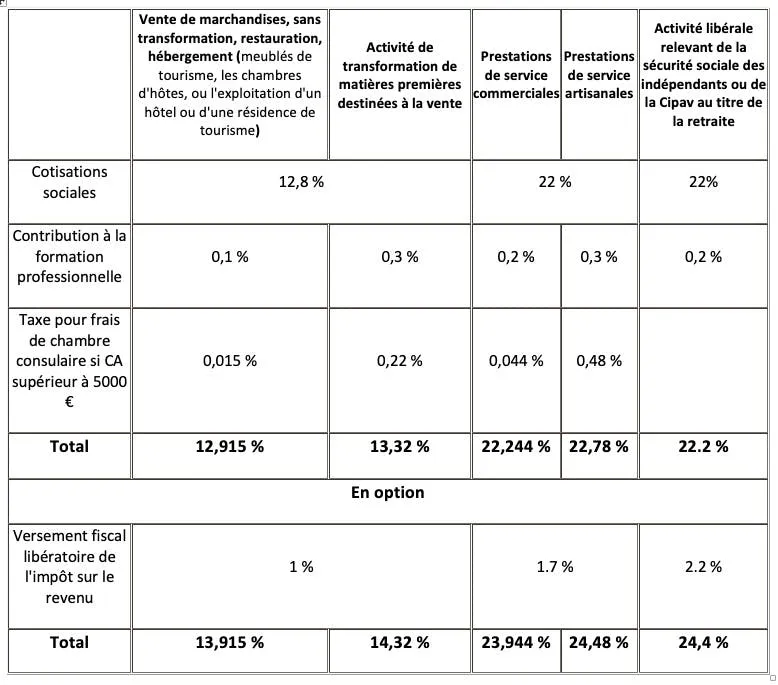
You’re subject to the Contribution to Vocational Training (Contribution à la Formation Professionnelle). It corresponds to a percentage of your revenue and you pay it at the same time as your social security contributions.
The CFP allows you to get financial support for training. To be eligible, you must have generated revenue over the past 12 months.
The TFCC
The TFCC are the Chamber Fee Taxes (Taxes pour Frais de Chambre Consulaire). They are additional taxes on top of the Corporate Property Contribution (CFE).
Depending on your situation, they will be labeled as the Chamber of Trades and Crafts Tax (TCMA) or the Chamber of Commerce and Industry Tax (TCCI).
The final withholding tax option
If you opted for the final withholding tax (versement libératoire), it is added at the same time to the amount due.
The ACRE
Depending on the date you set up your sole trader business, you may be eligible for the ACRE, which applies specific reduced rates to your social security contributions.
Summary table of sole trader charges
The Corporate Property Contribution (CFE)
The CFE is a local tax that replaced the former business tax (taxe professionnelle). It is one of the sole trader charges and is calculated based on your business’s registered location, your revenue, and the rate set by your municipality.
The CFE becomes due starting from the second year after your sole trader business is created. You’ll receive a form to return during your first year, which will serve as your initial declaration.
How to get an exemption from CFE charges
If your revenue is below €5,000, you’re exempt from CFE.
It’s also possible to get a CFE exemption for certain craft activities. To qualify, you must practice a manual trade, not speculate on raw materials, and not use equipment or machinery that could be considered a significant part of your income.
The location of your sole trader business can also entitle you to tax benefits. Local authorities (municipalities, departments, and regions) have identified areas in need of economic revitalization. These are known as Employment Areas to be Revitalized (BER), Urban Free Zones (ZFU), and Defense Restructuring Zones (ZRD).
You must request this exemption when filling out your initial CFE declaration, which you need to return during your first year of activity.
When planning your sole trader business, you therefore need to take all these sole trader charges into account. Depending on your activity, you must also plan for your everyday expenses: travel to visit clients, purchases of raw materials, etc. These are in no way deductible from your income tax returns.
