

 Français
 How to calculate net to gross price easily: Step-by-step guide
Learn how to calculate net to gross prices with ease. Follow our guide to master this conversion and avoid mistakes.

Going from a price excluding VAT (net) to a price including VAT (gross) may sound simple, but it’s a crucial operation for any entrepreneur. The basic formula is straightforward: multiply the net price by (1 + the VAT rate).
For example, if you sell a product for €100 net and the applicable VAT is 20%, the final price for your customer will be €120 gross. The calculation is: €100 x (1 + 0.20), or €100 x 1.20. Knowing how to handle this calculation is essential for setting consistent prices and avoiding invoicing errors.
The basics to master: net price, gross price and VAT
Before diving headfirst into calculations, it’s essential to understand the three pillars of invoicing in France. Mastering the relationship between the net price (excluding VAT), Value Added Tax (VAT) and the gross price (including VAT) is the first step toward flawless commercial documents.
What exactly is the net price?
The net amount is simply the base price of your product or service. It’s the sum that comes back to you directly, before the State takes its share. Think of it as your gross revenue for a given sale; it’s on this basis that you’ll calculate your margins and profitability.
The central role of VAT
Value Added Tax (VAT) is an indirect tax paid by the end consumer. As a business, your role is that of an intermediary: you collect it on behalf of the State. You charge VAT to your customers, then remit it to the tax authorities. This money therefore never actually belongs to you.
Did you know? VAT is designed to be neutral for your business. You collect VAT on what you sell (output VAT) and, at the same time, you recover the VAT you paid on your own business purchases (input VAT). What you remit to the State is the difference between the two.
The move from net to gross depends entirely on the VAT rate you apply. In France, the standard rate has been set at 20% since January 1, 2014, but other rates also exist.
The gross price: the final amount for the customer
The gross amount is the price your customer ultimately pays. It combines the net price of your service and the amount of VAT.
The logic is therefore as follows: Gross price = Net price + VAT amount.
This distinction is not a minor detail. A mistake on the VAT rate or the calculation can lead to complications with the tax authorities. To go further, feel free to check out our full guide on calculating VAT, packed with information and concrete examples.
The main VAT rates applicable in France
In France, several VAT rates coexist. The most common is the standard rate of 20%, but it’s crucial to check whether it actually applies to your activity, as reduced rates exist for certain products and services.
This table helps you quickly identify the right VAT rate for your products or services, a key step for an accurate net-to-gross calculation.
| VAT rate | Designation | Examples of application |
|---|---|---|
| 20% | Standard rate | The majority of goods and services. |
| 10% | Intermediate rate | Restaurants, renovation work, passenger transport. |
| 5.5% | Reduced rate | Food products, books, live performance tickets. |
| 2.1% | Special rate | Reimbursable medicines, press. |
Knowing these rates is fundamental. Applying the wrong percentage can distort your invoices and complicate your VAT return. So always take the time to check which rate applies to your situation.
Going from net price to gross price: the calculation method explained
Now that you have the basics, let’s move on to practice. Calculating a gross price from a net amount is a common, even daily, operation for any entrepreneur. Fortunately, the method is simple and reliable, as long as you follow the logic carefully to avoid getting tangled up.
The very first thing to do, and this is crucial, is to identify the correct VAT rate for your product or service. As we’ve seen, rates can range from 2.1% to 20%. A mistake here throws off your entire invoicing and returns. So take the time to check carefully.
From percentage to coefficient: the trick that simplifies everything
Once you know the right VAT rate, there’s a small trick to make the calculation ultra-fast: turn that percentage into a multiplying coefficient. This is much more direct than calculating the VAT amount and then adding it to the net price.
Here’s how it works for the most common rates:
- 20% VAT: the coefficient is 1.20.
- 10% VAT: the coefficient is 1.10.
- 5.5% VAT: the coefficient is 1.055.
- 2.1% VAT: the coefficient is 1.021.
Behind this conversion, the logic is quite simple: Coefficient = 1 + (VAT rate / 100). Adopting this method makes calculating the final price much smoother.
Calculating the gross price: the last step
With your coefficient in hand, the hard part is done! All that’s left is to multiply your net price by this figure to get the gross amount directly.
In short, the formula to remember is: Gross price = Net price x (1 + VAT rate/100).
A single multiplication, and you get the final amount your customer will have to pay, tax included.
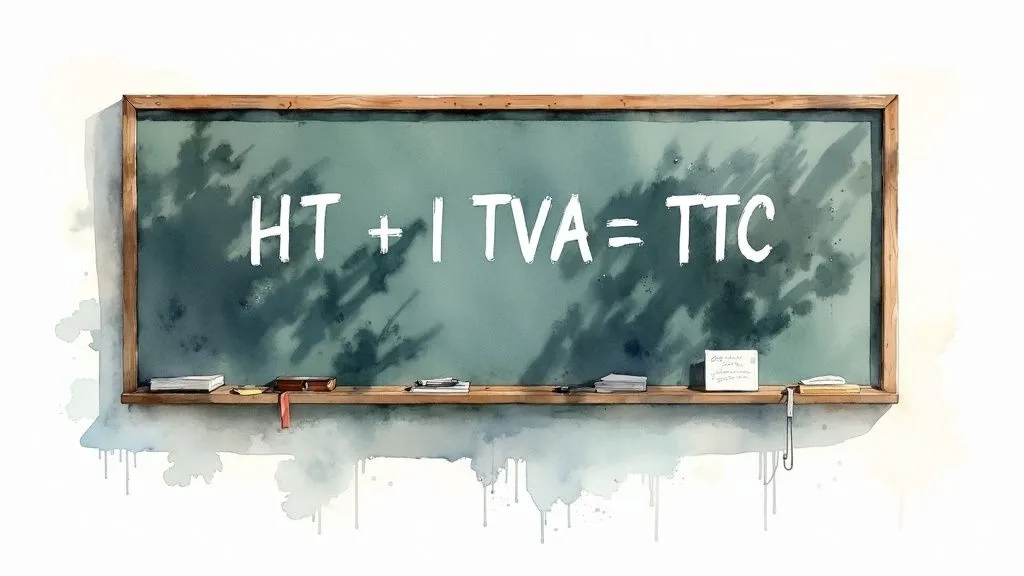
The image below perfectly summarizes this process, from the base price to the final amount on the invoice.

This visual makes it clear: the gross price is simply an increase over the net price, in a proportion dictated by the VAT rate. By mastering this formula, you ensure your invoices are always accurate and compliant with regulations. It’s a real peace of mind.
Concrete examples for each VAT rate
Theory is great, but nothing beats practice to truly master a subject. To make the net-to-gross conversion second nature, the simplest approach is to look at concrete situations, the kind you face every day in your business.
Let’s go through a few use cases for the main VAT rates together. These scenarios will help you better visualize the impact of each rate on your selling prices and make sure you’ve fully grasped the calculation method. Practice makes perfect, after all.
Service provision at the standard rate of 20%
Imagine you’re a marketing consultant and need to invoice a client for a project. You’ve agreed on a fee of €800 net.
For this service, the standard VAT rate applies.
- Net amount: €800
- VAT rate: 20% (so the coefficient is 1.20)
- Gross price calculation: €800 x 1.20 = €960 gross
Your client will therefore need to pay you €960. Of this total, €160 corresponds to VAT (€960 - €800), an amount you collect on behalf of the State and will need to remit to it.
A restaurant meal at the intermediate rate of 10%
Let’s change scenery. You’re a restaurant owner. A couple orders two set menus at €35 each. The price on your menu is displayed gross, as required by law, but for your bookkeeping, you need to clearly separate the net amount from the VAT.
For this example, let’s assume your cost price and desired margin bring you to a net price of €70 for these two meals.
- Net amount: €70
- VAT rate: 10% (so the coefficient is 1.10)
- Gross price calculation: €70 x 1.10 = €77 gross
You’ll present a bill of €77 to the customers. The VAT you collected on this table is €7.
Watch out for a classic pitfall in the restaurant business: several VAT rates can coexist on a single bill. If your customers had ordered a bottle of wine with their meal, the alcoholic beverages would have been taxed at 20%, not 10%. You need to stay vigilant.
Selling a book at the reduced rate of 5.5%
One last practical case: you’re an independent bookseller. You bought a novel from your supplier for €12 net. After applying your markup, you decide to sell it for €20 net.
The book, as a cultural item, fortunately benefits from a reduced VAT rate.
- Net amount: €20
- VAT rate: 5.5% (so the coefficient is 1.055)
- Gross price calculation: €20 x 1.055 = €21.10 gross
The price the customer will see on the shelf will therefore be €21.10. As you can see from these examples, the calculation mechanism stays the same; only the multiplying coefficient changes depending on the applicable VAT rate.
How to easily go from a gross price to the net amount
As an entrepreneur, if you already know how to go from a net amount to a gross price, mastering the reverse path is just as crucial. It’s an operation you’ll do constantly: to analyze your margins, break down a supplier invoice, or prepare your VAT returns.
The logic is the reverse of adding VAT. To get back to the base amount, you shouldn’t subtract, but divide. You’ll use the same VAT coefficient as for the net-to-gross calculation, but this time it will serve as a divisor.
The formula for finding the net amount
To isolate the net amount from a price including VAT, the formula is fairly direct. No need to overcomplicate things.
Net amount = Gross amount / (1 + VAT rate/100)
Let’s take a concrete example. You paid €240 gross for a product with a standard VAT rate of 20%. The calculation is simple: €240 ÷ 1.20 = €200 net. It’s as simple as that. Keep this formula handy, it’s fundamental for sound management.
Knowing how to do this calculation by hand remains a valuable skill, even in the all-digital era. Indeed, nearly 75% of French businesses use software for these conversions, but nothing replaces a quick check to make sure everything is correct.
The mistake everyone makes (and how to avoid it)
The most common mistake, by far, is trying to subtract the VAT percentage directly from the gross amount. It’s an understandable reflex, but it always leads to a wrong result.
Let’s see why with a simple example:
- The correct calculation: An item costing €120 gross (VAT at 20%) corresponds to €120 / 1.20 = €100 net.
- The wrong calculation: Calculating 20% of €120 (i.e. €24) and subtracting it (€120 - €24 = €96) is a mistake.
The reason is that VAT is calculated on the basis of the net amount, not the final amount. It’s a subtle nuance, but one that makes all the difference. Once you’ve understood it, you’ll never make the mistake again.
Of course, to make your daily life easier, tools like Bizyness handle these operations automatically, without you having to think about it. If this interests you, our article on automatic VAT calculation explains how these solutions can save you valuable time.
Tools that will make your life easier with VAT
Calculating VAT by hand is a good exercise for understanding the mechanism. But let’s be honest, day to day, it’s a waste of time and an open door to mistakes. A small typo, the wrong rate applied, and your entire bookkeeping can be thrown off. Fortunately, there are much more reliable and faster solutions.
By adopting a dedicated tool, you give yourself considerable peace of mind. No more stress over calculation errors or missing a rate change.
Why invoicing software changes the game
The real advantage of management software like Bizyness is that it automates everything. You create a quote, add your products or services at net price, and that’s it. The software handles applying the correct VAT rate and calculating the gross amount on its own.
Think of a freelancer juggling multiple small assignments. If they spend 5 minutes on each invoice by hand, the lost time adds up fast. With a tool, it comes down to a few clicks. Over a year, that’s entire hours saved, which you can spend on your clients instead of paperwork.
These tools also ensure you’re always up to date. VAT rates are updated automatically as regulations change. No need to keep track of the latest finance laws yourself, the software does it for you.
The online calculator: the trick for a quick check
You don’t necessarily need a full solution, or you just want to quickly check a figure? Online VAT calculators are perfect for that. They’re free, fast and accessible everywhere.
It’s the ideal tool in several situations:
- Checking a supplier invoice to make sure the VAT amount is correct.
- Giving a quick gross price estimate on the fly during a conversation with a customer.
- Finding a net amount from a simple receipt for your expense reports.
Whether it’s a full invoicing software or a simple web calculator, these tools are there to help you gain efficiency and peace of mind. Make the most of them.
Frequently asked questions about calculating net to gross price
Even with the right formulas in mind, going from the net price to the gross price often raises a few practical questions. That’s perfectly normal. Let’s dive into the most common questions together to clear up any remaining doubts and let you invoice with complete peace of mind.
How can I find the VAT amount in a flash?
To extract the exact VAT amount from a net price, no need for complicated calculations. Forget about calculating the gross price and then subtracting. The most direct method is to multiply your net base by the VAT rate.
Let’s take a concrete example: a service invoiced at €200 net with VAT at 20%. The calculation is as simple as it gets: €200 x 0.20 = €40. That’s the exact VAT amount. Your gross total will therefore be €200 + €40, or €240.
Is VAT mandatory on all invoices?
No, not necessarily! It’s entirely a question of legal status and revenue. If you’re a micro-entrepreneur under the VAT exemption scheme (franchise en base), for example, you don’t collect VAT.
In that case, your invoices are issued net of VAT. They must include the mandatory legal notice: “TVA non applicable, art. 293 B du CGI” (VAT not applicable). It’s only once you exceed certain revenue thresholds that you switch over and become liable for VAT. For more clarity, I invite you to read our guide on VAT for sole traders / micro-entrepreneurs.
What’s the classic mistake to avoid when finding the net price?
Ah, the famous mistake! Many people, trying to find the net amount from a gross amount, are tempted to subtract the VAT percentage from the total. This is a reasoning error, because VAT is added on top of a net base, it isn’t calculated on the gross amount.
Imagine a product at €120 gross (VAT at 20%). The wrong reflex would be to do €120 - (20% of €120), which gives a wrong result of €96. The one and only correct method is to divide the gross price by the appropriate coefficient: €120 / 1.20 = €100 net. That’s the real base price.
What about invoicing customers abroad?
Invoicing outside France can quickly become a headache. VAT handling depends on two things: where your customer is located (inside or outside the EU) and who they are (a business or an individual).
- For businesses based in the EU: This is often referred to as reverse charge. You invoice net of VAT, and it’s your customer who handles the VAT declaration in their country.
- For customers outside the EU: Generally, services are exempt from French VAT, but be careful, specific rules may apply depending on the case.
International taxation is a complex topic. My most sincere advice: to avoid any risk, work with a chartered accountant who can secure your invoices and guarantee that you’re compliant.
VAT, quotes, invoicing… none of this should keep you up at night. With Bizyness, you can automate these calculations, be confident in your compliance and, above all, get back valuable time to focus on what really matters: growing your business.
