

 Français
How to Calculate Selling Price: A Simple and Effective Method
Learn how to calculate selling price easily, factoring in cost, margin and VAT to optimize the profitability of your business.

Setting the right selling price isn’t just a matter of arithmetic. It’s a genuine balancing act. To understand how to calculate a selling price, you need to juggle three key elements: your product’s full cost price, the profit margin you’re aiming for, and the VAT to apply. It’s the harmony between these three pillars that ensures your project’s profitability.
How do you lay the foundations of a solid pricing strategy?
Setting a selling price is one of the most important decisions you’ll ever make. It’s not just a number on a label. It reflects the value of your offer, your position in the market and, ultimately, the long-term viability of your business.
A poorly set price can quickly turn into a nightmare. Too low, and you risk working for nothing, or even at a loss, while giving the impression that your product is of poor quality. Too high, without a perceived value to justify it, and you’ll send potential customers straight to the competition.
The pillars of well-thought-out pricing
Before pulling out the calculator, it’s crucial to understand the foundations of a fair price. A good pricing strategy isn’t about copying what the competitor next door is doing. It rests on a sharp analysis of your own business.
Here are the three fundamentals you need to master inside out:
- Perfect knowledge of your costs: You need to know precisely every euro spent producing and marketing your offer. This means direct costs (raw materials, for example), but also all indirect costs (your workshop’s rent, marketing expenses, salaries, and so on).
- Defining a coherent margin: Your margin isn’t just a nice extra. It’s what pays your bills, secures your income, and gives you the means to reinvest and grow your business.
- Understanding perceived value: The displayed price must match what your customers believe your product is worth. What problem are you solving for them? What unique benefit are you bringing them? The answer to these questions is the key to justifying your price.
A price isn’t just what the customer pays. It’s the sum of the value, the trust, and the promise your brand carries. Underestimating it weakens your entire business model.
Why copying the competition is a bad idea
It’s tempting to glance at competitors’ prices and simply align with them. That’s interesting information, sure, but it should never be your only guide. Your competitors don’t have the same overhead as you, not the same value proposition, and certainly not the same goals.
By building your own strategy, you stay in control. You’re able to explain the value of your offer and make sure every sale strengthens your business’s financial health. In the steps that follow, we’ll break down each phase of the calculation so you can build this strategy with confidence.
Cost price: the cornerstone of your selling price
To set a selling price that makes sense, everything starts from one single point: the cost price. It’s the foundation on which your entire profitability rests. In concrete terms, it’s the sum of all the expenses you incur to bring a product or service to market.
Underestimating it, or worse, ignoring it, is a bit like sailing blind through a storm. You risk selling at a loss without even realizing it. This figure is far more complex than the simple purchase cost of your raw materials; it covers absolutely everything, from the most obvious expenses to the most hidden ones.
Direct vs. indirect costs: how do you sort them out?
To start, you need to carry out a genuine inventory of your expenses. They’re usually sorted into two broad families to make things clearer: direct costs and indirect costs.
The distinction is fairly easy to grasp:
- Direct costs are the ones you can directly “attach” to a product. Think of the raw materials used to build a table, the wages of the worker who assembled it, or even the shipping costs to receive the wood. It’s everything intrinsically tied to the creation of the product itself.
- Indirect costs are more general. They’re essential to your business running smoothly, but you can’t attribute them to a single table. This includes your workshop’s rent, electricity bills, your accountant’s fee, or your advertising budget on social media.
This visual perfectly illustrates the idea: direct costs are the bricks of your product, while indirect costs are the mortar holding the whole structure together.
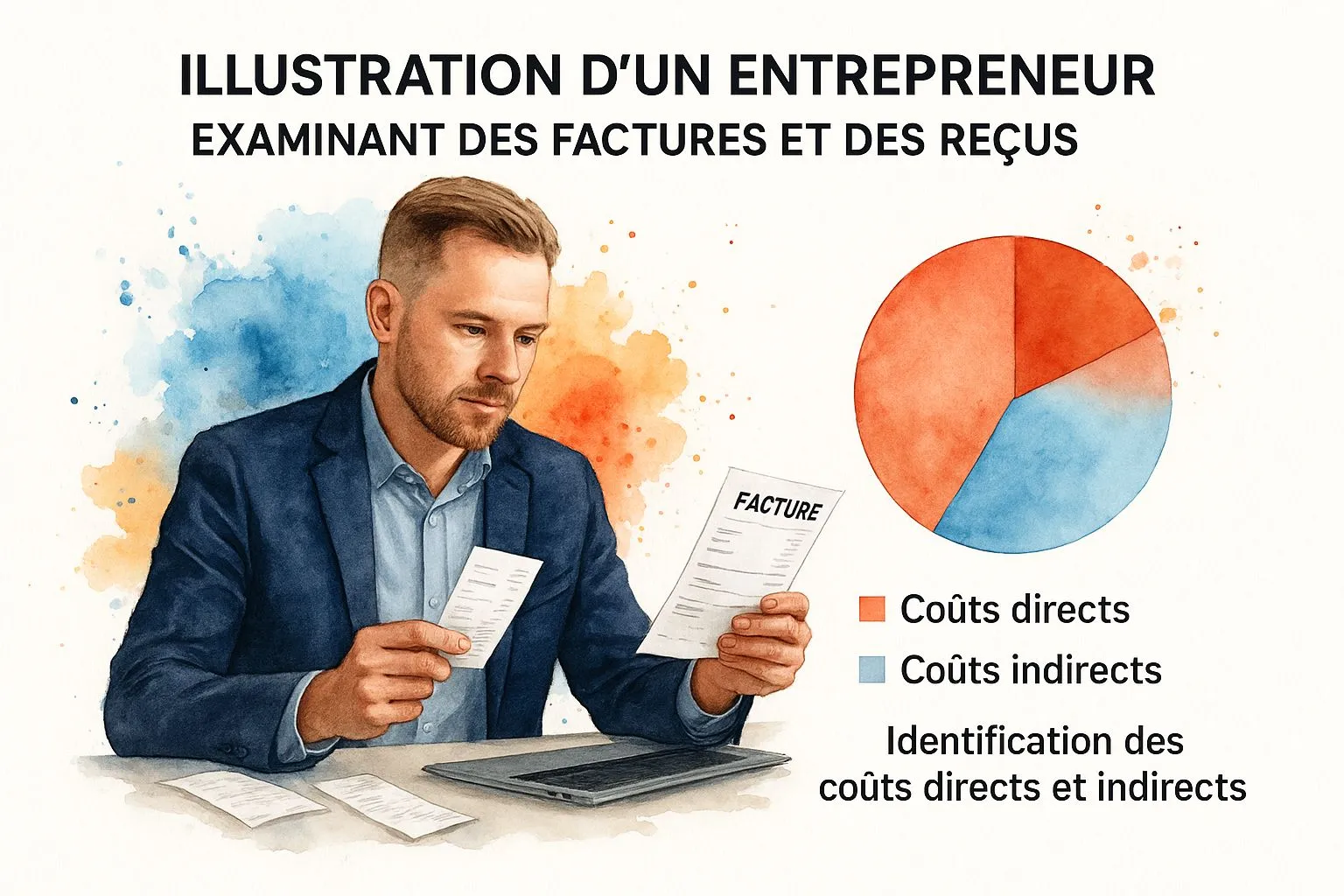
Every invoice, every expense, no matter how small, should be scrutinized so nothing is left to chance. This rigor is what makes the difference.
The nuance of fixed and variable costs
To go further, you also need to think in terms of fixed and variable costs. Fixed costs, as the name suggests, don’t move whether you sell one table or a hundred (your rent, for example). Variable costs, on the other hand, evolve with your activity: the more you produce, the more they increase (the cost of wood, for example).
The real challenge isn’t so much adding up the obvious costs as knowing how to intelligently allocate indirect and fixed costs across each product sold. The accuracy of your cost price depends entirely on this allocation.
This distinction is fundamental. If the topic interests you, our dedicated guide to calculating variable costs will give you extra keys to refine your analysis.
To illustrate how these costs combine, let’s take a concrete example.
Example of cost allocation for a product
This table shows how the different costs are allocated to calculate the unit cost price for a production run of 1,000 units.
| Cost type | Details | Total amount (€) | Cost per unit (€) |
|---|---|---|---|
| Direct variable costs | Raw materials (wood, screws) | €5,000 | €5.00 |
| Direct variable costs | Direct labor (wages) | €10,000 | €10.00 |
| Indirect fixed costs | Workshop rent, insurance | €2,000 | €2.00 |
| Indirect variable costs | Electricity, delivery fees | €1,500 | €1.50 |
| Total | Total cost price | €18,500 | €18.50 |
The final calculation is simple in theory: add up all the costs over a given period (a month, for example) and divide that total by the number of products manufactured during that same period. In our example, the cost price to make one unit is €18.50.
This figure, and only this one, must serve as the starting point for what follows. Once you fully master it, you can finally address the question of the margin you want to apply.
How do you set the right margin to become (and stay) profitable?

There you have it, you now have a clear view of your cost price. That’s the foundation everything else will rest on. Now for the crucial step: defining your commercial margin. It’s what makes the difference between simply “selling” and “making money”.
Choosing this margin is a genuine balancing act. It needs to be generous enough to cover all your expenses, pay yourself a salary and fund your growth. But it shouldn’t be so high that it scares customers away. It’s quite an art.
Markup or margin rate: two tools for the same goal
In the jargon, you often hear these two concepts. They may sound similar, but they don’t approach the problem from the same angle.
The markup rate is your ally if you start from the purchase cost. It’s a classic in trade and retail. It answers the question: “How much do I earn compared to what I paid for this product?”
Its formula is straightforward:
Selling price excl. VAT = Purchase cost excl. VAT x (1 + Markup rate)
The margin rate, on the other hand, works differently. It expresses your gain as a percentage of the final selling price. It’s a performance indicator that shows what share of every euro collected is actually profit.
To calculate it, the formula is slightly less intuitive:
Selling price excl. VAT = Cost price / (1 - Margin rate)
Grasping the difference is essential. The markup rate helps you build your price from the cost. The margin rate lets you break down the profitability of an already-established selling price.
What’s your survival margin?
The real question, beyond the formulas, is: which figure should you choose? Above all, your margin must let you cross the break-even point, meaning cover all your costs (fixed and variable). This is your minimum viable margin.
It’s not a number pulled out of thin air. It depends entirely on your cost structure. It must not only ensure your business runs day to day, but also give it the means to grow: invest, communicate, innovate.
To that end, calculating your break-even point is an essential step. Our dedicated guide to calculating the break-even point will walk you step by step through determining the minimum revenue you need to generate.
Let’s take a practical case to make this clearer.
- The context: A craftsperson makes an item whose total cost price comes to €18.50.
- The goal: To make a living from their business and grow it, they’ve set themselves a target of 40% commercial margin.
- The calculation: Applying the markup rate formula, we get:
Selling price excl. VAT = €18.50 x (1 + 0.40)
Their selling price excluding VAT will therefore be €25.90. It’s on this basis that VAT will then be applied to obtain the final price the customer will see in store.
VAT: the finishing touch to your selling price
There you go, you have your selling price excluding VAT. You know your cost price and the margin you want to achieve. You might think the hard part is done, but there’s one more crucial step: Value Added Tax, the famous VAT.
This isn’t the price that will be displayed on the label for the end consumer. And even though this tax is collected on behalf of the government and doesn’t end up in your cash flow, mastering it is anything but optional. A calculation error opens the door to tax trouble or a distorted perception of your prices.
No room for error: identifying the right VAT rate
In France, VAT rates are no laughing matter. They vary depending on what you’re selling, and applying the wrong one can cost you dearly. Imagine having to repay the difference to the tax authorities months later… your margin could take quite a hit.
Here are the rates you’ll come across most often:
- The standard rate of 20%: This is the default rate. It applies to the vast majority of products and services.
- The intermediate rate of 10%: Common in the restaurant industry, ready-to-eat meals, or passenger transport.
- The reduced rate of 5.5%: This applies to products considered essential, such as most (unprocessed) food products or books.
Take the example of a restaurant owner, an excellent case study. They must be particularly vigilant: a meal served at the table is at 10%, but a simple bottle of water to go drops to 5.5%. And for the bottle of wine that goes with it? It jumps to 20%. Precision is therefore the watchword.
The magic formula to go from excl. VAT to incl. VAT
Once you’re certain of the rate to apply, calculating the final price, the one the customer will pay (the price including VAT), is actually very simple.
Here’s the formula to remember:
Selling price incl. VAT = Selling price excl. VAT × (1 + VAT rate)
Let’s say you’ve set your price excluding VAT at €25.90 for a product subject to the standard rate.
The calculation would be: €25.90 x (1 + 0.20) = €31.08.
Your selling price displayed in store or on your website would therefore be €31.08 incl. VAT.
This is an essential mechanic to understand. If you want to dig deeper into the topic, our complete guide to calculating VAT is there to give you even more examples and tips.
An exception worth knowing: the VAT exemption scheme
If you’re a sole trader (or micro-entrepreneur), you may have heard of the VAT exemption scheme (franchise en base de TVA). This is a special regime that exempts you from charging VAT to your customers, provided your revenue doesn’t exceed certain thresholds.
For you, the calculation is therefore simpler: your selling price equals your price excluding VAT. Be careful, there’s a formal requirement in exchange: you must include the legal mention “TVA non applicable, art. 293 B du CGI” on all your invoices. Without it, they aren’t compliant.
Confronting your price with market reality

There you have it, you have your figure. The selling price that, on paper, secures your profitability. But this figure, however logical, is still just a hypothesis. The real test starts now: the market’s.
It’s time to look up from your spreadsheet. A profitable price must above all be a price your customers are willing to pay. It’s time to face the competition and the psychology of the buyer.
Positioning yourself against competitors
Observing what others are doing is essential. But be careful, this isn’t about blindly copying. You need to decode their strategy in order to better define your own. Broadly, you have three main options.
- Playing it aligned: This is the safest path. You set a price very close to that of your direct competitors. A reassuring option if your offer is similar, but one that forces you to find other ways to stand out.
- Betting on penetration pricing: You decide to slash prices to break into the market. The idea is to quickly gain market share and build awareness. It’s an aggressive strategy, but a risky one. It can hurt your brand image, and it’s often very hard to raise prices afterwards.
- Choosing price skimming: Conversely, you display a price higher than average. For this to work, the difference must be justified: perceived superior quality, real innovation, an exceptional customer experience… You position yourself right away as the premium offer in your sector.
The right choice depends entirely on your product, your target customers and, of course, your ambitions.
Your price isn’t just an amount, it’s a message. It instantly communicates your positioning: are you the affordable option, the market standard, or the go-to expert?
The weight of perceived value
This is arguably the most crucial concept, and yet the most often overlooked. Perceived value is what your product or service is worth in your customers’ minds. And this value is often completely disconnected from your costs.
No one buys while thinking about your rent or the price of your raw materials. Your customers pay for the solution you bring to their problem, for the emotion you spark, for the status your product gives them. This is what explains why some products sell well beyond their manufacturing cost.
So how do you assess this famous value? Simply ask your potential customers. Run surveys, talk with your target audience. Ask very concrete questions: “At what price would you start to consider this product too expensive?” or “Below what price would you start doubting its quality?”
Finding the right psychological price
These questions will guide you toward what’s called the psychological price. It’s that perfect balance point where the price is high enough for you to be comfortable, while still staying within your customers’ zone of acceptability.
The famous .99 prices immediately come to mind. For example, €19.99 instead of €20. It’s a classic, but one that still works very well, because our brain anchors the price to the lower ten.
But price psychology doesn’t stop there. It’s also, and above all, about how you present your rate. A subscription displayed at €10 per month feels infinitely more accessible than a one-time payment of €120, even if the total is identical. The perception of cost is completely different.
Ultimately, the right price is the one that keeps your business model standing while being validated by the people who matter most: your customers. It’s an ongoing dialogue with your market, a constant adjustment to stay relevant and, above all, profitable.
Your questions about calculating selling price
Even with the best method, a few grey areas often remain. That’s perfectly normal. Let’s go through the most frequently asked questions to clear up any last doubts about your pricing strategy. The goal? For you to know precisely how to calculate a selling price without ever hesitating again.
No vague theory here, just clear, directly actionable answers.
How do you set the price of a service?
For a service, the logic is the same as for a product, but the most valuable raw material is your time. Everything starts there.
First, calculate a fair hourly rate. It must cover all your costs (your software, your professional insurance, office rental, etc.) and, of course, the salary you’re aiming for. Once you have this rate, multiply it by the number of hours you estimate the service will take. And above all, don’t forget to add a margin. It represents the value you bring to your client and protects you against unforeseen events.
Should prices be displayed excluding or including VAT?
The answer depends entirely on who you’re addressing.
- For individuals (B2C): The law is clear, you must display the price including VAT. This is the final amount your customer will pay, and there should be no surprises at checkout.
- For businesses (B2B): It’s customary to talk in terms of prices excluding VAT. Why? Simply because businesses reclaim VAT. Communicating excluding VAT lets them compare your offer to competitors’ on an equal footing.
Getting this wrong can create misunderstandings and seriously dent your professional image.
A price of €120 including VAT isn’t perceived the same way by everyone. For an individual, it’s the final cost. For a business that reclaims 20% VAT, the real cost is only €100. This nuance changes everything.
What should I do if my costs go up?
Burying your head in the sand is the worst strategy. If you ignore a rise in your costs, your profitability will melt away. The only solution is to pass on the increase, even if the idea doesn’t appeal to you.
The secret is communication. Give your loyal customers transparent notice. A simple explanation is enough: “the cost of my raw materials has gone up, so I have to adjust my prices to keep offering you the same quality.” A small, justified increase will always go over better than an unexplained drop in quality.
Can I have several prices for the same product?
Not only can you, you should seriously consider it! It’s a formidable strategy called differentiated pricing.
The idea is to adapt your price based on specific criteria:
- Volume: Offer a decreasing price for large orders.
- Timing: Think seasonal promotions or “off-peak” rates.
- Customer profile: Create special offers for students or preferential rates for your subscribers.
This flexibility lets you capture a broader customer base and optimize your revenue by adjusting to what each type of customer is genuinely willing to pay.
Simplify managing your prices and invoicing with Bizyness. Our tool is designed to help you calculate your margins, apply the right VAT rate and keep an eye on your profitability at a glance. You can finally focus on what matters most: growing your business. Discover Bizyness today.
