

 Français
 How to invoice a client without mistakes
Discover how to invoice a client in a professional way. Our practical guide helps you create compliant invoices and optimize your cash flow.

Invoicing a client is much more than a simple administrative formality. It’s the culmination of your work, the key moment when your efforts turn into revenue. It means creating a fully compliant document, including every mandatory legal notice, then sending it promptly. It’s an essential step for maintaining a good business relationship and, above all, for protecting your cash flow.
Master invoicing to secure your cash flow
I’ve seen many entrepreneurs treat invoicing as a chore — a piece of paperwork to get out of the way. That’s a mistake. In reality, it’s the engine of your cash flow and a pillar of your client relationship. A clear, professional invoice sent at the right time isn’t just a payment request. It’s a message that shows your seriousness and inspires trust.
Think of every invoice as an opportunity to polish your brand image. Every document you send is a touchpoint. It can either reinforce the positive perception your client has of you, or weaken it.
Turning an obligation into a strategic advantage
A well-run invoicing process is a genuine asset for retaining clients. As we all know, in today’s context, keeping a client costs far less than winning a new one. Some studies even show that acquiring a new client can be up to 22 times more expensive than retaining an existing one!
Investing in an efficient invoicing system like the one Bizyness offers doesn’t just guarantee cash coming in. It cements the relationship over the long term.
A well-designed invoice isn’t just a payment request. It’s the last impression you leave your client with after a service. Make sure it’s flawless.
This attention to detail is even more critical for freelancers and sole traders. If that’s your situation, I strongly recommend reading our full guide on invoicing for sole traders, which covers all their specific requirements.
The pillars of successful invoicing
To really make the most of this legal obligation, you need to focus on a few fundamentals. An optimized invoicing system rests on accuracy, speed, and clarity — qualities that benefit your business as much as your client.
The table below sums up these essential elements for sound, efficient management.
| Pillar | Importance for the business | Impact on the client |
|---|---|---|
| Compliance | Avoids tax penalties and disputes. | Receives an official, reliable document, building trust. |
| Clarity | Reduces back-and-forth and questions. | Immediately understands what they’re paying for, with no ambiguity. |
| Speed | Speeds up cash inflows. | Appreciates the professionalism and responsiveness. |
| Professionalism | Strengthens brand image and credibility. | Feels respected and valued as a business partner. |
Ultimately, the way you invoice says a lot about your business. A rigorous, client-focused approach is the best way to protect your financial health while building a solid reputation.
Here’s how to create an invoice that won’t cause you any headaches, step by step.
Ensuring your invoices are compliant: more than a formality
When you’re starting out, you tend to think an invoice is just a list of services and a price. That’s a mistake I’ve seen cost people dearly. An invoice is above all a legal and accounting document. A single omission, a small error, and you open the door to penalties, but above all to payment delays that can really weaken your cash flow.
Every piece of information has a reason to be there. The tax authorities are very particular about it, and believe me, your clients — especially larger organizations — will scrutinize your document before approving any payment. A non-compliant invoice is an invoice put on hold.
Mandatory notices: the backbone of your invoice
Before even talking about VAT or services, there’s a set of non-negotiable information. Without it, your invoice has no legal value. Think of it as the foundation of a house: if it isn’t solid, everything else collapses.
Here are the elements that absolutely must appear on every invoice you send:
- The invoice number: This is the basic requirement. It must be unique and follow a logical sequence with no gaps. For example, INV2024-01, INV2024-02, and so on. A break in this sequence can quickly catch the tax authorities’ attention during an audit.
- The issue date: This marks the official starting point of the agreed payment term.
- Your full identity: Your name and address (or company name and registered office), and of course your SIREN number.
- Your client’s identity: Their name (or company name) and address. If they’re a professional, their SIREN number is also required.
These four pillars clearly identify the transaction and the two parties, and guarantee that this document is unique within your accounting records.
Think of your invoice as the identity card of your work. If any information is missing, it loses its validity and can be disputed. The result? You wait longer for your money.
VAT and your status: where the details matter
VAT handling is often the point that raises the most questions, and for good reason — the rules change depending on your tax regime. So it’s essential to know exactly where you stand.
For example, if you’re a sole trader (micro-entrepreneur) benefiting from the VAT exemption threshold, you must state this clearly. The magic wording is: “VAT not applicable, Article 293 B of the French General Tax Code (CGI).” If you forget it, your client might think they can reclaim VAT… that doesn’t exist. That means an accounting headache for them, and back-and-forth for you.
For a business subject to VAT, it’s a different story. You must be perfectly transparent and state:
- Your intra-community VAT number.
- The VAT rate for each line of service or product (often 20%, but sometimes 10% or 5.5%).
- The total amount of VAT you’re collecting.
This information is crucial so your client can file their own VAT return without a hitch.
Invoicing abroad: plan ahead to avoid blockages
Invoicing gets a bit more complex once you cross borders. The rules aren’t the same depending on whether your client is inside or outside the European Union.
For a business client based in another EU country, the invoice is generally issued net of VAT (excl. tax). This is the reverse-charge mechanism. For it to work, you must state their intra-community VAT number and add the phrase “VAT reverse charge.” In practice, this means they will handle VAT in their own country.
If your client is outside the EU, the invoice is also issued excl. tax, but the legal justification changes. For a service, the wording to use is “VAT exemption – Article 259-1 of the French General Tax Code (CGI).” A practical tip: if possible, draft the invoice in French and in your client’s language. This removes any ambiguity and makes processing easier on their end.
How to create and send your invoices with total peace of mind
We’ve all been there when starting out. Creating your first invoice can feel like a mountain to climb. You wonder which tool to use, how not to forget anything… The choice you make, between a manual method or the help of software, will directly affect how much time you spend on it and the image you project to your client.
Many freelancers and small businesses start out with a spreadsheet, like Excel or Google Sheets. It’s free, and everyone has it on hand. But very quickly you hit the limits: calculation errors slipping into a formula, the struggle to track numbering without mistakes, and let’s be honest, a final result that often lacks professionalism. All that time spent double-checking everything is time taken away from your actual work.
Make your life easier with the right tools
This is where invoicing software like Bizyness completely changes the game. No more tedious manual entry. The tool retrieves your client’s information, calculates VAT for you, and assigns a unique invoice number that follows the legal logic. This kind of automation considerably reduces the risk of human error, one of the most common causes of payment delays.
In concrete terms, using a dedicated tool means:
- Saving precious time: a compliant, professional invoice in just a few clicks.
- Avoiding silly mistakes: calculations, numbering, mandatory notices… it’s all taken care of.
- Keeping an eye on everything: you can see at a glance which invoices have been sent, read by the client, paid, or overdue.
- Boosting your credibility: well-presented documents are a mark of seriousness that strengthens your brand image.
This infographic shows just how smooth the process becomes with dedicated software, from your dashboard all the way to sending the invoice.
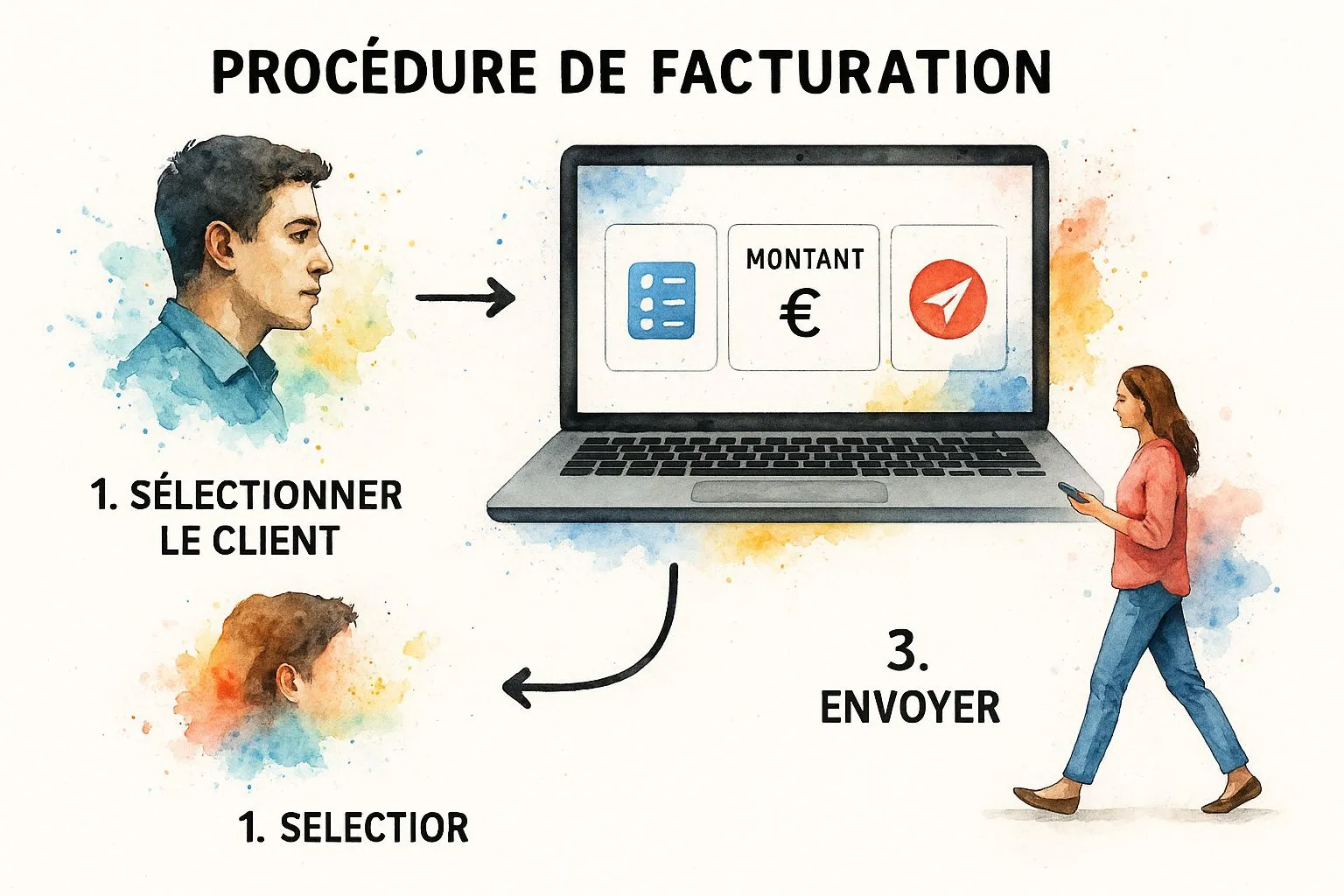
As you can see, steps that might seem complicated are simplified within a clear interface, making invoicing accessible even if you’re not an accounting expert.
Personalize your emails to leave a lasting impression
Sending the invoice isn’t just an administrative formality. It’s an important touchpoint with your client. An empty or overly generic accompanying email can leave a cold, purely transactional impression. Take thirty seconds to add a personal touch.
A simple message like “Hi [Client’s first name], I hope you were happy with [the service]. Here’s the corresponding invoice. Feel free to reach out if you have any questions! Have a great day,” can change everything. It shows that behind the invoice, there’s a human being who cares about the relationship.
Good invoicing software isn’t just a time-saver. It’s a genuine ally for building a lasting relationship of trust with your clients, invoice after invoice.
This human, transparent communication is crucial. In France, the quality of the client relationship is closely tied to how businesses communicate, including through invoicing. Did you know that 71% of French people feel that brands hide their contact details to avoid being reached? That’s a major source of frustration. A clear invoice, with a friendly message and clearly visible contact details, is the best way to reassure clients and counter that mistrust. You can also read the full study on customer relationships to dig deeper into the topic.
Ultimately, invoicing a client well isn’t just a matter of following the rules. It’s a clever mix of good tools, clear processes, and that human touch that makes all the difference in getting paid on time and building client loyalty.
Tracking payments without losing your mind
Sending an invoice is good. Seeing the money land in your account is the real end of the mission. We tend to forget it, but getting paid quickly is just as crucial as the quality of your work. And for that, it’s better to be proactive than to sit back and wait.
A first reflex that many people skip: making sure the client actually received the invoice. A short email a few days after sending it, something like “Just checking you received invoice no. [number] okay?” can save a lot of headaches. Countless invoices get lost in spam folders or land on the wrong person’s desk. This small check saves you time.
To get paid quickly, make it easy for your client
The secret to fast payment? Make the act of paying as simple as possible. If your client has to go hunting for information to find your IBAN or wonder how they can pay you, you’re creating unnecessary friction. It’s best to offer several options, clearly stated on the invoice itself.
Consider mixing it up:
- Bank transfer: the classic option. Make sure your IBAN stands out clearly.
- Online payment: via platforms like Stripe or PayPal. This is often the most effective method, since the client can pay by card in just a few clicks.
The experience you offer doesn’t end once your work is done. Invoicing and payment are its direct continuation. In a French customer service market estimated at $16.91 billion in 2023, every touchpoint is an opportunity to score points. Given that 63.2% of French consumers find customer service to be good overall, a smooth payment experience is an excellent way to demonstrate your professionalism. For more figures, take a look at these customer service statistics.
A client who can pay you easily is a client who will do so more willingly. Never underestimate the power of simplicity when it comes to money.
What to do when a payment is late
Even with every precaution in the world, delays happen. How you communicate at that point makes all the difference, both for preserving your client relationship and your cash flow. The idea isn’t to come out swinging, but to stay firm and professional.
The first reminder can be perfectly friendly. A courteous email usually does the trick: “Unless I’m mistaken, it looks like invoice [number] is still outstanding. Could you please check on your end?” If there’s still no response, you’ll need to gradually firm up the tone, up to a possible formal notice.
A tool like Bizyness can even automate these reminders and help you keep the right tone at every stage. This rigor is a pillar of sound financial management. If this topic interests you, you can dig deeper by reading our guide on business financial management.
How to protect yourself from the most common invoicing mistakes

When it comes to invoicing, a bit of foresight can save you a lot of headaches and protect your client relationships. Invoicing well means more than just ticking legal boxes. You also need to know the common pitfalls that can turn a simple administrative formality into a real headache.
A small mistake, an oversight, and the trouble begins: rejected invoices, late-payment penalties cancelling each other out, or even a dispute that can seriously damage your reputation. Fortunately, these mistakes are almost always the same ones. Once you’ve identified them, it becomes much easier to avoid them. The idea is to develop a kind of reflex, a mental checklist, so that every invoice you send is flawless.
Forgetting mandatory notices
This is by far the most common mistake, but also the easiest to fix. As we’ve seen, an invoice without a SIREN number, without an issue date, or without the client’s precise identity is simply invalid in the eyes of the law. A reasonably organized client, especially a large company, will reject it without a second thought. The result? Payment is postponed, and you have to start all over again.
Picture the scene: your invoice arrives at a large company. It has to pass through several departments, from the operational manager to accounting. Any missing piece of information will stop it dead in its tracks. And there you are, in for weeks of waiting and follow-ups. This is where a tool like Bizyness becomes a valuable ally: it makes these fields mandatory, preventing you from generating an incomplete invoice.
Chaotic numbering
Your invoice numbers must absolutely follow a chronological, continuous sequence. A series like INV2024-01, INV2024-02, suddenly followed by INV2024-05, is an immediate red flag for the tax authorities during an audit. It suggests missing invoices, and therefore, potentially, undeclared revenue.
- The right reflex: Adopt a simple, logical naming system, for example
YEAR-MONTH-NUMBER, and never deviate from it. - Expert advice: Let invoicing software handle this for you. There’s no better guarantee for flawless, gap-free numbering.
An invoice is never a standalone document. It’s part of a series that tells the accounting story of your business. Any inconsistency in that story can cost you dearly.
Service descriptions that are too vague
“Consulting services.” “Web development.” That’s too vague. This kind of description is an open door to misunderstandings and disputes. Your client must understand, without a shadow of a doubt, what they’re paying for. If any doubt remains, they might dispute the invoice or, at best, delay payment while seeking clarification.
So be as precise as possible. Detail the deliverables, the period covered by the service, or the number of hours worked.
| Description to avoid | Description to prefer |
|---|---|
| Consulting | Strategic digital marketing consulting - 10 hours (week 24) |
| Content creation | Writing 4 blog articles of 800 words - Topic: SEO |
| Website design | UX/UI mockup of 3 pages (Home, Contact, Services) - 2 rounds of revisions included |
This clarity removes all ambiguity, makes approval by your client much smoother, and ultimately speeds up payment. A simple tip for invoicing a client well is to reuse the exact wording from the quote they’ve already signed. It’s the best way to make sure everyone is on the same page.
Answering your questions about invoicing
Even when following a guide to the letter, specific cases and tricky questions always come up eventually. That’s perfectly normal! Invoicing is a crossroads where sales, legal matters, and sometimes even the subtleties of international trade all meet.
I’ve gathered here the questions that come up most often in the field. The idea is to give you direct, pragmatic answers to clear up any remaining doubts and let you invoice with total peace of mind.
What is the legal deadline for sending an invoice?
The law is clear: the invoice must be issued as soon as the delivery or service is completed. That’s the basic principle.
In practice, the tax authorities show a certain amount of flexibility, especially for complex assignments spread out over time. But don’t get into bad habits. Sending your invoice quickly isn’t just a formality. It’s a sign of professionalism that reassures your client. And let’s be honest, the sooner it goes out, the sooner you have a chance of being paid.
Can you modify an invoice that’s already been sent?
The answer is a categorical no. Once an invoice has been issued and sent, it becomes an official accounting record, a final document. It cannot be modified or deleted. Tampering with a validated invoice can cost you dearly in the event of an audit.
So what do you do if you spot a mistake? Don’t panic, there’s a proper procedure:
- For a minor correction: You need to create a corrective invoice. This new document must explicitly reference the number of the original invoice it corrects.
- For a full cancellation: The solution is to issue a credit note. This is what will formally cancel out the original invoice in your accounts.
Think of a sent invoice as set in stone. Any change must go through the issuance of a new accounting document (a credit note or a corrective invoice). It’s the only way to guarantee the traceability and compliance of your accounting.
How do you invoice a client abroad?
Invoicing outside France is above all a question of VAT. The rules of the game change depending on whether your client is inside or outside the European Union.
If it’s a business client based in another EU country, you must invoice net of VAT (excl. tax). This is what’s known as the reverse-charge mechanism. For it to be valid, don’t forget to state their intra-community VAT number on the invoice and add the wording “VAT reverse charge.”
For a client located outside the European Union, the invoice is also issued excl. tax. The legal wording to include is different; for a service, for example, it will be: “VAT exemption - Article 259-1 of the French General Tax Code (CGI).”
Am I required to use certified invoicing software?
It all depends on your activity. The requirement to use management or point-of-sale software certified as “anti-VAT-fraud” only applies to you if you tick two boxes at the same time: you’re subject to VAT AND you invoice individual consumers (B2C).
If you work exclusively with professionals (B2B), this requirement doesn’t apply. That said, I can only recommend using a tool like Bizyness. Beyond simple legal compliance, it ensures your invoices are flawless, saves you from data-entry errors, and saves you a huge amount of time on time-consuming tasks like payment tracking or reminders. If this topic interests you, take a look at our full article on following up on an unpaid invoice.
Make your life easier and focus on your core business. With Bizyness, create compliant invoices in just a few clicks, track your payments in real time, and automate your reminders. Discover how Bizyness can transform your business management today.
