

 Français
How to Sell Digital Products: The Ultimate 2025 Guide
Discover how to sell digital products successfully. Complete strategies, platforms and expert tips to turn your ideas into revenue.

Decoding the potential of the French digital products market

The French digital products market is a dynamic, fast-growing sector offering many opportunities for creators. Consumption habits have evolved with digitalization, creating fertile ground for digital products. This new ecosystem allows lucrative, often still untapped niches to emerge. Analyzing this market is essential to succeeding at selling digital products.
Promising sectors and strategic choices
Some sectors of the French digital market show remarkable growth. Online courses, for example, meet a growing demand for personal and professional development. Digital productivity tools simplify everyday life for entrepreneurs and individuals alike, boosting sales. Finally, premium content, such as ebooks, podcasts and exclusive videos, builds loyalty among an audience ready to invest in quality content. Positioning yourself in these promising segments is an effective strategy.
Understanding the needs of French consumers
French consumers are connected and quality-conscious. They look for digital products that meet their specific needs and offer real added value. Content quality is an essential criterion, as are ease of access and user experience. Trust is also a decisive factor in the purchase decision. A transparent, accessible creator will find greater success with a French audience. Understanding these expectations is fundamental to designing high-performing digital products.
The growth of the French digital market
The growth of the French digital market underlines the increasing importance of digital products. The French digital market is expected to exceed €70 billion in revenue in 2025, up 4% from the previous year. This growth is notably driven by digital advertising, which should reach €12.5 billion in 2025, a 13% increase compared to 2024. To learn more about the French digital market, check out these statistics. This trend confirms the potential of the digital products market and encourages creators to get started.
Succeeding in digital: the keys to success
Why do some creators manage to generate significant revenue with digital products, while others struggle? Success often depends on understanding the market, product quality and the effectiveness of the marketing strategy. By analyzing French consumers’ expectations, offering quality digital products and implementing a relevant marketing strategy, creators can maximize their chances of success. Innovation and continuous adaptation are also essential to staying competitive in an ever-changing digital environment.
Turning your skills into profitable digital products
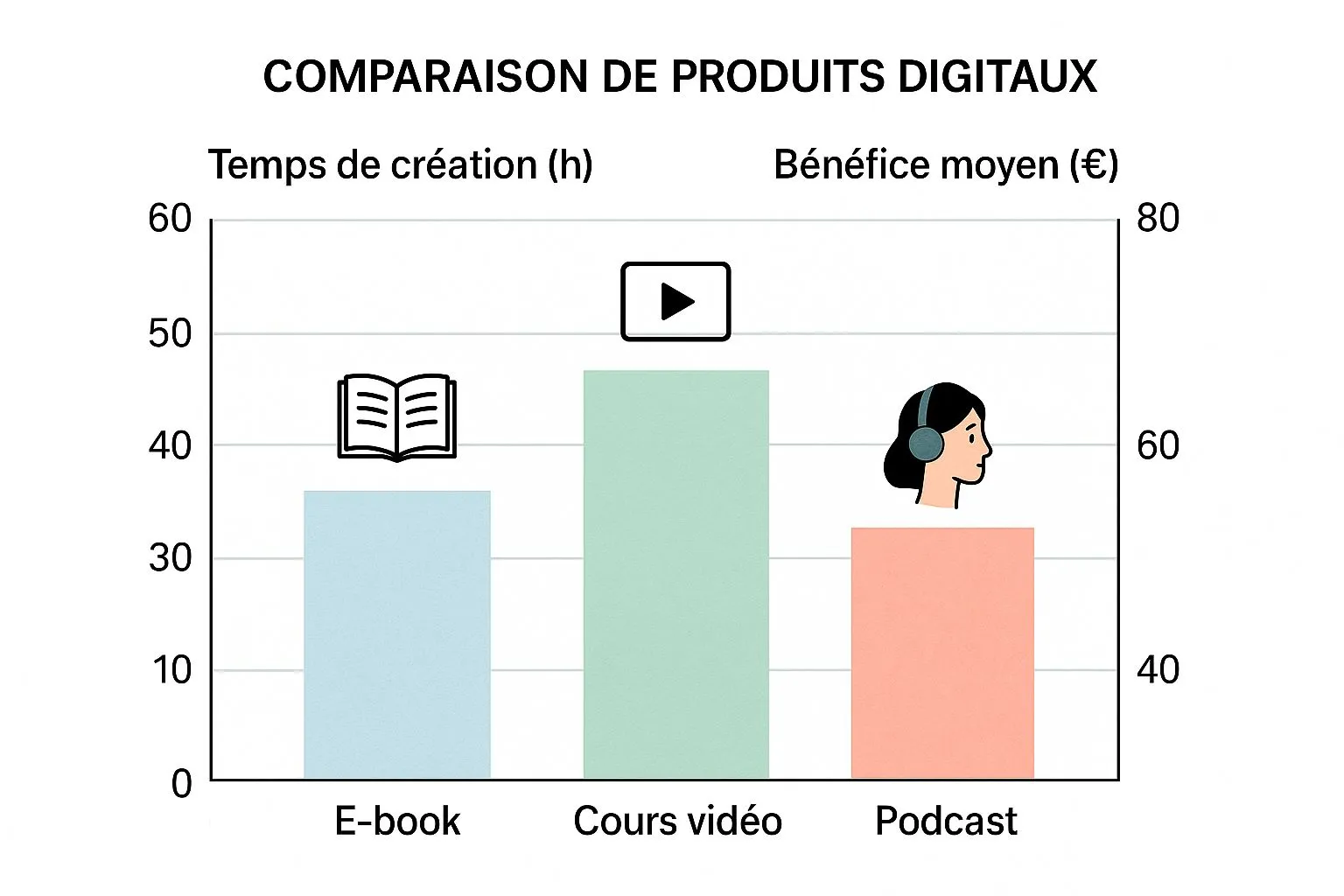
The infographic above compares the creation time and average profit of three popular digital products: the ebook, the video course and the podcast. Video courses, despite a longer production time, generally offer a better return on investment. This format is perceived as having greater value, justifying a higher selling price. Ebooks, meanwhile, remain an excellent option for a quick, less resource-intensive launch.
Identifying your profitable skills
Turning your skills into profitable digital products starts with self-analysis. What are your areas of expertise? What do you excel at? This could be technical skills, such as web development, graphic design or video editing. Or more creative fields, such as writing, music or photography. The key is to focus on your passions and what you can teach or share. Think about the problems you can solve and the questions you’re regularly asked. These are valuable indicators for identifying potential digital products.
Validating your ideas before launching
After identifying your key skills, it’s essential to validate your product ideas. Don’t rush into creation without first checking that demand exists. Survey your audience on social media, forums or through online polls. Also analyze the competition: what digital products are on offer? At what prices? The goal is to make sure your idea meets a real need and can generate revenue. For example, if you’re a digital marketing expert, you could offer an online SEO course. Before creating the full course, test interest with a free webinar or an introductory ebook.
Choosing the format suited to your expertise
The format of your digital product will depend on your expertise and your target audience. Here are a few examples:
- Online courses: Ideal for delivering structured knowledge, with videos, quizzes and exercises.
- Ebooks: Perfect for sharing detailed information on a specific topic.
- Templates and tools: Help simplify tasks and save time.
- Online communities: Offer a space for members to exchange and support one another.
- Software and apps: Digital solutions addressing specific needs.
For creating visuals, you can use a tool like Canva.
Before presenting your comparison table of digital product types, here’s a brief introduction explaining its purpose: the table below lets you compare the different types of digital products, their advantages and disadvantages in terms of creation, as well as their revenue potential depending on the target audience.
| Product type | Ease of creation | Initial investment | Revenue potential | Target audience |
|---|---|---|---|---|
| Ebook | Easy | Low | Moderate | Broad public |
| Video course | Medium | Moderate | High | Targeted public |
| Podcast | Easy | Low | Moderate | Niche |
| Templates and tools | Variable | Variable | High | Professionals |
| Online communities | Medium | Low | Recurring | Specific community |
| Software and apps | Difficult | High | Very high | Broad public or niche |
In summary, the table highlights the high revenue potential of software and apps, but also the difficulty of creating them. Ebooks and podcasts, easier to create, offer moderate revenue potential. Video courses represent a good balance between ease of creation and revenue potential.
Structuring your products for maximum impact
A successful digital product is one that provides a concrete solution to your audience. Structure your content clearly and concisely, dividing it into modules or chapters for smooth navigation. Illustrate your points with concrete examples and case studies. Include calls to action to encourage your customers to take the next step. User experience is essential: your product must be easy to use and accessible on all devices (computer, tablet, smartphone). Finally, pay attention to visual presentation. A professional, attractive design strengthens the credibility of your offer. Take inspiration from entrepreneurs who use platforms like Bizyness to run their business and offer quality digital products.
Avoiding costly beginner mistakes
90% of beginners focus on creating the product before validating the idea. Others neglect marketing or set inappropriate prices. To avoid these pitfalls, validate your idea, define a clear marketing strategy and test different pricing models. Use accessible tools to create professional content. Don’t hesitate to draw inspiration from best practices and seek feedback from your audience. This will maximize your chances of success from the launch of your first digital product.
Choosing the sales platform that maximizes your profits

The sales platform is essential to the success of selling digital products. A poor choice can hold back your growth, while a well-suited platform can propel your sales. How do you find your way among the many options available? This guide will help you choose the ideal platform to maximize your profits.
Marketplaces, online stores and specialized platforms: pros and cons
You have several options for selling your digital products: marketplaces, online stores (or proprietary stores) and specialized platforms. Each solution has its advantages and disadvantages.
Marketplaces, such as Amazon or Etsy, offer immediate visibility with a large audience. However, commissions can be high and competition is fierce.
An online store, built with platforms like Shopify or WooCommerce, gives you full control over your brand image and pricing. In return, it requires an investment of time and resources to attract traffic.
Finally, specialized platforms dedicated to a specific type of digital product, such as online courses on platforms like Podia or Teachable, can be an excellent option for targeting a specific audience. The right choice depends on your product, your budget and your goals.
Matching the platform to the product
Some digital products sell better on certain platforms. For example, professional software will find its place on a specialized platform or on your own website, while a mainstream ebook might perform better on a marketplace.
It’s important to analyze your target audience and choose the platform where they are. Also consider the nature of your product: an interactive online course will require a platform with specific features.
Managing commissions
Commission fees can significantly impact your profits. On marketplaces, these fees are generally fixed and can reach up to 50%. It’s sometimes possible to negotiate more favorable rates, especially if you generate a significant sales volume.
For an online store, fees are related to hosting, domain name and marketing tools. Calculate these costs carefully to set profitable prices.
Diversifying your online presence
Relying on a single platform can be risky. An algorithm change or a drop in traffic can impact your sales. Diversifying your presence across several platforms limits these risks and maximizes your visibility.
You could, for example, sell your ebooks on Amazon and offer your courses on your own website. Diversifying means not putting all your eggs in one basket. For more information on building an e-commerce brand, check out this article: How to choose your e-commerce brand name?
Platform selection criteria
Here are the key criteria for choosing a sales platform:
- Audience: Does the platform attract your target audience?
- Marketing tools: Does it offer tools to promote your products?
- Autonomy: What level of control do you have over your brand and pricing?
- Growth potential: Can the platform support the development of your business?
Before wrapping up, here’s a comparison table to help you choose:
Comparison of the main sales platforms
Comparative analysis of popular platforms with their commissions, advantages and recommended product types
| Platform | Commission | Advantages | Disadvantages | Best for |
|---|---|---|---|---|
| Marketplaces (Amazon, Etsy) | Up to 50% | High visibility, large audience | Strong competition, high commissions, little brand control | Mainstream products, ebooks, handmade goods |
| Online stores (Shopify, WooCommerce) | Hosting and tool fees | Full control, custom brand image | Requires driving traffic, investment of time and resources | All product types, building a strong brand, selling courses |
| Specialized platforms (Podia, Teachable) | Varies by platform | Targeted audience, specific features | Less visibility than a marketplace | Online courses, specialized software, premium content |
This table summarizes the key points of each type of platform. Marketplaces offer high visibility but high commissions, while online stores allow full control but require more marketing effort. Finally, specialized platforms target a niche audience.
By analyzing these criteria, you’ll choose the platform best suited to your needs and maximize your chances of success. A good platform is an investment in the future of your business.
Mastering the digital marketing that drives consistent sales
Forget the old marketing playbook: here are the effective digital strategies for selling digital products in France today. Build a high-performing marketing engine that generates qualified leads and recurring sales, even starting from scratch.
Content marketing: your ally for authority
Content marketing is essential for establishing your expertise and building trust. Create valuable content, such as blog posts, tutorial videos (YouTube) or webinars, that answers your target audience’s questions. Share your know-how by offering concrete solutions to their problems.
This type of informative, relevant content naturally attracts qualified leads and engages them with your brand. Don’t forget to optimize your content for SEO to improve your visibility on search engines.
SEO: optimizing your visibility for “how to sell digital products”
To sell digital products effectively, visibility is essential. Search engine optimization (SEO) is your best ally for reaching top positions in search results for relevant keywords, such as “how to sell digital products.”
Naturally incorporate this keyword and similar phrases into your titles, meta descriptions and content. Analyze your competitors’ keywords and draw inspiration from their best practices. Strong SEO positioning guarantees a steady flow of interested leads. You might also be interested in: How to sell ebooks.
Social media: an engaged community
Social media is a powerful tool for building a community around your digital products. Identify the platforms your target audience favors (Facebook, Instagram, Twitter, LinkedIn) and focus your efforts there.
Post engaging content regularly, run contests, answer questions and interact with your followers. The goal? Turn your followers into loyal customers and true brand ambassadors. A direct connection with your audience is a major asset for generating sales.
Online advertising and email marketing: conversion levers
Online advertising campaigns, through platforms like Google Ads or Facebook Ads, let you target a specific audience and generate sales quickly. Measure your campaign performance and optimize continuously for a better return on investment.
Email marketing is also an essential tool. Collect your leads’ email addresses (in compliance with GDPR) and send them newsletters, promotional offers and exclusive content. Automate your sends to save time and maximize the impact of your campaigns.
Partnerships and testimonials: social proof
Partnerships with other creators or businesses let you expand your audience and reach new potential customers. Choose partners whose audience complements yours and aim for win-win collaborations.
Customer testimonials are a powerful persuasion lever. Encourage your satisfied customers to share their experience. Positive reviews strengthen the credibility of your offers. In France, the impact of reviews is significant: more than 65 million online shoppers, and 85% of consumers check reviews before buying. Discover more about e-commerce in France. For more information, check out their Blog. By combining these strategies, you’ll build a high-performing marketing ecosystem that generates consistent sales.
Optimizing your pricing to maximize profits and appeal

Finding the right price for your digital products is an essential part of your business strategy. A price that’s too low hurts your profitability, while a price that’s too high risks holding back sales. This article explains how to find the ideal balance to optimize your revenue.
Analyzing the competition to position yourself better
Competitive analysis is an essential step. Observe your competitors’ pricing, identify their strengths and weaknesses. The goal isn’t to copy their rates, but to understand each one’s positioning. Focus on the added value of your offer. What sets your products apart? Higher-quality content? Personalized support? Access to an exclusive community? Highlight these strengths to justify a price in line with the real value you provide.
Determining the value your customers perceive
Perceived value is the importance your customers place on your product. It can be higher than the cost of production. To assess it, identify the concrete benefits your products provide. If your course helps increase revenue by 20%, the perceived value will be much higher than its price. Use this value as the basis for setting a price that is both attractive and profitable.
Using cognitive biases wisely
Cognitive biases influence our purchasing decisions. The anchoring effect, for example, involves presenting a high initial price before offering a discount. The reduced price then seems more appealing. Loss aversion, meanwhile, plays on the fear of missing out on a good deal. Use these mechanisms subtly to optimize your conversions.
Choosing the right pricing model
Several pricing models are available to you:
- Flat price: Simple and clear, ideal for one-off products like ebooks.
- Subscriptions: Enable recurring revenue, suited to premium content.
- Freemium: Offers a limited free version and a full paid version.
- Bundles: Group several products together at an attractive price.
Choose the model that best fits your products and your strategy. Tools like Bizyness make billing management easier, whatever model you choose.
Adjusting your prices through testing
Experiment with different prices to find the optimal price between sales volume and profit margin. Analyze the results and adjust your rates based on demand. One-off promotions can also boost sales.
Upselling and cross-selling: increasing average order value
Upselling offers a higher-tier version of a product, while cross-selling suggests complementary products. These techniques can increase average order value by 40%. For example, after purchasing an ebook, offer a complementary course.
Adapting your prices to demand and seasons
Demand can fluctuate depending on the season, events or trends. Adjust your prices to maximize your profits. Offer discounts during slow periods and slightly raise your prices during peak demand. By mastering these strategies, you’ll optimize your pricing to maximize profits while maintaining an attractive position.
Building a base of loyal customers and ambassadors
Selling digital products isn’t just a simple transaction. It’s the start of a lasting relationship with your customers. Turning these buyers into loyal customers, and then into true ambassadors, is the key to sustainable growth. In this section, we’ll explore strategies for building this solid foundation, focused on an exceptional customer experience and long-term engagement.
Impeccable customer support: the foundation of loyalty
Responsive, high-performing customer support is essential, especially in the digital products field. Responding quickly to questions, resolving technical issues and guiding users as they get to grips with your products is fundamental. Every interaction is an opportunity to build loyalty and turn a satisfied customer into an enthusiastic promoter. A satisfied customer is a customer who will come back and recommend your products.
Post-purchase follow-up: nurturing the relationship
Post-purchase follow-up is just as crucial. Maintain the connection with your customers through newsletters, exclusive offers and relevant content. Offer regular updates, complementary tutorials or exclusive bonuses. The goal is to stay top of mind with your customers and nurture the relationship over the long term.
Handling returns effectively and with empathy
Returns are part and parcel of online commerce. Implement a transparent return policy and handle every request professionally and with empathy. Effective return management can not only soothe a dissatisfied customer but also strengthen your credibility and brand image. Turning a potentially negative experience into a positive one is a considerable asset for building customer loyalty.
Building a community: the power of the collective
An active community around your digital products is a powerful loyalty driver. Create a forum, a Facebook group, or a dedicated platform where your customers can exchange, help each other and share their experiences. A tight-knit community strengthens the sense of belonging and encourages recommendations. Check out our guide on How to find customers.
The importance of customer data: personalization and anticipation
Leverage customer data to personalize your offers and anticipate needs. Analyze purchasing behavior, preferences and feedback to offer increasingly relevant products and services. Personalization is a key factor in creating a unique customer experience and strengthening loyalty.
Loyalty programs: rewarding trust
Set up loyalty programs to reward your most engaged customers. Offer discounts, privileged access or special bonuses to your best customers. A well-designed loyalty program encourages repeat purchases and turns your customers into true brand ambassadors. Incidentally, e-commerce in France has seen significant growth in recent years, directly impacting the sale of digital products. In 2024, e-commerce revenue in France reached €159.9 billion, up 10.5% from 2023, driven mainly by a 20% increase in online service sales. Discover more about e-commerce in France.
Feedback: a source of continuous improvement
Regularly seek feedback from your customers and use it to improve your products and services. Show your customers that you’re listening and that their suggestions are taken into account. Turning criticism into concrete improvements is a mark of quality and a powerful loyalty driver. By building a solid relationship with your customers, you turn every sale into an opportunity for sustainable growth for your business.
A concrete action plan to launch your business successfully
Launching a digital products business can seem complex. Yet with a well-defined action plan, even a few hours a week are enough to get started. This plan will guide you step by step, from concept to growth.
Phase 1: Defining and validating your idea (1 to 2 weeks)
This first phase is crucial. It lays the foundation of your project. Take the time to clearly define your idea and validate its potential.
-
Identify your niche and key skills: Take stock of your expertise and passions. What specific problem can you solve with your skills?
-
Market research: Analyze demand and study the competition. Is there an audience for your idea? Tools like Google Trends will help you assess interest in your niche.
-
Choose your product format: Ebook, online course, software, template, etc. What format best matches your expertise and your target audience’s expectations?
-
Create an MVP (Minimum Viable Product): Develop a simplified version of your product. This prototype will let you quickly test market interest and gather valuable feedback.
Phase 2: Creating and launching your product (2 to 4 weeks)
Once your idea is validated, it’s time to bring your project to life. This phase focuses on producing and launching your digital product.
-
Develop your digital product: Prioritize content quality and user experience. A well-designed product is essential for building customer loyalty.
-
Choose your sales platform: Marketplace, online store or specialized platform? Each option has its advantages and disadvantages. Choose the solution best suited to your needs and budget.
-
Launch your product: Take care with your product’s presentation and visuals. Simplify the purchase process to maximize conversions.
Phase 3: Launch and promotion (1 to 2 weeks)
Your product is ready. Now it’s time to make it known to your target audience.
-
Announce the launch to your audience: Use social media, email marketing and your website to announce your product’s release.
-
Set up marketing campaigns: Explore different marketing strategies: online advertising, free content, partnerships, etc.
-
Collect initial feedback: Analyze comments and reviews from your first customers. Adapt your strategy based on this feedback.
Phase 4: Loyalty and growth (ongoing)
The launch is only the beginning. Building loyalty and driving growth are ongoing efforts.
-
Provide excellent customer support: Respond quickly to customer questions and resolve issues effectively.
-
Nurture the customer relationship: Send newsletters, offer exclusive deals and share valuable content to maintain customer engagement.
-
Analyze data and adjust your strategy: Track your key performance indicators (KPIs) and continuously adapt your approach to optimize results.
Tools to support you
Several tools can help you manage and grow your business:
-
Bizyness : Simplify your accounting and administrative management.
-
Canva : Create professional visuals for your products and marketing.
-
Online sales platforms: Shopify, WooCommerce, Podia, Teachable…
Launch timeline and success metrics
The time needed to launch varies depending on your profile and availability. A part-time beginner may take 3 to 6 months, while an experienced full-time entrepreneur can launch their business in 1 to 3 months.
Track the following metrics to measure your success: number of sales, conversion rate, customer satisfaction, and revenue generated.
