

 Français
 How to sell on Shopify and turn your idea into success
Discover how to sell on Shopify with our practical guide. Concrete strategies to launch and grow your e-commerce store in France.

Succeeding on Shopify comes down to a clear method built around four pillars: the right product, a store that makes people want to buy, a strategy to attract customers, and flawless behind-the-scenes management. It’s not just about picking a tool — it’s about building a complete strategy that turns a simple idea into a business that runs and lasts.
Why Shopify is the best ally for your e-commerce project
Launching your own online store can feel a bit daunting, that’s true. But Shopify was designed precisely for that: to make technology accessible so you can focus on what really matters — your product and your customers. It’s not just a platform; it’s a real ecosystem with all the tools you need to start, run, and grow your business.
The French market has enormous potential, but success won’t come on its own. You need a thoughtful approach from the very start. For example, planning ahead for your finances is absolutely essential.
The mistake I see most often is betting everything on customer acquisition while completely forgetting the structure behind it. Growing too fast without solid processes, especially for accounting, can quickly turn a great success into a real administrative and financial nightmare.
A platform built to support your growth
What makes Shopify strong is its ability to keep innovating to help online sellers at every stage of their journey. This momentum is real — just look at the numbers. In the third quarter of 2023, Shopify recorded impressive growth of 25% in revenue, confirming its position as a market leader.
This infographic perfectly summarizes the four major steps to building an effective sales machine on Shopify.
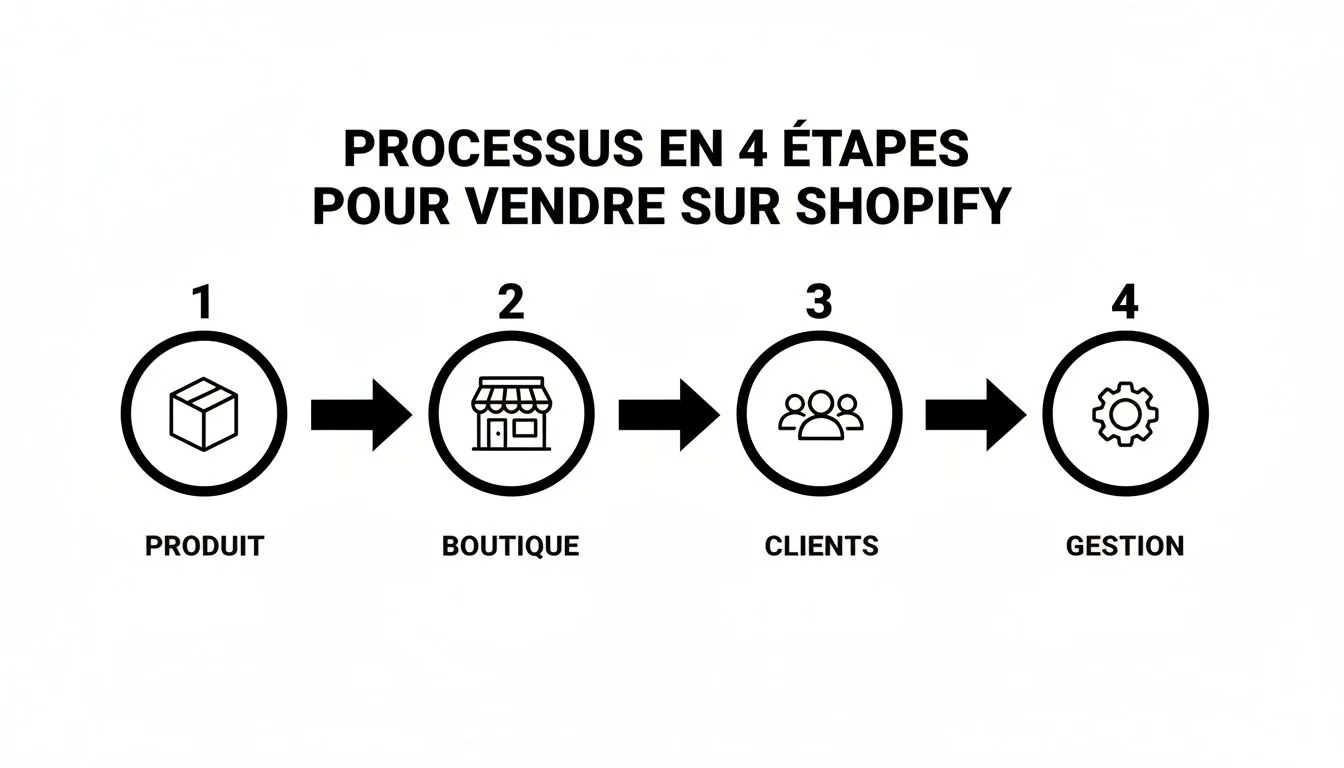
This diagram shows clearly how each step builds on the previous one. It’s proof that a structured approach is the key to success.
Your roadmap for selling on Shopify
This table summarizes the four fundamental pillars for launching and growing a high-performing Shopify store.
| Pillar | Main objective | Point of caution |
|---|---|---|
| The Product | Validate an offer that meets a real market need. | Avoid “passion” products with no real demand. |
| The Store | Create a smooth, reassuring buying experience that converts. | Don’t neglect the mobile version and page load speed. |
| The Customers | Attract qualified traffic and build a loyal community. | Don’t rely on a single acquisition channel. |
| The Management | Automate operations to guarantee profitability. | Don’t let manual accounting and invoicing hold back growth. |
Following this roadmap helps you build solid foundations and avoid overlooking any aspect essential to your success.
For growth to turn into lasting profitability, automating repetitive tasks like invoicing and accounting is a must. If you’re still unsure which platform to choose, our guide to the best online selling platforms can help you decide. By streamlining these processes, you free up precious time to focus on what pays off: selling more.
Laying the right foundations before you even open Shopify
You don’t jump into e-commerce on a whim. The success of your Shopify store is decided long before your first click in the dashboard. It’s a project that requires strategy, and the decisions you make now will directly impact how solid your business is for months and years to come.
Far too many entrepreneurs, excited by the idea of building their site, dive headfirst into design and features. They forget the essentials: the foundations. This preparation phase is absolutely crucial to avoid the classic trap: launching a great product that nobody wants, in a crowded market, with no identity whatsoever.
To succeed, the golden rule is simple: listen to the market before trying to talk to it.
Finding a profitable niche and a product that actually sells
The number one mistake? Starting with a product you’re passionate about without ever checking whether there’s a real market for it. Your love for handmade lavender candles from the Alps is one thing, but are there enough customers willing to pay for you to make a living from it?
The right approach is the opposite. Start by looking for a problem, an unmet need, a frustration. Only then will you find the product that provides the solution.
To do this, dive into online communities. Forums like Reddit, Facebook groups, and specialized forums are goldmines. Read, listen to the conversations, note the questions that keep coming up. Tools like Google Trends or even Amazon’s search suggestions can point you toward trends that are just starting to take off.
A hit product often has these characteristics:
- It solves a specific problem: Think of a travel accessory that genuinely simplifies life, not just the 1000th t-shirt with a nice design.
- It appeals to enthusiasts: Hiking, yoga, model-making, or gardening fans are niches where people don’t hesitate to spend on their passion.
- It has a comfortable margin: Your selling price must not only cover the cost of the product, marketing, and shipping, but also leave you a net profit worth the effort.
Analyzing the competition to find your place
Once you have an idea, it’s time to play spy. Go see what your future competitors are doing. The goal isn’t to blindly copy them, but to understand what works and, above all, to spot their weaknesses. Go through their sites with a fine-tooth comb: what are their best-sellers? What’s their tone of voice?
And above all, read customer reviews, especially the negative ones. Every complaint, every one-star comment is a golden opportunity for you to do better.
Your unique selling proposition (USP) is simply the answer to this question: “Why would a customer buy from me rather than from the market leader?” It could be superior quality, incredible customer service, faster delivery, or a very specific specialization.
For example, if everyone sells generic phone cases, you could specialize in ultra-rugged cases for extreme sports enthusiasts. Your USP is no longer “a phone case,” but “the ultimate protection for your smartphone during the action.” The difference is huge.
Building a brand identity with character
Your brand is much more than a logo and a catchy name. It’s the emotion you evoke, the perception customers have of you. It’s what creates a connection and turns a customer into a fan.
Find a name that’s easy to remember, easy to say, and not already taken. Your logo should be simple, recognizable at a glance, and effective everywhere, whether tiny on your site’s browser tab (the favicon) or large on your Instagram profile.
But the most important thing is your story. Why this brand? What’s your mission? People don’t buy what you do, they buy why you do it. It’s this story, this purpose, that will resonate with people and make them want to support you.
Building a simple, concrete business plan
Forget 50-page business plans gathering dust. What you need is a practical guide for your first months of activity. This document should clearly and concisely answer a few vital questions:
- Who is my ideal customer? (Their age, interests, where they hang out online?)
- What are my financial goals? (How many sales do I need to break even, then to start earning a good living?)
- How will I find my first customers? (Facebook ads, SEO, content marketing, word of mouth?)
- What are my startup costs? (Shopify subscription, initial stock purchase, launch advertising budget…)
This document isn’t set in stone; it’s your roadmap. It will serve as your compass for making informed decisions instead of flying blind. With such solid foundations, the technical part of building your store will feel much, much simpler.
Building a Shopify store that inspires trust
Your strategic foundations are solid, congratulations! Now it’s time to get your hands dirty and build the digital storefront where your future customers will meet your brand for the first time. This is a crucial step: a well-designed store isn’t just about aesthetics — it needs to reassure, guide, and, of course, sell.
In e-commerce, trust is everything. An amateurish design, hard-to-find information, or a slightly unclear checkout process can wipe out all your marketing efforts in one click. The goal, then, is to create a professional store that exudes credibility from the very first second.
The subscription and theme: your first decisive choices
The first thing to do is sign up on Shopify and choose a subscription.
For most entrepreneurs starting out, the Basic plan is more than enough. It comes with everything you need to launch a functional store without breaking the bank. You can always upgrade later once sales take off.
Here’s a quick overview to help you see things clearly.
Which Shopify plan to choose to get started
This comparison table helps you choose the Shopify plan best suited to your needs and budget for a successful launch.
| Plan | Ideal for | Transaction fees (via Shopify Payments) | Key features to consider |
|---|---|---|---|
| Basic | New online sellers and small stores | 1.8% + €0.25 (online) | 2 staff accounts, basic reports, up to 1,000 inventory locations. |
| Shopify | Growing businesses with regular sales | 1.6% + €0.25 (online) | 5 staff accounts, professional reports, basic e-commerce automation. |
| Advanced | High-volume businesses needing advanced reporting | 1.4% + €0.25 (online) | 15 staff accounts, custom reports, third-party calculated shipping rates. |
This table highlights the main differences for getting started. For 90% of projects, the Basic plan is really the most logical starting point.
Once you’ve signed up, it’s time to choose a theme — your first major design decision. The theme is the visual and functional skeleton of your site. Shopify offers excellent free themes, like Dawn or Sense, which are already very well optimized for speed and mobile.
A little tip from experience: don’t get seduced by themes overloaded with flashy gadgets. A good theme should be fast, clear, and above all, showcase your products. Simplicity is very often conversion’s best friend.
A clean design, easy-to-read fonts, and clear navigation are the pillars of a good user experience. Your customer should never have to wonder where to click.
Creating product pages that make people want to buy
The product page is your best salesperson. This is where the visitor decides: “I’m buying” or “I’m leaving.” For it to be effective, every element must play a precise role.
- High-quality visuals: Photos are king. They should show the product from every angle, in use, and zoom in on the details that make the difference. You don’t need a professional photographer at first: a recent smartphone, good natural light, and a neutral background can work wonders.
- A description that tells a story: Avoid a simple list of technical specs. Tell the benefits. Instead of “100% organic cotton t-shirt,” go with “Feel the unmatched softness of organic cotton against your skin, comfort that stays with you all day.” Keep the technical details (dimensions, materials) for an easy-to-scan bullet list.
- Clearly visible price: No bad surprises — display it clearly.
- Obvious call to action: An “Add to cart” button in a color that stands out.
- Shipping and return info: Display it right under the add-to-cart button. It’s a huge purchase blocker if it’s unclear.
- Social proof: As soon as you have any, include customer reviews. It’s one of the most powerful arguments.
Setting up payments and shipping
For money to come in, your customers obviously need to be able to pay. The simplest and most integrated solution is to activate Shopify Payments. This lets you accept card payments directly on your store, with competitive transaction fees. Also consider offering PayPal, a very popular option that reassures a lot of buyers.
Setting up shipping is just as strategic. Define clear shipping zones (France, Europe…) and transparent rates. A small trick that always works: offering free shipping above a certain amount is an excellent lever for boosting average order value.
Managing VAT in France and internationally
VAT management can seem a bit intimidating at first, but it’s a mandatory step. In France, most products and services are subject to a 20% rate. Fortunately, Shopify helps you configure these taxes so they’re applied automatically at checkout.
If you’re targeting individual customers in other EU countries, you’ll hear about the VAT one-stop shop (OSS/IOSS). This system was created to simplify VAT reporting and payment on distance sales within the EU. Tools like Bizyness are specifically designed to automate this complex management, applying the correct VAT rates based on the buyer’s country and preparing your returns. To get off to a good start, you can also enrich your store with some of the best Shopify apps that simplify day-to-day management.
By the way, the French e-commerce market on Shopify is booming, with one underlying trend: mobile. During Black Friday 2023, 55% of sales were completed on mobile. This confirms that the majority of Shopify orders now go through a smartphone. This reality is a strong signal: the mobile experience shouldn’t just be “good” — it needs to be flawless.
Attracting your first customers and generating sales
Your store is live, the design is flawless, the products are ready. Congratulations! But now the real work begins: getting people in. A beautiful store with no visitors is like throwing a party without sending out invitations. It’s time to build a real marketing engine to generate a steady flow of qualified traffic.
The idea isn’t to spend a fortune, but to activate the right levers intelligently. Customer acquisition is a marathon, not a sprint. Your goal is to build several solid acquisition channels so you never depend on a single traffic source. Diversity is your best insurance against the unexpected.
Getting started with SEO for lasting visibility
Search engine optimization, or SEO, is by far your best ally in the long run. It’s the set of techniques that let your store show up on Google when someone searches for your products. The big advantage? You don’t have to pay for every click.
Fortunately, Shopify already includes very good technical SEO foundations, but most of the work rests on your shoulders. And it all starts with your product pages.
These aren’t just simple information pages; they’re real gateways for Google. For each product, ask yourself the right question: “What keywords would my ideal customer type into the search bar to find this item?” Once you have them, weave them naturally into:
- The product title: Be precise and descriptive. “Waterproof hiking boots for men” is far more effective than “Everest model.”
- The product description: Tell a story, highlight the benefits, while placing your keywords and their synonyms.
- Your images’ “alt” tags: Describe what the image shows. This is essential for image SEO and accessibility.
Then think about content marketing. A blog is a powerful tool. Selling specialty coffee? Write guides on “how to choose a coffee grinder” or “the secrets of a perfect V60 extraction.” Every article is a new chance to attract potential customers. Apps like Bloggle can also make it much easier to create optimized articles directly within Shopify.
Launching paid ads on a controlled budget
While SEO takes patience, paid advertising offers almost immediate results. It’s the ideal way to quickly test your products, validate your offers, and refine your marketing messages. The two go-to platforms for getting started are undoubtedly Google Ads and social media ads on platforms like Facebook or Instagram.
With Google Ads, you reach people actively searching for what you sell. Purchase intent is very strong. I’d recommend focusing on “Shopping” campaigns, which display your products directly with their photo and price in the results. It’s often the most profitable channel to start with.
Social media ads (Facebook, Instagram, TikTok) work differently. Here, you target audiences based on their interests, age, location… It’s perfect for introducing your brand to new people who weren’t actively looking for you.
Don’t fall into the trap of wanting to invest hundreds of euros from day one. Start small, with a budget of €10 to €15 a day, to test different audiences and visuals. Analyze what works and gradually reinvest the profits. That’s the key.
The most common beginner mistake is launching campaigns without having properly installed the Facebook pixel or Google Ads conversion tracking. Without these trackers, you’re flying blind, unable to tell which ads are making you money and which are burning through your budget.
Building a community and retaining customers with email marketing
Acquiring a new customer is expensive. Much more so than convincing a former one to come back. That’s why email marketing is absolutely essential. Every visitor who leaves your site without buying is a missed opportunity… unless you’ve managed to get their email address.
Set up a simple pop-up offering a small discount (for example, 10% off the first order) in exchange for a newsletter signup. This “investment” is tiny compared to the value of a qualified contact you can follow up with for free.
Once your list starts growing, don’t just send promotions. Build a real relationship. Share:
- Behind-the-scenes looks at your brand.
- Tips for getting the most out of your products.
- Exclusive content reserved for your community.
This approach turns a simple list of addresses into a real engine for your business. It’s also an excellent way to diversify your revenue sources, as we explain in our guide on marketing campaigns for e-commerce.
Finally, never underestimate the power of social media to build an authentic connection with your audience. Reply to comments, run polls, show the faces behind the brand. The engagement you build today will turn into loyal sales tomorrow.
Analyzing and optimizing your store to convert
Congratulations, you’ve managed to attract people to your site. But the real battle starts now: turning those visitors into customers. That’s the whole point of conversion rate optimization (CRO). Think of it as a continuous improvement process, where every decision is guided by data to turn your store into a real selling machine.
The goal isn’t to guess what your customers want, but to understand their behavior in order to smooth out every bit of friction in their buying journey. In e-commerce, every detail matters, from page speed to the color of a button.
Diving into Shopify Analytics to understand your visitors
Your Shopify dashboard is a goldmine, as long as you know where to dig. The “Analytics” section gives you the pulse of your business. Don’t just glance at revenue; go deeper to understand the why behind the numbers.
To get started, ask yourself the right questions while looking at these key reports:
- Acquisition: Where do people come from? Social media, Google, your ads? This shows you directly which channels are working and where to double down.
- Behavior: Which pages are the most popular? How long do people stay on your product pages? This information tells you what’s captivating (or boring) your audience.
- Conversion rate: This is the crux of it — the percentage of visitors who check out. The key metric to master is of course the conversion rate, and understanding how it works is the basis of any optimization.
A metric that stings but is essential is the cart abandonment rate. If this number is high, there’s a wall somewhere between wanting to buy and paying.
Putting an end to abandoned carts
An abandoned cart isn’t a lost sale. It’s often a “maybe later.” Your job is to turn that hesitation into certainty. The usual culprits are surprise shipping fees, an endless checkout process, or simple doubt about the site’s reliability.
Here are concrete actions to recover these sales slipping through your fingers:
- Simplify checkout to the max: Enable one-click payment options like Shop Pay, Apple Pay, or PayPal. The fewer fields to fill in, the less likely your customer is to bail.
- Set up follow-up emails: Use an app like Klaviyo to send a short automatic email a few hours after abandonment. A simple reminder, sometimes with a small promo code, works wonders.
- Be transparent about costs: Display shipping fees as early as possible in the process. Nobody likes bad surprises when it’s time to pull out their card.
These adjustments may seem simple, but their impact on your revenue is direct. They smooth out the experience and reassure the customer at the most critical moment.
Building trust through social proof
On the internet, trust isn’t optional, it’s mandatory. How can a new visitor know your store is legitimate and your products are quality? Through social proof.
Social proof is all the signals that show visitors that other people have bought before them, that they’re satisfied, and that they recommend you. It’s word of mouth for the digital age.
Building in social proof is a hugely powerful conversion lever. Here’s how:
- Customer reviews: Install an app like Judge.me or Loox to automatically collect and display reviews on your product pages. Reviews with photos are the gold standard.
- Testimonials: Highlight your best feedback directly on your homepage.
- Press or influencer mentions: If a blog or well-known figure talks about you, proudly display it with their logo.
This transparency creates a virtuous cycle: the more positive reviews you have, the more you sell, which generates even more reviews. It’s an essential growth engine to sell on Shopify for the long haul. We clearly saw the power of this trust during sales peaks, like during Black Friday 2023 in France. In-store sales via Shopify POS surged 48% and the total number of buyers climbed 28%. That shows clearly how trust, online and in-store alike, translates into real results.
Get ready to grow by automating your management
Your store is taking off, orders are pouring in… That’s great news, but this growth comes with its share of complexity. Every new sale, every additional customer adds to your administrative and financial workload. At first, a simple spreadsheet often seems good enough to track sales and expenses.
Yet this artisanal method quickly hits its limits. Data entry errors, time wasted reconciling everything by hand, and a lack of real-time visibility end up holding back your growth. How can you make the right strategic decisions if your financial data is scattered and unreliable?
To sell on Shopify and build lasting growth, automation isn’t a luxury — it’s a genuine necessity.
Why your spreadsheet is no longer enough
As soon as order volumes increase a bit, your trusty old spreadsheet turns into a real bottleneck. Let’s be clear: it was never designed to handle the complexity of modern e-commerce, especially if you venture into selling internationally.
Manually managing invoicing and accounting exposes you to very real risks:
- VAT errors: Applying the wrong rate depending on the customer’s country can quickly turn into a tax headache and cost a lot to fix.
- Massive time loss: Every hour spent copy-pasting data is an hour you’re not investing in your core business: marketing, product, sales.
- Flying blind: Getting an accurate real-time view of your profitability becomes nearly impossible.
The stakes go beyond just saving time. It’s about building a solid, compliant financial foundation. Rigorous financial management is the backbone of any business ready to scale up.
This is exactly where specialized tools come in and change everything.
The solution: financial management finally connected to your business
Imagine, for a moment, a platform that plugs directly into your Shopify store, as well as into your payment processors like Stripe and PayPal. That’s exactly the principle behind a solution like Bizyness. Every sale automatically triggers a cascade of actions, without you having to lift a finger.
Concretely, here’s what this changes for you day to day:
- 100% automated invoicing: Every Shopify order instantly generates a fully compliant invoice, with the correct legal mentions and the correct VAT rate. No more oversights.
- Simplified VAT management: The tool automatically applies the appropriate VAT rate, whether your customer is in France or anywhere else in Europe (it even handles the OSS/IOSS one-stop shop).
- Ready-to-use accounting: All your transactions are pre-categorized and structured for your accountant. Your tax filings become much simpler and faster.
By centralizing all these flows, you move from reactive, manual management to a proactive, intelligent system. You free up mental energy and precious resources to focus on what really matters: growing your business.
Frequently asked questions about selling on Shopify

Getting into e-commerce is a bit like planning a big trip: you have a lot of questions on your mind. To help you avoid unpleasant surprises, I’ve gathered here the most common questions that come up among entrepreneurs just starting out. The idea is to give you clear, solid foundations to start off on the right foot.
What budget should you plan to get started
This is often the first burning question. The initial budget for selling on Shopify obviously depends on your project, but we can sketch out a realistic estimate to avoid breaking the bank.
First, there are unavoidable fixed costs. Think of the Shopify subscription itself, which starts around €27/month for the Basic plan. Add to that a domain name (about fifteen euros a year) and potentially a few apps for specific features.
The biggest chunk, generally, is the starting inventory and the launch marketing budget. To be comfortable, a range of €1,000 to €2,500 is often a good starting point. That covers these items and keeps a bit of a safety margin.
Do you need a company to sell on Shopify
The answer is simple: yes. As soon as you sell products regularly, it’s considered a professional commercial activity. So you need a legal structure to be in compliance.
To get started, the micro-entreprise (sole trader/micro-entrepreneur) is by far the simplest and most accessible form. Setup is quick, accounting obligations are light… It’s really ideal for testing an idea without taking on excessive financial risk.
A little tip from experience: as soon as your income starts to really take off, consider moving to a more protective structure like a SASU or an EURL. It’s better to plan ahead for this change so you can support your growth with peace of mind.
How long until your first sales
Ah, the million-dollar question! There’s no magic formula, of course. The time it takes to make your first sales is directly tied to the quality of your preparation and your strategy for attracting customers.
Concretely, if you have a well-crafted offer and launch well-targeted ad campaigns from day one, it’s entirely possible to see your first orders come in in under a week. On the other hand, if you’re relying on more organic strategies like SEO, you’ll need to be more patient and wait several months before your efforts pay off.
By automating your financial management, you stack the odds in your favor for controlled growth. With Bizyness, turn every sale into a compliant accounting flow, effortlessly.
Discover how Bizyness simplifies life for online sellers at Bizyness.fr
