

 Français
 Download our free income statement template
Get a simple income statement template to analyze your profitability. Download our practical guide now to better steer your business.
In short, an income statement is a bit like your business’s health record. It lays your income (revenue) side by side with your expenses (costs) over a given period — a month, a quarter, a year — to tell you whether you turned a profit or a loss. It’s the ideal tool for judging, at a glance, the profitability of your venture.
The income statement, a powerful ally for steering your business

Let’s be honest, accounting can be intimidating, especially when you’re just starting out. But what if I told you there’s a dashboard that can show you not only whether you’re making money, but above all where it’s going? That’s exactly what the income statement does for you.
Even though the law doesn’t require it for sole traders (micro-entrepreneurs), this tool is a genuine strategic asset. It has the power to turn a simple list of numbers into a clear, meaningful analysis of your micro-business’s financial health.
Looking beyond your revenue alone
Revenue is often the first thing people look at. The problem is that impressive revenue doesn’t necessarily mean your business is profitable. That’s where the income statement comes in and becomes your best friend.
Concretely, it lets you answer questions every entrepreneur asks themselves:
- Are my prices set correctly? By putting your revenue face to face with your expenses, you’ll immediately see whether your margin is sufficient.
- Where can I save money? The detailed list of your expenses will highlight the costliest items. It’s the ideal starting point for optimizing.
- Is my business viable in the long run? A positive result confirmed month after month is the most encouraging signal there is.
Picture a freelance graphic designer. Every invoice she issues for a logo or a brand identity goes into the “revenue” column. On the other side, her Adobe subscription, a font purchased for a client, or travel expenses for a meeting fill the “expenses” column.
By the end of the month, the calculation is quick. She immediately knows whether she generated a profit or whether her expenses were too high. This clear view lets her adjust her strategy for the following month, instead of flying blind.
A simplified day-to-day management tool
One of the big advantages of starting from an income statement template is its simplicity. You don’t need to be a chartered accountant to find your way around. The structure is designed to clearly distinguish what comes in from what goes out.
In France, the full version of the income statement is highly structured for analyzing a company’s performance. You start from revenue, deduct production costs to get the margin, then subtract other operating expenses to find the operating result. Next, you add financial and exceptional items before deducting tax to arrive at net income. To learn more, the site livementor.com explains the detailed structure of an income statement very well.
So this document isn’t just a look in the rearview mirror. It’s a true compass for your future decisions, helping you set realistic goals and build solid financial foundations for your growth.
Customizing your income statement in Excel

Alright, let’s get to it. A good income statement isn’t a rigid document — it’s a living tool that should match the shape of your business. To help you, we’ve designed a simple, straightforward Excel template, built specifically for sole traders.
Download it and follow the guide. The idea is to turn this simple spreadsheet into a real dashboard that will help you make the right decisions for your business.
Update the basic information
The first thing to do is dress up the document in your company’s colors. It might seem like a detail, but if you ever need to present it to your bank or an investor, a professional, well-identified document makes all the difference.
It’s very simple, just:
- Insert your logo: Drag it into the header for an instant professional touch.
- Fill in your details: Take a moment to fill in your business name, your SIRET number, and your contact details in the fields provided.
- Set the period: Clearly indicate the period concerned. Is it a monthly, quarterly, or yearly review?
This first step will only take a few minutes. It lays solid foundations and a clear framework for your whole financial analysis.
Create categories that make sense to you
This is where the template really comes to life. A template, by definition, is generic. It can’t guess the specifics of your income or your expenses. So it’s up to you to teach it the language of your trade.
An income statement is truly useful when it speaks your language. If you constantly have to mentally translate each line, the tool becomes a burden. It’s up to the tool to adapt to your reality, not the other way around.
Let’s take a concrete example. A freelance web developer won’t just have one line for “Services.” To see things clearly, he’ll break down his income like this:
- Showcase website creation
- E-commerce store development
- Monthly maintenance contract
- Technical SEO consulting assignment
Likewise, for expenses, a marketing consultant won’t just write “Software,” but rather “SEO tool subscription,” “Emailing software,” or “Facebook ad budget.” It’s this precision that will let you see exactly what’s driving your revenue up and what’s dragging your margin down.
To edit the template, nothing could be easier: click on the label cells and rename them. Don’t be afraid to add or remove rows so the structure fits your business perfectly. This customization work is what turns a simple file into a powerful, tailor-made analysis tool.
Recording your revenue properly, without missing anything

The “Revenue” column of your income statement is a mirror of your business. That’s where every assignment, every sale, becomes a figure. To have a clear and accurate financial picture, it’s crucial to take care of this part.
Get into this good habit: as soon as an invoice is issued, immediately record its pre-tax (VAT-excluded) amount in the right category of your spreadsheet. It’s a small discipline that will keep you from underestimating your revenue and will ensure your books stay up to date, without any hassle.
How should you break down your income?
Few sole traders have only one source of income. Most of us juggle several roles. That’s why it’s so important to properly break down your revenue to analyze what’s working… and what isn’t.
Take the concrete example of an independent photographer. Their business isn’t just about taking photos. Their revenue can break down as follows:
- Service work: Portrait shoots, wedding coverage, corporate assignments.
- Product sales: Fine art prints sold on their online shop, photo albums they put together.
- Training: Photography classes for beginners or themed workshops they run.
By creating a line for each of these activities in their income statement, they can see at a glance which segment is the most profitable. That’s valuable information for knowing where to focus their efforts.
Rigorous revenue tracking isn’t just an administrative chore. It’s a genuine strategic tool. It shows you where the real value of your business lies and helps you make the right decisions to boost your profitability.
Handling everyday special cases
Freelance life is full of the unexpected. Your tracking needs to adapt, for example, to handling deposits. The golden rule is simple: a deposit is recorded at the time it’s invoiced. If you ask for 30% at order time in June and the balance on delivery in July, each payment must be recorded in the corresponding month.
The same rigor obviously applies to recording your expenses. Tracking your costs is just as essential for calculating your margin. To go further on this point, I recommend our detailed guide on direct and indirect costs and their impact.
This precise management of financial flows matters to businesses of all sizes. On a national scale, wages paid by market-sector companies in France exceeded €157 billion, plus nearly €65 billion in employer contributions. These figures, which you can find on the INSEE website, clearly show that money going out, particularly wages, is a major item. It’s a good reminder of how important meticulous tracking is.
Consistency, your best ally
One last piece of advice, and it’s probably the most important: make sure the total revenue shown in your income statement matches exactly what you declare to URSSAF each month or each quarter.
This consistency is your safety net. It protects you from errors and oversights, and above all, it shields you from a potential reassessment in the event of an audit. It’s the basis of sound management that will let you sleep soundly.
Identifying and categorizing your business expenses
Once the revenue column is filled in properly, it’s time to tackle the expenses column. This is where precision becomes your best ally for truly understanding your profitability. Believe me, rigorous tracking of every expense is the only way to avoid unpleasant surprises.
The principle is simple in theory: every outflow of money linked to your business must be scrupulously recorded. That obviously lets you calculate your profit, but above all it helps you understand where your money is going and, ultimately, optimize your costs.
Common expense categories
To see things more clearly, the secret is to organize your tracking well. In your income statement template, create categories that make sense to you. Every trade has its own particularities, of course, but some expenses are nearly universal for sole traders.
Here’s a list of the most common expense items, the ones you really shouldn’t forget:
- Social security contributions (URSSAF): This is often the heaviest expense. Be sure to record the amount religiously after each declaration.
- Purchases of supplies or raw materials: Absolutely everything you buy to produce your service or sell your product.
- Subscriptions to online tools (SaaS): Your invoicing software, your design tools, your emailing solution… these small amounts add up fast.
- Professional banking fees: Account maintenance fees, transaction commissions, etc.
- Travel expenses: Train tickets, mileage allowances, tolls. Keep this in mind especially if you rebill these costs to your clients.
- Advertising and marketing: Your budget for social media campaigns, keyword purchases, or even flyer printing.
My advice for not missing anything: set aside an hour at the end of each month to go through your professional bank statement. Every debit line should match an expense you’ve recorded in your spreadsheet. It’s the most reliable way to make sure your tracking is complete.
The distinction between an expense and an investment: it changes everything!
Watch out, not all expenses are equal from an accounting standpoint. It’s really important to grasp the difference between an expense and an investment, also known as a capitalized asset.
An expense is spending that’s “consumed” quickly and directly reduces your result for the current year. Your phone subscription or the purchase of printer paper are perfect examples.
An investment, on the other hand, is the purchase of an asset meant to last, one that will serve your business over several years. The classic example is the laptop you work on. This asset doesn’t lose all its value in a year; it’s said to depreciate over time.
Even though the sole trader (micro-entrepreneur) tax regime doesn’t allow you to deduct this depreciation for tax purposes, making this distinction in your income statement template will give you a much more accurate financial picture. This way you separate operating expenses from purchases that build your business’s value. To better understand how to structure all this, taking a look at a detailed income statement table can really help.
Getting into this habit will help you better assess the real performance of your business, without it being skewed by a big one-off purchase. It’s a real step forward toward professional financial management.
Reading between the lines of your income statement to make the right decisions
Your income statement is now complete. The numbers are there, in black and white. Now what? This is exactly where everything begins. This document isn’t just a bookkeeping summary; it’s your dashboard, a valuable tool for steering your sole-trader business. The idea is to make these numbers speak so you can make truly informed decisions.
An income statement doesn’t just tell you whether you made or lost money. It reveals the why and the how. By scrutinizing the relationship between what comes in (your revenue) and what goes out (your expenses), you get answers to crucial questions: is my business really profitable? Are my prices positioned well? Are my expenses under control?
Margin and net income: your first performance indicators
Two figures will immediately grab your attention: margin and net income. Margin is the difference between your revenue and the costs directly tied to what you sell. It gives you a sense of the gross profitability of your products or services. Net income (Revenue - Expenses), meanwhile, is the final verdict: the profit that actually stays in your pocket at the end of the period.
This chart perfectly illustrates a business’s performance by comparing revenue, expenses, and the resulting net margin.
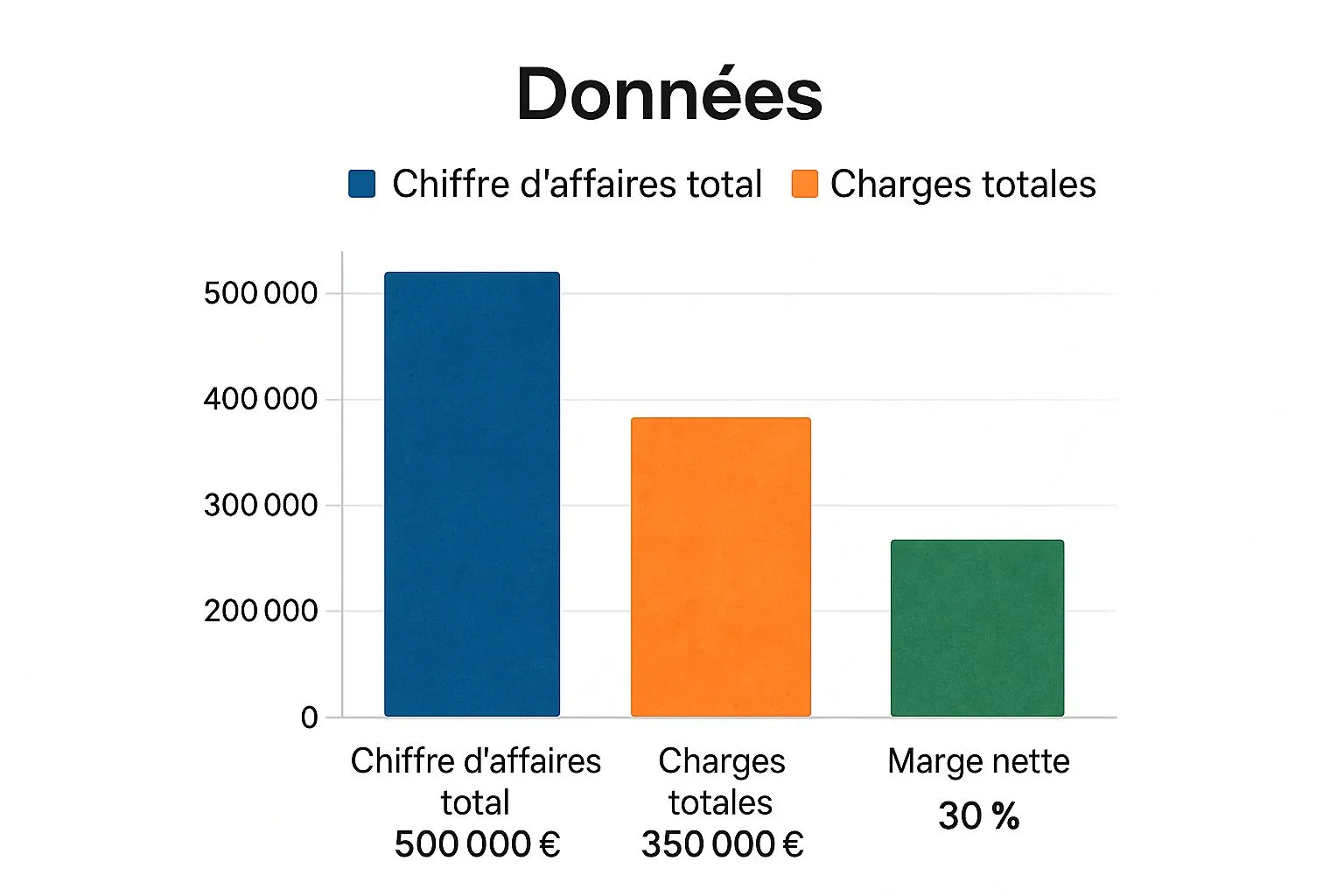
Here, we see a net margin of 30%. That’s an excellent signal, suggesting sound management where expenses are well controlled relative to revenue. It’s a strong indicator of your venture’s viability.
What matters most isn’t the number itself, but what it teaches you. Even a weak result is a great starting point if it pushes you to ask the right questions to improve it.
If the result is positive, congratulations! It’s a sign your business model holds up. The question then becomes: how do you use this profit intelligently? Several options are open to you:
- Reinvest in your business: buy better equipment, launch an ad campaign, develop a new offering.
- Increase your own pay: after all, it’s the fair reward for your efforts.
- Build up a cash reserve: setting money aside is essential for weathering hard times or slower periods.
What to do when the result is in the red?
A negative result is never pleasant, but it’s by no means a dead end. See it as an alert, a signal that pushes you to dig in and understand where the problem is coming from. Very often, the cause lies at one of two levels: either your selling prices are too low, or your expenses are too high.
This is where your income statement becomes your best ally. Dive into the details of your expenses: is there an item that’s spiraled out of control? A subscription you no longer use? At the same time, take a close look at your revenue: have you billed enough? Could you raise your prices without scaring off your clients?
To help you interpret these figures quickly, here’s a table summarizing the key indicators.
Interpreting the income statement’s key indicators
This table summarizes the main financial indicators, their simplified calculation, and what they concretely mean for a sole trader.
| Indicator | Simplified calculation | What it means for you |
|---|---|---|
| Revenue | Total of your collected invoices | The total volume of your business. Is it growing? Stable? Declining? |
| Gross margin | Revenue - Cost of goods/materials purchased | Measures the direct profitability of your sales, before other costs (rent, etc.). |
| EBITDA (Gross Operating Surplus) | Gross margin - Other external expenses (rent, insurance, etc.) | The wealth created by your activity alone, before taxes and depreciation. |
| Net income | Total revenue - Total expenses | The final profit (or loss). What’s left after everything is paid. |
By analyzing these different levels, you can pinpoint exactly where the problem lies: are you selling well but your operating costs are too high? Or does the issue come directly from your margin on products?
This analysis will let you build a concrete action plan. To go further and plan ahead, feel free to take a look at this example of a projected income statement to simulate the impact of your future decisions. The goal is simple: use past data to build a more profitable future.
Questions about your income statement? We’ve got answers.
Even with the best income statement template in hand, it’s completely normal to still have a few questions. It’s a powerful tool, but some concepts can seem fuzzy at first. Let’s demystify together the points that often puzzle sole traders.
Profit and pay: are they the same thing?
No, and it’s a crucial nuance to grasp for steering your business well. Profit, also called net income, is what’s left for your micro-business once you’ve deducted all your expenses from your revenue (Total revenue - Total expenses). It’s essentially your company’s financial oxygen, the wealth it has generated.
Your pay, on the other hand, is something else entirely. It’s the money that you, as the entrepreneur, decide to transfer from your business account to your personal account. You could very well have generated a profit of €2,000 this month, but choose to pay yourself only €1,500. Why? Perhaps to leave cash in the business ahead of a future investment, or to smooth out your income.
The income statement helps you calculate profit. Your pay, however, is a purely personal management decision, which flows from that profit and from your needs.
How do I handle my URSSAF social contributions in this spreadsheet?
Your URSSAF contributions are a business expense in their own right, and one of the most significant. They therefore have their place in the “Expenses” column of your income statement template.
The simplest and most reliable approach is to record the exact amount URSSAF withdraws each month or quarter, at the time the payment is made. This “cash basis” method has the advantage of being concrete: it matches exactly what actually leaves your bank account and gives you an accurate net result.
How often should I update my income statement?
Regularity is really the secret to making this tool useful rather than a chore. A monthly update is, in my experience, the ideal pace. It’s frequent enough to react quickly if something goes off track, but not too demanding day to day.
My advice? Block off an appointment with yourself in your calendar, for example the first hour of the first Monday of each month. It’s the perfect time to gather your invoices, review the past month’s expenses, and get a clear picture of your performance.
What’s the difference with a balance sheet?
Great question, it’s a point that confuses a lot of people! To keep it simple, I like to use a metaphor:
- The income statement is a bit like a scene from a movie. It tells a story over a defined period (a month, a quarter, a year) and tells you whether, in the end, you made or lost money.
- The balance sheet is a photograph. It freezes the situation at a precise moment (often December 31) and lists everything your business owns (assets: cash, equipment…) and everything it owes (liabilities: debts, loans…).
The two are complementary, but for the day-to-day steering of a micro-business, the income statement is often much more telling and actionable.
If you’d like to dig deeper into these topics and better understand the finer points of management, don’t hesitate. Explore other articles on financial management that can shed more light on the subject.
Ready to take control of your finances without the headache? Bizyness is the management tool designed for sole traders who want to focus on their craft, not on paperwork. Invoicing, expense tracking, a clear view of your profitability: everything is simplified. Discover Bizyness today.
