

 Français
Invoice Payment Reminders: Effective Tips & Strategies
Discover how to optimize your invoice payment reminders with our practical tips. Boost your collection rate quickly.

Why unpaid invoices paralyze your business

An unpaid invoice isn’t just another line in a spreadsheet. It’s the grain of sand that can jam the whole machine. Beyond the stress it causes, every late payment directly affects your ability to invest, pay your suppliers, or even pay yourself a decent salary. It’s a fearsome domino effect: a client who drags their feet on paying can force you to delay your own payments, which can damage your reputation and strain your business relationships. For many entrepreneurs, the resulting cash shortage becomes the main obstacle to growth — or even a threat to the survival of their business.
The devastating impact on your cash flow
The real danger of unpaid invoices lies in the hidden costs we tend to overlook. Of course, there’s the immediate lost revenue. But there’s also all the precious time you and your team spend on invoice payment reminders. That time is energy you’re not putting toward growing your business. For a small business, chasing payments can quickly become a second job — exhausting and frankly discouraging. Managing this isn’t a mere administrative formality; it’s a matter of performance. To dig deeper into this topic, our article explains why a cash flow budget is crucial for your future.
A very real French problem
Far from being an exception, this situation is deeply rooted in France, especially in business-to-business (B2B) relationships. A recent study reveals a chilling figure: more than 56% of B2B payments arrive late. That figure climbs to 61.4% in the services sector. These statistics prove it: without a solid reminder strategy, you’re exposed to an underlying trend that heavily penalizes even the most serious businesses. To grasp the full scale of the phenomenon, you can explore the key figures on payment terms. Setting up an effective reminder system is therefore no longer a luxury but a necessity to protect your cash flow and secure your company’s future.
Anticipating unpaid invoices with a smart monitoring system
To truly master your accounts receivable, you need to act before a late payment even happens. Taking a proactive approach is far more cost-effective than simply reacting to invoices that are already overdue. Companies that manage their cash flow effectively don’t just send an invoice payment reminder after the due date; they build a real monitoring system. This can start simply, with a spreadsheet dashboard, but the most effective solutions analyze payment habits to anticipate risks.
The idea is simple: stop enduring and start forecasting. In France, this foresight is crucial. A 2023 study showed that 82% of businesses have faced late payments, with an average delay reaching 48 days. This alarming figure proves that meticulous tracking is essential to protect your business from this domino effect.
Segmenting to anticipate better
One particularly effective technique is to segment your client portfolio. All your clients are different and don’t represent the same level of risk. By classifying them according to their payment history, you can adjust your vigilance:
- Good payers: A simple friendly reminder before the due date is often enough to maintain good relations.
- Occasionally late payers: These require closer attention. Set up alerts to keep an eye on their invoices as soon as they’re issued.
- Chronic late payers: For this group, a firmer approach is needed. Consider requesting a deposit or offering shorter payment terms to secure your cash inflows.
Spotting warning signals
Your monitoring system should alert you to certain early warning signs. For example, a usually punctual client who starts accumulating delays, even minor ones, could be facing financial difficulties. Management tools like Bizyness let you visualize these trends on a clear, intuitive dashboard. By spotting these weak signals in time, you can start a conversation well before the situation deteriorates, preserving your business relationship while securing your cash flow.
Writing reminder messages that actually work

We’ve all received those impersonal copy-paste messages that go straight to the trash. An effective invoice payment reminder isn’t just a due-date notice; it’s a genuine communication tool. Psychology plays a crucial role here. Your goal is to trigger payment while preserving, and even improving, your client relationship. That takes a bit of empathy and a good dose of strategy.
The trick is to tailor your approach to the client’s profile and the stage of the reminder process. A first reminder should be friendly, assuming it’s simply an oversight. An accusatory tone at this stage would be completely counterproductive. However, if weeks go by with no response, your message needs to become firmer while staying professional throughout.
The right tone for each reminder
The art of the reminder is to let the tone escalate gradually. Think of it as a conversation that grows more serious over time.
-
First reminder (Day +2): The friendly touch. Start with a short, courteous message. The subject line can be as simple as “Quick reminder about invoice #[number].” Keep the body light: “Unless we’re mistaken, it looks like invoice […] has reached its due date. Could you please take a look?” This non-confrontational approach opens the dialogue without putting the client on the defensive. Consider including a direct payment link to make things easier for them. To learn more, feel free to check out our tips for writing a courteous reminder letter.
-
Second reminder (Day +15): Professional precision. If the first reminder went unanswered, it’s time to step things up. The subject line should be clearer: “Reminder — Invoice #[number] unpaid.” The message should explicitly mention the missed due date and, ideally, include the invoice as an attachment. A sentence like “Our records show that invoice #[…] dated […] is still awaiting payment. We would appreciate it if you could settle it as soon as possible” is both firm and respectful. This is often the point where mentioning potential late-payment penalties becomes an effective lever.
Going further: formal notice
If, after these two attempts, there’s still radio silence, the next step is formal notice (mise en demeure). This is a legally binding document that must be sent by registered mail with acknowledgment of receipt. Its tone is formal, and it must include very specific mandatory wording to be valid. Think of it as the last warning before considering more serious debt collection procedures.
Automating intelligently without losing the human touch
Automating invoice payment reminders is a valuable help, but be careful not to fall into the trap of a cold, impersonal robot. The real challenge is creating scenarios that adapt to each client, blending the efficiency of a machine with human nuance. Rather than sending a one-size-fits-all message, the goal is to build dynamic reminder journeys that evolve based on your relationship with the client.
Segmentation, the key to personalization at scale
To get there, segmentation is your best friend. A well-configured system doesn’t just check whether an invoice is late. It factors in richer information to fine-tune its actions. Here are a few criteria for fairer reminders:
- Payment history: A loyal client who always pays on time shouldn’t receive the same message as a client who is regularly late.
- Invoice amount: Invoices with a significant financial stake deserve special attention. You might, for example, trigger an internal notification so a team member can step in manually more quickly.
- Length of the relationship: You don’t address a brand-new client the same way you address a partner you’ve worked with for years.
This approach keeps that personal touch that makes all the difference. Automation can easily handle 80% of routine reminders, freeing up precious time for you to personally handle the 20% of trickier cases that require a real conversation.
Anticipating rather than enduring, thanks to data
Well-designed automation isn’t limited to sending reminders. By integrating with your accounting software, as Bizyness can, it centralizes information and gives you an overview of your cash flow. Modern tools can even use predictive analytics to spot the risk of unpaid invoices before they materialize.
This ability to anticipate is essential, especially when you consider that in the fourth quarter of 2024, French companies paid their suppliers with an average delay of 13.6 days. Artificial intelligence is also starting to play an increasingly important role in preventing these risks. To learn more on the subject, you can check out the Banque de France’s analyses on payment terms. By adjusting your reminder scenarios in real time based on these predictions, you’re not just reacting — you’re actively steering your accounts receivable.
Navigating tricky situations with tact
Not all unpaid invoices are the same. A late payment can hide many things: a client who’s simply swamped, a perfectly legitimate dispute, or genuine financial difficulties. Your ability to read between the lines and adjust your communication is crucial. An invoice payment reminder that’s too aggressive risks destroying a good relationship, while an approach that’s too lenient can give the impression that you don’t take your payments seriously.
The real challenge is finding the right balance to recover what you’re owed while preserving the business relationship, especially with a loyal client. The best strategy is often to start with a human, understanding approach, hardening the tone gradually if the situation doesn’t resolve.
Knowing how to negotiate a payment plan
When a client admits to going through a rough patch, rigidity is your worst enemy. Offering a payment schedule is often the wisest decision. It shows you’re an attentive business partner, which considerably increases your chances of recovering the full amount.
A good payment plan should be:
- Realistic: Make sure the proposed installments are affordable for your client.
- Formalized: Always put the agreement in writing. The document should specify dates and amounts, and be signed by both parties.
- Monitored: Check that each installment is actually paid on the agreed date.
To better understand how these options fit into a well-oiled reminder process, let’s take a look at this diagram summarizing the key steps.
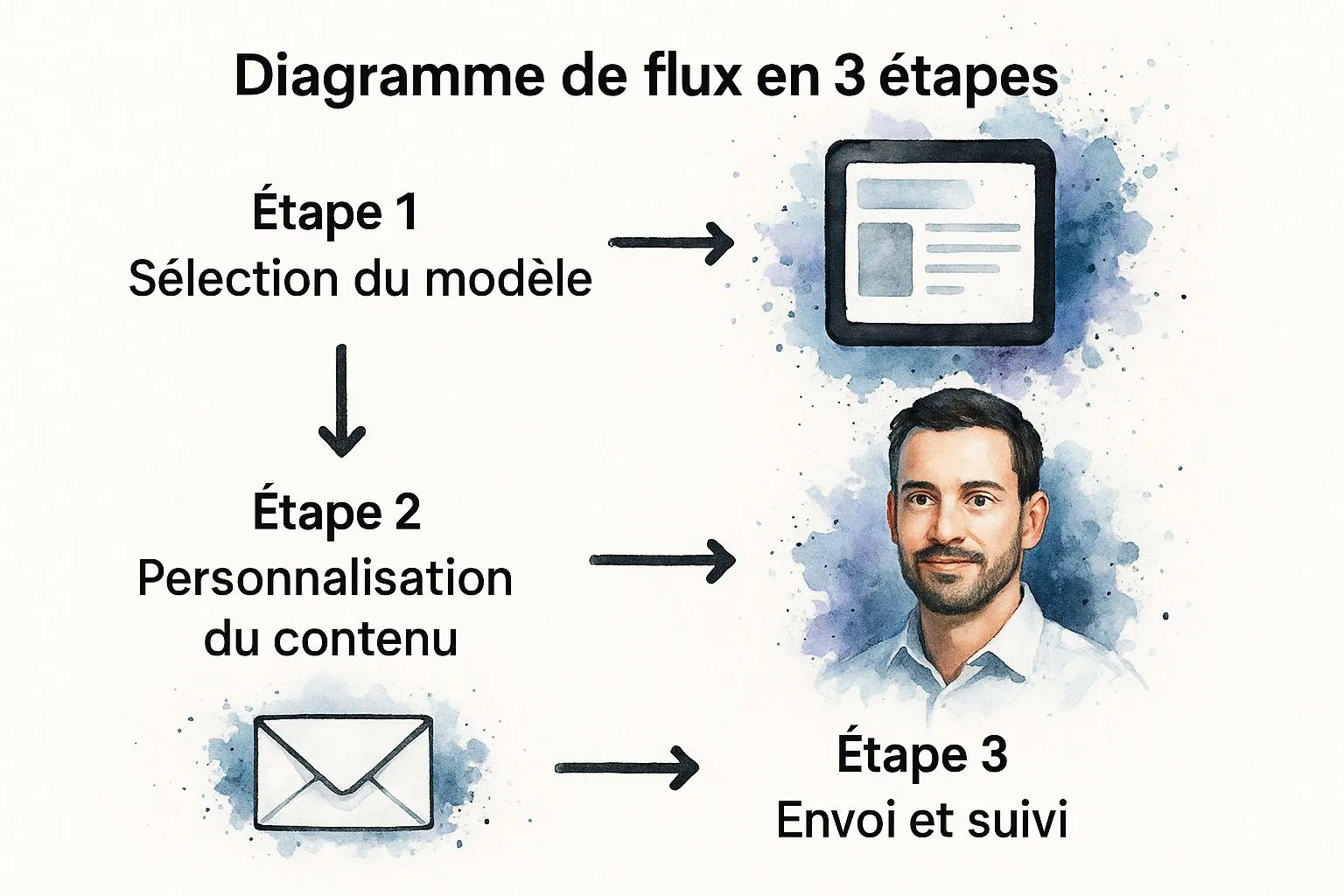
As you can see, after personalizing your message, follow-up is an essential phase. This is where you’ll adapt your strategy, especially when facing a tricky situation.
When should you step things up?
Despite all your good will, some clients just don’t play along. It’s then essential to know when to end amicable discussions and move to more formal action. If promises aren’t kept and the dialogue breaks down, it’s time to consider more structured procedures.
The table below outlines the different stages of a debt collection procedure, to help you see things more clearly.
| Stage | Recommended timeframe | Average cost | Success rate | Actions to take |
|---|---|---|---|---|
| Amicable reminders | Day +1 to Day +60 | €0 - €50 (time spent) | 80-90% | Phone calls, personalized emails, proposed payment schedule. |
| Formal notice | Day +60 to Day +90 | €150 - €300 (via lawyer) | 60-70% | Sending a registered letter with acknowledgment of receipt demanding payment within a set timeframe. |
| Judicial recovery | Day +90 and beyond | Varies (bailiff, lawyer fees) | 40-60% | Payment order, summons for payment. |
| Debt collection agency | Day +90 and beyond | Commission (15-30% of amounts) | 50-70% | Outsourcing the case to specialized professionals. |
This table clearly shows that the longer you wait, the higher the cost and the lower the success rate.
To explore these options in more detail, feel free to check out our guide on collecting customer debts. Don’t let a situation drag on; acting quickly is often the best guarantee of success.
Measuring what really matters
Sending an invoice payment reminder is one thing, but knowing whether it’s actually effective is another. Many businesses simply look at the total amount recovered. Yet the essential insights are often hidden in the details. To truly master your collections, you need to look beyond the raw numbers and analyze what really reveals the performance of your actions.
Think of your reminder strategy as a marketing campaign. You wouldn’t limit yourself to the number of sales, would you? You’d want to know each email’s click-through rate, the customer acquisition cost, and the effect on loyalty. It’s exactly the same idea here. The goal isn’t just to recover your money, but to do it intelligently, without spending too much time on it and, above all, without damaging your business relationships.
The key performance indicators (KPIs) to track
To see things more clearly, it’s essential to set up a dashboard, even a simple one. Here are the indicators that deserve your full attention to evaluate the effectiveness of your reminders.
- Average payment delay (DSO - Days Sales Outstanding): This is the average number of days between issuing your invoice and receiving payment. If your DSO decreases, that’s an excellent sign that your efforts are paying off.
- Collection rate by stage: What percentage of invoices are settled after the first friendly reminder? And after the second? Or after the formal notice? This information helps you see which stages of your process are the most effective.
- Cost per reminder: Try to estimate the time you (or your team) spend on each reminder action. This will give you an idea of the real cost of collections and help you know if your efforts are worthwhile.
- Impact on the client relationship: This one is trickier to measure, but you can track the number of disputes or complaints following a reminder campaign. Satisfaction surveys can also be a good way to take your clients’ temperature.
How to use this data to improve
These indicators aren’t just numbers to collect. They’re real tools for continuous improvement. For example, if you notice that 80% of your payments arrive right after the first friendly reminder, you know exactly where to focus your personalization efforts to maximize results.
Conversely, if the payment rate after formal notice stalls, it might be time to revisit your message or consider more specialized solutions.
By using a tool like Bizyness, you can automate a large part of this tracking and generate clear reports to visualize these trends. The idea is to use this data to continuously refine your invoice payment reminder method, making it ever more effective and freeing up your time.
Your immediate action plan
Tackling unpaid invoices can seem like a mountain to climb, but with a well-thought-out plan, the first results won’t be long in coming. The idea isn’t to change everything overnight, but to move forward step by step. Let’s focus first on what will have the biggest impact for the least effort.
Your first week: take stock and prioritize
The first step is to face the situation head-on. Take an hour to list all your outstanding invoices. Don’t just note the amounts — go further and classify them:
- Minor oversights: Less than 15 days late.
- Concerning delays: Between 15 and 45 days.
- Critical cases: More than 45 days.
This simple segmentation will give you a very clear view of your priorities. For the “minor oversights,” send an invoice payment reminder right away, drawing inspiration from the templates we covered above. The goal is to quickly resolve 80% of the simplest cases. For the rest, you now know which files will need more personalized attention.
Your first month: get equipped and automate
Once this initial sorting is done, it’s time to set up tools that will save you precious time in the long run. This is the perfect moment to try invoicing software that handles automatic reminders. A free version can work well to get started.
Set up your first reminder scenario: a polite reminder on Day +3 and a second, slightly more formal one, on Day +15. By automating these basic tasks, you’ll free up considerable time. You’ll then be able to focus on the complex cases identified in the first week. Don’t forget to add a direct payment link to your invoices; it’s a very simple trick that can really speed up settlements.
A classic mistake is wanting to create overly complex scenarios from the start. Keep it simple. What matters is getting the machine running. You can always fine-tune it later by analyzing what works best.
Regaining control of your invoicing and reminders is the first step toward healthier cash flow. To go further and manage your entire business with peace of mind, discover how Bizyness can simplify your everyday life as an entrepreneur.
