

 Français
 Invoicing for businesses: A complete guide to optimizing your processes
Master the art of invoicing with proven strategies that deliver measurable results. Discover concrete expert techniques to create, manage and optimize a high-performing invoicing system.

The fundamentals of effective invoicing
Invoicing is a key element in ensuring the smooth operation of any business. Beyond the regulatory aspect, well-managed invoicing helps optimize cash flow and maintain lasting relationships with customers.
The key elements of a flawless invoice
For fast, hassle-free payment, your invoice must follow certain rules. The mandatory elements are:
- A unique invoice number: Enables precise tracking of documents
- Issue and due dates: Defines the payment schedule
- Complete contact details: For both parties (names, addresses, business registration number)
- A detailed description of services: A clear description of the products/services
- Amounts: Unit prices, quantities, totals excluding and including VAT
- VAT: The applicable rate must be clearly stated
You can also add useful information such as your terms and conditions of sale or payment terms.
Managing payment terms effectively
Managing payment terms directly impacts your cash flow. The legal deadline is 30 days, but it can extend to 60 days or 45 days end of month by agreement. Cash payment is also possible. In 2023, 8.3% of businesses had delays of more than 30 days (compared to 7.2% in 2022). Nevertheless, 50% of companies pay their suppliers on time. More information is available in this report.
Implementing rigorous controls
A careful validation system helps avoid errors. Whether it’s a human review or an automated process, this step is essential. It allows all key elements to be checked before sending: calculations, legal notices, and consistency of customer data.
Turning invoicing into an asset
Well-managed invoicing strengthens your position. It improves not only your cash flow but also customer satisfaction. Clear invoices sent promptly reflect your professionalism. By making payment easy for your customers, you facilitate exchanges and encourage faster settlements.
The e-invoicing revolution
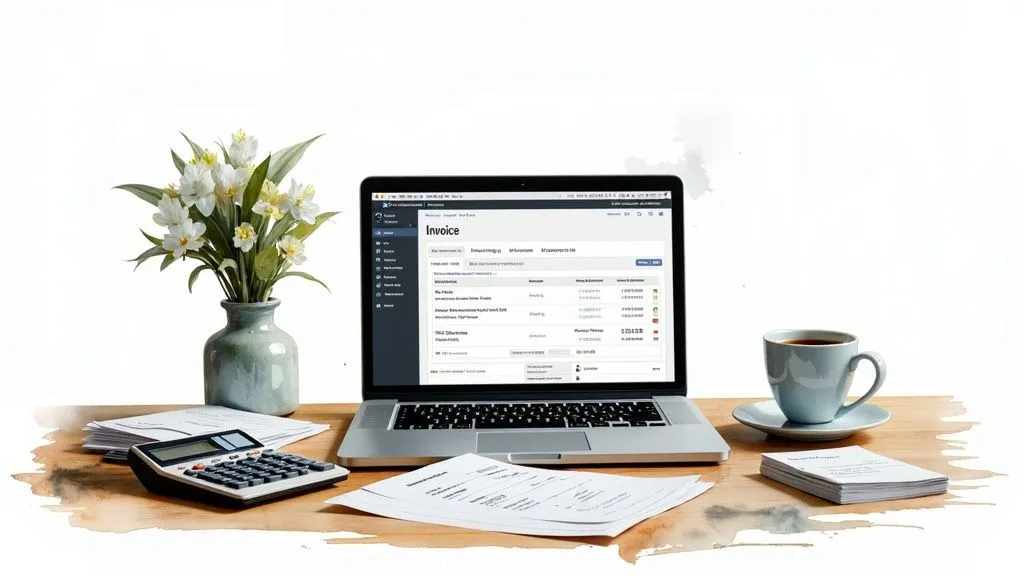
E-invoicing has become an essential element for any modern business. It marks a major shift in accounting management and delivers concrete benefits in terms of operational efficiency. This digital transition turns an administrative obligation into a genuine asset for the business.
The concrete benefits
Adopting e-invoicing considerably reduces the time spent on administrative tasks. Teams gain productivity by avoiding printing, postal delivery and paper archiving. This change generates significant savings on supplies (paper, ink), postage and physical storage.
Tools for every need
The market offers various solutions suited to all types of businesses. Sole traders and small structures can opt for simple software like Bizyness. Larger organizations have access to comprehensive platforms with multi-currency management and accounting integration. In 2023, 31% of French businesses used structured e-invoicing. More information on the evolution of e-invoicing in France.
Key points for a successful transition
A successful move to digital requires good preparation. Team training is essential for smooth adoption of the new system. It’s also necessary to ensure compatibility with existing tools and legal compliance of invoices. Clear processes and precise indicators will help track progress.
Lessons from experience
Businesses that have made the switch report tangible benefits: shorter payment terms, better customer relationships and simplified audits. Performance indicators such as the digitization rate, processing times and tracking of unpaid invoices confirm the positive impact on business activity.
Training for success
The success of the transition relies on team buy-in and skills. A structured training program must accompany the rollout. It should cover both technical aspects and new procedures. Effective training enables quick onboarding and optimal use of the system.
Choosing your tool
Given the variety of solutions available, it’s essential to precisely identify your needs. Sole traders can make do with a basic tool like Bizyness. Larger businesses will need advanced features: multi-currency support, integrations, and more. Take the time to evaluate the options to choose the one that fits your needs and budget.
Mastering Chorus Pro for the public sector

Chorus Pro is the official platform that businesses must use for e-invoicing with the public sector. To ensure fast payments, it’s important to understand how it works. Here is a practical guide to help you better manage your invoices on Chorus Pro.
Setting up your Chorus Pro account for smooth invoicing
To get started with Chorus Pro, precise setup is required. Take the time to explore the interface and its features. Keep essential information such as your business registration number and your service code on hand.
- Enter your contact details: Carefully complete all of your company’s information
- Manage access rights: Grant appropriate permissions to each user
- Enable notifications: To track every step of invoice processing
Careful setup at the start will save you a lot of time later.
Automating your processes with Chorus Pro
Automation helps reduce errors and process invoices faster. Here are the main options:
- Automatic creation: Use compatible software to generate your invoices. For example, Bizyness makes invoicing easier and streamlines submission to Chorus Pro.
- Link with accounting: Connect Chorus Pro to your accounting software
- Setting up rules: Automate reminders and rejection tracking
These options let you focus on your core business. In 2023, 78 million invoices were processed via Chorus Pro, an increase of 5.4% compared to 2022. More information on the evolution of Chorus Pro.
Setting up a quality control system
To avoid rejections, systematically check these points before submitting:
- Data accuracy: Make sure the information matches the order
- Compliance with rules: Check compliance with Chorus Pro standards
- Internal validation: Have invoices reviewed before sending
Rigorous control avoids payment delays and maintains good relationships with your public-sector customers.
Optimizing your daily use
For efficient day-to-day management:
- Organize your documents: Keep all invoice-related files easily accessible
- Use tracking: Regularly check the status of your invoices
- Stay in touch: Don’t hesitate to communicate with your customers when needed
By following this advice, you’ll be able to use Chorus Pro more smoothly and improve your administrative management.
Strategic optimization of the invoicing process

Effective invoicing management is fundamental to ensuring a business’s financial health. This process goes well beyond simply issuing invoices: it involves automating tasks, tracking payments and analyzing data to reduce payment delays. Well-managed invoicing helps maintain healthy cash flow and lets you focus on business growth.
Smart automation and human oversight: a winning combination
Automation is essential for optimizing invoicing. Bizyness software automates the creation and sending of invoices as well as reminders. However, human oversight remains essential to verify the accuracy of information and handle special cases. This combination reduces errors while ensuring document compliance. A concrete example: the software generates recurring invoices while a team member checks customer data.
The tools that offer the best return on investment
Choosing the right tools is crucial for high-performing invoicing. Software like Bizyness offers essential features to simplify the process and payment tracking. Connecting to your accounting system enables unified financial management. Online payment solutions like Stripe or PayPal make it easier for your customers to pay. These investments pay off in the long run.
Tracking techniques to prevent payment delays
Precise invoice tracking helps limit payment delays. Setting up automatic alerts allows reminders to be sent at the right time. A clear dashboard shows the status of each invoice (paid, pending, unpaid) and makes it easy to spot problems quickly. For example, a simple color code indicates status: green for paid, orange for pending, red for unpaid.
Filing systems for simplified audits
Rigorous document organization is essential, particularly in the event of an audit. Digital archiving via invoicing software makes it easier to store and search for documents. A clear filing method improves the traceability of each invoice. A practical example: naming files with the invoice number, customer name and date allows quick access to information.
Measuring your progress: key indicators
Continuous improvement requires regular performance tracking. Precise indicators such as the Average Payment Period (APP) help assess how quickly invoices are settled. The unpaid invoice rate helps identify necessary corrective actions. Analyzing this data lets you refine your invoicing strategy and continually improve your processes.
Advanced strategies for managing unpaid invoices
Managing unpaid invoices is a real challenge for businesses. To maintain healthy cash flow and preserve customer relationships, it’s essential to go beyond simple reminders. Let’s look at concrete approaches to reducing the impact of payment delays.
High-performing automated reminder systems
Automation tools like Bizyness offer practical solutions for managing unpaid invoices. These systems allow you to schedule personalized reminders by email or SMS based on the customer’s profile and level of delay. This approach optimizes collection while ensuring regular follow-up.
The art of negotiation to resolve deadlocks
In complex situations, direct dialogue often proves necessary. By understanding the customer’s difficulties, it becomes possible to find suitable solutions such as setting up a payment plan. This constructive approach builds trust and encourages collection.
Effective legal protection
When unpaid invoices persist, legal remedies become unavoidable. The first step is to send a formal notice by registered mail. If necessary, calling on a bailiff or initiating legal proceedings helps defend your rights. The support of a legal professional is recommended for these steps.
Proven, effective communication templates
Clear, direct messages improve the effectiveness of reminders. A first courteous reminder may be enough, followed if needed by firmer follow-ups. The key is to stay factual, clearly stating amounts, due dates and penalties. Professional communication encourages customer cooperation.
Early warning indicators to anticipate problems
Regularly tracking certain indicators allows you to act quickly. Monitoring the Average Payment Period and the overall unpaid invoice rate helps detect problems. A sudden increase may reveal difficulties with a customer or in the invoicing process. This active monitoring allows you to intervene before the situation worsens. Rigorous management combined with the right tools minimizes the impact of delays on the business’s financial health.
Preparing for the future of invoicing
The field of invoicing is evolving rapidly with the arrival of new technological solutions. These advances are profoundly changing how businesses manage financial transactions. Understanding these changes is essential to staying competitive.
Artificial intelligence (AI) powering invoicing
AI brings major improvements to invoicing automation. It enables automatic data entry and significantly reduces human error. AI algorithms can also anticipate payment delays and identify at-risk customers, which optimizes cash flow management.
Blockchain: enhanced security and transparency
Blockchain is revolutionizing transaction security. Recording invoices on the blockchain guarantees their authenticity and traceability. This technology facilitates audits, limits fraud and speeds up international payments.
The Internet of Things (IoT) and automated invoicing
IoT opens up new possibilities for automating invoicing, especially in logistics. Connected sensors record deliveries and generate invoices without human intervention. This automation reduces processing times and improves productivity.
Adapting your innovation strategy
A proactive approach is essential to modernize your invoicing. You need to evaluate available technologies, understand their benefits and integrate them gradually. Team training is crucial to a successful transition. Regular monitoring allows you to adjust your strategy to new trends.
Preparing for upcoming changes
Technological evolution requires continuous adaptation. Businesses must be ready to rethink their methods to stay competitive. While adopting new solutions requires investment, the gains in efficiency and security are considerable.
Want to simplify your invoicing right now? Bizyness is the solution suited to sole traders and small businesses. Discover how Bizyness can optimize your administrative management by visiting the Bizyness website.
