

 Français
 Guide to Invoicing in English for Freelancers
Master invoicing in English with our guide. Practical templates and tips to bill your international clients without errors.

When you work with international clients, invoicing in English — or simply invoicing, as it’s called — becomes an unavoidable step. It’s not just about translating a document, but about creating a professional invoice that’s clear and compliant with international standards. Terms like “Invoice Number”, “Due Date” or “VAT” (Value Added Tax) need to be used correctly so everything is crystal clear.
Trust us, mastering this process will save you a lot of headaches and, above all, payment delays. It’s a mark of seriousness that builds trust with your foreign partners.
Why is flawless invoicing in English so important?

Opening up internationally is a great growth opportunity. But it comes with a golden rule: communicate without the slightest ambiguity. Your invoice is often the last document your client will see from you for a given job. A sloppy, poorly translated invoice can create friction, sow doubt and, ultimately, delay payment.
Put yourself in the shoes of your client in New York or London. If they receive an invoice with a vague service description or confusing payment terms, their first instinct won’t be to reach for their card. They’ll send you an email asking for clarification. And every back-and-forth is time lost before the money reaches your account.
It’s much more than a simple translation
A professional invoice isn’t just an administrative piece of paper. It’s the ultimate reflection of your professionalism. For it to inspire confidence, you need to get several key points right:
- The right vocabulary: Use the established terms everyone understands, like Subtotal or Total Amount Due.
- Accuracy of information: Double- or even triple-checking addresses, VAT numbers and bank details is never a waste of time.
- Legal compliance: Don’t forget to include the mandatory French legal notices, even if the invoice is written in English.
A classic pitfall is wanting to translate everything. Your French legal notices (SIREN number, legal form, etc.) must absolutely remain in French to be valid in the eyes of the French administration. Don’t translate them!
The concrete impact on your international exchanges
Rigorous invoicing has an impact that goes beyond your simple client relationship. It’s an essential cog in global trade, facilitating trade tracking and customs duty management. Clear, precise invoicing helps, at its own scale, to keep trade flows moving smoothly.
Of course, knowing how to write a perfect invoice is part of a broader skill: speaking English at work well. The better you master the language, the simpler and more effective your business relationships will be.
The key elements of an international invoice
Writing an invoice for a client abroad is much more than a simple translation. An invoice is a codified document, with precise terms your client expects to see in order to process it without a hitch. For everything to go smoothly, it’s crucial to master every section of the document, from the header to the payment terms.
You always start with the header, which brings together all the identification information. This is where your details and your client’s details appear. Precision here is non-negotiable: a small error in a name or address can be enough to delay payment by several weeks.
Who’s billing whom? The importance of identifying the parties
To identify yourself as the invoice issuer, you can use simple, direct terms like “From”, “Billed by” or even “Seller”. Just below, state your company’s full name, postal address and contact information.
For your client, the equivalent labels are just as clear: “To”, “Billed to” or “Customer”. Always take the time to check you have the correct billing address (which isn’t always the same as the physical address) and, if possible, the name of a specific contact in the accounting department. It’s a small detail that greatly eases the invoice’s internal processing.
This information may seem basic, but it forms the foundation of a legal and professional document. For micro-entrepreneurs, getting these details right is essential to establishing credibility. Feel free to check out an invoicing example for a micro-business to see how to structure these elements properly.
The dates and numbers you must never forget
Beyond the contact details, three pieces of information are absolutely vital for tracking and validating your invoice.
- Invoice Number: The invoice’s number. It must be unique and follow a clear logic (for example, 2024-001, 2024-002…).
- Issue Date (or Date of Issue): The date the invoice was issued. This is what triggers the countdown for the payment deadline.
- Due Date (or Payment Due): The due date. This is the deadline by which your client must have paid you.
Forget one of these elements, and your invoice risks getting stuck. Most large companies’ accounting software requires this information just to record the document in their system.
Pro tip: To avoid any confusion with date formats (Americans write the month first, MM/DD/YYYY, unlike Europe), get into the habit of writing the month in full. “October 25, 2024” is much clearer and more universal than “10/25/2024”.
The difference between “Invoice”, “Receipt” and “Statement”
In English business jargon, words have a very precise meaning. Mixing up terms can create misunderstandings and give an unprofessional impression. So it’s important to know when to use each document.
This infographic clearly shows the central role of each term in the invoicing cycle.
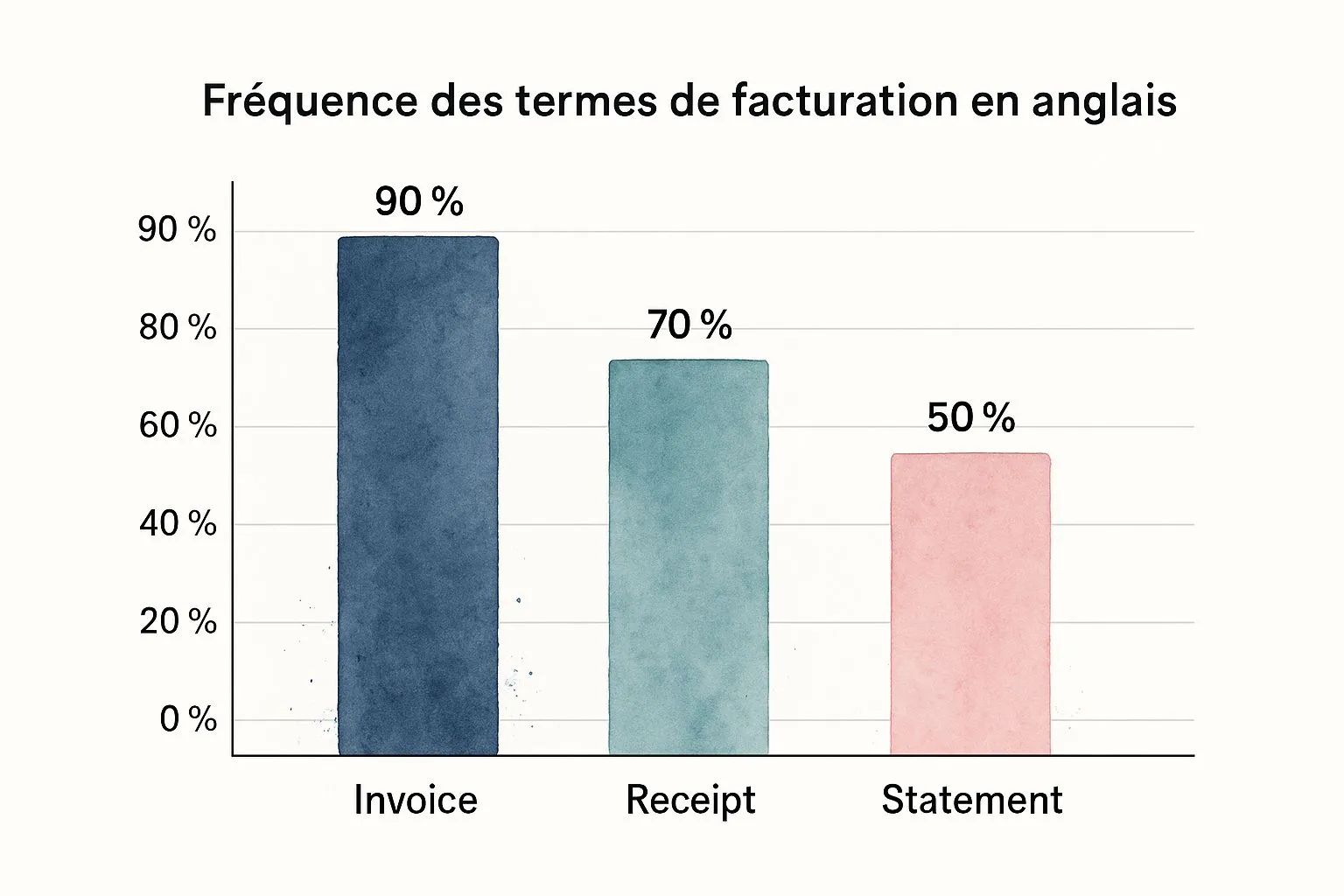
As you can see, the invoice is by far the most common document. It’s the official payment request that initiates the transaction.
Here’s a small glossary to help you see things more clearly and use the right word at the right time.
Practical glossary for your invoices in English
An essential glossary for translating invoicing terms from French to English and avoiding any ambiguity.
| French term | English translation (UK/US) | Context and practical use |
|---|---|---|
| Facture | Invoice | The document you send to request payment for your products or services. It’s the starting point. |
| Reçu / Justificatif | Receipt | The document you send after receiving payment. It serves as proof that the debt has been settled. |
| Relevé de compte | Statement (or Statement of Account) | A summary of all transactions (invoices, payments, credit notes) with a client over a given period. Useful for regular clients. |
By mastering these three terms, you already cover 90% of common situations and ensure communication with your client’s accounting department is smooth and free of misunderstandings.
Describing your services and products precisely
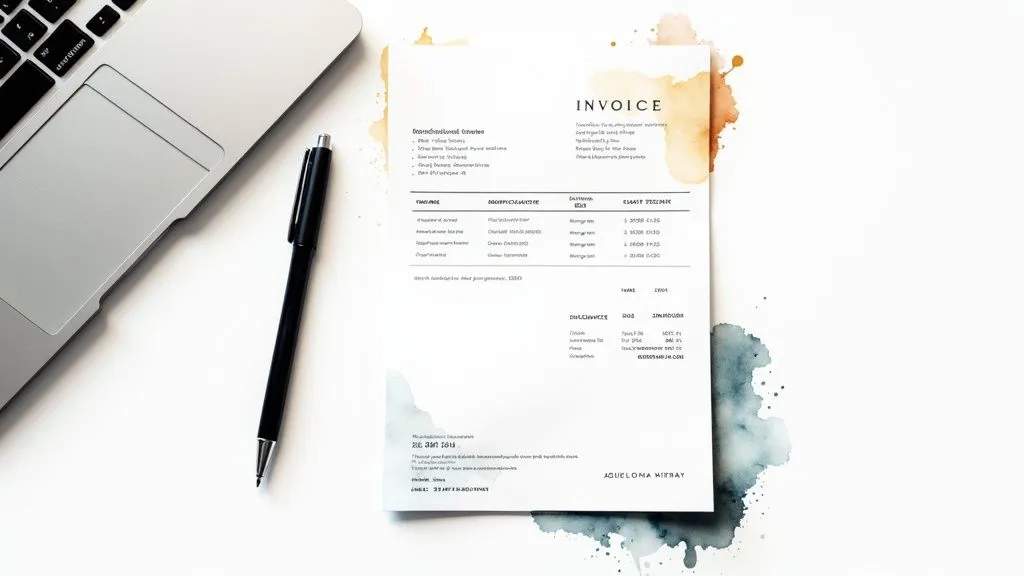
This is where it all happens, at the heart of your invoice. A description line that’s too vague, like “Marketing Services”, opens the door to questions, doubts and, ultimately, payment delays. Your goal is simple: your client should understand at a glance exactly what they’re paying for, without needing to call you.
This section, generally titled “Description of Services/Products” or just “Description”, is there to detail every element of your work. The best way to do this is to use a table that breaks down the total cost, making everything crystal clear.
Transparency above all: break down your work
For each service or product, clarity is your best ally. Think of a simple table with a few essential columns:
- Item/Service: The name of the service or product. Be precise.
- Quantity (Qty) or Hours (Hrs): The quantity sold or the number of hours worked.
- Unit Price or Rate: Your price per unit or your hourly rate.
- Line Total or Amount: The total for that line (Quantity x Unit Price).
The choice between “Quantity” and “Hours” obviously depends on the nature of your business. A consultant will bill hours, while a photographer selling prints will use quantities. What matters is consistency.
The secret is to put yourself in your client’s shoes. “SEO Consulting - October 2024” is fine. But “SEO Consulting: Technical Audit & Keyword Research (15 hours @ €100/hr)” is perfect. It leaves no room for interpretation.
Concrete examples for different professions
The best description is the one that fits your professional reality. Every field has its own subtleties, and your invoice in English must reflect them to be truly professional.
Case study 1: The web developer on a fixed-price project
Even for a fixed-price project, detailing the major steps or key deliverables reinforces perceived value. Your client can concretely see the progress of the work.
- Item/Service: Website Development - E-commerce Platform Setup
- Quantity: 1
- Unit Price: 2,500.00
- Line Total: 2,500.00
Case study 2: The graphic designer selling a package
If you offer a packaged service, the description is an opportunity to remind the client everything it includes. It’s a subtle way to justify your rate and show the scope of your offering.
- Item/Service: Corporate Logo Design Package (Includes 3 concepts, final vector files, and brand style guide)
- Quantity: 1
- Unit Price: 850.00
- Line Total: 850.00
Case study 3: The SEO consultant billing by the hour
Hourly billing requires total transparency. To avoid an endless list, you can group hours by broad task category. It’s clearer and just as precise.
- Item/Service: Monthly SEO Consulting - On-page optimization
- Hours: 8
- Rate: 90.00
- Line Total: 720.00
By adopting these formulations, you’re not just sending a payment request. You’re sending a professional document that justifies your value and, through its clarity, encourages prompt payment. Every line becomes tangible proof of the quality of your work.
Navigating the jungle of international VAT

Tackling the question of VAT (Value Added Tax) on an international invoice can quickly make you break out in a cold sweat. Rest assured, once you’ve grasped the logic, it all becomes much simpler. The secret is to correctly identify your client’s situation to know which treatment to apply.
To start, the structure of the amounts on your invoice must be crystal clear. Always display these three elements, in this order:
- Subtotal (or Net Total): the total amount before tax.
- VAT (followed by the rate, for example VAT 20%): the tax amount, if applicable.
- Total (or Total Amount Due): the final amount to be paid, including tax.
Now let’s look at the two most common scenarios.
Your client is a business within the European Union
If you’re invoicing a professional (B2B) based in another EU country, the reverse charge mechanism comes into play. In practice, you issue an invoice without VAT. It’s then up to your client to declare and pay this VAT in their own country. Simple, right?
For everything to be in order, don’t forget to state your intra-community VAT number as well as your client’s. It’s mandatory.
The wording that protects you: To justify the absence of VAT, add the phrase “Reverse charge - VAT exempt under Article 226, 11 of the VAT Directive”. This is the standard wording, understood by all European tax authorities.
Your client is based outside the European Union
The scenario changes slightly if your client is located, for example, in the United States, Canada or the United Kingdom. Your service is then viewed as an export. The good news is that you also invoice without tax in this case.
The legal justification, however, is different. We’re no longer talking about a reverse charge, but a VAT exemption for exports.
The wording not to forget: The phrase to include is “VAT exemption - Article 259 B of the French General Tax Code”. It clearly indicates to the French tax authorities why you didn’t collect VAT on this transaction.
Handling these cases rigorously is essential to staying compliant. If you want to dig deeper into the topic, our guide on calculating VAT is an excellent resource for mastering all the details.
Getting these aspects right is all the more crucial as electronic invoicing will become mandatory in France between 2026 and 2027. One of the goals of this reform is precisely to better track VAT flows. Flawless invoicing in English is therefore your best ally in preparing for these new requirements.
Defining payment terms: the crux of the matter
Once you’ve listed your services, it’s time to tackle the part that directly affects your cash flow: how and when your client must pay you. This is often where things go wrong. Vague or incomplete payment instructions are the number one cause of payment delays, take our word for it.
To avoid this, the “Payment Terms” section must be crystal clear. Here, there’s no room for improvisation. Rely on standard wording, understood by any accounting department in the world. It’s a simple way to show that you’re a seasoned professional, even internationally.
The payment deadline: be direct
Your client shouldn’t have to search for the date by which they must pay you. The deadline should jump out at them.
Here are the two most common and effective phrasings:
- “Due upon receipt”: This simply means payment is due as soon as the invoice is received. It’s perfect for short assignments, deposits, or when working with a new client to establish good habits from the start.
- “Net 30” (or Net 15, Net 60…): This is the classic of international trade. “Net 30” means full payment is expected within 30 calendar days of the invoice’s issue date. It’s the most widespread and accepted term in B2B.
By using one of these terms, you set a clear framework and spare yourself back-and-forth emails asking “when was that due again?”.
A small practical tip: don’t just write a “Due Date” with nothing else. Adding the mention “Net 30” alongside reinforces the formal, professional nature of your request. It’s a standard practice accountants expect to see.
Bank details: aim for perfection
To receive a wire transfer from abroad without a hitch, your bank details must be flawless. The slightest error or missing piece of information, and the transfer is guaranteed to get stuck.
In the “Payment Details” or “Bank Details” section, make sure to clearly list:
- Bank Name: Your bank’s full, official name.
- Account Holder Name: The name of the account holder, as it appears on your bank statement (yours or your company’s).
- IBAN: Your account number in international format.
- BIC/SWIFT Code: Your bank’s international identifier.
The IBAN and BIC/SWIFT code are the two keys to international payments. They are non-negotiable. Without them, your client simply won’t be able to initiate the transfer.
This is a point of vigilance for everyone, and particularly for freelancers who need smooth cash flow. By the way, if you have more general questions, our guide on invoicing as a sole trader could be useful to you.
The finishing touch: a word of thanks
An invoice isn’t just a cold accounting document. It’s also a touchpoint with your client. Ending on a positive note can make all the difference.
A simple message in the “Notes” section or just at the bottom of the page humanizes the exchange and strengthens your relationship.
A few simple ideas:
- “We appreciate your prompt payment.”
- “Thank you for choosing us. We look forward to working with you again.”
This small touch shows that there’s a human behind the invoice. It’s a simple thing, but it often encourages more timely payment.
Your questions about invoicing in English
Going international is great, but it comes with its share of practical questions, especially when it comes to invoicing. To save you headaches and let you finalize your documents with peace of mind, we’ve gathered the most common questions we come across among entrepreneurs.
What currency should I bill my client abroad in?
The golden rule is anticipation. It’s best to agree with your client from the start, ideally at the quote or contract stage. If nothing is specified, issuing the invoice in your client’s currency (USD, GBP, etc.) is often an appreciated commercial gesture. It’s simpler for them.
That said, to keep control over your incoming payments and avoid unpleasant surprises related to exchange rates or conversion fees, you can absolutely decide to invoice in euros. What matters is that it’s clear to everyone. State it clearly, for example with the mention “Total in EUR”, and always use the correct symbol (€, $, £) next to each amount. No room for doubt.
Do I have to translate all my French legal notices?
Absolutely not! This is an essential point to understand. Your legal obligations — SIREN number, legal form, VAT statement — depend on French law. For your invoice to be valid in the eyes of the administration, these notices must absolutely remain in their original language, French.
The trick is to isolate them in the footer. The body of the invoice will be in English so your client understands everything. At the bottom, the notices in French ensure your legal compliance. It’s clean, clear and tidy.
This is the best way to juggle clarity for your client with respecting your obligations in France. Professional and compliant invoicing in English is as simple as that.
How do I follow up with an English-speaking client for payment?
Business culture in English-speaking countries tends to be more direct, but professionalism still matters. If an invoice reaches its due date, don’t panic. A first courteous reminder does the job perfectly.
Here are a few phrasings that work well:
- For a first friendly reminder: “This is a friendly reminder that invoice #123 is due for payment.”
- If the invoice is already overdue: “Our records show that invoice #123 is now overdue. Please let us know the status of this payment.”
Get straight to the point, stay factual and leave out any emotion. If your terms and conditions allow for it, you can of course mention the application of late payment fees in a second or third follow-up email.
Is invoicing software really useful?
Honestly, when you’re just starting out, a good old spreadsheet template can be enough. But as soon as you start having clients abroad on a regular basis, invoicing software is no longer a luxury — it’s a real ally.
It’s not just for show. A good tool will:
- Manage your invoice numbering without you having to think about it.
- Calculate VAT correctly based on your client’s country (a real headache avoided).
- Provide you with ready-made, compliant multilingual templates.
- Let you track payment status: sent, viewed, paid, overdue.
In short, dedicated software drastically reduces the risk of making an error, saves you a huge amount of time and, not least, reinforces the professional image you project to your international clients.
With Bizyness, invoicing in English becomes child’s play. Our tool lets you create multilingual, multi-currency invoices in just a few clicks, while automatically handling VAT and staying legally compliant. Simplify your admin so you can focus on what really matters: your international growth. Discover how Bizyness can help you.
