

 Français
Invoicing software for SASU, SARL, SAS, EURL
Discover the differences between the various legal business structures to choose the right invoicing software for SASU, SARL, SAS or EURL companies.

Choosing your company’s legal structure determines many things, including your accounting obligations. Whatever you decide, you then need to pick the best invoicing software for SASU, SARL, SAS or EURL companies — one that lets you work simply while meeting your obligations to the tax authorities.
N.B. as a reminder:
- SASU = Single-Shareholder Simplified Joint-Stock Company
- SARL = Limited Liability Company
- SAS = Simplified Joint-Stock Company
- EURL = Single-Member Limited Liability Company
Criteria for choosing your company’s legal structure
There is no “ideal” legal status, because your choice should be the one that best suits your project. You should first consider the criteria listed below before settling on the structure that fits you. Only then is it time to select the right invoicing software for SASU, SARL, SAS or EURL companies.
The nature of your activity
Some activities, fortunately rare, dictate the choice of your legal structure. This includes savings, capitalization or insurance activities, which cannot be carried out as a SARL; tobacconists are restricted to an SNC (General Partnership) or a sole proprietorship, and performing artists cannot set up a joint-stock company (SAS or SASU).
Alone or with partners?
If you’re starting out alone, you may want to bring in partners later. However, not all statuses allow this.
Personal liability
Your legal status determines how well your personal assets are protected.
Operating rules
The status establishes either a solo operating mode, letting you decide everything on your own, or a collective one, requiring you to reach agreement with your partners.
Financial investment
You need to factor in the minimum capital requirement as well as the company’s financial needs.
Tax regime
Depending on your legal status, you are subject to Income Tax (IR) or Corporate Tax (IS).
Social security regime
The social security regime defines how you are paid and your social security affiliation.
Succession
Finally, your choice of legal status sets the rules for passing the business on to your children.
The versatility of invoicing software for SASU, SARL, SAS, EURL
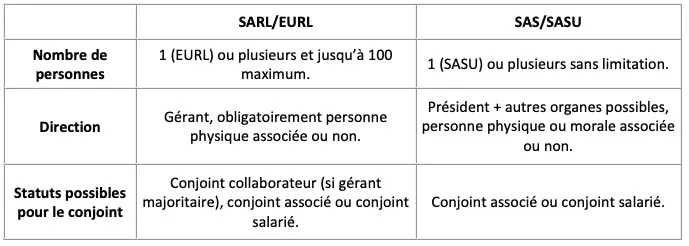
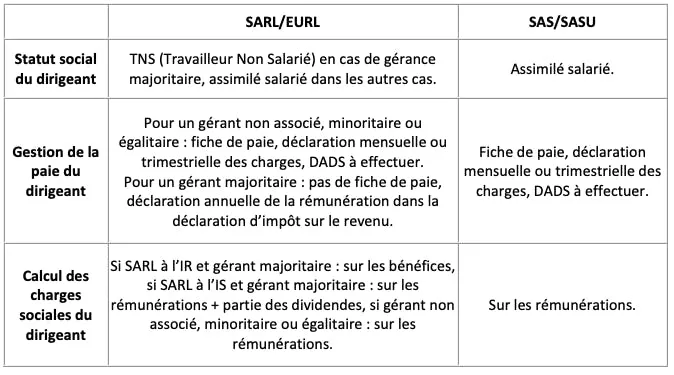
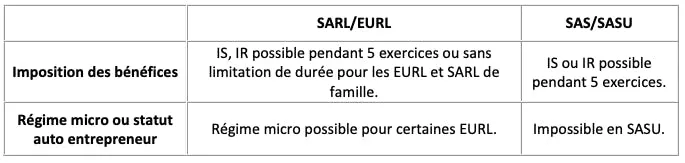
The comparison tables below will help you refine your choice and select your invoicing software for SASU, SARL, SAS or EURL companies. Note that some software, such as Bizyness, is versatile and adapts to each of these four statuses.
You have every interest in using versatile accounting software that covers the criteria for SASU, SARL, SAS and EURL companies. This way, you can transfer your data if you decide to change your legal status. This can happen when you want to bring in partners you hadn’t planned for at the start, if your business grows faster than expected, if you want to change how your assets are protected or how you plan to pass the business on to your children, and so on.
Furthermore, you may own several companies with different legal structures. With software like Bizyness, you can manage all your businesses from a single interface.
The basic characteristics of these legal structures
The four statuses (SASU, SARL, SAS and EURL) share a legal personality, liability limited to contributions, assets belonging to the company, and articles of association that must be drafted.
The incorporation formalities are also the same: form M0, articles of association, legal notice, declaration of no criminal record for the directors, deposit of funds into a blocked account, and, where applicable, a contributions auditor’s report on in-kind contributions.
The director’s social status and start-up assistance
The common points between the four statuses are:
1. compensation method: fixed and/or variable, set by the partners in the articles of association or by meeting minutes;
2. start-up assistance for the director: ACCRE, ARCE (lump-sum capital payment) or continuation of ARE, subject to conditions;
3. possible continuation of ARE depending on the salary set (full continuation if there is no compensation), with later adjustment based on profit if the IR option is chosen.
Tax rules for SASU, SARL, SAS and EURL
The four statuses share several common points:
- the director’s compensation can be deducted, unless you choose the IR regime;
- tax treatment of the director’s compensation for a non-partner manager: taxed as salaries and wages;
- tax treatment of the director’s compensation for a partner manager: taxed as salaries and wages, or attached to professional BIC or BNC income if the IR option is chosen;
- VAT exemption, simplified regime or standard actual regime;
- company vehicle tax when passenger cars are used.
Only two points differ:
The company’s administrative and accounting operations
There are many common points between the statuses, which simplifies the choice of your invoicing software for SASU, SARL, SAS or EURL companies.
— The accounting obligations are the same: keeping commercial accounts and preparing annual financial statements. Simplified accounting is possible for small businesses.
— It is in your interest to join a CGA (Approved Management Center) or an OGA (Approved Management Body) if you choose the IR option, otherwise your taxable profits may be increased.
— Approval of the accounts and allocation of profits by the partners is mandatory.
— You must appoint a statutory auditor if you exceed certain thresholds.
— Filing the accounts with the registry is mandatory, except for exemptions below certain thresholds.
— When the business is transferred, you can sell either the shares or the business itself (goodwill).
The difference your invoicing software for SASU, SARL, SAS or EURL companies needs to account for concerns dividend management. For a SAS or SASU, dividends are possible without social security contributions if you have chosen to be taxed under IS. For a SARL or EURL, this is only possible if taxed under IS. Social security contributions apply to part of the dividends for majority managers.
The other difference concerns the transfer of shares. For a SARL or EURL: a written deed and an approval procedure are mandatory when transferring shares to a third party, and this can be extended by the articles of association. For a SASU or SAS: a written deed is not mandatory, and an approval procedure is only required if provided for in the articles of association, with possible pre-emption and inalienability mechanisms.
Choosing your invoicing software for SASU, SARL, SAS, EURL
You should only choose your invoicing software for SASU, SARL, SAS or EURL companies after studying all these points. To make sure it truly suits your business, take advantage of a trial period — as offered by Bizyness for 15 days — and take the time to explore all its features.
