

 Français
 Effective Late Payment Reminder Letter to Get Paid
Our practical guide to writing a late payment reminder letter that works. Get templates and tips to recover what you're owed quickly.
A late payment reminder letter is much more than a simple wake-up call. It’s an essential tool for your business’s survival, a direct way to secure your cash flow and speed up the collection of what you’re owed.
When written well, with a professional but firm tone, it resolves most late payments, often without even scratching your client relationship.
Why a good reminder letter can change everything for your cash flow
A late payment is never just another line in an accounting file. It’s a crack in your cash flow that, if left unaddressed, can quickly weaken your entire business. For an SME or a sole trader, the impact is almost immediate.
The reminder letter is your first concrete action to defend yourself. We tend to see it as an aggressive act, but it’s quite the opposite: it sets a professional framework and simply shows that you manage your business seriously. This approach protects your working capital and saves you a lot of stress.
The importance of acting without delay
Letting too much time pass before reacting sends a very bad message. Essentially, you’re telling your client that their payment isn’t that urgent, which can encourage them to push the deadline back even further. A reminder sent a few days after the due date, on the other hand, changes the game. It shows your rigor and drastically increases your chances of being paid quickly.
Don’t see the reminder letter as a confrontation, but rather as a good management tool. It’s a structured conversation that reminds your client of their commitments, while assuming it’s simply an oversight.
The numbers don’t lie
In France, the headache of unpaid invoices is a reality. Nearly 30% of businesses report experiencing payment delays of more than 60 days. The good news is that a methodical approach works. It’s estimated that on average, 70% of reminders sent by mail lead to recovering all or part of the debt. To dig deeper into this topic, I’d recommend taking a look at the economic data on payment terms.
This step is therefore crucial to staying afloat. To better understand how managing unpaid invoices impacts your finances, our complete guide on business cash flow management is an excellent resource. Healthy cash flow starts with proactive invoice management.
The essential information to include in your letter

For an unpaid invoice reminder letter to avoid ending up in the trash, it needs to be written carefully and methodically. Every detail matters to turn a simple letter into an official document that leaves no room for interpretation. The goal is simple: be clear, precise, and undeniable.
A single piece of missing information, however small, can be enough to make your approach ineffective or, worse, push the deadline back even further. It’s not just about being polite — you need to build a solid case.
The basic identification elements
Before talking about money, let’s lay the groundwork. Perfect identification of each party is non-negotiable. It’s the foundation of your letter.
Be sure to include:
- Your complete details: Company name, registered address, SIRET number, and a contact (phone or email). Your client should know at a glance who is writing to them.
- The client’s details: Name, company name, and exact billing address. This shows that you’re targeting the right party and that this isn’t a mistake.
- The date and place of writing: This information is crucial. It sets the starting point for your approach and will be useful for calculating legal deadlines later on.
These elements, while basic, immediately give your letter official weight.
The heart of your claim
Now we get to the core of the matter. Here, precision is your best weapon for hoping to get paid quickly.
The centerpiece of your reminder is, of course, the invoice itself. Without its reference details, your letter has no legal value. Be uncompromising on this point: mention its number, issue date, total amount including VAT, and the original due date.
Then state clearly, without beating around the bush, that this due date has now passed. Make a clear and direct request: payment of the amount owed.
Finally, to show that you know your rights, don’t forget to mention the late payment penalties that now apply as well as the flat-rate collection cost compensation. For business clients, this is set at €40. It’s a powerful legal reminder, usually provided for in your terms and conditions of sale. To learn more, our article on the definition of payment terms will be very useful. By adding these mentions, your unpaid invoice reminder letter goes from a simple friendly reminder to a proper formal notice.
How to adapt your approach at each reminder stage
Effectively managing unpaid invoices isn’t about sending a single threatening letter. It’s an art, a process where the tone and firmness of your communication should escalate. The idea is to adapt your approach at each stage to maximize your chances of recovering your money, while trying to preserve the relationship with your client.
Think of it as a marathon, not a sprint. You need to know how to dose the pressure without ever tipping into aggressiveness, which would be entirely counterproductive.
This infographic gives you a good overview of the timeline to follow, from the simple reminder to the final notice before moving to more serious action.
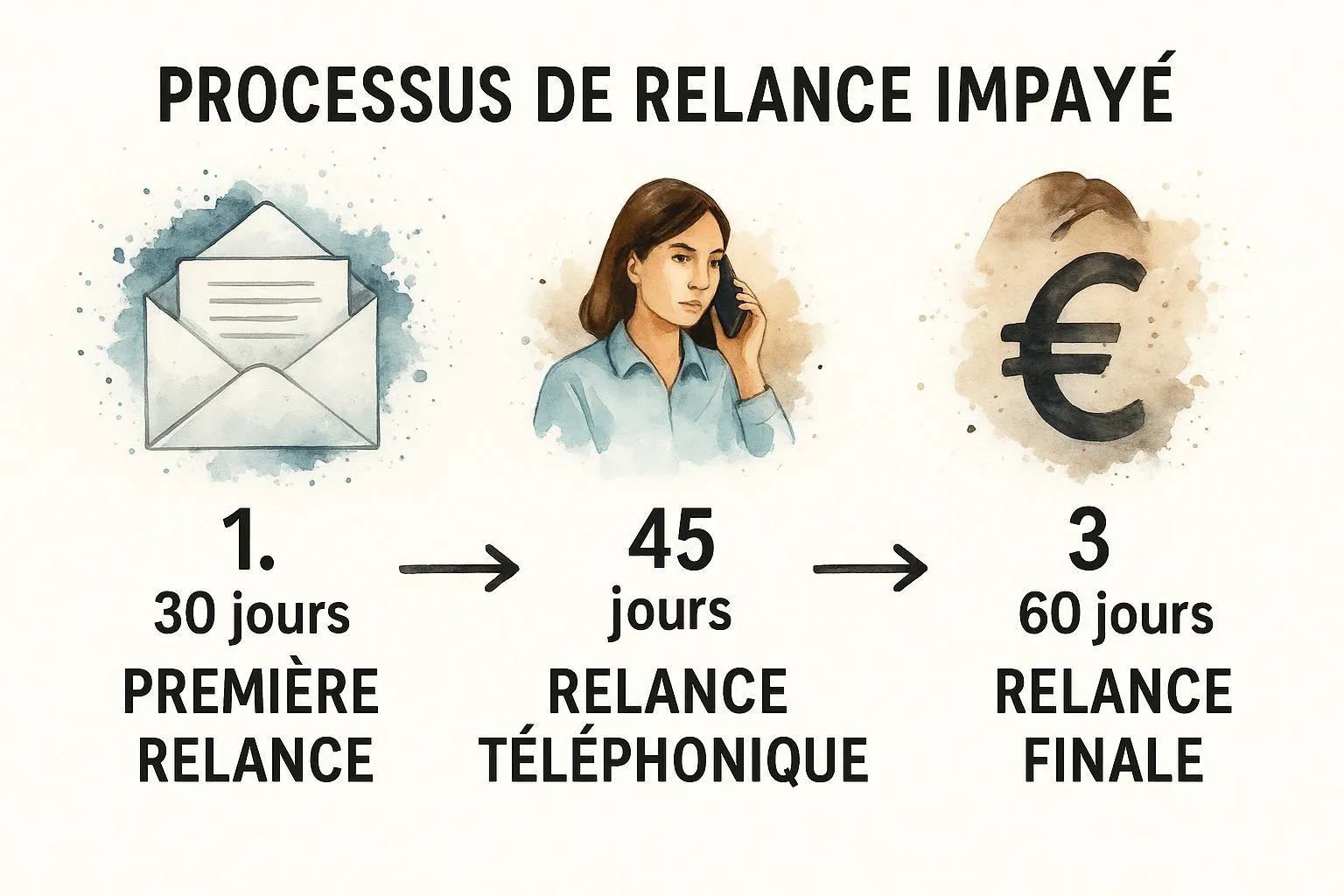
You can clearly see this controlled escalation, which juggles different communication channels to maintain constant, but always professional, pressure.
The first reminder: play the courtesy card
Your very first action after the due date should always start from a simple assumption: it’s an oversight. Your goal is just to gently flag the pending invoice, without creating conflict.
Adopt a helpful, even conciliatory tone. At this stage, a simple email is more than enough.
- Email subject: Get straight to the point, for example: “Quick reminder regarding our invoice no. [Number]”.
- Message body: Recall the key information (invoice number, amount, date) and simply ask whether everything is in order or whether payment has been sent.
- The small phrase that changes everything: Use phrases like “Unless we’re mistaken…” or “We would like to remind you that invoice…”.
Trust me, this gentle approach is enough to resolve about 70% of late payments, without any friction.
The second reminder: getting more direct
If your first reminder goes unanswered after a week or two, it’s time to change your tone. You move to firmer communication, while remaining impeccable in form.
The assumption of an oversight becomes less likely. You need to show that you’re closely following up on the matter. The best strategy here is often a phone call, immediately followed by an email summarizing your conversation. The call creates direct contact; the email leaves an undeniable written record.
The goal of this second reminder is clear: understand why things are stalled and get a specific commitment. Never hang up without a firm payment date from your client.
Comparison of reminder levels for an unpaid invoice
To make things clearer, this table summarizes the characteristics of each stage of the process, from the simple reminder to the formal warning.
| Reminder level | Main goal | Tone to adopt | Recommended channel |
|---|---|---|---|
| Reminder 1 (Friendly) | Flag a potential oversight | Courteous, helpful | |
| Reminder 2 (Direct) | Get an explanation and a commitment | Firm but professional | Phone call + confirmation email |
| Formal notice (Formal) | Warn before legal action | Formal, legal, unambiguous | Registered letter with acknowledgment of receipt |
Each stage therefore has its own role and its own way of being carried out for maximum effectiveness.
The formal notice: the last warning
When all friendly attempts have failed, the formal notice is your last card before considering legal proceedings. It’s an official document that must imperatively be sent by registered letter with acknowledgment of receipt to have legal value.
The content must be crystal clear:
- The title “Formal Notice” must appear clearly.
- A precise summary of the debt.
- A final, non-negotiable payment deadline (generally 8 days).
- An explicit mention of the legal proceedings that will be initiated if payment is not made within this deadline.
The formal notice marks the end of the amicable discussion. It opens the door to contentious proceedings. To dig deeper into the subject, our article on client debt collection strategies will give you further leads.
A few reminder letter templates to get you started

Enough theory, let’s move on to practice. Knowing what to write and how to phrase it is often what holds people back. To help you get started, here are some concrete templates, adapted to each stage of the reminder process.
The idea is to give you a solid base, both professional and legally sound. All you’ll need to do is personalize the fields in brackets to have an unpaid invoice reminder letter ready to send in a few minutes.
Template 1: The first reminder, friendly tone (by email)
Here, we assume it’s a simple oversight. The goal is to remind your client of the deadline in a courteous way, without pressuring them.
Subject: Quick reminder regarding our invoice no. [Invoice number]
Email body:
Hello [Client name],
I hope you’re doing well.
Unless we’re mistaken, it appears that invoice no. [Invoice number] for an amount of [Amount] €, due on [Due date], is still awaiting payment.
Could you let us know when we can expect to receive your payment? Of course, if it has already been made, please disregard this message.
I remain at your disposal should you have any questions.
Best regards,
[Your name/Company name]
Template 2: The second reminder, a bit more formal
No response to your first email? It’s time to step it up a notch. The tone becomes a bit firmer, without being aggressive. This letter can be sent by email or, for more impact, by regular mail.
Subject: Reminder no. 2 – Unpaid invoice no. [Invoice number]
Message body:
Hello [Client name],
Despite our previous reminder, we note that invoice no. [Invoice number] for an amount of [Amount] €, issued on [Issue date], has still not been paid.
We ask you to please settle this matter within eight days. Without a response from you within this timeframe, we will be obliged to apply the late payment penalties provided for by law.
Awaiting your payment,
Best regards,
[Your name/Company name]
Template 3: The formal notice, the decisive step
This is your last attempt before considering legal action. This letter has real legal value and must imperatively be sent by registered letter with acknowledgment of receipt. This is non-negotiable.
Be careful, the formal notice is not just a simple letter. It’s a formal legal act. It’s what officially starts the accrual of late interest (default interest) and will prove, in the event of a dispute, that you tried everything amicably.
Subject: FORMAL NOTICE TO PAY
Letter body:
Dear Sir or Madam,
Despite our reminders dated [Date of reminder 1] and [Date of reminder 2], we regret to note that invoice no. [Invoice number], for an amount of [Amount] €, remains unpaid to this day.
By this letter, we hereby give you formal notice to pay us the amount owed within a strict deadline of 8 days from receipt of this letter.
Please be aware that failing payment within this deadline, we will have no choice but to initiate the necessary legal proceedings to recover our debt. This process will incur additional costs that will be charged to you.
Mistakes that can torpedo your debt collection
An unpaid invoice reminder letter can be incredibly effective, but be careful: a single misstep can reduce your efforts to nothing. Trust me, I’ve seen businesses sabotage their own chances of collection by falling into very common traps. It’s therefore crucial to know them in order to avoid them.
The most common mistake, and probably the most damaging, lies in the tone. Falling into aggressiveness is a tempting reflex but entirely counterproductive. A cornered client is a client who won’t pay. Conversely, a tone that’s too soft, almost apologetic, sends a very bad signal: that the payment isn’t that urgent. The whole art lies in finding the right balance: a firm, professional, and factual tone. Emotion has no place here.
Oversights that cost you dearly
Tone is one thing. But substance is another. A reminder cannot suffer from any imprecision, at the risk of losing all its value.
Here are the pitfalls I see most often in the field:
- Incomplete information. It’s basic, but it’s easily forgotten. Without the invoice number, the original due date, or the exact amount owed, your request becomes vague and easy to ignore. The client has a ready-made excuse not to pay you.
- The absence of a clear deadline. Not setting a new deadline for payment leaves the door open to procrastination. Be precise: “we expect your payment within 8 days”.
- Lack of follow-up. A single letter, then nothing? That’s the best way to show that you’re not really determined. Persistence is what makes the difference between getting paid and not.
Expert advice: never brandish a legal threat if you’re not prepared to follow through. Mentioning legal action without ever following up on it destroys your credibility for all future unpaid invoices. It’s the worst mistake you can make.
The posture that makes the difference
To maximize your chances, you need to adopt the posture of a rigorous manager, not an exasperated creditor. Every communication, every reminder, should be perceived as a logical, controlled step in your process. Nothing is left to chance.
See each reminder letter as a piece you’re adding to a file. It should be factual, precise, and constitute written proof of your efforts. This rigor protects your business, but above all it sends a strong message of professionalism that, quite often, is enough to convince a client to settle their situation quickly.
Answering your questions about reminder letters

Even with the best templates in hand, managing unpaid invoices brings its share of questions. That’s completely normal. Having clear answers helps clear up any remaining doubts and act with more confidence.
Let’s look together at the questions that come up most often in the field. The idea is to help you make your approach more professional and avoid small mistakes that can cost you dearly.
When should I send the very first reminder?
Timing is key. If you follow up too early, you risk coming across as an overly zealous creditor. If you wait too long, you send the signal that payment isn’t that urgent.
The practice I always recommend is sending a first friendly reminder between 3 and 5 business days after the due date. It’s the perfect middle ground.
This short delay shows that you’re keeping a close eye on your accounts, while still assuming it’s a simple oversight. And between us, that’s the case most of the time.
Which channel should I use for each reminder?
The communication channel should match the tone of your message. You don’t follow up the same way at the start of the process as at the end.
- First reminder (the friendly one): An email, without hesitation. It’s fast, discreet, and leaves a written record without excessive formality.
- Second reminder (the firmer one): Here, the combo of phone call + confirmation email is formidable. The call allows for a direct exchange and an understanding of the situation. The email, right after, formalizes what was said and the payment commitment.
- Formal notice (the final step): A registered letter with acknowledgment of receipt is mandatory. It’s the only option that gives you solid legal proof that your approach was carried out by the book. Essential if the matter goes further.
Many business owners make the mistake of sticking only to emails. Remember to vary your points of contact. A phone call often has much more impact and clearly shows that you won’t let the matter drop.
Can I charge late payment penalties from the first letter?
On paper, yes, absolutely. The law is clear: late payment penalties are due from the first day of delay, without even a reminder being necessary.
Now, from a business perspective, that’s another story. Pulling out the penalties from the very first friendly reminder is often seen as very aggressive and can strain the relationship with your client.
My advice: save this card for the second reminder. Mentioning the penalties at this stage gives much more weight to your request and marks a logical, justified escalation.
Stop wasting precious time chasing after your payments. With Bizyness, you can automate your invoice reminders and stay in control of your cash flow without even thinking about it. Discover how Bizyness can simplify your life today.
