

 Français
Madelin Law for Sole Traders: The Complete Guide
Find out whether the Madelin law is right for you as a sole trader. This guide covers eligibility, alternatives, and how to optimize your protection.

The Madelin law and the sole trader (micro-entrepreneur) status are a bit like a missed connection. Although it was designed for self-employed workers, this law is not directly accessible to the micro-entreprise regime. Why? Simply because its main advantage — the tax deduction of contributions — runs into the simplified way your taxes are calculated.
What exactly is the Madelin law?

Introduced in 1994, the Madelin law is a tax incentive designed to encourage self-employed workers (non-salaried workers, or TNS in French) to build their own social safety net. Because when you’re self-employed, unlike a salaried worker, it’s up to you to anticipate hard times and plan for the future.
The core idea is to fill the gaps left by mandatory schemes, which can sometimes fall short. The principle is as simple as it is effective: the contributions you pay for your personal protection can be deducted from your taxable income.
A promise: better protection while paying less tax
Think of the Madelin law as a kind of shield for your career as a self-employed professional. It gives you access to specific contracts to secure the most important aspects of your professional and personal life:
- Supplementary retirement: to ensure calmer days once you’ve hung up your tools.
- Income protection (prévoyance): essential insurance in case of work stoppage, disability, or death. It guarantees an income for you and your loved ones if the worst happens.
- Health insurance (mutuelle): essential to supplement Social Security and limit out-of-pocket healthcare costs.
- Loss-of-work guarantee: a kind of private unemployment insurance for the self-employed, offering a lifeline if your activity ends involuntarily.
In short, the Madelin law turns a precautionary expense into a tax optimization tool. You protect yourself better, and on top of that, you reduce your income tax.
So why is the sole trader left out?
If this scheme is so appealing, why doesn’t it apply to you as a sole trader? The answer lies in the very mechanics of your tax regime. The micro-entreprise status is designed to be ultra-simple, which means it doesn’t take your actual expenses into account.
Instead, the tax authorities apply a flat-rate allowance to your revenue to determine your taxable income. This allowance is a kind of “bet”: it’s supposed to cover all your business expenses, without you having to provide any proof. The logical consequence: it’s impossible to deduct anything extra, including Madelin contributions.
The number of sole traders is exploding, with growth of 17.5% in 2020 alone, now representing more than 56% of self-employed workers. For this large number of entrepreneurs to benefit from the Madelin law, there’s only one solution: leave the micro-tax regime and switch to the actual expenses tax regime (régime réel). This is a major decision that requires much more rigorous accounting. For more detail, you can consult the full data on self-employed workers.
This difference is crucial and is the starting point of our whole guide. Understanding this incompatibility is the first step toward making the right choices about your social protection as a sole trader.
How the Madelin law’s tax deduction works
To really understand why the Madelin law and sole trader status are an impossible match, you need to look at how each one works from a tax perspective. It’s a bit like comparing two management philosophies: one meticulous and detailed, the other broad and simplified.
Picture a simple image. Your annual income is a cake. For a self-employed professional under the actual expenses regime (BIC or BNC), the Madelin law gives them the right to cut a slice of that cake — their contributions for health insurance, income protection, retirement — and set it aside before the tax authorities calculate their share of tax. The result: the cake to be taxed is smaller, and the tax naturally goes down.
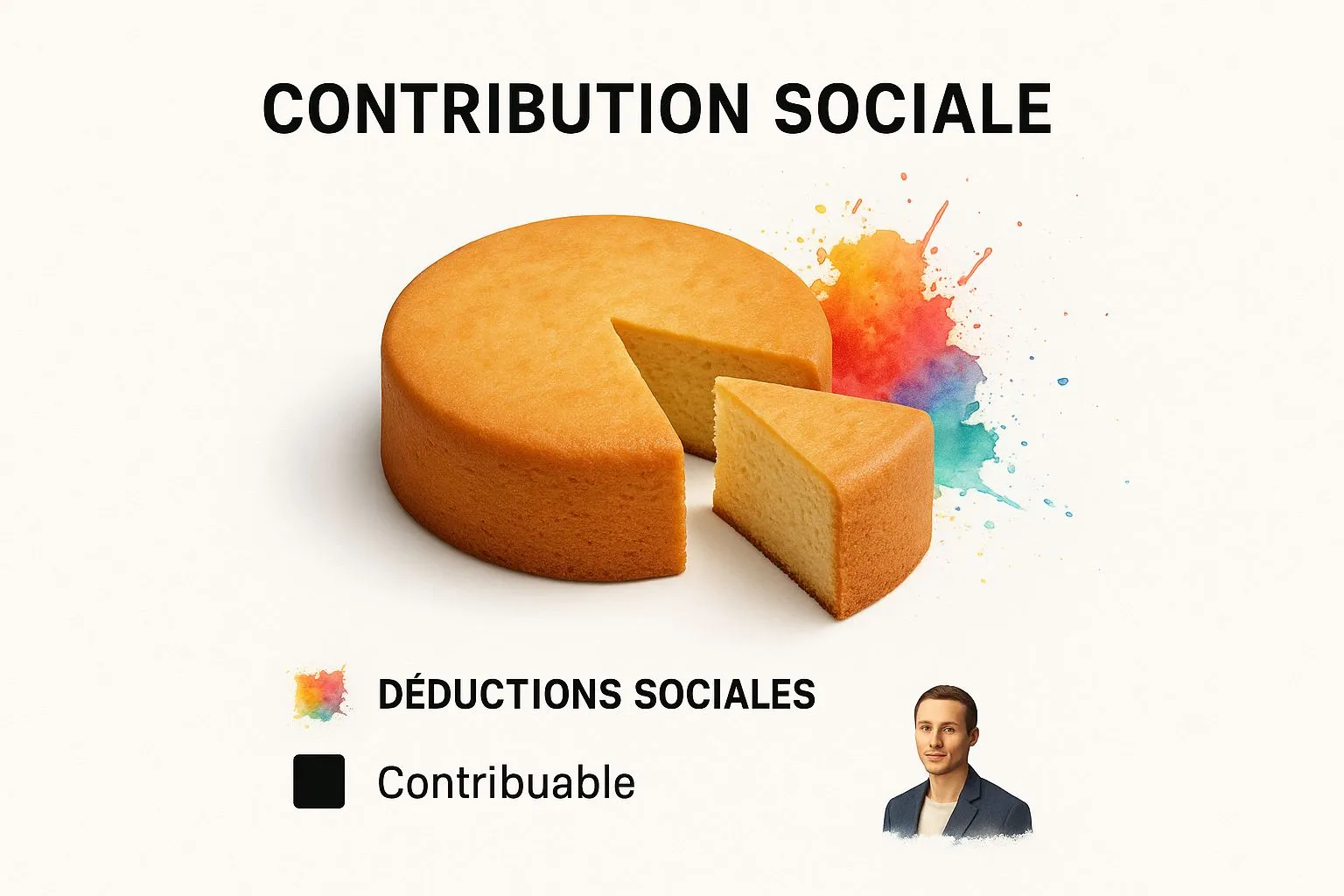
Actual expenses versus flat-rate allowance: two separate worlds
This deduction is possible for the self-employed professional under the actual expenses regime because their filing method requires it. They must list and justify every business expense, one by one. Equipment purchases, travel costs, subcontracting invoices — everything is subtracted from revenue. It’s this precise accounting that opens the door to deducting Madelin contributions.
The sole trader operates on completely different ground. Their regime, the micro-tax regime, is based on the idea of absolute simplicity: the flat-rate allowance.
The tax authorities assume you have business expenses. But instead of asking you to prove them, they apply an automatic allowance to your revenue. This percentage is supposed to cover all your expenses, without you needing to provide any proof.
The table below highlights this fundamental difference.
Comparison of the micro-tax regime and the actual expenses regime
This table highlights the fundamental differences between the micro-entreprise regime and the actual expenses tax regime regarding expense management and access to Madelin-type tax deductions.
| Criteria | Micro-Entreprise Regime (Sole Trader) | Actual Expenses Tax Regime (BIC/BNC) |
|---|---|---|
| Expense calculation | Automatic flat-rate allowance on revenue. No proof required. | Deduction of actual expenses based on justified spending. |
| Accounting | Ultra-simplified (revenue ledger). | Complete, with balance sheet and income statement. |
| Madelin deduction | Impossible. Contributions are considered included in the allowance. | Possible. Contributions are a deductible expense from taxable profit. |
| Complexity | Very low. Ideal for starting out and testing an activity. | High. Often requires the help of an accountant. |
This comparison clearly shows that the two systems aren’t designed to interact. Choosing the micro regime means choosing simplicity in exchange for the inability to deduct actual expenses.
The impossibility of a double advantage
That’s the heart of the problem. Since the flat-rate allowance already theoretically includes all your expenses, you can’t deduct additional expenses like Madelin contributions a second time. You can’t have your cake and eat it too — the simplicity of the allowance and the deduction of actual expenses.
This principle is the cornerstone of any tax optimization as a sole trader.
The Madelin law, which dates back to 1994, was designed to encourage self-employed workers (TNS) to better protect themselves by offering a tax advantage. The idea was to let them contribute toward their health, income protection, and retirement while reducing their taxes.
But this advantage was tailor-made for regimes that declare profits under the actual expenses system (BIC or BNC). The sole trader status, with its flat-rate mechanism, is therefore inherently excluded from this scheme.
This distinction has very concrete consequences for your protection strategy. While the simplicity of the micro regime is an undeniable asset, especially when starting out, it forces you to think differently about building your personal social safety net.
The different types of protection offered by Madelin contracts

Even though sole trader status doesn’t give you access to the direct tax advantage of the Madelin law, it’s important to understand what it offers. This helps you grasp what the scheme brings to self-employed professionals under the actual expenses regime, and also know which guarantees to look for in other contracts. The Madelin law rests on four main pillars, each designed to secure a part of a self-employed worker’s (TNS) life.
Think of these contracts as different pieces of armor. Each piece protects against a specific risk, and together they offer solid coverage against life’s uncertainties. The idea is simple: fill the gaps in the basic schemes, which are often much less generous for the self-employed than for salaried employees.
Supplementary retirement to prepare for the future
The first pillar, and probably the best known, is retirement preparation. It’s a fact: self-employed workers’ contributions to mandatory schemes are often too low to guarantee a comfortable standard of living in retirement. This is a real point of concern, regardless of your business’s legal form.
Madelin retirement contracts, which have since evolved into the Plan d’Épargne Retraite (PER), help you build up capital or a lifetime annuity. The savings effort is strongly encouraged through a tax deduction on payments. For a self-employed worker, this ceiling can go up to 10% of taxable profit (capped at 8 times the annual Social Security ceiling, or PASS), with an extra 15% on the portion of profit between 1 and 8 PASS.
Income protection: an essential safety net
Income protection (prévoyance) is perhaps the most vital pillar for your short- and medium-term financial security. It’s what kicks in during a “hard blow”: an accident, an illness that leaves you bedridden, a disability, or worse, death.
For a self-employed person, stopping work for even a few weeks means seeing your income drop to zero. Income protection is the only guarantee that won’t put your family and your business at risk in the face of the unexpected.
A Madelin income protection contract offers several essential shields:
- Daily allowances to offset your loss of income in case of work stoppage.
- A disability annuity to guarantee you an income if you can no longer practice your profession, whether partially or fully.
- A death benefit or annuity to financially protect your loved ones (spouse, children) if you were to pass away.
The tax deduction for income protection (and health insurance) is capped. It amounts to 3.75% of professional income, plus 7% of the PASS, with the total not exceeding 3% of 8 times the PASS. Understanding the mechanics of income protection is a key step for any entrepreneur concerned about their security. To go further, feel free to check out our guide on business income protection.
Health insurance for optimal coverage
The third pillar is supplementary health coverage, commonly known as a mutuelle. Its role? To top up Social Security reimbursements, which are rarely complete.
A Madelin health plan covers the healthcare costs of the self-employed professional and their family. It can cover poorly reimbursed expenses such as optical care, dental care, or consultations with specialists who charge above standard rates. To be deductible, the contract must be “responsible and solidarity-based” and meet the 100% Santé criteria.
The loss-of-work guarantee: tailor-made unemployment insurance
Finally, the fourth and last pillar is the loss-of-work guarantee. This is an often-overlooked protection, but one that carries real importance. Think of it as private unemployment insurance, designed for self-employed people who must stop their activity against their will.
This guarantee is triggered in specific situations, for example:
- Liquidation or court-ordered receivership.
- A major economic restructuring that forces you to stop.
- A merger or acquisition of your business.
Compensation takes the form of replacement income paid over a set period, often between 12 and 24 months. The tax deduction cap for this guarantee is specific: it corresponds to the higher of 1.875% of professional income (capped at 8 PASS) and 2.5% of the PASS.
Are you a sole trader eyeing the Madelin law? That’s understandable. But as we’ve seen, the two aren’t directly compatible. So how can you still benefit?
The question is on everyone’s mind: is there a bridge? The answer is yes, but it’s no small matter. It’s even a complete about-face for your business.
There’s only one path: say goodbye to the micro-tax regime and switch to the actual expenses tax regime. This decision changes everything about how you run your business and declare your income.
This change may be imposed on you if your revenue exceeds the micro-entreprise thresholds two years in a row. But it can also be the result of your own strategy — a carefully considered decision to optimize your situation.
Switching to the actual expenses regime: a strategic decision
Opting for the actual expenses regime is a bit like trading a simple, practical city car for a race car. More power, more adjustable settings, but also a much more demanding drive. You leave behind the legendary simplicity of sole trader status.
Gone is expense calculation based on a simple percentage. You enter a world where every euro of business spending must be tracked, justified, and recorded.
In practice, this requires keeping full accounting records. Your simple revenue ledger will no longer be enough. You’ll now need to draw up a balance sheet and an income statement — real dashboards that reflect the financial health of your business. Given this complexity, hiring an accountant often becomes unavoidable, representing a new cost to plan for.
Switching to the actual expenses regime means trading administrative simplicity for more refined financial management. The goal? Better social protection and often fairer taxation. It’s a calculation to make, tailored to your business.
The impact on your taxes is direct. Instead of the flat-rate allowance (for example, 34% for liberal professions), you’ll now deduct your business expenses at their exact amount to calculate your taxable profit.
The advantages of switching regimes
The most obvious benefit is, of course, access to Madelin contracts. Once under the actual expenses regime, you can finally subscribe to income protection, health insurance, or retirement contracts and fully deduct the contributions from your profit. Less declared profit mathematically means less tax to pay.
But that’s not all. The actual expenses regime lets you deduct all your business expenses. That’s excellent news if your actual expenses exceed the micro-entreprise’s flat-rate allowance.
Think about everything you could deduct:
- Your purchases of equipment or goods
- Your subcontractors’ fees
- The rent for your office or workshop
- All your subscriptions: phone, internet, business software…
- Your travel expenses (fuel, tolls, vehicle maintenance)
- Your personal social contributions
This is where the math gets interesting. Imagine: if your actual expenses reach 40% of your revenue in a service business, while the flat-rate allowance is 34%, the actual expenses regime is already more advantageous for you — even before counting the Madelin contributions!
The drawbacks not to underestimate
Watch out, this change of scenery comes at a price. The administrative complexity and the associated costs are the two main obstacles to consider very carefully.
Switching to business accounting means new expenses:
- Accountant’s fees: essential to avoid mistakes, they can quickly add up to several hundred, even thousands of euros per year.
- Accounting software subscription: a necessary tool for rigorous tracking.
- Your time: gathering invoices, tracking payments, communicating with your accountant… all of this takes time away from working for your clients.
It’s therefore essential to run the numbers. Weigh the tax savings you’ll achieve (thanks to expense and Madelin contract deductions) against the new costs this regime will generate.
Your personal taxation will also become more complex. To get a clearer picture, even if you leave the micro-entreprise regime, the basics remain important. Feel free to check out our guide on tax filing for sole traders, which will give you useful fundamentals.
In short, yes, a sole trader can access the benefits of the Madelin law. But it requires a bold decision that deeply restructures the business. Weigh the pros and cons carefully, run your numbers, and decide whether it’s worth it for you.
What alternatives exist to protect yourself well as a sole trader?
Does switching to the actual expenses regime feel like an overly complicated ordeal, or premature for your business? No need to panic. Giving up the benefits of the Madelin law doesn’t mean giving up on your social protection. There are other very effective strategies for building yourself a real safety net, even while remaining a sole trader.
The goal shifts slightly: you’re no longer chasing tax deductions at all costs. Instead, you’re looking to build tailor-made protection with the right tools. You can absolutely subscribe to “classic” income protection and health insurance contracts. In practice, they offer the same guarantees as Madelin contracts, just without the tax advantage on your contributions.
Of course, these solutions represent a “dry” expense, with no direct tax optimization. But their role is absolutely crucial: they guarantee you an income in case of a hard blow (illness, accident) and good reimbursement of your healthcare costs.
The individual PER, your best ally for retirement
To prepare for your later years, the most relevant alternative is undoubtedly the individual Plan d’Épargne Retraite (PER). It’s a real find, because it offers a tax advantage very similar to that of the Madelin law, while being accessible to everyone, including sole traders.
How does it work? The subtlety is that payments into your PER aren’t deducted from your revenue, but from your overall taxable income. This is the total income of your tax household, after your micro-entreprise’s flat-rate allowance has been applied.
The individual PER is the simplest and most effective solution for a sole trader who wants to prepare for retirement while reducing their taxes. It sidesteps the incompatibility of the micro-tax regime by acting directly on your personal income tax return.
This means that even as a sole trader, you can contribute to your PER and, at the same time, reduce the amount of personal income tax you pay. It’s a genuinely effective optimization strategy to offset the weakness of retirement contributions under the micro-social regime.
Building your own protection toolkit
Beyond insurance contracts, good protection is also a matter of smart, diversified financial management. The old saying “don’t put all your eggs in one basket” has never been truer. A multi-pronged approach will always be more solid.
Here are a few essential tools for securing your business and your future:
- Individual health insurance: this is the foundation. A good (non-Madelin) contract will cover your healthcare expenses and those of your family. Take the time to compare offers to find the best balance of coverage and price.
- An individual income protection contract: just as essential, it guarantees you daily allowances in case of work stoppage. Think of it as your insurance against loss of income.
- A precautionary savings cushion: set aside a “safety cushion” in an accessible savings account such as a Livret A. Aim for the equivalent of 3 to 6 months of your expenses to handle the unexpected without stress.
- Life insurance (assurance-vie): this is a very flexible savings tool, perfect for medium- to long-term projects. It can be used for retirement, but also to finance a property purchase or pass on capital.
By the way, to better manage your business and client relationships, investing in yourself is also a form of protection. For example, improving your professional French can prove to be a valuable asset for strengthening your credibility and ensuring your business’s longevity.
A tailor-made strategy for every sole trader
There’s no miracle solution that works for everyone. The best strategy will always be the one that fits your personal situation, your industry, and your risk tolerance.
Take a moment to assess your real needs. Do you have children? Does your spouse have good coverage of their own? Does your job involve particular physical risks?
By smartly combining a PER for retirement, good health insurance, solid income protection, and a safety cushion, you can truly achieve an excellent level of protection. You may not get the Madelin law’s tax deduction across the board, but you’ll gain peace of mind. And for an entrepreneur, that’s priceless.
Your questions about the Madelin law and sole trader status
Starting out as a sole trader is a bit like becoming the captain of your own ship. But to sail smoothly, you need solid insurance. The Madelin law, with its tax advantages, seems like an ideal lifeline, but it raises a lot of questions.
To help you chart your course, I’ve gathered here the most frequently asked questions about the pairing of Madelin law and sole trader status. Clear, direct answers so you can make the right decisions for your social protection.
Can a sole trader really subscribe to a Madelin contract?
Yes, absolutely! Legally speaking, nothing stops you from signing a Madelin contract for your health insurance, income protection, or retirement planning. The door is open.
The real issue is the tax advantage. And that’s where it gets tricky: as a sole trader, you cannot deduct these contributions from your taxable income. That’s the core of the Madelin scheme that’s out of your reach.
In plain terms, you’re free to subscribe, but you’ll pay your contributions out of pocket, without any tax reduction in return. That’s why you often hear that Madelin is “inaccessible” for micro-entrepreneurs. Technically it’s possible, but financially it loses all its appeal.
Why doesn’t the tax deduction apply to sole traders?
The reason is purely mechanical — it stems from the very nature of the micro-entreprise regime. This status was designed to be ultra-simple. To calculate what you owe in taxes, you’re not asked for a list of your actual expenses.
Instead, the tax authorities apply a flat-rate allowance directly to your revenue. This allowance is a kind of overall estimate of all your business expenses.
As far as the tax authorities are concerned, your health insurance or income protection contributions are already theoretically included in this allowance. It’s therefore impossible to deduct them a second time. It’s a simple rule: no double benefit.
Deducting actual expenses, including Madelin contributions, is the privilege of self-employed professionals who have chosen the actual expenses tax regime (BIC or BNC).
What’s the risk if I take no supplementary protection at all?
The risk is both personal and financial, and it’s enormous. Imagine an accident or illness that leaves you bedridden for several months. Without good income protection, disaster is guaranteed.
Your income stops dead, but your expenses keep coming: rent, bills, loans… The basic scheme for self-employed workers does pay daily allowances, but they’re often very low and conditional.
For a self-employed person, supplementary protection isn’t a luxury — it’s a vital necessity. It’s what ensures the survival of your business and the security of your household in the face of a hard blow.
Similarly, insufficient health coverage can lead you to put off important care, particularly dental or optical treatment, because you can’t afford to pay upfront.
Is the individual PER a good alternative for my retirement?
Yes, and it’s even the best option for a sole trader who wants to prepare for their later years while reducing their taxes. The Plan d’Épargne Retraite (PER) was designed to adapt to every situation.
The fundamental difference with a Madelin contract is that payments into a PER are deductible from your overall taxable income, not from your business profit. And that changes everything.
In practice, even under the micro-tax regime with its allowance, you can deduct the amounts paid into your PER from your personal income tax return. So you lower your income tax while setting money aside. It’s a very effective lever that sidesteps the Madelin law’s incompatibility.
When should I think about switching to the actual expenses regime?
Switching to the actual expenses regime is a strategic decision that requires a bit of calculation. The right moment comes when the total of your actual business expenses becomes higher than the amount of your flat-rate allowance.
Run the test, it’s simple:
- List all your business expenses for a year (equipment purchases, subcontracting, office rent, insurance, etc.).
- Calculate the weight of these expenses relative to your annual revenue.
- Compare this percentage with the allowance rate that applies to you (for example, 34% for liberal professions).
If your actual expenses reach 40% of your revenue, for example, it’s clear-cut: the actual expenses regime is more advantageous for you. That’s the signal that it’s time to consider the switch. As a bonus, it will finally open the door to deducting your Madelin contributions.
If I switch to the actual expenses regime, how do I declare my Madelin contributions?
Once you’ve left the comfort of the micro regime, filing becomes much more straightforward. All the contributions you pay for your Madelin contracts (health insurance, income protection, retirement…) are then considered business expenses.
You’ll simply need to report them on your professional income tax return (the well-known form 2042 C PRO), in the box dedicated to deductible expenses. Each year, your insurer will send you a Madelin tax certificate summarizing the amounts to declare, which serves as supporting documentation.
One thing to watch out for: you must respect the deduction caps, which are specific to each type of contract (health, retirement…). To avoid mistakes and truly optimize your taxation, working with an accountant is often a very worthwhile investment.
With Bizyness, running your sole trader business becomes child’s play. Focus on your core business, we’ll handle the rest. Discover how our tool can simplify your life and help you manage your business with complete peace of mind at https://www.bizyness.fr.
