

 Français
Margin calculation: how to optimize your profits
Master margin calculation with our guide. Discover the formulas, real-world examples, and strategies to set your prices and boost your profitability.

Trading margin is simply the difference between your selling price (excluding tax) and the purchase cost of your product or service (also excluding tax). It’s the first and most direct indicator of what each sale actually brings in, before you even think about paying rent, salaries, or electricity.
Why margin calculation is your best ally

Far more than a simple calculation, margin is the true dashboard of your company’s financial health. It turns a series of numbers into valuable information for making clear decisions, instead of flying blind. Whether you’re launching your business or running a well-established SME, mastering this indicator is absolutely crucial.
Concretely, understanding your margin gives you direct control over several fundamental aspects of your business:
- Setting fair, profitable prices: This is the foundation. You know exactly the price point at which you start making money, which lets you build a pricing strategy that ensures your company’s long-term survival.
- Optimizing your costs: By identifying the products that bring in the least, you have solid arguments to renegotiate with your suppliers or decide to drop a product from your catalog.
- Making better business decisions: Planning a promotion? Margin calculation tells you precisely how far you can lower your prices without jeopardizing your profitability.
- Having a clear view of your performance: Every sale is broken down. You can see at a glance how it actually contributes to your revenue growth.
In other words, margin isn’t just a figure in an accounting report. It’s the pulse of your business, a vital signal telling you whether your business model holds up and, above all, how to keep improving it.
This indicator matters so much that it’s even monitored at a national level. The evolution of margin rates in France, for example, has often triggered public policy. An OFCE analysis highlighted a near-stagnation of the French margin rate between 1995 and 2018 compared to Germany. This finding directly led to measures such as the CICE (Tax Credit for Competitiveness and Employment) to try to reinvigorate business competitiveness.
To effectively steer your company using these indicators, it’s essential to work with reliable, up-to-date data. Consider automating the updates to your sales dashboard to always have a clear, real-time view of your performance.
The key formulas for calculating your margin: a practical guide
To really steer your business, you need to juggle a few essential calculations. Don’t worry, it’s not complex math — just a toolkit of three simple formulas. Each has its own purpose, and together they give you a very precise picture of your sales profitability.
Let’s master them step by step, with a concrete example so everything is perfectly clear.
Gross margin: what you actually earn on each sale
Gross margin, sometimes also called trading margin, is the basics. It’s the direct profit you pocket from selling a product, once you’ve paid its purchase cost. It’s the first building block of your profitability, before you even think about paying rent, salaries, or advertising.
The formula couldn’t be simpler:
Gross margin (€) = Selling price (excl. VAT) - Purchase cost (excl. VAT)
Let’s take a concrete example:
Imagine you sell T-shirts. You buy each T-shirt for €8 excl. VAT from your supplier. After a bit of market research, you decide to sell it for €25 excl. VAT in your shop.
Your gross margin calculation is therefore:
€25 - €8 = €17
Every time a customer buys this T-shirt, you generate a gross margin of €17. This amount then helps you cover all the other expenses of your business. For this calculation to be accurate, it’s essential to correctly identify everything that makes up your purchase cost. If you want to dig deeper into this, our guide on calculating variable costs is for you.
Margin rate: a percentage to compare like with like
Knowing you earn €17 on a T-shirt is good. But is that more profitable than a sweatshirt where you earn €25? This is where the margin rate becomes your best friend. It turns your margin into a percentage relative to the purchase cost, letting you easily compare the performance of all your products.
Here’s how to calculate it:
Margin rate (%) = (Gross margin / Purchase cost excl. VAT) x 100
Back to our T-shirt:
- Gross margin: €17
- Purchase cost: €8
The calculation is:
(€17 / €8) x 100 = 212.5%
A rate of 212.5%! What does that mean? Simply that your margin represents more than double the price the T-shirt cost you. It’s an excellent way to know which products are the real drivers of your profitability, even if they don’t have the same selling price.
The multiplier coefficient: your shortcut for setting prices
Finally, the multiplier coefficient is the go-to practical tool for setting your selling prices. Instead of guessing, it helps you apply a consistent pricing policy across your entire catalog, starting from what the products cost you.
The formula to calculate it:
Multiplier coefficient = Selling price (excl. VAT) / Purchase cost (excl. VAT)
Still with our T-shirt:
€25 / €8 = 3.125
This coefficient of 3.125 becomes your reference. Tomorrow, if your supplier offers you a new sweatshirt at €15 excl. VAT, you no longer need to rack your brain. Simply apply your coefficient to define a consistent selling price: €15 x 3.125 = €46.88 excl. VAT. It’s a formidable trick for saving time and ensuring the consistency of your pricing strategy.
To help you remember these concepts, here’s a summary table.
Summary of margin calculation formulas
This table summarizes the key formulas for calculating trading margin, margin rate, and the multiplier coefficient, for quick reference.
| Indicator | Calculation formula | Main purpose |
|---|---|---|
| Gross margin (or trading margin) | Selling price excl. VAT - Purchase cost excl. VAT | Measure the direct profit generated by a sale. |
| Margin rate | (Gross margin / Purchase cost excl. VAT) x 100 | Compare the profitability of different products. |
| Multiplier coefficient | Selling price excl. VAT / Purchase cost excl. VAT | Quickly set consistent selling prices. |
With these three tools in hand, you have a solid foundation for analyzing your profitability and making informed pricing decisions.
From gross margin to net margin: calculating your real profitability
Gross margin is an excellent starting point, but it only tells part of the story. Broadly speaking, it tells you how much you earn on selling a product, but not what’s actually left in your pocket at the end of the month. To get a clear, complete view of your profitability, it’s crucial to dig a little deeper and calculate your net margin.
Think of gross margin as the box-office revenue of a concert. The figure may seem impressive, but it doesn’t account for the cost of renting the venue, security, promotion, or the musicians’ fees. Net margin is what’s left once all these bills are paid.
This infographic clearly shows the progression, from basic concepts like gross margin to more strategic tools like the multiplier coefficient.
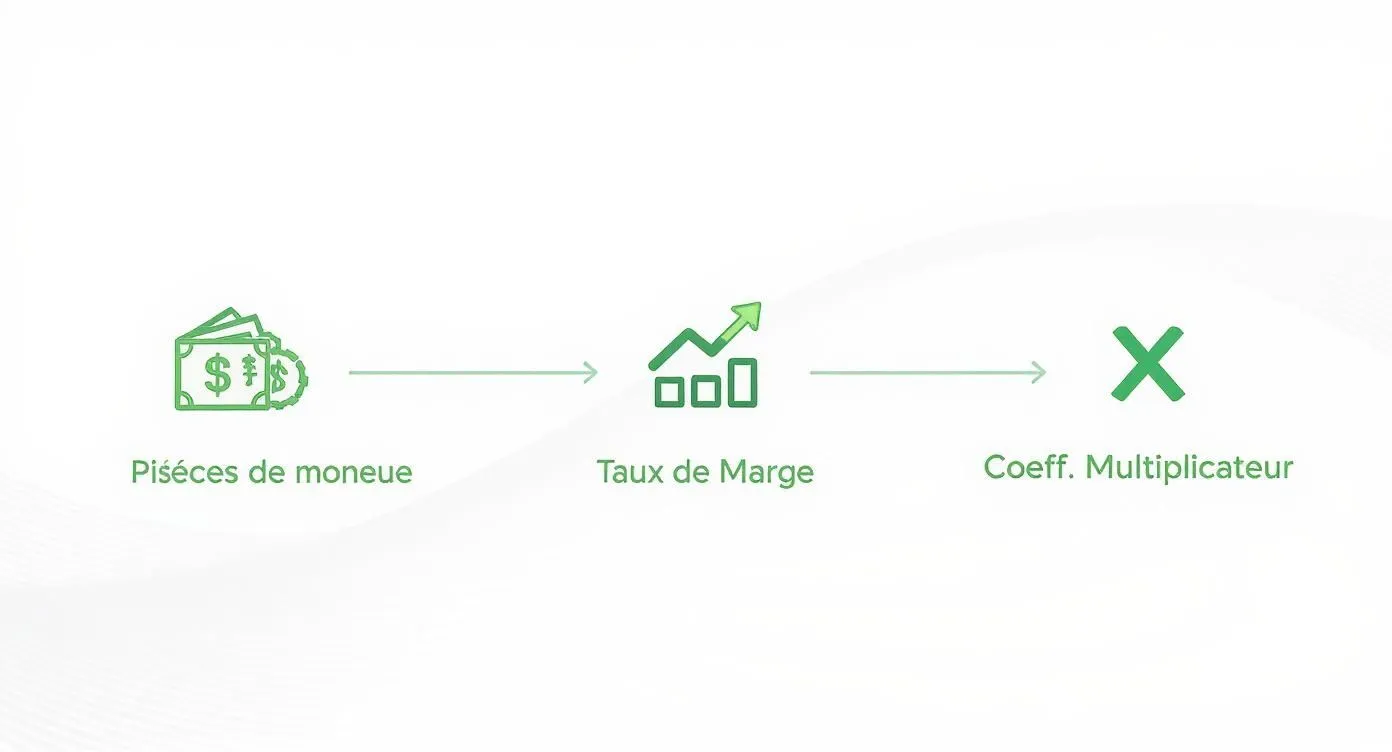
You can immediately see that these indicators are linked and all aim at the same goal: helping you build a pricing policy that holds up.
The critical difference between fixed and variable costs
To go from gross margin to net margin, you need to subtract all the other expenses that run your business. They can be classified into two main families: fixed costs and variable costs.
- Variable costs: These are directly tied to your volume of activity. The more you sell, the more they increase. The perfect example is the purchase cost of your goods, but this category also includes delivery fees or sales commissions.
- Fixed costs: These don’t move (or barely move), whether you sell a single product or a thousand. These are all the expenses you have to pay every month, no matter what, just for your business to exist.
Here are some concrete examples of fixed costs:
- Rent for your premises or office.
- Your employees’ salaries.
- Various subscriptions (software, phone, internet).
- Professional insurance.
- Bank fees.
It’s only after deducting all of these expenses (fixed and variable) from your revenue that you get your net profit. This is the figure — and only this one — that tells you whether your business is actually making money. To dig deeper into the topic, our article on calculating the break-even point is an excellent read. It will help you define the minimum revenue you need to generate to cover all your expenses.
The net margin formula, in plain terms:
Net margin (€) = Revenue (excl. VAT) - Purchase cost of goods (excl. VAT) - Total fixed and variable expenses (excl. VAT)
The VAT trap in your calculations
This is a classic mistake, especially when starting out as a sole trader: thinking in terms of prices including VAT (VAT-inclusive). It’s a habit that can cost you dearly and completely distort your view of profitability.
VAT (Value Added Tax) is not your money. You merely collect it on behalf of the government before remitting it. It’s therefore essential to do all your margin calculations, whether gross or net, on amounts excluding VAT.
Let’s take a simple example:
You sell a product for €36 including VAT. If the VAT rate is 20%, the price that actually comes back to you is €30 excl. VAT. If this product cost you €15 excl. VAT to buy, your gross margin is €15 (€30 - €15), and certainly not €21 (€36 - €15). The €6 difference corresponds to the VAT you owe the government.
Ignoring this nuance is like artificially inflating your profits. The risk? Making poor decisions, such as setting prices too low that, once VAT is removed, won’t even be enough to cover all your expenses.
Interpreting your margin rate according to your sector
A “good” margin rate doesn’t mean anything on its own. Taken out of context, a number is just a number. To really make sense of it, you need to compare it. It’s by putting it in perspective with the practices of your sector that you’ll know whether your performance is good, average, or whether there’s a problem somewhere.
In short, a margin rate that would be excellent for one type of business could be a real warning sign for another. This contextualization is crucial for judging the health of your business, setting meaningful goals, and finding the right levers for growth.
Margin standards, sector by sector
Every field of activity has its own logic: its own cost structure, its own level of competition, and very different profitability expectations. Comparing yourself to your direct competitors is therefore an essential step in effectively steering your business.
Here are a few benchmarks to help you get your bearings:
- Mass retail and e-commerce: In these businesses, everything relies on volume. Margins on each product are often very thin, sometimes 1% to 5%. Profitability comes only from the ability to sell in very, very large quantities. A rate that may seem low is therefore often the sign of excellent performance.
- Food service: Here, the calculation is more subtle, because you first need to control the cost of raw materials (the well-known “food cost”). A gross margin on dishes (“solids”) ideally sits between 70% and 75%. On drinks (“liquids”), on the other hand, it can climb much higher.
- Service businesses (consulting, IT, agencies): For these activities, there is generally little to no cost of purchasing goods. Gross margin therefore often flirts with 100%. The indicator to watch closely is instead net margin, which needs to be comfortable enough to cover salaries, expenses, and all operating costs.
Think of margin rate like an exam grade. A 15/20 is great in philosophy, but perhaps just average in math. It’s the sector of activity that gives the result its true meaning.
Comparing yourself to make progress
When you look at the breakdown of margin rates in France, the differences are striking. The construction sector, for example, often has fairly modest net margins, between 5% and 10%, because it depends heavily on the cost of materials. In contrast, high-value-added sectors like business services or tech can aim for net margins exceeding 40%. For a French SME, a net margin rate above 10% is often considered a sign of good health. To go further, you can consult this complete overview of margin rates in France.
Analyzing your position isn’t just about knowing whether you’re “in line” with the norm. It’s above all an excellent way to spot opportunities. If your margin is lower than that of your competitors, it may be a sign that your purchase costs are too high or that your pricing policy needs revisiting. Conversely, if your margin is well above average, it means your customers perceive strong value in what you offer. That’s a valuable advantage worth exploiting.
How margin helps you set your selling prices

Now that you’re juggling the different formulas, let’s get practical. Margin calculation isn’t just an indicator to check once a year. It’s your main ally for building a price list that is both consistent and, above all, profitable.
For this, there’s a simple and very effective approach, especially when starting out: the “cost-plus pricing” method. The principle is straightforward: you start from what the product cost you and add the margin you want to earn.
The cost-plus pricing method, step by step
This technique has a huge advantage: it guarantees that every sale covers your expenses and generates a profit. It’s an essential safeguard against selling at a loss, a classic trap when you simply copy competitors’ prices.
Here’s how to proceed:
- Calculate your full cost price (excl. VAT): Take your purchase price and add all the expenses directly tied to it (transport, packaging, customs fees, etc.).
- Define your target margin rate (%): This is the profit you’re aiming for, expressed as a percentage of the cost. This figure will depend on your sector, your profitability goals, and the value your customers perceive.
- Apply the magic formula: Selling price excl. VAT = Cost price excl. VAT x (1 + Target margin rate).
Let’s take a concrete example. Imagine one of your handmade creations costs you €30 to produce (raw materials, labor time…). You’re aiming for a margin rate of 150% to be profitable. The calculation will be: €30 x (1 + 1.50) = €75 excl. VAT.
Setting a price isn’t playing the lottery. It’s above all a strategic decision based on numbers. The cost-plus method gives you this solid, logical foundation to justify each of your prices.
To give you an idea, in France, the average margin rate of companies was 27.1% in 2019. But watch out, this figure hides very different realities! In the construction sector, it dropped to 21.1%, and for half of mid-sized companies, it was even below 22.3%. This INSEE data clearly illustrates that you always need to adapt your margin to your field of activity. You can also find more details on margin rates in France on the INSEE website.
Going beyond the simple calculation
Margin calculation gives you your price floor, the minimum rate to be profitable. But that’s only the starting point. To find the right price, you also need to look up and around you. Two other elements are crucial: the perceived value for your customers and the prices charged by the competition.
The perfect price sits at the intersection of what the product costs you, what the customer is willing to pay, and what the market will accept. Finding this balance requires a clear method. Our complete guide explains in detail exactly how to calculate a selling price while taking all these dimensions into account.
Your questions about margin calculation
Even after fully understanding the theory, you often run into very practical questions. That’s normal. The idea here is to answer these questions to clear up any remaining doubts so you can use these calculations with complete confidence.
Are margin and profit the same thing?
No, and this is a very common confusion. Imagine you sell T-shirts. Trading margin (or gross margin) is what you earn on selling one single T-shirt. It’s your direct gain, before even thinking about paying your shop’s rent or your own salary.
Profit, on the other hand, is the overall result at the end of the month or year. You take the sum of all the margins you made on all your T-shirts sold, and you subtract absolutely all the other expenses: rent, electricity, salaries, taxes, marketing… everything.
Simply put: margin is the profitability of a single sale. Profit is the financial health of your entire business.
Is a high margin rate always a good thing?
You might think so, but it’s not that simple. A very high margin rate is good, but it always needs to be looked at in light of your sales. If you sell a product with a huge margin but nobody buys it because it’s too expensive, your final profit will be negligible.
Conversely, look at mass retail: they make very thin margins on each product, but they sell astronomical quantities. It’s all a matter of balance. The real key to success is finding the sweet spot between a comfortable margin and a sufficient sales volume.
How can I improve my trading margin?
To boost your margin, you have two main levers to pull. But be careful, each requires a bit of strategy so you don’t shoot yourself in the foot.
- Raise your selling prices: This is the most direct solution, but it needs to be justified. If you improve quality, your customer service is impeccable, or your brand becomes highly desirable, go for it. But a price increase that comes out of nowhere risks simply driving your customers to the competition.
- Reduce your purchase costs: This is the other route, often very effective. Take the time to renegotiate with your suppliers. Sometimes, buying in larger quantities can get you access to nice discounts. Also consider optimizing your production or logistics to shave off a few euros.
Should I include delivery fees in my purchase cost?
Yes, absolutely. This is a classic mistake that can completely distort your calculations. Purchase cost isn’t just the price shown on the supplier’s invoice. It’s the price of the product plus all the fees you had to pay to get it into stock, ready to be sold.
This therefore includes:
- Transport and delivery fees.
- Any customs duties.
- Handling costs to put it on the shelf.
Forgetting these fees means lying to yourself about the real profitability of your products. Rigor on this point is your best ally for effectively steering your business.
Tracking all these figures can quickly become a real headache. Bizyness was designed to take this mental load off your shoulders. The tool automates these calculations and integrates them directly into your everyday management. To see how you could save time and gain clarity on your profitability, take a look at https://www.bizyness.fr.
