

 Français
Master your administrative management as a sole trader
Simplify your administrative management as a sole trader with our proven strategies. A practical guide for ambitious entrepreneurs.

The basics of your administrative system (without drowning in it)

Administrative management can seem intimidating for a sole trader. Between tax returns, invoicing and payment tracking, it’s easy to feel overwhelmed. Yet with good organization and the right tools, this task can be simplified.
It’s worth remembering that admin work doesn’t have to be a burden.
Simplifying the complexity
Let’s break down the administrative side. It’s estimated that 80% of new sole traders make mistakes, often due to a lack of clear information. A well-structured administrative system lets you focus on your core business instead of getting lost in paperwork. Think of your business as a car: admin is the maintenance, essential to keeping it running smoothly.
The key steps to a stress-free management
To set up a solid administrative system, here are a few essential steps:
- Centralize your documents: Choose a filing system, physical or digital, to bring together all your important documents (invoices, contracts, etc.).
- Automate repetitive tasks: Tools like Bizyness let you automate invoicing, payment tracking and VAT returns.
- Plan your deadlines: Note every important date (returns, payments) in a calendar or dedicated app.
- Track your cash flow: Regularly monitoring your income and expenses will help you anticipate difficulties and optimize your financial management.
Distinguishing the urgent from the important
Prioritizing your administrative tasks is essential. Filing your revenue return, for example, is a legal obligation, while filing certain documents can be postponed. The goal is to establish a routine that lets you handle the essentials without feeling overwhelmed. The dynamism of French entrepreneurship is illustrated by the 4.0% rise in business creations between February 2024 and January 2025 compared with the same period the previous year. Sole traders, accounting for nearly 50% of these creations, are at the heart of this trend. Check out the business creation statistics here.
Choosing the right tools
Choosing tools suited to your business is fundamental. A simple spreadsheet may be enough to manage your invoices at first, but online accounting software like Bizyness will give you more features and security as your business grows. Investing in effective software is a guarantee of peace of mind and a considerable time saver. That time saved lets you focus on more important things, like growing your business and satisfying your customers.
Tax returns and social contributions: what really matters
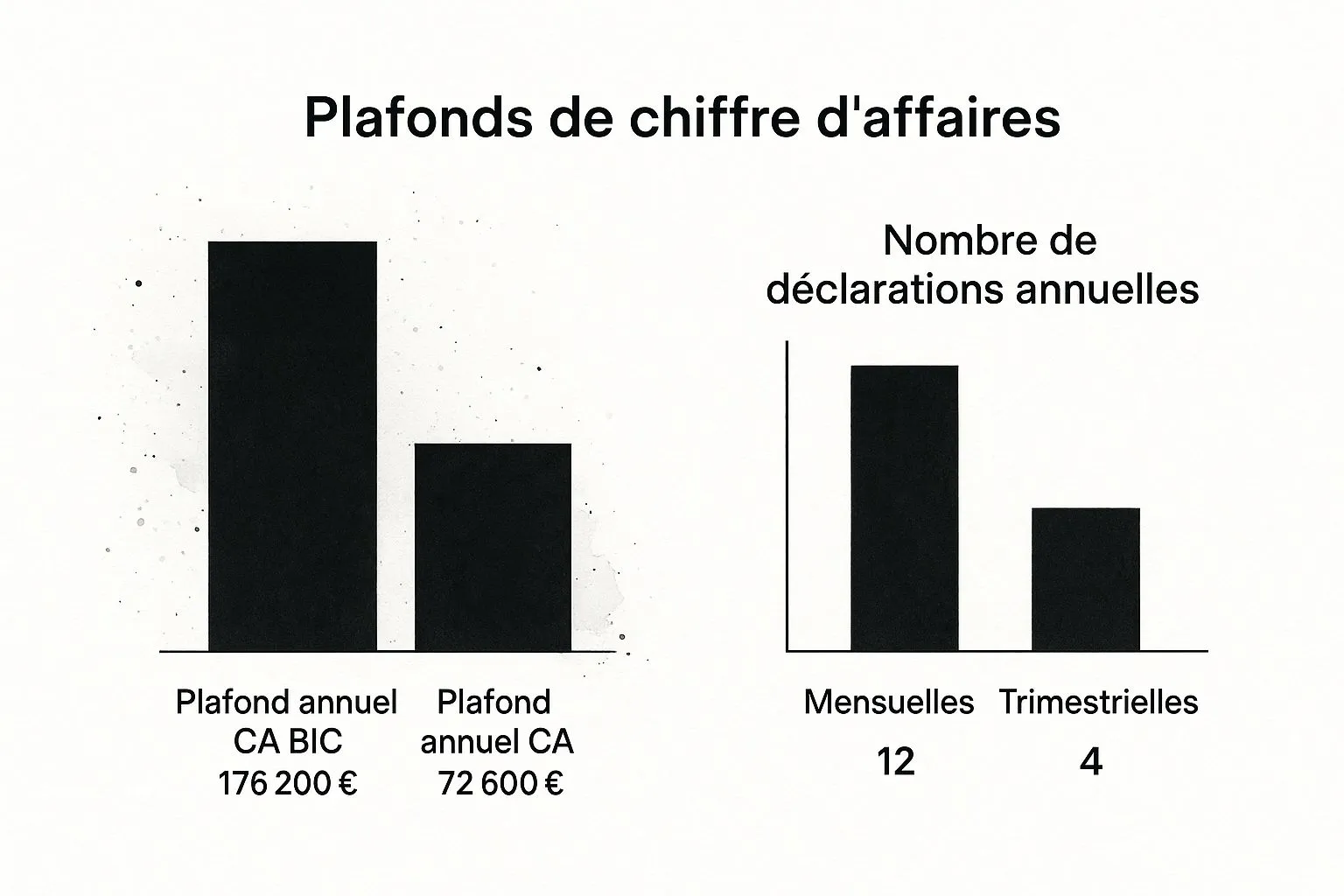
This chart shows the revenue thresholds for BIC (industrial and commercial profits) and BNC (non-commercial profits) activities. It also illustrates how often returns are filed, whether monthly or quarterly. There’s a notable difference between the revenue thresholds for BIC and BNC activities. The impact of choosing a monthly or quarterly filing frequency on the number of returns to file each year is also clearly visible.
As a sole trader, managing your tax returns and social contributions is a pillar of your business. Precise tracking will help you avoid penalties and focus fully on growing your business. It’s therefore essential to understand the deadlines and calculation methods for simplified administrative management.
Calculating your social contributions: an essential step
Your social contributions are calculated based on your revenue and the nature of your activity (BIC or BNC). Important reminder: these contributions fund your social protection (health insurance, retirement, etc.). Using a tool like Bizyness can greatly ease this process and minimize the risk of errors.
To help you visualize the deadlines, here’s a summary table:
Sole trader filing calendar — Summary of monthly and quarterly deadlines by activity type
| Activity type | Filing frequency | Deadline | Agency |
|---|---|---|---|
| BIC | Monthly | The last day of the month | URSSAF |
| BIC | Quarterly | The last day of the month following the quarter | URSSAF |
| BNC | Monthly | The last day of the month | URSSAF |
| BNC | Quarterly | The last day of the month following the quarter | URSSAF |
This table lets you quickly identify which agency to file with and the deadline to meet. Feel free to check it regularly.
Monthly or quarterly filing: which should you choose?
Monthly filing gives you a better overview of your financial situation and simplifies cash flow management. On the other hand, quarterly filing may be more suitable if your business is steady and you want to reduce the frequency of your administrative tasks. The choice depends on your personal organization and preferences.
Planning ahead and automating for more peace of mind
Setting up reminders for deadlines is a simple and effective method. Some software even lets you automate the payment of your contributions, saving you precious time. Imagine no longer having to worry about deadlines!
In the second quarter of 2024, the number of sole traders reporting positive revenue grew by 5.6%. This figure reflects the dynamism of this status, despite a slight slowdown compared with the previous year (+6.3%). More information on sole trader statistics is available here.
The revenue book: a valuable ally
The revenue book (livre des recettes) is a requirement for most sole traders. It lets you track your receipts and justify your revenue in the event of an audit. Keeping it up to date is essential for optimal administrative management. Also keep all your expense receipts and invoices.
Tools to make your life easier
Many online tools, like Bizyness, simplify the management of your sole trader business. Generating compliant invoices, tracking expenses, preparing returns: these solutions let you handle these tasks in just a few clicks. Feel free to explore these options to optimize your time and administrative efficiency.
In conclusion: a winning routine
By adopting a well-organized administrative routine, you’ll gain peace of mind and productivity. Planning ahead, automating and using the right tools are the keys to turning administrative management into a simple, well-controlled task, letting you focus on what matters most: growing your business.
Professional invoicing that impresses your clients
For a sole trader, flawless invoicing is essential. It reflects your professionalism and is the cornerstone of sound financial management. Let’s explore together how to turn your invoicing into a real asset for your business.
Mandatory information: clarity and precision
The goal is to follow the rules without falling into excessive formalism. Mandatory information, such as your SIRET number and your client’s details, must be present, but presented clearly and legibly. Your invoice is like a business card: it should be both informative and pleasant to look at.
Here’s a reminder of the essential information:
- Your identity: Name, address, SIRET number, APE code
- Your client’s identity: Name and address
- The invoice issue date
- The invoice number: Chronological and without gaps
- A description of the services or products sold
- The quantity and unit price
- The total amount excluding and including VAT
- The mention “VAT not applicable, article 293 B of the French Tax Code”
- The payment terms
- Late payment penalties (optional)
Invoice numbering: an efficient system
A clear numbering system simplifies payment tracking and lets you easily find your invoices. Chronological numbering is often enough, but adding the year or month can improve your organization. For example, 2025-10-001 for the first invoice of October 2025. A small detail that reinforces your image as an organized professional.
Payment tracking: anticipating difficulties
Managing unpaid invoices is essential for the financial health of your business. Rigorous tracking lets you follow up with clients effectively and preserve your business relationships. An interesting article on this topic: How to master invoicing as a sole trader?
Follow-ups: firmness and courtesy
Chasing a client for an unpaid invoice can be tricky. The goal is to recover what you’re owed while maintaining a positive professional relationship. A first friendly follow-up by email is often enough. If needed, a phone call can follow. In all cases, favor courtesy and professionalism.
Payment terms: optimizing your cash flow
Clear payment terms suited to your business are essential for optimal cash flow management. Offer 30-day payment terms or a deposit for larger jobs. The important thing is to find a balance that works for you and reassures your clients.
Tools and automation: saving time efficiently
Automating certain tasks, such as creating and sending invoices, can save you precious time. Tools like Bizyness let you create professional, compliant invoices in just a few clicks, with payment tracking and automatic follow-up features. This time saved lets you focus on your core business.
Mastering your invoicing means strengthening your credibility and optimizing your administrative management. A profitable investment in the long run.
The tools that truly make a difference
Having looked at the basics of administrative management, let’s now turn to the tools that can truly make a difference. The choice is vast, and it can sometimes be hard to find your way. How do you identify the ideal software without exceeding your budget? This guide presents the most effective solutions for optimizing your day-to-day management.
Identifying your needs: the first step
Before rushing into free trials, it’s essential to identify your needs. List the most time-consuming administrative tasks: invoicing, expense tracking, tax returns, etc. Some tools are general-purpose, others more specialized. The goal is to find the one that perfectly matches your sole trader business. A good tool should save you time, not the opposite.
Free or paid: which should you choose?
Many free solutions offer interesting features, particularly for invoicing or contact management. However, they can be limited, for example by the number of invoices allowed or the lack of customer support. Paid solutions generally offer more advanced features, such as automated tax filing or bank integration. It’s important to carefully weigh the pros and cons based on your budget and requirements.
Integration and workflow
The ideal tool should integrate seamlessly with your current way of working. If you already use a spreadsheet for your expenses, make sure the software you choose allows you to import that data. A smooth transition is essential for quick, effective adoption.
Measuring impact for greater efficiency
Once the tool is in place, assess its impact on your productivity. Are you saving time? Are your administrative tasks simpler? Don’t hesitate to test several solutions and compare their performance.
Avoiding marketing traps
Beware of superfluous features and marketing promises. Software offering hundreds of features you’ll only use 10% of isn’t necessarily the best choice. Focus on the essentials: simplicity, efficiency and fit with your needs.
Migrating your data safely
If you switch software, make sure you can easily export your data. Losing information could be harmful to your business. Choose solutions that offer export options to standard formats like CSV or Excel.
Building your toolset: step by step
To help you choose, here’s a comparison table of some popular tools:
Comparison of management tools for sole traders
Analysis of the leading digital solutions with their benefits and pricing
| Tool | Monthly price | Key features | User rating |
|---|---|---|---|
| Bizyness | Free / Paid | Invoicing, quotes, simplified accounting, client management | 4.5/5 |
| Tiime | Free / Paid | Invoicing, expense tracking, expense report management | 4/5 |
| Pennylane | Paid | Full accounting, inventory management, performance monitoring | 4.8/5 |
This table, while not exhaustive, highlights the importance of comparing different solutions based on your own criteria.
Bizyness: an all-in-one solution
Bizyness is particularly well-suited to sole traders. It combines invoicing, expense tracking and payment management. Its intuitive interface and comprehensive features make it a valuable ally for simplifying your administrative management. The free plan lets you discover the core features.
Choosing the right tools is a strategic investment for your business. By optimizing your administrative management, you free up time to focus on what matters: growing your business.
Smart tax optimization (within the rules)

As a sole trader, optimizing your taxes is a legitimate concern. It’s important to master the legal levers to minimize your costs and maximize your income. This article will guide you through the various options offered by the micro-entrepreneur regime for efficient, profitable administrative management.
Flat-rate withholding tax or standard income tax?
The micro-entrepreneur regime offers two options for paying income tax: flat-rate withholding tax (versement libératoire) and standard income tax.
Flat-rate withholding tax, calculated on revenue, is deducted directly along with social contributions. Simple and practical, this option can be advantageous for lower incomes.
Standard income tax, on the other hand, includes your sole trader income in your overall income tax return. This option is often more sensible when income increases or in the case of other tax allowances.
Calculating the break-even threshold
To determine the most advantageous tax option, it’s essential to calculate your break-even threshold. This threshold represents the revenue level above which standard income tax becomes more advantageous than the flat-rate withholding tax.
The calculation takes into account the tax rate, expenses and family situation. Online simulators can help you make this calculation accurately.
Anticipating rising costs
Costs rise as your business grows. Anticipating this rise is essential to maintaining optimal profitability.
You need to factor in rising social contributions, necessary investments and any recourse to outside services. Good administrative management requires a realistic financial projection.
Preparing for a change of status
The micro-entrepreneur regime has its limits. If your revenue exceeds certain thresholds, a change of status will be mandatory.
Preparing for this transition ahead of time lets you anticipate the administrative and tax changes involved. Don’t hesitate to consult an accountant to support you through this process. For more information, see this article: Tax optimization for sole traders.
Support schemes
Many support schemes exist for sole traders. ACCRE, regional grants, contribution exemptions… Find out which support schemes you’re entitled to.
These schemes can help you reduce your costs and grow your business.
Mastering tax optimization
Tax optimization is an ongoing process. By mastering the different levers – choice of tax regime, anticipating costs, knowledge of support schemes – you can legally optimize your financial situation and ensure the long-term viability of your business. Tools like Bizyness can simplify your administrative management and let you focus on growing your business.
Who are today’s sole traders, really?
Understanding the entrepreneurial landscape is essential to properly position your micro-business. This section analyzes sole trader profiles and their challenges, based on their situation.
Young entrepreneurs vs. experienced founders: two visions of admin work
Young entrepreneurs, often more familiar with digital tools, can sometimes overlook certain administrative aspects. The excitement of starting up can overshadow the importance of rigorous organization. Yet a solid administrative system from the start is a valuable investment for the future.
Meanwhile, more experienced founders, drawing on their track record, have generally developed proven management methods. Their main challenge lies in adapting to the constant evolution of regulations and digital tools.
Booming sectors: what administrative specifics apply?
Certain sectors, such as e-commerce or coaching, are experiencing strong growth. These activities, often carried out online, come with specific administrative requirements to master.
For example, managing VAT for international sales or obligations related to personal data protection are key points. Support from an expert or the use of tools like Bizyness can be real assets.
Typical mistakes: the impact of age and experience
Administrative mistakes are common, especially early on. Young entrepreneurs may, for example, neglect to keep a revenue book or track their invoices. Lack of experience can also lead to poorly optimized tax choices.
More experienced founders can sometimes be overwhelmed by regulatory changes. Staying informed and adapting your management strategy is therefore essential. In France, 50% of micro-business founders are under 32, while more than 10% are over 53. This diversity of profiles highlights the importance of personalized support. To learn more about the typical profile of sole traders, see this article: Typical profile of micro-business founders.
Adapting your management strategy: an asset for success
Whatever your situation, adapting your administrative management strategy to your profile is essential. A young entrepreneur in tech won’t have the same needs as an experienced craftsperson. Using digital tools, like Bizyness, can simplify and automate certain tasks — a considerable advantage.
Specific resources: where to find information
Many resources exist to support sole traders: specialized websites, support networks, chambers of commerce… The key is to stay well informed and choose the resources suited to your needs. Don’t hesitate to consult an accountant for more complex questions.
Positioning yourself in the entrepreneurial landscape
Understanding the specifics of each sole trader profile helps you better position yourself and identify the resources and tools suited to your situation. The goal is to turn administrative management, often seen as a burden, into a genuine performance lever.
Your action plan for stress-free administrative management
Having looked at the various aspects of administrative management for sole traders, it’s time to build a concrete action plan. This plan will guide you in applying best practices and optimizing your precious time. You’ll gain peace of mind and be able to focus fully on growing your business.
Step 1: Organize your workspace
A dedicated workspace, even a modest one, is fundamental. Whether physical or digital, its organization should let you easily find all your documents.
-
Physical filing: Use folders and binders to store your invoices, quotes and other important documents.
-
Digital filing: Structure folders and subfolders on your computer with a clear, consistent naming system. Tools like Bizyness offer filing and archiving features.
Step 2: Set up a tracking system
Regularly tracking your income and expenses is essential for your business’s financial health.
-
Dashboard: Create a simple dashboard to visualize your key indicators (revenue, expenses, profit). This will give you a quick, accurate overview of your situation.
-
Accounting software: Online accounting software like Bizyness can automate the tracking of your transactions and save you considerable time.
Step 3: Automate repetitive tasks
Automation is a major asset for optimizing your time and focusing on higher-value tasks.
-
Invoicing: Use invoicing software to generate and send your invoices automatically.
-
Tax returns: Some tools make it easier to prepare and submit your returns online.
-
Client follow-ups: Automating follow-ups on unpaid invoices ensures rigorous tracking and helps you avoid costly oversights.
Step 4: Plan ahead for deadlines
Anticipating tax and social contribution deadlines will spare you penalties and unnecessary stress.
-
Calendar: Note all important dates in a calendar, whether physical or digital.
-
Reminders: Set up automatic reminders so you never miss a deadline.
Step 5: Stay informed of regulatory changes
Regulations are constantly evolving, so staying informed is essential.
-
Monitoring: Subscribe to specialized newsletters and follow industry news to stay on top of changes.
-
Expert advice: Don’t hesitate to seek advice from an accountant for personalized support.
Step 6: Measure your progress
Regularly assess the effectiveness of your management system to keep improving it.
-
Performance indicators: Track relevant indicators, such as time spent on administrative tasks or the number of unpaid invoices.
-
Adjustments: Adapt your action plan based on the results you get and the needs of your business.
Step 7: Celebrate your administrative wins!
Administrative management can be tedious, so it’s important to recognize your efforts and celebrate every goal reached. This will keep you motivated and encourage you to keep going.
Staying the course and adapting to growth
Your business will evolve, and your administrative organization needs to keep pace. Stay flexible and adapt your action plan to your needs. You might be interested in this article: How to master administrative management as a freelancer?
Simplify your administrative management with Bizyness
For simplified, high-performing administrative management, discover Bizyness, the all-in-one solution for sole traders. From invoicing to tax returns, Bizyness supports you in all your administrative tasks. Enjoy a free trial!
