

 Français
 Mastering the professional activity questionnaire
Discover how to fill out the professional activity questionnaire efficiently to simplify your administrative tasks.

Why the professional activity questionnaire matters
Receiving the professional activity questionnaire after setting up a business can seem like a simple formality. Yet it is a strategic tool, essential for your business and for the French economy. It collects crucial data on the country’s economic fabric. This information feeds into the economic and sector-specific policies that, in turn, directly affect your business.
How your answers contribute to the economy
The data gathered through this questionnaire feeds national statistics on employment and different sectors of activity. These statistics are essential for understanding labor market dynamics and adapting public policy. For example, they help identify growing sectors, struggling ones, and training needs.
In France, the questionnaire is particularly important for sole proprietorships. It gathers essential information about their business. For example, in 2021, around 46.3% of people in employment in mainland France (excluding Mayotte) were managers or held intermediate occupations, at 21.6% and 24.7% respectively. These figures illustrate the importance of collecting accurate data on employment and occupations. Using this data helps businesses better understand their positioning and adapt their strategies. The questionnaire is generally sent by the corporate tax office (SIE). It contains information about the business such as the email address, phone numbers, and the effective start date of activity. Learn more about questionnaires for sole proprietorships.

The impact on your business
Filling out this questionnaire accurately and completely can positively affect your positioning. It ensures you are correctly identified and classified within your sector of activity. It can also make it easier to access certain forms of support, such as grants or tax exemptions, reserved for specific categories of businesses.
An asset for decision-making
Understanding how this information is used by official bodies, such as INSEE or Pôle emploi, lets you anticipate market changes and adapt your strategy. Knowing the trends in your sector allows you to adjust your product or service offering.
The professional activity questionnaire is therefore not just a constraint. It is a genuine opportunity for the growth of your business. It is a valuable tool for a better understanding of the economic environment and for informed strategic decision-making.
Section-by-section breakdown: don’t miss a single detail
Filling out a professional activity questionnaire can seem tedious. Yet understanding each section and its nuances is essential for an accurate and strategic declaration. A thorough review will save you from later corrections and help you save time.
Business identification
This first section, often pre-filled, gathers your contact details and business identification. Carefully check every piece of information: email address, phone numbers, start date of activity, etc. A single error, even a minor one, can lead to administrative complications later on.
Accountant information (optional)
If you use an accountant, provide their details. This allows the tax administration to contact them if needed. If you manage your accounting on your own, as is often the case for sole traders using platforms like Bizyness, you can leave this section blank. This simplifies the process and saves you valuable time.
Characteristics of business premises
This section deserves special attention. The description of your premises has tax implications. Indicate precisely whether you work from home, in a dedicated space, or through a business domiciliation service. Detail the surface area, the use of the space, and the type of occupancy (owner, tenant, etc.). For example, if your office is at home, mention the exact surface area allocated to your business. In the case of domiciliation, provide a certificate.
Before moving to the next section, let’s look at the table below, which summarizes the key information required for each part of the questionnaire. It highlights the importance of each section for a complete and compliant declaration.
| Section | Information required | Importance |
|---|---|---|
| Business identification | Contact details, business identification (SIRET, etc.) | Essential for identification |
| Accountant information | Accountant’s contact details (optional) | Useful for communication with the tax administration |
| Characteristics of business premises | Address, surface area, type of occupancy, use of space | Determining factor for tax purposes |
| Additional and miscellaneous information | Membership in an SCM, craft activity, other details | Completes the activity profile |
This table summarizes the key points to remember for each section. Particular attention should be paid to “Characteristics of business premises,” as this section has a direct impact on the tax aspects of your declaration.
Additional and miscellaneous information
This section covers specific aspects of your business. Do you belong to an SCM (Société Civile de Moyens)? Do you run a craft activity? Check the relevant boxes. The “Other” section lets you add details not covered elsewhere. If your activity is seasonal, for example, this is the place to specify it.
Visualizing questionnaire data
The chart below illustrates data on professional activity questionnaires, including the response rate by business size, respondent satisfaction, and the average time spent completing it.
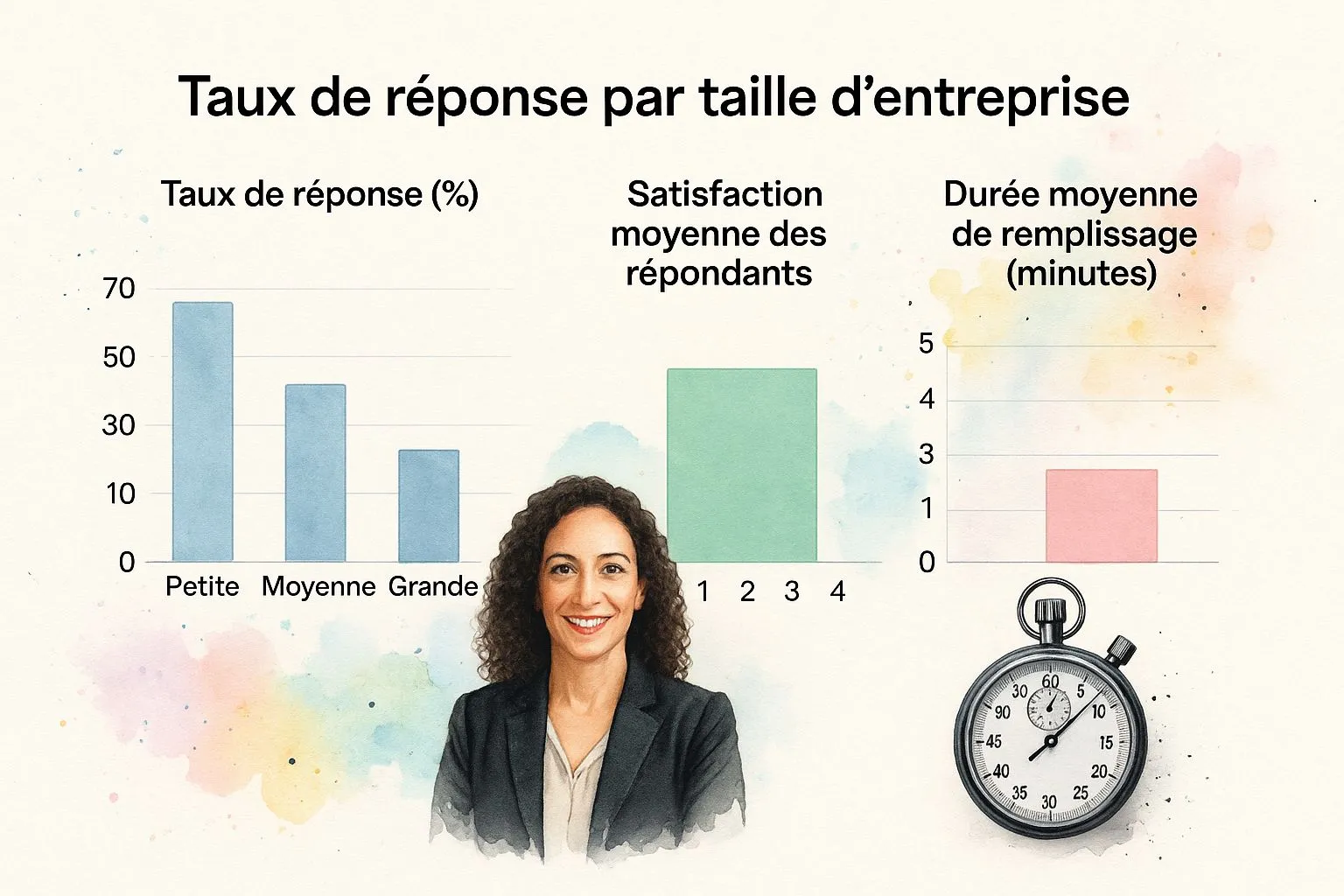
We can see a higher response rate for larger companies, likely thanks to more substantial administrative resources. Satisfaction seems higher among small businesses, while completion time remains broadly similar regardless of business size. Simplifying the completion process, especially for smaller structures, is therefore a major challenge.
In conclusion, mastering every section of the questionnaire is essential for an accurate and efficient declaration. It helps you avoid errors and optimize your administrative and tax situation. A correctly completed questionnaire contributes to the long-term stability of your business.
The expert method for a flawless questionnaire

Behind every perfectly completed professional questionnaire lies a rigorous method. Instead of rushing, experts carefully prepare the ground. This preparation is essential for providing accurate and consistent information, and for avoiding potentially costly errors.
Gather the important documents
Before you even begin, it is essential to gather all the necessary documents. For example, the INSEE notice, the commercial lease if you are a tenant, or the domiciliation certificate if your business address differs from your home address. Having these documents on hand will save you time and prevent errors.
Choose the right moment
Filling out a professional questionnaire should not be taken lightly. Choose a time when you are focused and available to devote yourself fully to it. Avoid rushing through it between two appointments. A calm, distraction-free environment is essential for optimal concentration.
Organize your data
Once you have gathered your documents and chosen the right time, organize the information logically. Note the key points of each document, highlight important passages, and structure your data. This preliminary organization will make completing the form easier and minimize the risk of errors.
Write precise, strategic answers
Precision is essential. Each answer must be clear, concise, and true to your situation. For example, the description of your activity should be detailed enough to allow for an accurate classification of your business. Think strategically too. The way you present your activity can influence your image with official bodies and potential partners.
The data collected through these questionnaires is used by organizations such as Insee to produce statistics on employment and sectors of activity. Insee makes free statistics from these surveys available to government bodies, elected officials, and the public. In 2021, 6.5% of people in employment in France were craftspeople, shopkeepers, or business owners, and 1.5% were farmers. These statistics are essential for understanding the structure of the labor market. Learn more.
A concrete example
Let’s take the example of an e-commerce entrepreneur using accounting software like Bizyness. When filling out the questionnaire, they will need to specify the nature of their business (online sales), the platform used (own website, marketplace, etc.), and the management tools they use, such as Bizyness. This information helps paint an accurate picture of their business.
By applying these methods, you will turn the questionnaire from an administrative obligation into an opportunity to clarify your positioning and optimize your presence with institutions and partners. Every detail matters, and a methodical approach is the key to success.
The pitfalls that cost entrepreneurs dearly
Filling out a professional activity questionnaire may seem like a formality, but even minor mistakes can have significant consequences for your business. From administrative complications to tax reassessments and lost business opportunities, it is crucial to understand the common pitfalls and how to avoid them.
The APE/NAF code: an important distinction
A common source of confusion concerns the APE code (Main Activity Carried Out) and the NAF code (French Classification of Activities). While similar, they serve distinct purposes. The APE code, assigned by INSEE when the business is created, is used for statistical purposes. The NAF code, meanwhile, is used by the tax administration. An error can affect your affiliation with social security bodies and your eligibility for certain forms of support. So carefully check the consistency between these two codes.
Main activity: clarity above all
Describing your main activity vaguely is a common mistake. “Consulting” is not enough: specify the type of consulting, the sector of activity, and your target audience. An accurate description ensures your business is classified correctly and makes it easier to access the right support schemes. Using management software like Bizyness can be mentioned to demonstrate your professionalism.
Business premises: a tax issue
The description of business premises is a crucial point. Indicate precisely the surface area dedicated to the business, especially in the case of working from home. An error can affect the calculation of the CFE (Corporate Property Tax) and lead to additional costs. In the case of business domiciliation, a certificate is required. Provide the necessary supporting documents, such as a commercial lease, to avoid any dispute.
Additional information: an asset to leverage
The “Miscellaneous” and “Other” sections should not be overlooked. They allow you to add important details, such as the seasonality of your business. This information can entitle you to specific exemptions or support. A ski rental business, for example, would benefit greatly from mentioning the seasonal nature of its activity.
Tips for a flawless questionnaire
Take the time to read each question carefully and gather all the necessary documents. If in doubt, consult an accountant or contact your local tax office. Clear, precise wording that avoids technical jargon is essential. Make sure every piece of information is understandable to someone outside your industry. A complete, accurate description of your business is an investment in its future, helping you avoid problems and maximize your chances of success.
How this questionnaire shapes the future of your business

The professional activity questionnaire is an essential tool for your business. Far more than a mere administrative procedure, it influences key elements such as your tax regime, your social security contributions, and your access to public support. This document, often seen as a burden, can become a real asset for your growth.
Impact on taxation and contributions
Your answers to the questionnaire have a direct impact on your tax regime and the calculation of your social security contributions. For example, the accuracy of the information about your revenue and expenses determines the amount of tax owed. Similarly, the description of your business affects the calculation of your contributions. A complete and rigorous declaration is therefore essential to optimize your financial situation and avoid unexpected costs.
Access to support schemes and assistance programs
Access to certain public support schemes depends on the information provided in the questionnaire. By detailing your business and situation accurately, you increase your chances of benefiting from financial support, contribution exemptions, or personalized guidance. Some support schemes are specific to certain sectors of activity. A correctly completed questionnaire ensures you are properly identified and can fully benefit from the schemes you are entitled to.
Visibility with partners and investors
The professional activity questionnaire also influences your image with your business and financial partners. It provides essential information about your business, its activity, and its organization. This data can facilitate obtaining funding, forming partnerships, and expanding your professional network. A clear, well-structured presentation of your business, thanks to a well-completed questionnaire, strengthens your credibility and inspires trust.
The importance of data for labor market analysis
This questionnaire also contributes to labor market analysis. France Travail, in particular, uses the collected data to analyze job postings and registrations, enabling a better understanding of current trends. In 2021, 45.3% of people in employment were manual workers or employees, two out of five of whom were low-skilled. This information helps adapt training strategies and anticipate future skills needs.
Optimizing your declaration for optimal growth
In conclusion, the professional activity questionnaire is far more than a simple obligation. It is a strategic tool that, when used correctly, optimizes your tax and social situation, gives you access to important support, and improves your visibility. Software like Bizyness (https://www.bizyness.fr/) can help you manage your data and fill out this questionnaire accurately and efficiently. Don’t hesitate to use tools that simplify your administrative tasks so you can focus on growing your business.
Answers to the questions every entrepreneur is asking
Setting up and running a business often comes with many administrative questions. This section aims to provide clear, accurate answers to the most common questions entrepreneurs have, drawing on the expertise of industry professionals.
Mixed or seasonal activity: how to declare it?
Declaring a mixed activity (several different activities) or a seasonal one (activity over a specific period) requires special attention. It is essential to detail each activity, even secondary ones, specifying the period of operation for seasonal activities.
This ensures a declaration that accurately reflects your real situation and avoids any ambiguity. For example, a restaurant owner who also gives cooking classes must describe these two activities separately.
Sole trader vs. sole proprietorship: what are the differences for the questionnaire?
The questionnaire is broadly similar for both statuses, but a few nuances exist. A sole trader, often without an accountant, may simplify certain parts, particularly the “Accountant information” section.
However, the description of the activity, business premises, and additional information remain essential for both statuses. Using a tool like Bizyness can make administrative management and declarations easier.
Changing your activity after submission: what to do?
Any change of activity after submitting the questionnaire must be reported to the corporate tax office (SIE). Contact your SIE to find out the procedure and the documents required.
An explanatory letter with the necessary supporting documents is generally sufficient. It is important to make this change quickly, as incorrect information can have tax consequences.
Statutory deadlines and consequences of a delay
The questionnaire must be returned within 30 days of receipt. A delay can result in financial penalties. If you have difficulty meeting the deadline, contact your SIE to explain your situation and request a possible extension.
Planning ahead and staying organized is the best way to avoid delays and their consequences. Ensuring your premises are compliant is also essential. In this regard, a restaurant hygiene inspection can be worthwhile.
How to correct an error
An error in the questionnaire can be corrected by contacting your SIE. The procedure depends on the nature of the error and the time elapsed since submission.
Don’t hesitate to consult a professional if in doubt. Correcting an error quickly is always preferable.
To better understand the deadlines and consequences, see the table below:
This table summarizes the key deadlines and potential consequences related to the professional activity questionnaire.
| Situation | Statutory deadline | Potential consequences |
|---|---|---|
| Receipt of the questionnaire | 30 days | Financial penalties in case of delay |
| Correcting an error | Variable | Depends on the nature of the error and the time elapsed |
| Change of activity after submission | Variable | Need to contact the SIE |
As this table shows, meeting deadlines is crucial to avoid penalties. Don’t hesitate to contact your SIE with any questions.
Simplify your administrative management with Bizyness. This intuitive tool supports you through your processes, from filling out the questionnaire to managing your accounting. Focus on what matters most: growing your business.