

 Français
What changes for sole traders (micro-entrepreneurs) in 2023
Discover the changes for sole traders (micro-entrepreneurs) in 2023. They affect every aspect of the micro-entrepreneur status: revenue and tax thresholds, withholding tax, social contributions…

The rules for sole traders (micro-entrepreneurs) in 2023 have changed once again. Every year, you need to keep up with changes in the legislation. This year’s changes include an increase in the revenue thresholds, the creation of a single online business portal, an update to the income tax bracket scale, the introduction of the RNE (the National Business Register), and more. Here’s an overview of the situation.
The mandatory single business portal for sole traders in 2023
The single business portal – introduced by Article 1 of the PACTE law of 22 May 2019 – has been available online since 1 January 2022. You’re now required to go through it for all administrative procedures relating to your sole proprietorship: filing for business creation, modification, and cessation. You can no longer deal directly with your CFE (Business Formalities Centre) and can no longer submit paper documents; you must now file a fully digital application.
The single business portal is responsible for centralizing all information before routing it to the relevant CFEs:
- CCI: Chamber of Commerce and Industry;
- CMA: Chamber of Trades and Crafts;
- URSSAF;
- The commercial court registry, and so on.
However, nothing changes when it comes to declaring your revenue and paying your social contributions, which must still be done via the URSSAF website for sole traders.
The creation of the RNE, the National Business Register
The creation of the RNE (National Business Register) – overseen by the INPI (National Institute of Industrial Property) – was approved by an order issued in September 2021. The purpose of this register, whose data is public, is to list every business and company operating in France, regardless of legal structure.
Since 1 January 2023, all businesses, including sole traders, carrying out a commercial, craft, agricultural, or professional activity must be registered with it. As a result, the RM (Trades Register) and the RAA (Agricultural Assets Register) have been discontinued. On the other hand, the RCS (Trade and Companies Register) and the RSAC (Special Register of Commercial Agents) remain in place, although the businesses concerned must also be registered with the RNE.
The increase in revenue thresholds for sole traders in 2023
New thresholds have been set for sole traders in 2023. This measure also applies to 2024 and 2025, during which the thresholds should remain stable. The VAT thresholds have also been revised.
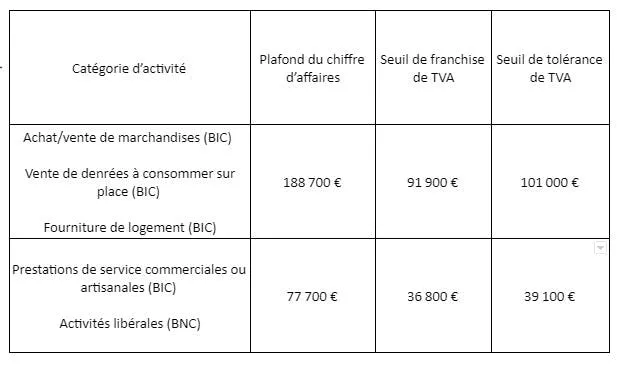
Exceeding the revenue thresholds for sole traders in 2023
If you exceed the sole trader thresholds in 2023 for the second year running, you automatically switch to the actual taxation regime (régime réel). For professional (liberal) activities, your regime becomes the “déclaration contrôlée.”
Exceeding the VAT exemption thresholds
As long as you stay below the first threshold, you don’t need to charge VAT. Once your annual revenue falls between the exemption threshold and the tolerance threshold for two consecutive years, you must charge and declare VAT starting 1 January of the following year.
If your annual revenue exceeds the tolerance threshold, you become liable for VAT from the first day of the month in which you exceed it.
The revaluation of income tax brackets for sole traders in 2023
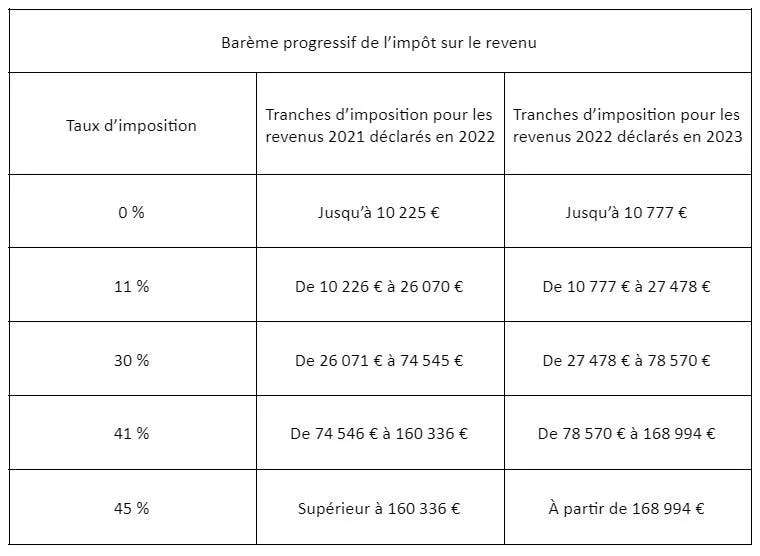
The finance law applied in 2023 changes the income tax brackets for sole traders in 2023.
Comparative table of the 2022/2023 progressive income tax scale
The change to the threshold for the flat-rate withholding option
The flat-rate withholding option (versement libératoire) is a measure specific to sole traders. It lets you pay your income tax at the same time as your social contributions, each month or each quarter depending on the option you’ve chosen. You then have no further income tax to pay.
Your tax amount is calculated by applying a percentage to your declared revenue. However, to be eligible for this flat-rate income tax option, your RFR (Reference Tax Income) must not exceed a set limit.
- 2020 RFR, shown on the 2022 tax notice = €25,710 per share.
- 2021 RFR, shown on the 2023 tax notice = €26,070 per share.
The lowering of the withholding tax adjustment threshold
Your income tax return allows the tax authorities to determine your withholding rate and the amount of your instalments for income tax withheld at source. This rate stays fixed and is revised when the next tax return is filed.
The 2023 finance law lowered the adjustment threshold for the withholding tax (PAS) rate. Like any taxpayer, a sole trader is entitled to request a reduction in their withholding rate if their current situation no longer matches the tax rate applied to them. This is the case, for example, if a change in your family situation affects your number of tax shares, or if your revenue drops significantly.
Until 2022, you were entitled to a maximum reduction of 10%. For income received since 1 January 2023, you’re only entitled to a reduction of 5%.
The reduction in social contribution rates from October 2022
The law of 16 August 2022 on protecting purchasing power confirmed the reduction in social contribution rates for sole traders in 2023.
- 12.3% for the purchase and resale of goods.
- 21.2% for commercial or craft-related services.
- 21.1% for other services and professional (liberal) activities affiliated with the general pension scheme.
- 21.2% for professional (liberal) activities affiliated with the Cipav pension fund.
If you’re eligible for the ACRE (business creator and takeover support scheme), you benefit from reduced rates during your first year of business.
- 6.2% for the purchase and resale of goods.
- 10.6% for commercial or craft-related services.
- 10.6% for other services and professional (liberal) activities affiliated with the general pension scheme.
- 12.1% for professional (liberal) activities affiliated with the Cipav pension fund.
